Jordan Scoliege (2022). Understanding the supervision activity to design a non-existent control system for automated driving through prospective ergonomics. In: Human Interaction & Emerging Technologies (IHIET 2022): Artificial Intelligence & Future Applications. AHFE Open Access, vol. 68, pp. 558–564. https://doi.org/10.54941/ahfe1002777
Just like the progressive evolution of industrial processes towards highly automated systems, today we see a similar evolution in the mobility sector with the development of autonomous vehicles. These evolutions have and will change the work activity of human from "realization" to "supervision". Due to the progressive increase in autonomy, the SAE (Society Of Automotive Engineers) has created a categorization in 6 levels (from 0 to 5, where 5 corresponding to a fully autonomous vehicle). As long as automated vehicles are not able to manage all driving situations (SAE levels 2, 3 and 4), the human operator remains in the control loop and cooperates with the autonomous system. In this context of progressive deployment and as it has been the case in other transportation modes such as aviation and railways, we anticipate the design of a centralized supervision center for fleet of autonomous vehicles. Although the literature highlights many bias in the relationship between humans and automation, the role of the supervision would be to secure the operation (by man's ability to recover a complex situation) of the vehicle by anticipating incidents (e.g.: support the driver-system relationship, like a traffic controller would do for pilots), while guaranteeing reliability (management of system failures) as well as the regularity of the network.To propose a specification of the high-level functions of a no-existing system, we deploy the approach of prospective ergonomics. This approach "consists in anticipating future needs, uses and behaviors or in building future needs in order to create processes, products or services that are well adapted to them" (Brangier & Robert, 2014). This recent modality of ergonomics intervention is based on the prospective foundation, [naturally] on the ergonomic foundation as well as on the creative foundation. We have set up a methodology divided into two phases.The first phase brings together the prospective and ergonomic foundations. We take up the work of Daniellou (1992) who proposes to be interested in situations which present strong similarities with the system to be designed, which he calls "reference situations". We have identified 8 sectors of activity in the spectrum of supervision such as aviation, bus, railway or nuclear. So far, we have been able to integrate four reference situations that have allowed us to identify seven components around supervision (safety, infrastructure, hardware, degree of automation, software, system organization, human factor). These elements are essential to the understanding of the supervision panorama.From the different situations observed we prepare the second phase of our methodology which corresponds to the creative foundation. Through expert staff we aim to bring elements of identification of the best method to help in the projection of the future. We will therefore compare the production of ideas between a group that will be able to base itself on the syntheses of the observed reference situations and a control group.The ambition of this work is to ameliorate the anthropocentric approach of long-term design.
Just like the progressive evolution of industrial processes towards highly automated systems, today we are now witnessing a similar evolution in the mobility sector with the development of autonomous vehicles. These evolu- tions change the work activity of human from “physical task” to “cognitive task”. For Endsley (2017) “the more autonomy you add to a system, the more reliable and robust it becomes, but the less situational awareness the operators have and the less able they are to (re)take manual control when needed”. The current work is a part of a PhD thesis started in September 2020 which, based on other sectors such as industry, aviation, or railw- ays, anticipates through an anthropocentric approach, the implementation of control center applied to autonomous vehicles. Initially, de Montmollin (1967) has distinguished two types of ergonomics approach: corrective and
Understanding the Supervision Activity to Design a Non-Existent Control System 559
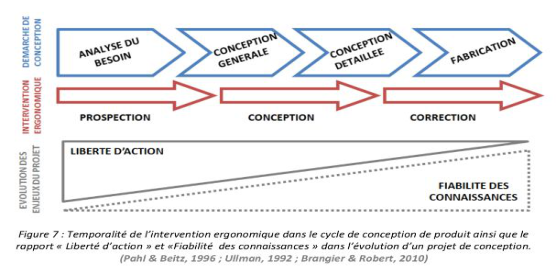
Figure 1: Temporality of ergonomic intervention in the product design cycle as well as the relationship between “freedom of action” and reliability of knowledge” in the evolution of a design project. (Pahl & Beitz, 1996; Ullman, 1992; Brangier & Robert, 2010; Barre, 2015).
design. The first addresses operational aspect for the past and current peri- ods while the second addresses the conceptual aspect for the present and near future temporality (Brangier & Robert, 2014). Most recently, the inte- rvention area of ergonomics should evolve to support the design of a future long-term system, through prospective ergonomics (ibid). In this paper, we will first review the concepts from the literature about prospective, then we will present the proposed methodology including the selected creativity tools.
DESIGNING A NON-EXISTENT SYSTEM Ergonomic intervention, in the form of corrective or design approach, is often driven by the definition of specific needs called “initial demand”. The resul- ting recommendations will be constrained by the existing systems. Indeed, the situation will be strongly restricted by its own organization, by the design choices or by direct and indirect environmental constraints. Figure 1 rela- yed by Barre (2015) shows the different methods of ergonomic intervention. The more ergonomics has latitude to intervene at the early of the project, the more “freedom of action” it has on the system to integrate the human factor. This helps to avoid and reduce design error recoveries once the pro- ject is implemented. The graph also indicates that at this stage, the reliability of knowledge is at its lowest.
To be able to intervene further upstream in design projects, it was neces- sary to detach the ergonomic intervention from the triggering need: the initial request. Prospective ergonomics (Laurig, 1986) appeared to allow this. Through this new modality of intervention, it’s possible to consider a more distant temporality and a still ill-defined future (i.e., long term) through cre- ativity and innovation (Laurig & Vedder, 1992 et Robert & Brangier, 2009, 2012). Brangier and Robert (2014) state that this approach “consists of anti- cipating future needs, uses, and behaviors or constructing future needs in order to create processes, products, or services that are well suited to them”.
The term prospective is a fusion between prospecting and perspective and it’s defined by the European Commission in 2002 as a “participatory process
of elaborating possible futures. It’s above all an attitude of mind (anticipating and wanting) and a behavior (imagining and hoping) at the service of present and future existence”. Prospective ergonomics is supported by 3 pillars: (1) prospective, (2) creative, and (3) ergonomic.
(1) Prospective. The anticipation of future needs, uses and behaviors requires the use of a set of retrospective data. (2) The creative basis for innovation, development, competitiveness, and wealth creation is supported by group stimulation techniques that foster the amplification of idea generation. (3) The third pillar means taking an interest in the work activity, allowing an anthropocentric approach to the project.
Our project is applied to the autonomous vehicles, which is not yet an operational technology for the public (higher than Level 2 in the SAE1 taxo- nomy). Some experiments are conducted as on the issues of control recovery, or on the trust and acceptability of drivers, passengers, and other road users. However, the development of this new mobility is mainly based on the use of technology (i.e., techno-push). The application of a prospective ergonomics approach to this kind of system allows, as Brangier & Robert (2014) emph- asize, to grant the anthropocentric approach the central place in the project. We identified in the literature that the “automation does not supplant human activity [...] rather, it changes the nature of the work that humans do, often unintentionally and unanticipated by the designers of automation” (Parasu- raman & Riley, 1997). In the history of industry, air traffic, railways, or urban transport, the human operator stays in the control loop and supervises automated systems.
For collecting data on the supervision, we have developed a methodology, based on the intervention of ergonomic design, “possible future activity”pro- posed by Daniellou (1992): analysis of reference situation. In this approach, the author recommends starting the process by looking at existing situati- ons to extract their main functions. These situations must be identified to find strong similarities with the current project. The understanding of the systems, the integration of the human factor and their strengths and wea- knesses should serve to build a preliminary basis for the creation of the future work situation. In our case, these elements (which are extracted from civil and military air traffic control, bus, and tramway supervision, as well as from dro- nes in logistics) will feed the creativity phase for the recommendation of the specific functions of our targeted system.
Creativity was initially perceived as a personal achievement, but this representation evolved when proposal of an “economic model of creative production” (Rouquette, 1973), in which the creator is perceived as a “pro- ducer” of ideas and creativity as an object that can be analyzed and on which one can intervene. A multitude of definitions of creativity exist, but there is a consensus that it is the ability to have an idea or to produce something that is both new and adapted to the context in which it occurs (Amabile, 1996; 1J3016_202104: Taxonomy and Definitions for Terms Related to Driving Automation Systems for On- Road Motor Vehicles - SAE International https://www.sae.org/standards/content/j3016_202104
Understanding the Supervision Activity to Design a Non-Existent Control System 561
Isaksen et al., 1993; Sternberg, 1999). Through its approach, creativity is a set of tools/methods to foster innovation. Indeed, according to Duchamp, innovation is an invention that leads to a market. We must understand here the successful implementation of creative ideas in the organization and/or society, considering the economic and social recognition of which they are the object.
According to Bonnardel & Lubart (2019) ergonomics seems to strongly favor the links between creativity and innovation. “Whether in the context of preventive design ergonomics or prospective innovation ergonomics, user- centered analyses contribute, in a major way to the transition from creativity to innovation” (ibid). Indeed, the approach to adapting the artifact to future users favors their innovative aspect, not only new but also as having value.
In the next section we will detail the protocol developed for the constru- ction of our creative phase.
METHODOLOGY
To propose a projection in a future environment and to analyze the work activity of our supervisory operator ensuring the proper functioning (safety, service, etc.) of a fleet of autonomous vehicles we choose the focus group method including an “expert community staff” (Brangier, Dinet, Bastien, 2009) form our topics. Unlike traditional focus groups where participants represent the general population, expert staffs bring together a targeted pro- fessional community. The experts are invited to express themselves as freely as possible on the subject at hand: opinions, representations of the activity, spe- culations on future behaviors, aversions, or preferences. Through this sample, it is sought to validate or correct the artifacts in development but also to iden- tify new essential specifications. The expert community staff method aims at gathering target communities. It is about gathering people likely to be concer- ned by the development of the project and thus determining a profile of the future users of the system or product. An expert in a community of practice is therefore a person who is a valid representative of the community. This validity is intrinsic (personal background and skills) but also extrinsic (repu- tation of the expert in her/his community). For our project, we will create 2 to 3 groups that will include 4 to 6 experts. As described by Brangier, Dinet and Bastien (2009), the focus groups will be organized in three phases: (1) free expression on the topic of the project; (2) participants are guided through the target functions presented; (3) participants work to synthesize the ideas presented with a critical standpoint. In our study, we include experts from dif- ferent field: engineering and informatics, human factors, and field operator (e.g., supervisor).
This work aims to meet two objectives: practical and theoretical. Thus, we intend to collect data on the high-level functions on the targeted system but also to bring elements to the intervention of prospective ergonomics. In this second objective we will compare the contribution of the modality of retrospective elements of supervision.
During the second phase of the workshop, we will differentiate the moda- lities of access to retrospective data (the requirements specification report
created from reference situations). The first group will be the control group. The experts of this group will have only access to general data on supervision and their own knowledge. The experts of the second group will have access to more detailed data on the situations that were integrated during the previous phase (the requirements specification report). These data will be presented in the form of summary and illustrated sheets. For last group we will put at their disposal, in addition to the summary sheet, a detailed presentation of each integrated situation and a table summarizing the proximities between the reference situations and the targeted system. This table is built on 8 cri- teria: structural-temporal constraints, system operator-environment distance, level of prescription, presence of automation, level of empowerment maturity, human factors consideration in supervision, complexity of the environment and proximity. This evaluation is partially inspired by the comparison of dif- ferent supervised situations proposed by Kostenko (2017). From the analysis of reference situations (e.g., aviation), we currently constructed these sup- ports to allow participants to identify the activities sectors most suited for a specific function to our project.
EXPECTED RESULTS In terms of expected results, the success of such an approach depends cri- tically on the ability of the workshop to project the experts into the target environment. The existing environment must serve as a basis for structuring the thinking, but it is necessary to allow a step back for understand what the autonomous system could imply for the supervision task. Indeed, the disap- pearance of the on-board piloting task presents a significant disruption to the system. We will expect that the participants of the workshop understand the functions that will be lost and how they can be compensated in the future system.
Furthermore, we intend to evaluate the generation of new, projected, and relevant ideas depending on the modalities of access to the retrospective data of the supervision. The results will help to establish the relevance of investi- gating the reference situations. As well, this step will allow us to assess the level of detail of their analysis.
CONCLUSION
As in aviation, railroads or industry, the task of supervision has always been exploited to enable the system to achieve a high level of safety. Unfortunately, some disasters due to poor human integration underline the importance of this approach. Applied to the autonomous vehicle, he anticipation of large- scale operations is currently being played out to integrate an anthropocentric approach. Indeed, autonomous vehicles are not yet marketable or are only beginning to appear with SAE Level 3 market approvals in 2022. The design project of a supervision center is perfectly in this perspective but requires the use of new intervention modalities to anticipate the role of the human operator within this system.
Understanding the Supervision Activity to Design a Non-Existent Control System 563
To propose a specification of high-level functions and designed an HMI we carry out a work in two stages. The collection of data from reference situations to understand supervision in industries that have been practicing it for many years. The projection in the future environment based on the exi- sting systems to anticipate the most important functions of the system which are upset by the automation of the vehicles (e.g., workload of the human operator, automation bias, attention/drowsiness).
The application of this work is in the automotive sector, but we hope that the theoretical aspects and practical advances made can support other industrial sectors where automation is likely to increase.
REFERENCES
Amabile, T.M. (1996) Creativity in context, Boulder, CO, Westview Press. Barré, J. (2015). Vers de nouveaux outils pour l’anticipation des besoins utilisateurs : apports méthodologiques pour l’ergonomie prospective. Thèse de Doctorat, École nationale supérieure d’arts et métiers – ENSAM. Brangier, E., Dinet, J., & Bastien, J. M. C. (2009). La méthode des staffs d’experts
de communautés Orientation théorique, démarche méthodologique et application pratique. Document numérique, 12(2), 111–132. https://doi.org/10.3166/dn.12. 2.~111--132 Brangier, E., & Robert, J.M. (2010, September). Manifeste pour l’ergonomie prospective : Anticiper de futures activités humaines en vue de concevoir de nouveaux artéfacts. In Conference Internationale Francophone sur I’Interaction Homme-Machine (pp. 57–64). ACM. Brangier, E., & Robert, J-M. (2014) L’ergonomie prospective : fondement et enjeux.
Presse universitaire de France ≪Le travail humain ≫, Vol. 77, pp. 1–20. Bonnardel, N., & Lubart, T. (2019). La créativité : approches et méthodes en psychologie et en ergonomie. RIMHE : Revue Interdisciplinaire Management, Homme & Entreprise, 37,8, 79–98. https://doi.org/10.3917/rimhe.037.0079 Daniellou, F. (1992) Le Statut de la Pratique et des Connaissances Dans L’intervention
Ergonomique de Conception Document d’HDR, ISBN 2-913407-05-6 Bordeaux Editions du Laboratoire d’Ergonomie des Systèmes Complexes, Université Victor Segalen Bordeaux 2. Duchamp, R. (1999). Méthodes de conception de produits nouveaux. Paris : Hermes Science Publications. Endsley, M. R. (2017). From here to autonomy: lessons learned from human–
automation research. Human factors, Vol. 59(1), pp. 5–27. Isaksen, S. G., Murdock, M. C., Firestein, R. L., Treffinger, D. J. (1993) Understanding and recognizing creativity: the emergence of a discipline, London, Ablex Publishing. Kostenko, A. S. (2017) Évaluation multidimensionnelle et dynamique de la maitrise
de la situation par l’opérateur : création d’un indicateur temps réel de charge men- tale pour l’activité de supervision de drones. Thèse Université de Bretagne Loire. https://tel.archives-ouvertes.fr/tel-01677692. Laurig, W. (1986). Prospective Ergonomics: New Approach to Industrial Ergonomics. In W. Karwowski (Ed.), Trends in Ergonomics/human Factors III. Elsevier Science Publisher B.V. North-Holland. Laurig, W., & Vedder, J. (1992). Overview (section 29.2). In J. Mager Stellman (Ed.),
Encyclopaedia of Occupational Health and Safety (p. 29.2). Fourth Edition, Vol. 1. International Labour Office, Geneva.
Montmollin, M. de (1967). Les systèmes homme-machine. Paris : PUF Parasuraman, R., & Riley, V. (1997), Humans and Automation: Use, Misuse, Disuse, Abuse. Human Factors: The Journal of the Human Factors and Ergonomics Society 1997 Pahl, G., & Beitz, W. (1996). Engineering Design. A systematic Approach. London:
Springer-Verlag. Robert, J.-M., & Brangier, E. (2009). What is prospective ergonomics? A reflection and position on the future of ergonomics. In B.-T. Karsh (Ed.), Ergonomics and Health Aspects (pp. 162–169). Springer Verlag Robert, J.-M., & Brangier, E. (2012). Prospective ergonomics: origin, goal, and
prospects. Work (A Journal of Prevention Assessment and Rehabilitation), 41, 5235–52 Rouquette, M-L. (1973). La créativité, Que sais-je ? Paris, PUF. Ullman, D.G. (1992). The mechanical design process. New York: McGraw-Hill.
Read this individual research paper free through the original publisher, or explore the full digital proceedings book.
ISBN 978-1-958651-44-5
Explore this ISBN in the AHFE Bookstore ↗Listed in the July 2026 bookstore catalogue; search by ISBN to confirm current availability · Digital book purchase optional