Latif Nur Indra, Filosa Gita Sukmono, Danang Kurniawan (2022). The Function of Social Media in Creating Participatory Based Government Policies in Indonesia. In: Human Interaction & Emerging Technologies (IHIET 2022): Artificial Intelligence & Future Applications. AHFE Open Access, vol. 68, pp. 428–435. https://doi.org/10.54941/ahfe1002761
Public participation is not only limited to direct movements such as demonstrations, the use of social media in the community has proven to be effective in escorting changes in government policies. This study aims to analyze the relationship between the "digital movement of opinion" on twitter social media through the hashtag "Percuma Lapor Polisi" in improving Indonesian Police services. This study uses a descriptive qualitative approach with the data source of social media twitter on #percumalaporpolisi. The #Percumalaporpolisi movement is a form of public disillusionment through social media twitter, towards the services of the Indonesian Police for the period 1 February – 1 March 2022. The data analysis phase of this research uses the “Social Network Analysis” method, to identify the social structure and explain the position of the main or affected stakeholders. can be called a vital player. In analyzing the data, the author is assisted by using tools based on the Netray.id website. The results of data analysis and visualization show that there are social networks of several key actors in the spread of #Percumalaporpolisi. The main actor plays a role in driving public opinion through conflicting information on social and economic cases that are not in favor of the community. Stimulating opinion is considered very effective in creating public support through the #Percumalaporpolisi movement on social media. Indonesians people are quicker to support movements that are oriented towards violence and blasphemy. The #Percumalaporpolisi movement focuses on the issue of agrarian conflicts between Wadas Village Residents and the government involving the military and police officers and the issue of alleged blasphemy. The incident created a tremendous digital opinion movement on the social media platform twitter. Social media can play an important role in overseeing the policy process at the national level, through leading opinion on social media.
New media plays a vital role in spreading accurate and responsible informa- tion (Widyastuti 2021). Twitter allows people to act collectively without the intervention of political parties, trade unions, and various civic organizations (Barisione & Ceron, 2017). The public has been questioning the credibi- lity of the Indonesian Police since the child criminal case by the State Civil Apparatus (ASN). People created the hashtag #percumalaporpolisi (#nou- segoingtothepolice) to respond to the viral case on Twitter on Thursday, October 7, 2021 (Rosa, n.d.). Twitter is an ideal platform for citizens to carry
The Function of Social Media in Creating Participatory 429
out social and political movements, one of which is hashtag activism (Bonilla and Rosa, 2015). This study used qualitative research to understand the con- dition by providing a detailed and in-depth description (Olsson, 2008). In the data processing process, the researchers used the Netray.id social media monitoring software, and Social Network Analysis (SNA) was used in the data processing process. SNA is an analytical approach to identifying social structures and explaining the positions of key stakeholders or those with key actors (Guerrero et al., 2020). In analyzing the case, the researchers used a Digital Movement of Opinion (DMO) point of view. DMO differs from social movements in that if social movements are characterized by collectivity and clear goals, digital opinion movements are influenced by the same concern for problems (Bennett & Segerberg, 2012). DMO is relatively newer than online petitions (e-petitions) or previously known digital social movements. Digital social movements or online petitions are generally led by certain actors or organizations (Eriyanto, 2020).
Digital Movement Opinion (DMO) The new media form, which is based on communication technology and algo- rithms, can evoke more emotional resonance in the audience, encouraging public opinion formation (Yi, 2021). Barisione and his colleagues developed an interesting concept of digital activism called the Digital Opinion Move- ment (DMO). This activism is arguably different from the concept of using digital media for social movements (online petitions, electronic advocacy or digital campaigns). This concept mediates two important debates related to public participation (Barisione and Ceron, 2017) Therefore, the concept of the digital opinion movement overcomes both survey-based notions of public opinion expressing the attitude of the silent majority (Perrin and McFarland, 2011).
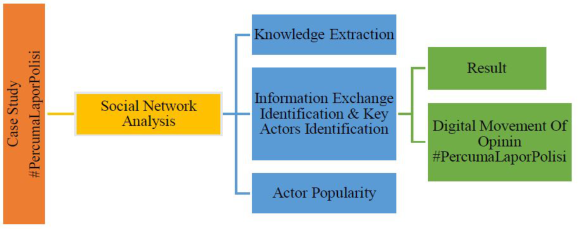
Social Network Analysis The development of computing paradigms at high speed and complexity with technological possibilities enables the analysis of valuable data through social network analysis methods (Can and Alatas, 2019). SNA studies human rela- tions by using graph theory. Using this graph theory, SNA can examine the structure of social relations within a group (Tsvetovat and Kouznetsov, 2011). The stages of SNA in the complete study are as follows (Tomasoa, Iriani, and Sembiring, 2019).
1) Actor Popularity 2) Knowledge Extraction 3) Identification of Information Exchange 4) Identification of Key Actor (Key Actor) 5) Identification of Boundary Spanner (BS).
SOCIAL NETWORK ANALYSIS OF #PERCUMALAPORPOLISI Improvement of the National Police Institution through the Digital Opinion Movement through #Percumalaporpolisi happened on Twitter with a data collection period of 1 February – 1 March 2022.
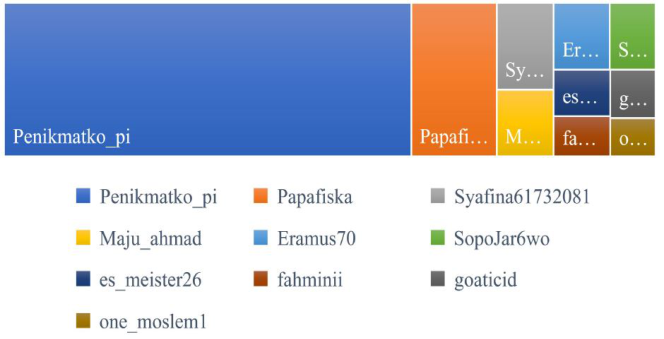
Figure 1: Actor Popularity in percentage.Table 1. Actor popularity (degree centrality).
Actor Popularity (Degree Centrality) Some actors are the main actors in the communication network with the highest popularity in spreading news. These actors play an important role in creating network groups in the #PercumaLaporPolisi distribution relati- onship. The actor’s popularity can be seen by analyzing the degree centrality (DC).
Some actors in the communication network are the main actors who have the highest popularity in the spread of #percumalaporpolisi. Based on this data, @penikmatko_pi occupied the first position with the highest number of tweets related to #percumalaporpolisi.
Knowledge Extraction Knowledge extraction is the extraction in the #percumalaporpolisi distri- bution relation on Twitter which several actors spread by identifying the topics/tweets.
The Function of Social Media in Creating Participatory 431
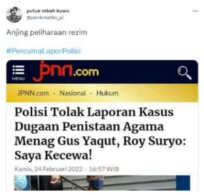
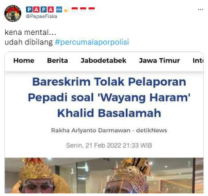
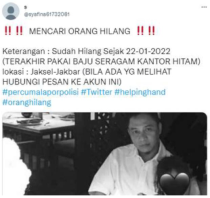
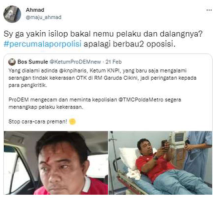
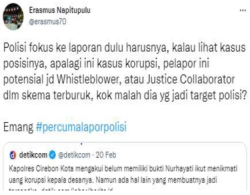
Figure 2: Tweet 1 by @penikmatko_pi (putue mbah kuwu).Figure 3: Tweet 2 by @papaefiska.Figure 4: Tweet 3 by @syafina61732081.Figure 5: Tweet 4 by @maju_ahmad.Figure 6: Tweet 5 by @eramus70.
(Figure 2) Shows a tweet made by @pekimatko_pi, who was cursing about the alleged blasphemy case by the Indonesian Minister of Religion. The tweet above was posted on 2022-02-24 at 17:35 WIT.
(Figure 3) Tweet made by @papaefiska, who was disappointed with the rejection of a report by the police regarding the case of Banning Wayang by a religious figure in Indonesia which had gone viral. The tweet above was posted on 2022-02-23 at 13:00 WIT.
(Figure 4) Tweet made by @syafina61732081, who was looking for some- one through a tweet on his Twitter in the hope of being found, but until now, the update on the case has not been processed by the police. The tweet above was posted on 2022-03-01 at 17:38 WIT.
(Figure 5) Tweet made by @maju_ahmad questioning the capability of the police in uncovering cases of abuse experienced by the KNPI NGO chairman. The tweet above was posted on 2022-02-22 at 08:16 WIT.
(Figure 6) Tweet made by @erasmus70 in which Eramus Napitupulu que- stioned the handling of a corruption case that ensnared a reporter for a corruption case in Cirebon. The tweet above was posted on 2022-02-20 at 07:35 WIT.
(See Table 2) is the result of the identification of news that was spread by the main actors of the #percumalaporpolisi tweet, showing all the active actors in spreading #percumalaporpolisi.
Information Exchange Identification’ In the information exchange communication network, the main actor tweets, replies, and retweets and is also mentioned by other main actors. This con- dition will result in a wider exchange of information. However, in this case, there is no exchange of information between the main actors, or the actors are acting alone or do not know each other.
Key Actor Identification or Top People (Betweenness Centrality) Key actors are individuals who play an important role in spreading #Percu- maLaporPolisi, especially actors who carry out Information exchange activi- ties. Key actors consist of hashtag creators and influencers.
The key actors or Top People in the table above are related to the highest mentions. Some were not included in the key actors (excluded) are @List- yoSigitP, @Knpiharis and @Divhumas_polri because they were part of the
The Function of Social Media in Creating Participatory 433
Table 3. Number of mention key actor/top people.
Table available in the original PDF paper.
Actor Total Mention Key Actor Level Account Background @penikmatko_pi 1,817 1 public @listyosigitp 657 2 government @papaefiska 395 3 public @divhumas_polri 360 4 government @eramus70 284 5 public @syafina61732081 199 6 public @sopojar6wo 194 7 public @knpiharis 145 8 public
Indonesian police agency and did not participate in spreading the #percuma- laporpolisi tweet. Looking at the list of main actors in tables 1 and 2 with the highest impressions and number of followers, the researchers found several important actors. Moreover, followed by the results from Table 3, the Key Actor or Top People are found as follows:
Creator: @Penikmatko_pi
Influencers: @Papaefiska and @Eramus70.
Identification of Boundary Spanner (BS) Boundary Spanner identification will find actors who carry out two-way communication between two or more network groups created by the main actor.
The actors above are related to two or more in one network (see Table 4). The boundary spanner actors are related to the follower and the main actors in the table. With this boundary spanner, the impact of information exchange activities where the follower actors and other follower actors only receive information and absorb information, then do the same to other actors.
OUTPUT (DIGITAL MOVEMENT OF OPINION) Based on social network analysis, key actors who actively participate in disse- minating information have been found. The next step is to analyze the results of SNA with the Digital Movement of Opinion, as seen in Figure 7.
Between the main actors, there was no communication interaction, so each actor moved independently, and there was no coordination between certain parties and was purely from the community’s movement. According
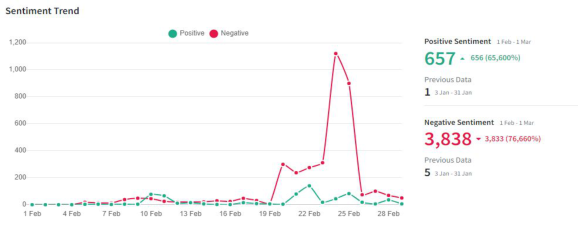
Figure 7: #Percumalaporpolisi research flow (adapted from Tomasoa, Iriani, and Sembiring 2019).Figure 8: Sentiment trend #Percumalaporpolisi.
to (Bennett and Segerberg, 2012), if a social movement is characterized by collectivity and clear goals, the digital opinion movement is bound by the same attention to the problem.
See Figure 8, on 9-11 February, there was a slight increase due to the case of the Quarry Mining Plan for the construction of the Bener Dam Natio- nal Project, where mining would be carried out in the Wadas Village area and received resistance from residents so that the Indonesian Government intervened by deploying joint police and military apparatus to secure seve- ral communities opponents. Sentiment tweets then experienced a significant increase from February 19-to 24. Based on tweets and media reports, the increase was triggered by the case of alleged blasphemy by the Minister of Religion of the Republic of Indonesia, who likened the barking of a dog to the adhan (Muslim call to worship). These issues made the public angry, vented it through Twitter, and again raised the hashtag #Percumalaporpolisi. Finally, the relevant officials and the head of the police immediately intervened to deal with the issue.
CONCLUSION
The social network analysis on #Percumalaporpolisi found 3 key actors in the dissemination of the hashtag information network, and there was no link between one actor and another. #percumalaporpolisi is purely a digital move- ment of opinion from the public. The digital movement of opinion analysis
The Function of Social Media in Creating Participatory 435
on #percumalaporpolisi showed that DMO effectively oversaw and influe- nced government policies, especially the police, as seen by the acceleration of handling cases by the police and the government in dealing with issues raised by the public through DMO.
ACKNOWLEDGMENT
Social media makes no boundaries between people around the world. Our empathy should not only be limited to our compatriots or one tribe but all human beings in the world. Thus, regional conflicts, economic conflicts, and conflicts over racial differences can be overcome because we are all equal and one nation.
REFERENCES
Barisione, M. & Ceron, A., 2017, “Social Media and European Politics,” Social Media and European Politics, (June). Bennett, W.L. & Segerberg, A., 2012, “The logic of connective action: Digital media
and the personalization of contentious politics,” Information Communication and Society, 15(5), 739–768. Bonilla, Y. & Rosa, J., 2015, “#Ferguson: Digital protest, hashtag ethnography, and the racial politics of social media in the United States,” American Ethnologist, 42(1), 4–17. Can, U.& Alatas, B., 2019, “A new direction in social network analysis: Online social
network analysis problems and applications,” Physica A: Statistical Mechanics and its Applications, 535, 122372. Eriyanto, E., 2020, “Hashtags and Digital Movement of Opinion Mobilization: A Social Network Analysis/SNA Study on #BubarkanKPAI vs #KamiBersamaKPAI Hashtags,” Jurnal Komunikasi Indonesia, 8(3). Guerrero, A.M., Barnes, M., Bodin, Chadès, I., Davis, K.J., Iftekhar, M.S., Morgans,
C. & Wilson, K.A., 2020, “Key considerations and challenges in the applica- tion of social-network research for environmental decision making,”Conservation Biology, 34(3), 733–742. Olsson, J., 2008, “Metode Penelitian Kualitatif dalam Penelitian Pendidikan Bahasa,” 信阳师范学院, 1(1), 305. Perrin, A.J. & McFarland, K., 2011, “Social theory and public opinion,” Annual
Review of Sociology, 37, 87–107. Rosa, M.C., no date, Deretan Kasus Kepolisian Picu Viralnya Tagar #PercumaLaporPolisi di Media Sosial, Kompas.com. Tomasoa, L., Iriani, A. & Sembiring, I., 2019, “Ekstraksi Knowledge tentang Pen-
yebaran #Ratnamiliksiapa pada Jejaring Sosial (Twitter) menggunakan Social Network Analysis (SNA),” Jurnal Teknologi Informasi dan Ilmu Komputer, 6(6), 677. Tsvetovat, M. & Kouznetsov, A., 2011, Social Network Analysis for Startups: Finding connections on the social web, “ O’Reilly Media, Inc.” Widyastuti, D.A.R., 2021, “Using New Media and Social Media in Disaster Com-
munication,” Komunikator, 13(2), 100–111. Yi, W., 2021, “From Words to Images: The Rise and Treatment of Visual Public Opinion in the Post-epidemic Era,” Jurnal Audiens, 2(2), 242–249.
Read this individual research paper free through the original publisher, or explore the full digital proceedings book.
ISBN 978-1-958651-44-5
Explore this ISBN in the AHFE Bookstore ↗Listed in the July 2026 bookstore catalogue; search by ISBN to confirm current availability · Digital book purchase optional