Hiroshi Ujita, Naoko Matsuo (2022). Human Performance Improvement Activities for Risk Reduction. In: Safety Management and Human Factors. AHFE Open Access, vol. 64, pp. 170–176. https://doi.org/10.54941/ahfe1002642
Inflexible or unchangeable organization is clearly supposed to include fatal risk in the system under current highly and fast developing situation, no matter how its size is. It means that any system doesn't reach the best results even if anyhow behavior's done, being not adjustable for risk reduction, due to variety and change in the system design or the organization decision-making. Namely, the Key for “the most rational optimization along with keeping the development” is actualized by using risk management adjustable to all organization or system, to solve the complicated issues struggling in current fast-changing international situation.System safety in a huge complex system is an activity that aims to improve safety by the balanced system without excess or deficiency by designing (hardware / software) and operating (human) [1]. In other words, it is the risk reduction activities to treat from the top priority of the risk. At present, the existing huge complex systems have been reduced in hardware / software risk through its countermeasures and quality assurance activities based on safety logic, so the remaining risk can be said to be an event involving humans. For this reason, risk reduction activities can be described as human performance improvement activities. Furthermore, continuing this activity will eventually lead to the improvement of the safety culture. In other words, what we want to emphasize here is that "system safety", "risk reduction activities", "human performance improvement activities", and "improvement of safety culture" have similar purposes and contents.In order to reduce the risk, it must be firmly suppressed in the original design process, so the safety concept is thoroughly incorporated into the system based on risk management at the design stage before operation. Next step, implement risk reduction measures are considered based on risk management at the construction or operation stages. As a response to the problem that remains even after taking measures in advance, that is, a risk that occurs at the stage of using equipment or processes, an error is detected and the countermeasure is taken. Therefore, we will first understand the vulnerabilities at the time of implementation and the weaknesses in human relationships between organizations and teams. As countermeasures, it is most important to give feedback to the hardware, next to software, and when it is not possible, it is important to take countermeasures by the organization or team, not to blame the individual. Measures against human errors are implemented by the devices and the mechanisms rather than the discipline. In summary, it is necessary to enhance performance for dealing with problems that are anticipated in advance, and then to enhance error detection that remains even after setup.Humans always make an error with a certain probability, but they are also flexible entities that can respond to ingenuity in any event. HPI, Human Performance Improvement is a system safety activity to reduce risk due to the human behavior in the system by understanding and optimizing human characteristics by using the Cause Analysis and the Risk Analysis. While humans can demonstrate high abilities, they have the characteristic that misrecognition and judgment errors are easy to occur in some circumstances. In such situation, HPI tools such as Tool Box Meeting, Peer Review, etc. are useful for preparing high reliable activities at the site. HPI means creating the environment where human abilities can be maximized. References[1] Ujita, H., Matsuo, N.: ‘System Safety, Risk Management, and Human Performance Improvement’, HCI2020, 2020.7, Virtual.
Inflexible or unchangeable organization is clearly supposed to include fatal risk in the system under current highly and fast developing situation, no mat- ter how its size is. It means that any system doesn’t reach the best results even if anyhow behavior’s done, being not adjustable for risk reduction, due to variety and change in the system design or the organization decision-making. Namely, the Key for “the most rational optimization along with keeping the development” is actualized by using risk management adjustable to all organization or system, to solve the complicated issues struggling in current fast-changing international situation.
Risk management concept is the most important philosophy for improving the safety of the huge complex system. Every engineer knows well and alw- ays considers about “The local optimization makes the entire worst”, and therefore well-balanced design and operation are required (Ujita et al. 2020). Even the total safety has been assured by the safety design based on Defense in Depth concept (IAEA 1996). operational problem would occur in the future
Human Performance Improvement Activities for Risk Reduction 171
by the chain of the fallacy of the Defense in Depth, then safety culture degra- dation, and finely organizational accident eventually happened. Probabilistic approach is required to the problems. In addition to this, we should answer to the question of “Safety Goal: How safe is safe enough?” to acquire the public confidence. To respond to the local optimization and operational problems and to safety goal question, risk analysis is required.
Risk Management and Human Performance Improvement Risk management in a huge complex system is an activity that aims to improve safety by the balanced system without excess or deficiency by desi- gning (hardware / software) and operating (human) (Ujita et al. 2020). In other words, it is the risk reduction activities to treat from the top priority of the risk. At present, the existing huge complex systems have been reduced in hardware / software risk through its countermeasures and quality assurance activities based on safety logic, so the remaining risk can be said to be an event involving humans. For this reason, risk reduction activities can be descri- bed as human performance improvement activities. Furthermore, continuing this activity will eventually lead to the improvement of the safety culture. In other words, what we want to emphasize here is that “risk management”, “risk reduction activities”, “human performance improvement activities”, and “improvement of safety culture” have similar purposes and contents.
Risk reduction measures that take HF, Human Factors into account include a cause analysis that analyzes and provides feedback on errors to prevent recurrences of the past errors, and a risk analysis (PRA and human reliability assessment) that predicts and takes countermeasures to prevent future risks. That is, the cause analysis and the risk analysis are two wheels to drive risk reduction and human performance improvement in the huge and complex systems.
Accident Model and Error Model As the technology systems become huge, complex and sophisticated, safety issues are shifted to the problem of organization from human, and further from hardware, such socialization is occurring in every technical field. For this reason, the analytical methods, as well as type and social perceptions of error or accident, are changing with the times also (Ujita et al. 2020). Human error and Domino accident model had initially appeared, are then changing to system error and Swiss cheese accident model, and recently move to safety culture degradation and the Organizational accident.
A conventional accident model is the Domino model, in which the cau- sation of trouble and the error is analyzed, and measures are taken. In the model, slip, lapse, and mistake are used which are the classification of the unsafe act to occur by on-site work. These are categorized as the basic error type, while violation which is intentional act violating rule has become increased recently and considered as cause of social accident.
Design philosophy of the Defense in Depths has been established, and the accident to occur recently is caused by the excellence of the error of a vari- ety of systems. The analysis of the organization blunder is necessary for the
172 Ujita and Matsuo
analysis by the Swiss cheese accident model in addition to conventional error analysis (Reason 1997).
An organization accident is a problem inside the organizations, which rea- ches earthshaking event for the organization as a result by the accumulation of the best intentions basically. It is an act of the good will, but becomes the error. As for the organization accident, the interdependence inside of the organization or between the organizations is accumulated by fallacy in the defense in depths, and it becomes a problem of the deterioration of the safety culture in its turn. The organizational management based on the organization analyses such as behavioral sciences will be necessary for these measures.
Human Factor and Human Performance Improvement Human factor and human performance improvement are compared here. Humans always make an error with a certain probability, but they are also flexible entities that can respond to ingenuity in any event. HF is a discipline that suppresses human error characteristics and extends good characteristics for understanding human characteristics and improving the environment. On the other hand, HPI, Human Performance Improvement is a risk manage- ment activity to reduce risk due to the human behavior in the system by understanding and optimizing human characteristics using the cause analysis and the risk analysis (USDOE 2009). Such activity is as part of risk mana- gement. HPI tools are designed to take highly effective countermeasures by using tools that conform to the behavioral characteristics common to the site, rather than individual measures (e.g., describing the measures in error-related procedures).
Humans have the ability to safely and efficiently operate complex systems in a limited amount of time. Especially in large and complex plants, the working skills and abilities of the people involved are high, and safe ope- ration is realized. However, while humans can demonstrate high abilities, they have the characteristic that misrecognition and judgment errors are easy to occur. Ergonomics and others adopt the idea that these errors are not cau- sed by humans, but by environmental factors surrounding humans. That is, it is necessary to create an environment that can maximize its capabi- lities and is less prone to errors. Creating such an environment requires a good understanding of human characteristics. Therefore, improving human performance means creating an environment where human abilities can be maximized.
It describes what human characteristics are the basis for risk reduction and human performance improvement as below;
1. Human information processing (cognition) model, 2. Personal characteristics (such as heuristics and bias), 3. Human relationship characteristics (such as influence), 4. Group characteristics (such as team behavior), and 5. Organizational characteristics (such as organizational economics).
Human Performance Improvement Activities for Risk Reduction 173
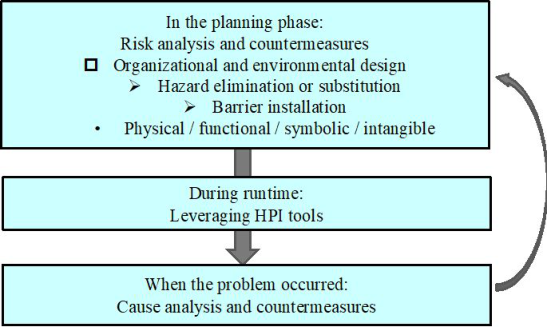
Figure 1: Risk reduction through HPI activities.
What is effective as a countermeasure based on human characteristics should be discussed; whose examples are affordance, heuristics and bias, bounded rationality, nudge, resilience, etc.
Human Performance Improvement Human performance improvement process is described in Fig. 1 In order to reduce the risk, it must be firmly suppressed in the original design process, so the safety concept is thoroughly incorporated into the system based on risk management at the design stage before operation. During runtime, Levera- ging HPI tools is useful, because they are designed to take highly effective countermeasures by using tools that conform to the behavioral characteri- stics common to the site, rather than individual measures (e.g., describing the measures in error-related procedures).
Next step, implement risk reduction measures are considered based on risk management at the construction or operation stages. As a response to the pro- blem that remains even after taking measures in advance, that is, a risk that occurs at the stage of using equipment or processes, an error is detected, and the countermeasure is taken. Therefore, we will first understand the vulnera- bilities at the time of implementation and the weaknesses in human relation- ships between organizations and teams. As countermeasures, it is most impor- tant to give feedback to the hardware, next to software, and when it is not possible, it is important to take countermeasures by the organization or team, not to blame the individual. Measures against human errors are implemented by the devices and the mechanisms rather than the discipline. In summary, it is necessary to enhance performance for dealing with problems that are antici- pated in advance, and then to enhance error detection that remains even after setup.
Risk reduction measures that take HF into account include a cause analysis that analyzes and provides feedback on errors to prevent recurrences of the past errors, and a risk analysis (Probabilistic risk assessments and human reli- ability assessment) that predicts and takes countermeasures to prevent future
174 Ujita and Matsuo
risks. Chapter 6 describes cause analysis, and the Chapter 7 discusses risk analysis.
Cause Analysis Since the purpose of cause analysis is to find system vulnerabilities, it is neces- sary to analyze the cause (root cause) of the problem, to find out where to improve it, and to take measures. The root cause is the following system vulnerability that has caused the direct cause of the trouble (human error, etc.).
Defective hardware protection function
Inappropriate management
Work environment that easily induces mistakes, etc.
For this purpose, trouble cannot be prevented without considering the human characteristics and how expert think (diagnose, decision, or plan). The m-SHEL model is a model that gives an HP analysis perspective. This model describes humans and the environmental factors that surround them and is useful as an analysis guide for analysts to make analysis without over- look and plan measures that are consistent. The 4M (man, machine, media, management) model basically has the same concept.
The basic flow of root cause analysis is shown below. Of the steps 1-6, the focus of the analysis is 2.-5.
1. Necessity and level of root cause analysis, 2. Understanding events by documents, interviews, etc., 3. Event arrangement by time series analysis, etc., 4. Causal arrangement by five why analysis, etc., 5. Completion of causal relationship and estimation of root cause, and 6. Planning of measures and evaluation of effectiveness.
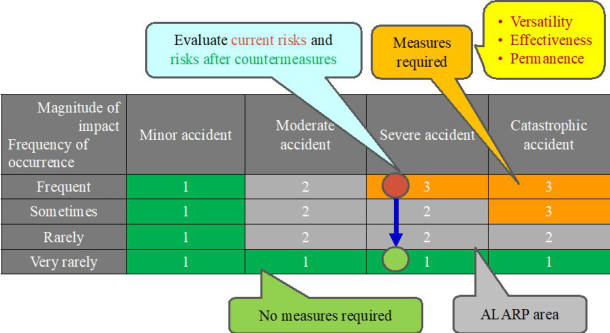
Certainly, it is important to master the analytical methods, but it is even more important to examine the “What is the analysis for?” in step 1. This determines the level of detail of the analysis and what analysis method to use. It is not the end of the analysis, but the “planning of measures”in step 6 is the most important. That’s because cause analysis is performed to take effective and versatile measures (with cost in mind). Risk matrix as shown in Fig. 2 is effectively used for decision in both steps 1 & 6.
Risk Analysis In general, a system has functions of hardware (mechanical / electric / electro- nic system) and software (control system). Hazard that threatens the safety of the system lies anywhere in the lifecycle which composed of planning, concept development, design, manufacturing, operation, maintenance, and disposal phases of the system. Therefore, it is difficult to achieve high safety only by fragmentary safety technology, post-mortem analysis, engineering safety evaluation focusing on hardware, or safety evaluation focusing only on human factors during operation. In particular, huge complex systems and products sold in large volumes can cause enormous losses and tragedies in the
Human Performance Improvement Activities for Risk Reduction 175
Figure 2: Risk assessment using risk matrix: risk mitigation to safety goal.
event of an accident. To improve risk management, preventive risk manage- ment analysis is essential. It analyzes the hazard risks (thorough pre-analysis and evaluation) over the life cycle of the system and drafts control measures (safety design that removes and controls hazards) to keep the risks below tar- get levels, derived by Safety Goal in advance. Risk matrix as shown in Fig. 2 is effectively used for decision in the both steps.
Safety Culture Organizational Accident Model proposed by Reason, J indicates operational problem other than design problem (Reason 1997). Fallacy of the defense in depth has frequently occurred recently because plant system is safe enough as operators becomes easily not to consider risk management. And then safety culture degradation would be happened, whose incident will easily become organizational accident. Such situation requires final barrier that is Crisis Management. Negative spiral can be changed to positive spiral of safety awareness improvement by continuous risk reduction activities and HPI activities.
CONCLUSION
Risk management concept is the most important philosophy for improving the safety of the huge complex system. Every engineer knows well and alw- ays considers about “The local optimization would make the entire worst of the system”, and therefore understands importance of the risk manage- ment concept that well balanced design and operation are required (Ujita et al. 2020). At present, the existing huge complex systems have been reduced in hardware risk through hardware countermeasures and quality assurance activities based on safety logic, so the remaining risk can be said to be an event involving human factors. For this reason, risk reduction activities can be described as human performance improvement activities. Furthermore,
176 Ujita and Matsuo
continuing this activity will eventually lead to the maintenance and improve- ment of the safety culture. In other words, what we want to emphasize here is that “risk management”, “risk reduction activities”, “human performa- nce improvement activities”, and “maintenance and improvement of safety culture” have similar purposes and contents.
Humans always make an error with a certain probability, but they are also flexible entities that can respond to ingenuity in any event. HF (human Factors) is a discipline that suppresses human error characteristics and extends good characteristics for understanding human characteristics and improving the environment. On the other hand, HPI (Human Performance Improvement) is a risk management activity to reduce risk due to the human behavior in the system by understanding and optimizing human characteri- stics using the cause analysis and the risk analysis. HPI tools are designed to take highly effective countermeasures by using tools that conform to the beh- avioral characteristics common to the site, rather than individual measures (e.g., describing the measures in error-related procedures).
Risk reduction measures that take HF into account include a cause analysis that analyzes and provides feedback on errors to prevent recurrences of the past errors, and a risk analysis (Probabilistic risk assessment and human reli- ability assessment) that predicts and takes countermeasures to prevent future risks. There are two wheels to drive of the cause analysis and the risk analysis.
ACKNOWLEDGMENT
The work was supported in part by the member of the committee for survey of human performance improvement based on risk management in Japan Nuclear Safety Institute.
REFERENCES
IAEA, ‘Defense in Depth in Nuclear Safety, INSAG-10, A report by the International Nuclear Safety Advisory Group’, 1996. Reason, J., Managing the Risks of Organizational Accidents, Ashgate, 1997. Ujita, H., Matsuo, N.: ‘System Safety, Risk Management, and Human Performance
Read this individual research paper free through the original publisher, or explore the full digital proceedings book.
ISBN 978-1-958651-40-7
Explore this ISBN in the AHFE Bookstore ↗Listed in the July 2026 bookstore catalogue; search by ISBN to confirm current availability · Digital book purchase optional