Amber Rohrer, Daniel Conde, Samuel Montalvo, Manuel Gomez, Jennica Juarez, Gabriel Ibarra-Mejia (2022). Changes in Lactate After the Completion of Repetitive Cycle Exercises with and without Compression Arm Sleeves. In: Physical Ergonomics and Human Factors. AHFE Open Access, vol. 63, pp. 227–231. https://doi.org/10.54941/ahfe1002617
Occupational compression sleeves are commonly used to relieve pain in the upper and lower extremities. Anecdotal data agree on the benefits of using compression sleeves while performing physical work. The purpose of this study was to assess the effects of wearing compression sleeves on the upper limbs on blood lactate concentration while completing a physically demanding activity. This study included six college-age participants from the University of Texas at El Paso. Anthropometric measurements were taken before the beginning of the study. Afterward, each participant’s basal capillary blood lactate level was established by averaging lactate concentration from three consecutive days. Capillary blood samples were taken from the participant’s earlobe, and lactate concentration (mmol/L) was assessed using the Lactate Plus Lactate Analyzer (Nova Biomedical). After obtaining all the baseline measurements, each participant completed six simulated work sessions, one with sleeves and another without sleeves, at an intensity of 25 Watts, 50 Watts, and 75 Watts a cadence of 60 RPM, and 10 minutes of duration. All participants rested for at least 72 hours between sessions to prevent muscular fatigue effects of lactate concentrations. The use of compression sleeves showed an average reduction of lactate concentration of 0.2 mmol/L. This study shows the potential benefits of wearing compression sleeves while performing activities involving the upper limbs by helping prevent lactate accumulation, a common indicator of muscular effort.
Occupational compression sleeves are commonly used to relieve pain in the upper and lower extremities. Lactate production and utilization reside within the muscle where oxidation and shuttling occur (Brooks, 1985; Brooks, 1998). Lactate production is associated with effort and fatigue (Theofilidis et al., 2018). Therefore, reducing blood lactate levels could potentially result in lesser physiological needs to generate effort.
After an exhaustive running exercise test, early data showed lower recovery in blood lactate levels (Berry & McMurray, 1987). More recently, a study using compression stockings in the lower limbs showed lower blood lactate recovery levels obtained at 0, 3, 5, 10-, 15-, 30-, and 60-min post-exercise compared to no compression stockings (Rimaud et al., 2010). Similarly, Rider et al. (2014) showed lower blood lactates during recovery time at 1 and 5 minutes during a maximal running test with cross-country runners. Furth- ermore, there appears to be no data on compression sleeves on the upper body during exhaustive exercise.
The study’s primary objective was to determine differences in blood lactate production between wearing compression sleeves and no compression sleeves at three different workloads during arm-ergometry. Moreover, it was hypo- thesized that compression sleeves would result in lower blood lactate levels when compared to a load-matched condition in which no sleeves are worn.
METHODS
The study included six college-age participants from the University of Texas at El Paso. Inclusion criteria included ages 18-25 years old, BMI < 25 kg/m2, normal blood pressure, no self-reported musculoskeletal injuries for the past six months, and apparently in healthy conditions to perform an exercise to fatigue. Participants were required to attend a baseline session where baseline anthropometrics, blood pressure, lactate, and heart rate were obtained, and no exercise was conducted. The University of Texas at El Paso’s Institutional Review Board approved this study.
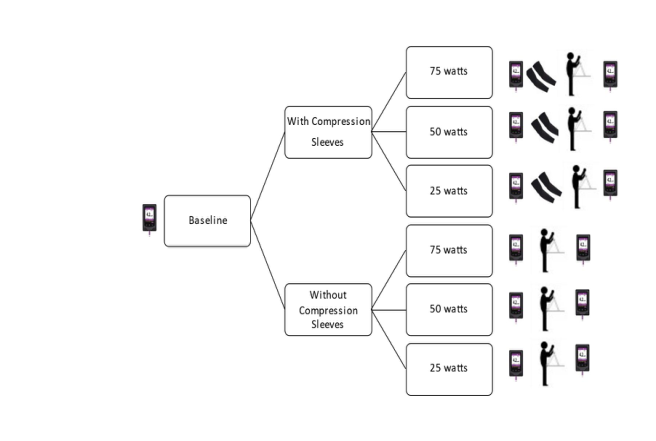
Anthropometric measurements were taken before the beginning of the study intervention. Afterward, each participant’s basal capillary blood lactate level was established by averaging lactate concentration from three con- secutive days. Capillary blood samples were taken from the participant’s earlobe, and lactate concentration (mmol/L) was assessed using the Lactate Plus Lactate Analyzer (Nova Biomedical). After obtaining all the baseline measurements, each participant completed six simulated work sessions in an Arm-ergometer (Angio, Lode, Groningen, Netherlands); one with sleeves and another without sleeves, at an intensity of 25, 50, and 75 Watts, at a cade- nce of 60 RPM, and 10 minutes of duration. All participants rested for at least 72 hours between sessions to prevent muscular fatigue effects of lactate concentrations (Figure 1).
Data were compiled into a master excel sheet. Data were then imported into Rstudio Integrative Development Environment to be analyzed with R statistical programming language using a custom-built script (Team, 2020). The following libraries were utilized: “dplyr” for grammar and data mani- pulation, “rstatix” for normality test and effect size, “lmer” and “lmerTest” for linear mixed-effects models, and “ggplot2”for data visualization. Lactate data distribution was assessed using visual analysis of the data distribution and the Shapiro-Wilk test; data by condition appeared normally distribu- ted. A linear mixed-effects model was utilized for the analysis in which lactate was the dependent variable, the condition was a fixed factor (inte- rcept), and the individual participants were considered the random factor
Changes in Lactate After the Completion of Repetitive Cycle Exercises 229
Figure 1: Experimental design. After the baseline session, 6 exercise arm-ergometer conditions were performed in random order (3 conditions with compressions sleeves, and 3 without compression sleeves).
(intercept and slope). Hence, the following formula was utilized: Lactate ~ Conditions + (1|Participant). After the statistical analysis, a series of indivi- dual pairwise t-tests were conducted. Thereafter, the magnitude of the effect size (ES) between conditions was analyzed using a Cohen’s D test with a Hedge’s g correction for a small sample size; the ES was interpreted as <0.2 trivial, 0.2-0.5 small, 0.6-1.1 moderate, 1.2-1.9 large, and > 2.0 very large (Hopkins, 2009; Montalvo, 2021). Significance was set priori at an alpha level of 0.05.
RESULTS
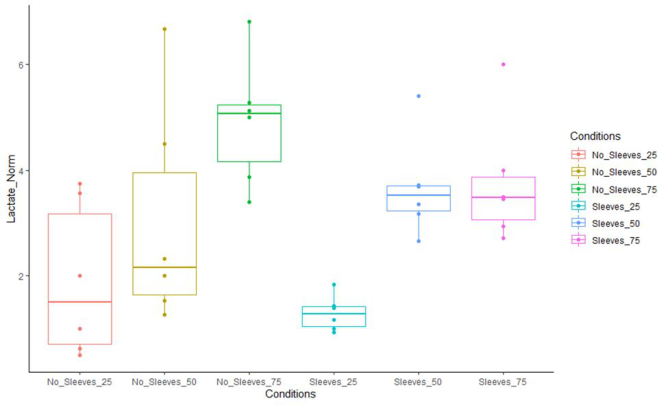
The participants were 23.66±1.24 years old, with a height of 1.71±0.04 meters, weight of 63.73±5.21 kg, body mass index of 21.59±1.73, diastolic blood pressure of 107.83±10.80, and systolic blood pressure of 71.5±3.68. Overall, there was a significant effect of condition (F(5,25) = 6.00, p<0.001). There was a significant effect of conditions (fixed factors) with no sleeves at 75 Watts, with sleeves at 50 Watts, and sleeves at 75 Watts (p<0.05). Moreover, participants had no random effect (p>0.05). F(2,26) = 8.76, p=.012. Individual pairwise data showed no statistical dif- ferences among sleeves and no sleeves conditions. However, analysis of the effect size between load-matched sleeves vs. no sleeves condition revealed small effects. There was a small effect between sleeves vs. no sleeves at 25w (ES = 0.43), sleeves and no sleeves at 50w (ES = 0.21), and sleeves and no sleeves at 75w (ES = 0.45) (Figure 2).
Figure 2: Boxplot with individual data points between normalized lactate levels to baseline among conditions.
DISCUSSION
The results obtained in this pilot study support our initial hypothesis that compression sleeves would result in a lower production of blood lactate compared to a matched-load condition in which no sleeves are worn. Data appears to agree with previous investigations in where wearing compres- sions stockings lead to lower blood lactate production when compared to not wearing compression stockings (Berry & McMurray, 1987; Rider et al., 2014; Rimaud et al., 2010). Furthermore, we demonstrate that wearing com- pression sleeves leads to lower blood lactate production after an exhaustive exercise at three different workloads during arm-ergometry exercise.
Our pilot study is not without limitations. For instance, our sample size was composed only of 6 individuals. Hence, the statistical power could have been compromised, which could be why the pairwise posthoc comparisons were not significant. However, the effect size using the Cohen’s D with a Hedge’s g correction shows a small effect size between compression slee- ves and no sleeves conditions. Therefore, these results should be taken with caution, and replication with larger sample size is encouraged.
CONCLUSION
Wearing compression sleeves during arm-ergometer exercise leads to lower blood lactate production post-exercise compared to a matched-load condi- tion in which no compression sleeves are worn. The finding appears to be of clinical importance. However, a replication of this study with a larger sample size is encouraged. Finally, our study reveals a trend that might be of clinical importance among individuals who exert repeated upper-body manual tasks. Wearing compression sleeves reduces blood lactate production independently of the load utilized.
Changes in Lactate After the Completion of Repetitive Cycle Exercises 231
PRACTICAL CLINICAL APPLICATIONS The use of arm sleeves might mitigate physical fatigue by reducing the produ- ction of blood lactate. Thus, it is recommended the use of arm sleeves during arm cyclical exercise or activities.
ACKNOWLEDGMENT
This project was funded by the University Research Institute (URI) Award (UTEP Faculty Senate Research Committee). Additionally, this project recei- ved in kind by On Site Therapy, LLC. The authors would like to thank the study participants for their participation and continued support.
REFERENCES
Berry, M. J., & McMurray, R. G. (1987). Effects of graduated compression stockings on blood lactate following an exhaustive bout of exercise. Am J Phys Med, 66(3), 121–132. Brooks, G. (1985). Circulation, respiration, and metabolism: current comparative
approaches. In: Springer, Berlin. Brooks, G. A. (1998). Mammalian fuel utilization during sustained exercise.
(1096–4959 (Print)). Hopkins, W. (2009). A scale of magnitude for effect statistics. Retrieved January 24th from http://www.sportsci.org/resource/stats/index.html Montalvo, S. (2021). Effects Of Different Stretching Modalities On The Antagonist
And Agonist Muscles On Isokinetic Strength And Vertical Jump Performance The University of Texas at El Paso]. Rider, B. C., Coughlin, A. M., Hew-Butler, T. D., & Goslin, B. R. (2014). Effect of compression stockings on physiological responses and running performance in division III collegiate cross-country runners during a maximal treadmill test. The Journal of Strength & Conditioning Research, 28(6), 1732–1738. Rimaud, D., Messonnier L Fau - Castells, J., Castells J Fau - Devillard, X., Devillard
X Fau - Calmels, P., & Calmels, P. (2010). Effects of compression stockings during exercise and recovery on blood lactate kinetics. (1439-6327 (Electronic)). Team, R. (2020). RStudio: Integrated Development for R. In Rstudio PBC. http: //www.rstudio.com/ Theofilidis, G., Bogdanis, G. C., Koutedakis, Y., & Karatzaferi, C. (2018). Monito-
ring Exercise-Induced Muscle Fatigue and Adaptations: Making Sense of Popular or Emerging Indices and Biomarkers. Sports (Basel, Switzerland), 6(4), 153. https://doi.org/10.3390/sports6040153
LISTED IN THE AHFE DIGITAL BOOKSTORE CATALOGUE
Explore the complete digital volume
Physical Ergonomics and Human Factors
Read this individual research paper free through the original publisher, or explore the full digital proceedings book.
ISBN 978-1-958651-39-1
Explore this ISBN in the AHFE Bookstore ↗Listed in the July 2026 bookstore catalogue; search by ISBN to confirm current availability · Digital book purchase optional