Torrey Mortenson, Ronald Boring, Thomas Ulrich, Roger Lew (2022). A Prospective Design Method for Nuclear Power: The Evaluation, Requirements, and Goals Outline for Nuclear (ERGON) Method. In: Human Factors in Energy: Oil, Gas, Nuclear and Electric Power. AHFE Open Access, vol. 54, pp. 65–74. https://doi.org/10.54941/ahfe1002222
Human factors researchers at Idaho National Laboratory (INL) have worked on projects spanning control room modernization, operator support systems, visualization design, and novel system creation. These projects demonstrated the need for an explicit design method for nuclear power. Human factors teams found a high standard in the Human Factors Engineering Program Review Model (NUREG-0711) and needed a design methodology which could be successful in gaining approval. Previous work has been synthesized as the Evaluation, Requirements, and Goals Outline for Nuclear (ERGON) method here. Design tasks are broken into four phases: Context and Orientation, Human Factors Review, Prototyping and Evaluation, Iteration and Improvement. ERGON is intended as a flexible and direct design method for many applications in nuclear power. ERGON has been vetted through collaborative research and development with nuclear utilities and as such, the ERGON method can assist utilities to achieve approval from a NUREG-0711 summative evaluation for HSI implementations.
The nuclear industry is in a state of transition regarding the technologies that govern the control systems within many power plants. Nuclear facilities, especially the control rooms that serve as the human-system interface (HSI) to the power generation process, remain largely analog, and the industry is faced with shrinking inventories of replacement parts and difficulties main- taining aging systems. Transitioning to digital control rooms that include novel digital display systems and interfaces is the next step; however, there are regulatory requirements that must be met to achieve this transition. Due to the high regulatory and safety requirements associated with nuclear power plants, this transition will require significant scrutiny, analysis, and assurances that these new digital systems will perform as safely as their ana- log antecedents have. This regulatory reality was identified by utilities as a
substantial hindrance to upgrading and modernizing plant facilities (Joe et al., 2012). Additionally, a lack of relevant experience, especially in human factors engineering, served as a further hindrance to proceeding with modernization efforts.
The U.S. Nuclear Regulatory Commission (NRC) is charged with over- sight of the nuclear industry and ensures that facilities are operated to a high standard of safety of the public and personnel. The NRC uses a specific report, Human Factors Engineering Program Review Model, NUREG-0711 (O’Hara et al., 2012), to evaluate if plant changes adhere to a robust and thorough human factors process to maximize the safety and performance of any new or significantly modified systems. The goal of NUREG-0711 is to guide regulators in their evaluation of specific licensee submittals, and as such it is useful for utilities as they progress through a change that requires a NUREG-0711 review, because it gives the utility the rubric ahead of time, so to speak. The challenge of executing a successful design project is not that it is unclear what the regulator expects, but rather there is an absence of a defined and tested design method capable of ensuring that the design process is sufficiently robust to meet with NRC approval.
Idaho National Laboratory (INL) human factors research teams have executed significant design and evaluation activities for control room HSIs related to the modernization, supplementation, or creation of control systems for nuclear power. To date, INL expertise in the design space has not been captured as a single process. Rather, the last decade of design expertise is disparately contained across a suite of processes and tools. There is a need for a unified and comprehensive design method that is robust, flexible, and sufficient to satisfy the requirements of NUREG-0711. This paper introdu- ces a method, based on a decade of research and development collaboration between INL human factors staff and industry partners. The Evaluation, Requirements, and Goals Outline for Nuclear (ERGON) method described here includes necessary tasks expected from a license submittal which requi- res NUREG-0711 review, respects the high-consequence and safety-focused culture of nuclear power, and is flexible to a broad range of nuclear design activities.
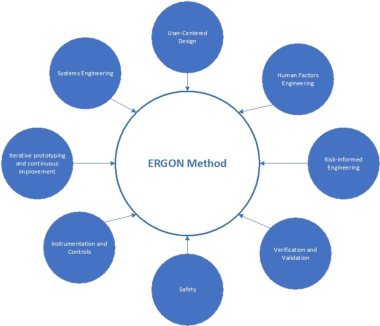
INCEPTION OF ERGON The ERGON method is a prospective design method for the nuclear power industry and, as such, is foundational in that field. The term ERGON— representing the concepts of Evaluation, Requirements, and Goals—was adopted to capture the primary objectives of a design project in nuclear power. Additionally, it bears mentioning that the ERGON method certainly doesn’t exist in a vacuum, as shown in Figure 1. The rigorous environment of nuclear power necessitates a commitment to interdisciplinary design and engineering to ensure a tight coupling of systems and human operations. The ERGON method inherits aspects of systems engineering, iterative pro- totyping, user-centered design, and risk-informed engineering. Many design methods have traces of these or similar disciplines in their composition, but
A Prospective Design Method for Nuclear Power 67
Figure 1: ERGON method influences.
there is a concerted effort in ERGON to weave these disciplines and their processes into the design of HSIs in nuclear power.
The development of the ERGON method began during the early years of the U.S. Department of Energy’s (DOE’s) Light Water Reactor Sustainability (LWRS) research into the potential of existing reactor facilities to operate beyond their initial license approvals. From this research arose a need for control room modernization research and development by the national labs to support nuclear power utilities across the country (Ulrich et al., 2012). As the human factors team at INL began working with utilities on digital upgrades of control room systems, there was a strong regulatory and requi- rement presence, namely NUREG-0711, which set a high standard for any new system. These high standards inserted uncertainty into control room modernization efforts. It was possible that a utility could invest substantial resources into designing, testing, and deploying new digital systems that may not meet with NRC approval. NUREG-0711 guides these regulatory pro- cesses from the regulator’s perspective but does not serve as explicit design guidance for the licensee or vendor to follow.
INL researchers undertook a rigorous application of standard human factors engineering principles and an effort to reverse engineer NUREG-0711 requirements into potential design tasks. Through this process, a method was framed and formalized that included evaluation techniques to meet NUREG- 0711 requirements, such as GONUKE (Boring et al., 2015). The ERGON method was not the intentional result of these efforts, but as nuclear power continues to require upgraded digital modifications or novel digital systems in their control room, there is a profound need for a formalized design method which can provide reasonable assurance of NUREG-0711 approval.
ERGON METHOD The ERGON method is made up of four primary phases, which have steps within. The phases are as follows.
Phase A: Context and Orientation
Phase B: Human Factors Engineering Review
Phase C: Prototyping, Testing, and Iteration
Phase D: Evaluation and Improvement The ERGON method is intended to be a roadmap for how to structure and perform the R&D activities of the design project; therefore, the ERGON method could be applied to all manner of industries and applications and result in many different end design styles. In other words, ERGON could be used in conjunction with various design philosophies or application spaces where specific elements and look and feel for HSIs may be set into an adopted style guide but use ERGON as the underlying design process. ERGON has many influences, but potentially none are more prevalent than user-centered design (UCD; Abras et al., 2004) and iterative prototyping for continuous improvement. What is important to remember about ERGON is that the steps are not necessarily fixed in position or time. It is expected that some steps may take place more than once, in parallel, or as iterations that may require re-evaluating previous decisions. Redesign in response to evaluation results is expected and shows that the process is working as intended.
Phase A: Context and Orientation The first phase in the ERGON process is to begin understanding the context of the design effort and to orient the team to the system being designed. This step is critical to understanding the design space and plan for significant inte- raction with key subject matter experts (SMEs) as part of the project timeline. In past efforts, these steps were completed during an in-person workshop held with stakeholders, subject matter experts (SMEs) for the systems in question, human factors personnel, and other relevant members of the design team. This style of engagement is highly recommended, as a collection of diverse experiences and perspectives can only benefit the design.
Step 1 - Collection of Engineering Documentation There is a steep learning curve in most process control industries, and nuclear power is no exception. The design team requires a thorough understanding of both the system and how the operating context will be deployed at the plant. Any relevant engineering documentation, requirements, specificati- ons, or assumptions should be collected and mapped together to understand where the system has been in the past and where it may need to go next. If materials are highly technical or inaccessible, then SMEs should be engaged early and often so that the design team can gain a firm understanding of the engineering needs of the system.
Step 2 – Interdisciplinary Workshop The design team will gather stakeholders, SMEs, consultants, and potential users to go over the design project. Key results from this meeting may include: a list of key functions or components related to the system’s safe performance, an understanding of how the system works and potential error states that need to be identified and supported by the design, description or definition
A Prospective Design Method for Nuclear Power 69
of the concept of operations or broader operating experience of the system, documenting any mental models or operator perceptions about this system and its performance, and others. All these steps are important to identifying initial design requirements.
Step 3 – Define Initial Requirements The design team then develops some initial requirements to inform the first round of prototyping. Primary functions, important human actions, automa- tion levels, and more will be known at this state and can be developed into initial design requirements. These requirements should include all possible design needs or user preferences known at this point, as well as a full expla- nation of any known constraints. Compiling these will give the design team what is needed to begin assembling a potential prototype. Phase B includes some structured activities to better understand potential human performance and context of performance within the described system. These may provide further information to be included in future iterations.
Phase B: Human Factors Engineering Review After the design team is adequately oriented and understands the context of the project, the next steps are to begin building support for the design by undertaking some key human factors tasks to ensure a robust and thorough design process. In addition to the value of these tasks from a design perspe- ctive, there are specific requirements in nuclear power (O’Hara, 2012) which require that these steps be undertaken and analyzed to ensure that the design is as thorough as possible. The following tasks can vary in depth and breadth, but all are critical to understand the complex systems at hand, and ensure the final design reflects that complexity.
Step 4 – Task Analysis Fundamentally, task analysis is a structured process for understanding the specific actions a user takes in executing a task. There are many different forms of task analysis, and each has specific benefits depending on the unique circumstances of the design project. Nuclear power doesn’t require a specific form or method of task analysis, but one is required under NUREG-0711’s requirements.
Step 5 – Functional Requirements Analysis and Functional Allocation Functional requirements analysis (FRA) is a method to identify functions that must be performed to satisfy the system’s overall goals. It defines the functions that must be accomplished to meet these goals at the desired high performa- nce level, and delineates the relationship between high-level functions and the system’s goals. This helps the design team capture any functions that have been missed up to this point as well as validate the characteristics of known functions.
Function allocation (FA) is the process of collecting known functions and assessing the relative state of automation for the system. Derived from the understanding that humans and machines excel in different tasking, function allocation allows the design team to plan which functions will be automated
and which will be left to human operators. This information will directly feed into the design by describing the key functions that need to be in the designs.
Step 6 – Operating Experience Review Operating experience review (OER) is the systematic collection and eva- luation of the historical operations, design documents, current operating procedures, and other information to build a picture of the overall experie- nce of the plant. A thorough OER provides many inputs and highlights some specific focus areas for other human factors review tasks discussed here. In addition to the benefit to the overall human factors design process, OERs are often required for major design projects in nuclear and other industries. The goal is to identify qualitative characteristics of system and task performance that may be missed by other activities.
Phase C: Prototyping, Testing, and Iteration At this point the design team should have an in-depth understanding of the system, tasks involved, and what capabilities the design needs to support. In many industries there is no requirement to reach this level of system expertise. In nuclear energy the complexity of the system and the safety implications of the system performance necessitates a thorough understanding of the system components.
Step 7 – Define Requirements Initial requirements that were identified earlier should have been further refined and developed through all of Phase B. Design requirements or spe- cifications (terms can be used interchangeably) are the first steps to deve- loping a potential design. Design specifications identify the key features, characteristics, operations, tasks, and more that will be present in the design.
Step 8 – Style Guide Adoption Design is a fundamentally iterative and evolving process and can begin at any step; however, introductory designs prior to the collection of documentation, processes, procedures, functions, and tasks should not be prioritized if they conflict with the information gained in the previous stages. The ERGON method is intended to be flexible as well as help design teams avoid potential pitfalls. Style guides are a critical step in the design process and are an explicit requirement of NUREG-0711.
Step 9 – Prototype Development and Iteration The ERGON method does not instruct on how to design specific items or displays; however, there are formats that can be successful in this step. Initial designs should be bold, experimental, and exploratory at this stage. Inclusion of requirements is necessary, but novel or unique approaches to those conce- pts are highly encouraged at this stage. It is a reality of design and project management that, after this point, specific aspects of the designs will begin to solidify and may become difficult to change as acceptance of design ele- ments occur. Therefore, this initial step is often the easiest way to truly be creative with innovative solutions.
A Prospective Design Method for Nuclear Power 71
Step 10 – Initial User Testing Once initial design sets are completed, users can be engaged for testing and evaluation of the interfaces. This testing can take many forms including inte- rviews, think-alouds, or static evaluations depending on the needs of the project and fidelity of the initial prototypes. User testing is critical early and often, and designs will improve and refine with each iterative loop between prototype design and user testing. The design team should document each round of user testing and the results from those sessions.
Phase D: Evaluation and Improvement Design and evaluation tend to operate together and can be seen as two sides of the same coin. A design must be evaluated, and the evaluation then needs inte- grated into the design. There are different forms of evaluation, just as there are different forms of design, but both are critical processes that are needed for any system to achieve any level of depth and robustness for successful implementation in a nuclear system.
Step 11 – GONUKE Evaluation The Guideline for Operational Nuclear Usability and Knowledge Elicitation (GONUKE) is a specific set of evaluative criteria that maps specific require- ments of NUREG-0711 to common design phases from the beginning to the end of a design project (Boring et al., 2015). It was developed as a means of tracking specific NUREG-0711 requirements and ensuring that evaluation was done in a way that was consistent with the rigor that would be applied by the regulator in evaluating the potential design.
Step 12 – Expert or Heuristics Evaluation Heuristics evaluation (also featured as a step in GONUKE) is a common term in human factors work, generally, and is used in many different fields as well. Heuristics evaluation is when an expert, usually someone trained in human factors, evaluates a system given a set of heuristics, or guidelines, and notes any issues related to those and any other issues found. In this text, examples of guidelines or heuristics include design requirements, the NUREG-0700 (O’Hara and Fleger, 2020) standard, and other design standards such as Niel- sen’s Usability Heuristics. Often, some combination of multiple standards is used to ensure a thorough review, and additional issues are generally disco- vered by the expert that will require attention. It is critical that this reviewer is someone outside of the design team who can protect from involvement in the design affecting the evaluation.
Step 13 – Important Human Actions Review Important human actions are specific actions human operators take which, if done in error, increase the risk of core damage or other critical damage to the facility. The design team must evaluate prospective interfaces and displays to ensure that important human actions have been tested and designed for in a way that supports the goal for safety and operational excellence.
Step 14 – Operator-in-the-Loop Studies Operator-in-the-loop or human-in-the-loop studies are a more in-depth and involved user testing process for systems in nuclear or process control (see GONUKE for a more comprehensive discussion). Expert user populations in the form of actual operators who may one day use the system being designed are brought into an experimental simulation and monitoring facility, like the Human Systems Simulation Laboratory (HSSL; Boring , 2020) at INL, where they are involved in a series of tests, demonstrations, and simulations of the newly designed system.
DISCUSSION
An important concern in high-consequence industries is validation. Are the processes, tools, or methods we use validated and found to be successful in the real world? This is understandable considering the high costs of fai- lure. This is a key concern with the ERGON method and design in nuclear power generally. As has been stated, the ERGON method is a result of a decade of design, evaluation, and implementation activities with real utilities and real systems. Phases and steps were developed with an understanding of NUREG-0711 and human factors engineering principles to ensure a qua- lity design and regulatory satisfaction at the end of a design project. The hope is that the ERGON method can assist in removing uncertainty from the design process in nuclear energy and can support future digitization efforts in the industry. An important point made throughout this paper is that specific design tasks may have unique characteristics or application spaces which are not addressed in ERGON. The ERGON method has been used successfully across three primary application spaces that are important areas in nuclear power, explained below: modification or modernization, supplementation or augmentation, and creation of new systems.
Modification or Modernization The ERGON method was born from the control room modernization efforts within the DOE’s LWRS program. As such, the modification or upgrade of existing analog systems to more digital counterparts was a focus for ERGON. The key characteristic of this type of application is that the nuclear system does not undergo fundamental changes in the equipment functionality, but the control system and user interface may contain new functionality in respect to how operators interact with the equipment. Operator interactions with the system are the focus of these applications.
Supplementation or Augmentation This application space is characterized by the introduction of some additi- onal functionality to an otherwise existing system wherein the underlying system will not be changed and the existing HSI may be retained to some degree. An example of this application is the Computerized Operator Sup- port System (COSS; Lew et al., 2017) constructed by the INL teams to add decision support and prognostic intelligence to the analog control displays
A Prospective Design Method for Nuclear Power 73
(Boring et al., 2015). These projects can be a means of making use of expan- ded computational and interactional flexibility that a digital system can provide to aid operators in understanding control rooms with large numbers of variables or indicators that require vigilant monitoring.
Creation of Novel Systems In the previous application spaces, the design teams had the benefit of existing operating experiences, system knowledge, training protocols, and procedu- res. These key sources of information help develop the design more quickly, and the team is starting from a better point. When creating entirely new systems, the design team truly becomes a member of the interdisciplinary team comprised of systems, nuclear, mechanical, and operations engineers. Many of the information collection tasks are prospective and hypothetical and represents greater challenges than the previous two applications spaces. The ERGON method was used successfully in the creation of a novel display and interface for a hypothetical thermal dispatch loop display system (Ulrich et al., 2020) and was evaluated positively by two crews of formerly licen- sed operators in regard to its support of their accurate understandings of plant performance and expectations of safety while interacting with the new system. In many ways this was the final test for the method and shows that ERGON can be used in many different instances.
ACKNOWLEDGMENT
This work of authorship was prepared as an account of work sponsored by Idaho National Laboratory (under Contract DE-AC07-05ID14517), an age- ncy of the U.S. Government. Neither the U.S. Government, nor any agency thereof, nor any of their employees makes any warranty, express or implied, or assumes any legal liability or responsibility for the accuracy, completeness, or usefulness of any information, apparatus, product, or process disclosed, or represents that its use would not infringe privately owned rights.
REFERENCES
Abras, C., Maloney-Krichmar, D., & Preece, J. (2004). User-centered design. Bainbridge, W. Encyclopedia of Human-Computer Interaction. Thousand Oaks: Sage Publications, 37(4), 445–456. Boring, R. L., Thomas, K. D., Ulrich, T. A., & Lew, R. T. (2015). Computerized
operator support systems to aid decision making in nuclear power plants. Procedia Manufacturing, 3, 5261–5268. Boring, R. L., Ulrich, T. A., Joe, J. C., & Lew, R. T. (2015). Guideline for operational nuclear usability and knowledge elicitation (GONUKE). Procedia Manufacturing, 3, 1327–1334. Boring, R.L. (2020). The first decade of the Human Systems Simulation Labora-
tory: A brief history of human factors research in support of nuclear power plants. Advances in Artificial Intelligence, Software and Systems Engineering, 1213, pp. 528–535. Higgins, J., & Fleger, S. (2012). Human Factors Engineering Program Review Model (NUREG-0711) Revision 3: Update Methodology and Key Revisions (No. BNL- 96812-2012-CP). Brookhaven National Lab. (BNL), Upton, NY (United States).
Joe, J. C., Boring, R. L., & Persensky, J. J. (2012). Commercial utility perspectives on nuclear power plant control room modernization (No. INL/CON-12-26175). Idaho National Laboratory (INL). O’Hara, J. M. (2020). Human-system interface design review guidelines (No. BNL-
216211-2020-FORE). Brookhaven National Lab. (BNL), Upton, NY (United States). Ulrich, T. A., Lew, R., Boring, R. L., Mortenson, T., Park, J., & Medema, H. (2020, December). Developing an Integrated Energy System Interface for Electricity- Hydrogen Hybrid Nuclear Operations. In Proceedings of the Human Factors and Ergonomics Society Annual Meeting (Vol. 64, No. 1, pp. 92–96). Sage CA: Los Angeles, CA: SAGE Publications.
LISTED IN THE AHFE DIGITAL BOOKSTORE CATALOGUE
Explore the complete digital volume
Human Factors in Energy: Oil, Gas, Nuclear and Electric Power
Read this individual research paper free through the original publisher, or explore the full digital proceedings book.
ISBN 978-1-958651-30-8
Explore this ISBN in the AHFE Bookstore ↗Listed in the July 2026 bookstore catalogue; search by ISBN to confirm current availability · Digital book purchase optional