Olaoluwa Akinshipe, Clinton Aigbavboa (2022). Progress on Attempts to Reduce Energy Consumption Used for Road Illumination. In: Human Factors in Energy: Oil, Gas, Nuclear and Electric Power. AHFE Open Access, vol. 54, pp. 8–15. https://doi.org/10.54941/ahfe1002215
Street lighting has become cheaper, more efficient, and easier to maintain due to the quality of research within this field.This report provides an exploratory account of the importance of an energy-efficient system suitable for highways and regular streets. Also, it evaluates the need for further research in the field of road lighting.The paper uses data sources from various geographical locations, including; South Africa, the United States and the Netherlands. This approach is adopted to discover a broader perspective of the constraints and methodologies employed to solve the same or similar problem, as results vary over different geographical locations worldwide.Judging by the amount of money spent, a typical home spends approximately 15% of its total electricity consumption on lighting. This makes the type of technology used for illumination to become increasingly essential. The introduction of energy-efficient Light Emitting Diodes (LEDs) has made it much easier to shrink these consumption numbers. Considering all this in perspective, Artificial Intelligence may need to be widely adopted to reduce these numbers further.
As lighting technologies evolve, they do so for one major reason – energy efficiency. Newer technologies such as the Compact Fluorescent Lamps (CFL) and Light Emitting Diodes (LED) have taken centre stage as one of the most prominent innovations in that respect – LEDs especially. The real progress, however, is how these technologies are being used.
What we have today, though, is a very mechanical approach - switch the lights on at night just before the sun sets and then shut them off the following day once there is sufficient lighting outdoors. Even when there’s no one to use them, streetlights are often powered from dusk to dawn every single day. Thousands of dollars are spent on road lightings on a global scale to deliver the required electricity to power them. Traditional incandescent/fluorescent light bulbs are costly to maintain and replace. This is why newer technologies and strategies are needed to provide more efficiency.
As interesting as it may sound, there are other times when streetlights are often kept turned on, even during the day. For example, the city of Cape Town published that this was done to dissuade theft of power and destruction of street lights and electrical equipment on specified city-managed roadways.
Progress on Attempts to Reduce Energy Consumption Used for Road Illumination 9
Table 1. Comparison of brightness (lumens) and power consumption (watt) for different technologies (Lumens, 2021).
Table available in the original PDF paper.
HOW MANY LUMENS DO YOU NEED?
MORE LUMENS = MORE LIGHT Look for this much light in LED (most efficient) CFL (more efficient)
If you used to buy this in incandescent lumens
Halogen (more efficient incandescent) 100 W 1600 up to 22 W up to 26 W up to 72 W 75 W 1100 up to 20 W up to 23 W up to 53 W 60 W 800 up to 12 W up to 15 W up to 43 W 40 W 450 up to 9 W up to 11 W up to 29 W
Lumens vs Watts: Output and wattages based on most common products available for each medium screw-based light bulb. Actual light output may vary by product.
It was also stated that the city might keep public streetlights manually turned on for maintenance purposes or to prevent events of physical damage during routine construction. Lastly, the control system that automatically turns the lights on and off could also be defective in some cases (Businesstech, 2021).
CURRENTLY USED LIGHTING TECHNOLOGIES Lighting solutions differ significantly in terms of energy efficiency, lifetime duration, and cost. Research is ongoing, and all evidence points to scien- tific prospects leading to even more robust, long-lasting, and cost-effective solutions.
Certain programmes are being implemented, such as; replacing existing lighting technologies like mercury vapour lights with high-pressure sodium lights, using compact fluorescent light bulbs instead of the traditional incan- descent bulbs, and using LEDs where possible, could manage the monetary implications of less cost-effective methods and technologies.
There are four important lighting technologies currently in use. These are; incandescent lamps, halogen lamps, compact fluorescent lamps and LED. These technologies are compared in terms of energy efficiency, life span, and eventually lifetime cost in the Table 1.
Please note the following definitions:
1. Lumen (Lm): Lumen measures the total amount of visible light emitted in all directions by a source per unit of time (or brightness). It is also the S.I. derived unit of luminous flux. 2. Watt (W): Watt is a measure of the power consumed by the light source.
From the table above, it is clear that the efficiency of a light bulb is solely dependent on the amount of energy it saves in terms of electricity costs. Cho- osing the right light bulb for specific use cases drastically improves the overall efficiency of any given lighting programme. Halogen or regular incandescent bulbs consume two to three times the energy consumed by their compact fluorescent or LED counterpart.
10 Akinshipe and Aigbavboa
As lighting technologies advance and meet government regulations, light bulbs in American homes are experiencing a transformation. In a recent survey by the Residential Energy Consumption Survey (RECS) in 2015, most residences were beginning to use a combination of incandescent and compact fluorescent bulbs (Paylesspower, 2021) According to statistics collected throughout the country, traditional incan- descent bulbs are no longer used by 18 percent of households. 86% of participants stated that they used one or more LED or CFL bulbs within their homes.
As LEDs grow increasingly prevalent, up to 29% of homes in the Uni- ted States begin to use at least one LED bulb. However, in Netherland, incandescent light bulbs account for at least 0.3 per cent of total electricity consumption. Putting this into perspective, the amount of energy consumed for transportation in three weeks or five days of natural gas usage for heating equals the annual electricity consumption of incandescent light bulbs (CBS Statistics Netherland 2007). Residential lighting has grown more energy- efficient in general, with CFLs and LEDs replacing inefficient incandescent bulbs.
Energy-efficient lighting provides the benefit of decreasing electricity con- sumption, especially during the evening peak hours. As a result, it adds to the municipality’s and country’s electrical supply security. South Africa’s Eskom and the Department of Energy (DoE) have previously acknowledged that effi- cient lighting plays an essential role in Demand Side Management (DSM) and have supported programs to promote the widespread use of CFL lamps (Sustainable, 2021).
RECENT ATTEMPTS AT ENERGY SAVINGS ON ROAD LIGHTS One of the most crucial duties of public authorities is providing street lighting that caters for pedestrian and vehicular traffic at times when natural light is insufficient. The benefits cannot be overemphasized. Considerably cutting down the number of automobile collisions and serving as a crime deterrent are apparent advantages.
A properly designed street lighting network should be energy-efficient, allow road users to continue with their lives even at night, decrease energy usage, and contribute to the aesthetic appeal of the neighbourhood involved (Beeindia, 2010). To achieve this, studies have been carried out to understand the underlying problems better and proffer workable solutions to mitigate these problems. Some of such studies are discussed below.
Migration to LED The LED street lighting system is a cutting-edge, energy-saving technology that promotes energy efficiency, reduces pollution, and lower maintenance and service costs. These features already distinguish outdoor LED lights from the conventional street lights that use HPS (High-Pressure Sodium) and other Sodium bulbs.
One other advantage of LED lights over HPS lights is their inherent ability to switch on instantly. This makes them ideal for security applications since they can be connected to motion sensors and instantly switch -on when they
Progress on Attempts to Reduce Energy Consumption Used for Road Illumination 11
Table 2. Comparison of street lighting technologies (Sustainable, 2021).
Table available in the original PDF paper.
Type Overview Colour of light
Life time (hours)
Lumens/ Watt white 12000– 24000 13–48
Mercury Vapour Pros: inexpensive, medium life span Cons: inefficient, contain mercury, get dimmer with age High Sodium Pressure Golden yellow
12000– 24000 45–130
Have replaced Mercury Vapour in many cities Pros: energy efficient, medium life span Cons: yellow colour, contain mercury and lead Soft white
12000– 20000 50–80
Compact fluorescent
Only for small street lights Pros: very energy efficient, good colour rendering Cons: limited size; become dimmer with age, contain mercury
white 50000– 70000 70–150
LED Rapidly evolving technology, that is expected to become mainstream Pros: very energy efficient, long life, low maintenance, Cons: high initial costs
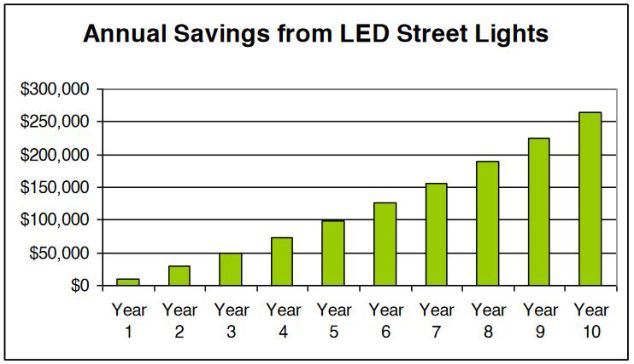
Figure 1: Annual savings from LED street lights (Shane, 2013).
detect even the tiniest movement. HPS lights, on the other hand, might take up to 10 minutes to reach peak brightness. That completely obliterates the entire security application for HPS lights (Stephen, 2021).
Figure 1 is a graph showing the amount saved annually after switching to LEDs.
12 Akinshipe and Aigbavboa
Solar Street Lights With the global energy crisis intensifying, all governments are scrambling to solve this critical situation. One obvious option is sourcing for and utilizing renewable energy sources for most use cases. Another option is to make use of new energy-saving technology to minimize energy consumption and increase energy usage efficiency.
Solar energy has proven to be one of the easiest, purest, and most com- mon natural energy sources. It accounts for around 3,850,000 exajoules (EJ) every year on earth, more than twice as much as all non-renewable resou- rces discovered and used by humans, such as crude oil, coal, natural gas, and radioactive sources like uranium (Ma, 2013).
The solar street light does not require the installation of a transmission line or routing of cables, nor does it necessitate any particular administration or control. It may be erected in any public space, such as a plaza, a parking lot, a campus, a roadway, or a highway. For example, when used with LEDs, it is one of the best solutions to energy conservation. Solar (photovoltaic) cells/panels are needed to absorb and convert the energy into electric power, LED lamps, charging units, control units, and batteries.
Dimming Road Lights The possibility of reducing road illumination to save energy and operational costs while avoiding any negative impacts on driver visibility was one of the solutions that were proffered. The combined effect of automobile headlights and variable road illumination intensities on visibility was investigated in an experimental investigation under varying road surface conditions and was found to be a bit beneficial (Sanaz et al. 2016). From a stationary automo- bile, the brightness levels of the road surface, contrast, and visibility levels of the objects were examined under three different road surface conditions: (a) dry, (b) wet, and (c) snowy conditions. The findings suggest the viability of decreasing road lighting intensity when automobile headlights approach street lights. In effect, street lights did not enhance vision when it was within the range of automobile headlights (Sanaz et al. 2018).
The dimming of streetlights can be accomplished electronically by using specific electrical components incorporated into the lights. The current approach to designing a street lighting control system with dimming allows for installing lights controlled by an automated power source responsible for delivering a certain amount of electricity needed for efficient illumina- tion. This offers adaptive management policies for operating the streetlights by offering distinct modes of varying lamp brightness and accounting for the requirements of outdoor illumination quality of various road segments (Ergüzel, 2019).
Smart Street Light System In this system, the street lights turn on when they’re needed and turn off when they’re not, rather than just mechanically turning them off during the day and back on at night. Leaving lights on when not needed end up becoming some of the world’s largest energy-inefficient systems. LEDs, brightness sensors,
Progress on Attempts to Reduce Energy Consumption Used for Road Illumination 13
motion sensors, and short-distance communication networks can be designed together to make up a smart street light system. The motion sensors are used to detect an incoming pedestrian or vehicular traffic, which sends signals to the brightness sensors and then the LEDs. This way, the lights turn on only when approached by moving figures (Yusaku et al., 2013). One major drawback of this system is having streets pitch dark and confusing incoming vehicles that are not close enough for the motion sensors to detect.
Some other studies propose that street light provides an energy-saving solution by detecting an incoming vehicle using infrared sensors and then activating a segment of high-intensity street lights a few meters in front of the vehicle. The intensity of the lights then decrease when the car leaves that segment. As a result, we save a significant amount of energy. As a result, when there are no vehicles on the roadway, all of the lights will turn dim instead of putting them off outright (Anikesh et al., 2018).
Web-Based Control System The high cost of retrofitting or replacing old lighting technologies and ado- pting LEDs may have significant cost implications, especially for large city networks. A web-based control system was proposed to make older tech- nologies such as high-pressure sodium bulbs more efficient in the long run (Anurak et al., 2021). The suggested concept turns current photo switch modules from traditional controllers into IoT devices. Regulators and main- tenance companies may set up a timetable for shutting off lights late at night to save energy. The devices are then managed and controlled by the web appli- cation on servers over the internet. The system’s low cost, ease of installation, and maintenance make it a more convenient approach than a total overhaul of previously existing street lighting technologies.
Pressure-Sensor Based System A combination of Piezoelectric Transducer (PZT) and Light Dependent Resi- stors (LDR) is used in this system. The LDR, also known as a photoresistor or photoconductor, is a special type of resistor whose resistance changes depen- ding on how much light hits its surface (WatElectronics, 2019). It is used in combination with the PZT to prevent the lights from being activated during the day.
When roads are built with piezoelectric technology, the energy created by moving vehicular pressure is harnessed by piezo-sensors and converted into electrical charge by a PZT, after which the energy is stored and used as a sou- rce of energy (Gudinho, 2020). As a roadside power-producing unit source, this energy source can also be used for vehicle street lighting. The electricity is generated as a result of the pressure created by the movement of vehicles on the road, and it can be used to regulate and automate street lights on highways.
CONCLUSION
Switching to LEDs has proved to be one of the most impactful technolo- gies in energy management. Private consumers, commercial enterprises and
14 Akinshipe and Aigbavboa
government-owned facilities can drastically reduce maintenance and energy costs just by using LEDs or CFLs. In addition to the type of light bulb used, sensors play an essential role in making street lighting even more efficient. Pie- zoelectric Transducer, Light Dependent Resistors, IoT, brightness deeming, solar-powered lighting and using web technologies for monitoring are all aspects of technology that needs to be explored to improve efficiency and reduce the cost to the bare minimum in the long run.
REFERENCES
Anikesh K., Raunak Kr S., Chandan K., Susita S. (2018). Vehicle Movement Street Light With Automatic Light Sensing. Anurak T., Chanchai C., Korakot S. (2021). A web-based control system for
traditional street lighting that uses high-pressure sodium lamps. Beeindia (2010). Energy Efficient Street Lighting. Bureau of Energy Efficiency India website: https://www.beeindia.gov.in/sites/default/files/ctools/Energy%20E fficient%20Street%20Lighting%20Guidelines.pdf Bulbs (2021). History of the Light Bulb. Bulbs website: https://www.bulbs.com/lear
ning/history.aspx CBS Statistics Netherland (2007). Incandescent light bulbs account for less than 1 percent of total energy consumption. Bureau of Energy Efficiency India website: https://www.beeindia.gov.in/sites/default/files/ctools/Energy%20Efficie nt%20Street%20Lighting%20Guidelines.pdf ElectricalTechnology (2016) What is Energy Efficient Lighting and Techniques to
Implement It. Electrical Technology website: https://www.electricaltechnology.o rg/2016/12/energy-efficient-lighting-techniques-to-implement-it.html Ergüzel A.T (2019). A study on the implementation of dimmable street lighting according to vehicle traffic density. Gudinho D. M., Pratiksha P., Soumya B., Sushmitha A., Priyadarshini R. (2020).
An Energy Efficient Street Light System - International Research Journal of Engineering and Technology. Lumens (2021). What is a Lumen? What’s the Difference Between it and a Watt? Lumens website: https://www.lumens.com/how-tos-and-advice/light-bulb- facts.html Ma H. (2013) The solar LED street light. Paylesspower (2021). Light Bulb Statistics. Paylesspower website: https://paylesspow
er.com/blog/light-bulb-statistics/ Peña-García A., Gil-Martín L.M., Hernández-Montes E. (2016). Use of sunlight in road tunnels: An approach to the improvementof light-pipes’ efficacy through heliostats - Tunnelling and Underground Space Technology. Sanaz B., Eino T., Iisakki K., Tapio L. (2018). The Effect of Dimmed Road Lighting
and Car Headlights on Visibility in Varying Road Surface Conditions. Sanaz B., Mikko M., Eino T., Iisakki K. (2016). The effects of dimmable road lighting: A comparison of measured and perceived visibility. Shane L. S. (2013). “HPS to LED Conversion – A City of Phoenix Experience”,
Illuminating Engineering Society. Stephen S. (2021). “LED Streetlights vs HPS Streetlights: What’s the Diff?”. Greenshine. Sustainable (2021). Energy Efficient Lighting. Sustainable energy solutions for South
African local government report: http://www.sustainable.org.za/userfiles/lightin g(2).pdf
Progress on Attempts to Reduce Energy Consumption Used for Road Illumination 15
WatElectronics (2019). What is a Light Dependent Resistor and Its Applications.
WatElectronics website: https://www.watelectronics.com/light-dependent-resisto r-ldr-with-applications/ Yusaku F., Noriaki Y., Akihiro T.N.O. (2013). Smart street light system with energy saving function based on the sensor network. Zazzel (2021). Diagram of a 5mm Round Light-Emitting Diode LED Poster. Zazzle
Human Factors in Energy: Oil, Gas, Nuclear and Electric Power
Read this individual research paper free through the original publisher, or explore the full digital proceedings book.
ISBN 978-1-958651-30-8
Explore this ISBN in the AHFE Bookstore ↗Listed in the July 2026 bookstore catalogue; search by ISBN to confirm current availability · Digital book purchase optional