Lei Tian, Wang Hairong (2022). Influence on Information Recall of Inherent Interactivity in Knowledge Visualization Design. In: Human Factors and Systems Interaction. AHFE Open Access, vol. 52, pp. 411–418. https://doi.org/10.54941/ahfe1002183
The inherent interactivity in knowledge visualization design is considered to be able to help users better understand and recall information content. However, little is known about whether and how such interactivity would affect information recall. Therefore, this study designs an experiment for subjects with a single factor at two levels (high and low intrinsic interaction) to explore the influencing mechanism between inherent interactivity and information recall, while measuring the influence of such intermediary variables as cognitive involvement, perceived active control and cognitive load on this mechanism. The results show that participants in low inherent interactivity can recall more information than in high inherent interactivity. In the analysis of mediating variables, the relationship between inherent interactivity and information recall is significantly affected by the mediating variables, and the perceived active control delivers a significant positive impact on this relationship.
The inherent interactivity of knowledge visualization refers to functions that are designed by software or systems and can interact with users. With the development and transformation of new media technology, it is found that inherent interactivity can enable more users to participate in information dis- semination and obtain information content, because inherent interactivity can shorten the distance between information content and users thanks to its own attributes, so as to give users a sense of control and interest when they read information. As a result, users can get a deeper understanding and thinking of information and easily recall information content again (Xu and Sundar, 2016). Potentially an important breakthrough in the field of know- ledge visualization, this study can improve users’ memory of knowledge in a wider range, thus improving their cultural literacy. However, some related research results show that inherent interactivity may have a negative impact on information recall. Specifically, although inherent interactivity may enh- ance users’ pleasure and satisfaction with interfaces, it may not necessarily improve users’ explanation, understanding and recall of content (Liu and Shrum, 2002). In addition, mediating variable effects (cognitive involvement,
perceived active control, and cognitive load) may exist in the influence of visualized intrinsic interactivity on information recall.
Therefore, this study will focus on whether and how inherent interactivity will affect information recall.
RELATED RESEARCH The Concept of Inherent Interactivity
Generally, inherent interactivity refers to the technical attribute of intera- ctivity (Kalyanaraman and Sundar, 2006), which is related to perceived interactivity. In other words, more inherent interactivities in interfaces can stimulate users’ senses and encourage users to perceive the interactivity in a system during operation. Inherent interactivity, as a technical attribute of interactivity, mainly includes function keys in an interface, such as navigation bars, control buttons, hypertext, sliders and other interactive elements.
In addition, the degree of inherent interactivity can be controlled via the number of interactive tools in an interface. More interactive functions can showcase a higher degree of inherent interactivity.
Inherent Interactivity and Information Recall Relevant researches have demonstrated that inherent interactivity may affect users’ recall of information through the following three intermediary varia- bles: cognitive involvement, perceived active control and cognitive load.
1) Inherent interactivity can improve information recall through inten- sive cognition involvement. The nonlinear inherent interactive environment will stimulate the users’ cognitive responses (including users’ thinking and handling of content), while inherent interactive functions can boost users’ perception ability, attract users to explore the width and depth of infor- mation, and enhance users’ understanding of the information content. For example, in a visualization system that implements the interactive function of hypertext navigation (Eveland and Dunwoody, 2002), users can participate in deep information interaction based on their own preferences and cognitive demands. Given that hypertext imitates the mode of human’s thinking netw- ork, users will generate a large number of ideas related to the content in the process of interaction with the interface. As a result, these ideas are beneficial for users to recall information again.
2) Inherent interactivity may improve information recall through a high level of perceptual active control, which refers to the degree of modification to an interface. When users have the right to edit some aspects of interfaces inde- pendently, they may become more active in processing information. Nguyen, Bol and Lustria (2020) found that users would improve their participation and satisfaction with websites by customizing the information presentation in interfaces, thus delivering positive impact on information recall.
3) Inherent interactivity may enhance users’ recall of information by redu- cing users’ cognitive load. When users access a system with high inherent interactivity (relative to low inherent interactivity), users can achieve their purpose more quickly through the guidance of navigation in the system, thus
Influence on information recall of Inherent Interactivity in Knowledge Visualization design 413
conducive to users’ understanding of the overall system framework. Howe- ver, some researchers believe that in a highly interactive system, users may perform multiple different tasks at the same time (such as browsing and navigating), which will impose cognitive costs on working memory. In addi- tion, multiple tasks may interfere with each other and compete for the same cognitive resources, thus adding more difficulties in information processing (coding, storage and retrieval).
The above analyses show that inherent interactivity may affect users’ recall of information through three factors: cognitive involvement, perceived active control and cognitive load. Therefore, an experiment is designed to study the influencing mechanism of inherent interactivity on information recall and measure the impact of the above three factors.
METHODOLOGIES Purpose
This study mainly explores the influencing mechanism of inherent interacti- vity on information recall, so as to find out whether and how intermediary variables regulate the impact of inherent interactivity on information recall. In order to achieve this goal, the experiment adopts a single factor and two level (high and low inherent interactivities) inter-subject design experiment method.
According to Jansen and others (2008), the process of information recall measurement may be influenced by additional factors, such as the memory and education level of the subjects. Therefore, in order to control the extra factors in the experiment, this study chooses some college students at a simi- lar educational level. Finally, it picks up a total of 120 samples, including 60 males and 60 females, aged between 18 and 25 years. In addition, the participants in the experiment claim in their self-text reports that they are familiar with common interactive styles.
Variables The experiment involves independent variables, intermediary variables, con- trol variables and dependent variables.
The independent variables of the experiment are inherent interactions, both at high and low levels. In order to test whether the independent variables have the expected effect on the participants, the manipulation check of the 7-point interactivity scale is added, the content of which is “the information interface I browse is interactive”.
Intermediary variables refer to the intrinsic and substantial reasons for independent variables to influence dependent variables, mainly including Cognitive involvement, Perceived active control and Cognitive load. The intermediary variables are measured by the 7-point scale, with its contents shown in Table 1.
Control variables are extra variables in the experiment, mainly including the subjects’ educational level, the content of experimental materials, and the layout and design styles. These extra variables are controlled experimentally.
414 Tian and Hairong
Table 1. Contents of all dimensions’ measurement tables.
Table available in the original PDF paper.
Scale content
Measurement Dimension Information recall What are the hazards of hypertension to the brain? What are the hazards of hypertension to the eyes? What are the hazards of hypertension to the kidney? What are the hazards of hypertension to the heart? Cognitive involvement When browsing the information, I will have some thou- ghts about the harm of hypertension. Perceptual active control When browsing the information, I can freely choose what I want to see. Cognitive load When browsing the information, I must think carefully to understand the knowledge on hypertension hazards.
The dependent variable of this experiment is information recall performa- nce, i.e., the degree of users recalling the experimental materials they have read. The dependent variable is tested via the information recall measure- ment scores as proposed by Jansen and so on (2008) : 0 = incorrect, 1 = partially correct, and 2 = completely correct.
In order to compare information recall with intrinsic interactivity, cogni- tive involvement, perceived active control and cognitive compliance scales in the same dimension, all scale scores are converted into percentages, that is, information recall scores =(Q1 + Q2 + Q3 + Q4) * 12.5. In addition, the percentage calculation method for the 7-point scale is: positive score = (X−1) * (100/6); and negative score = (7−X) * (100/6).
Materials
The experimental materials include a knowledge visualization interface with inherent interactivity between the high version and the low version. For the visual interface content, an unfamiliar knowledge theme of “the harm of hypertension to health” is adopted to reduce the familiarity of participants to the experimental materials. In addition, the two versions of knowledge visualization interface would not only have inherent interactivity; other infor- mation, such as interface content (texts and pictures) and layouts, are kept the same, in order to diminish the influence of additional factors of the experimental materials.
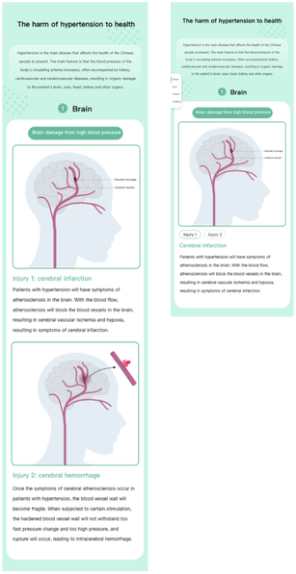
The difference in inherent interactivity of the knowledge visualization interface is mainly controlled through the number of interactive tools (such as buttons, breadcrumbs, etc.) in the interface. Low inherent interactivity doesn’t showcase interactive features, and the subjects in the experiment can only browse information by sliding up or down for the interface’s own attri- butes when accessing the visual interface. Two interactive tools are added in the highly interactive visual interface: breadcrumbs and responsive buttons. The visual interface is shown in Figure 1.
Influence on information recall of Inherent Interactivity in Knowledge Visualization design 415
Figure 1: Left: visualization of knowledge with low inherent interactivity. Right: visualization of knowledge with high inherent interactivity.
RESULTS
Reliability Test of the Scale In preparing the experimental materials, this study modifies some words in the original information recall scale, so as to fit the measurement content of this experiment. Therefore, for the reliability of experimental data, Cron- bach’s alpha standard coefficient is used to test the reliability of the scale. The data results demonstrate that the A value of the information recall question- naire is 0.88, which exceeds the commonly used standard scale (a = 0.8). So, it can be concluded that the scale of the information recall questionnaire of this experiment is highly reliable.
The Main Influence of Inherent Interactivity on Information Recall The descriptive statistical method is used to analyze the characteristics of all research data, and the distribution of the mean and standard errors of the variables in two different interactive visual interfaces is checked. The- reafter, an independent sample T test is conducted to identify whether the variables are different in the two inherent interaction groups. See Table 2 for descriptive statistics and Table 3 for independent sample T test.
416 Tian and Hairong
Table 2. Basic descriptive statistical scale.
Table available in the original PDF paper.
Equation reproduced from the original PDF.Equation reproduced from the original PDF.
Mean value (M)
Standard deviation value
Standard deviation
(SD) (M)
(SD) Information recall 59.17 20.18 84.17 14.16 Cognitive involvement 37.50 17.53 62.22 14.67 Perceptual active control 52.50 18.11 80.00 12.58 Cognitive load 69.72 13.89 66.39 17.76
Table 3. Independent sample t test (n = 120).
Table available in the original PDF paper.
95% confidence interval T DF P Lower limit Upper limit
Information recall −7.86 118 <0.001 −31.30 −18.70 Cognitive involvement −8.38 118 <0.001 −30.57 −18.88 Perceptual active control −9.66 118 <0.001 −33.14 −21.86 Cognitive load 1.15 118 3.33 −2.43 9.10
As seen above, the users’ information recall performance on high intrinsic interactivity is better (M = 84.17, SD = 14.16) than on low intrinsic intera- ctivity (M = 59.17, SD = 20.18), and there is a significant difference between the two groups in information recall, with t (118) = −7.86, P < 0.001. It can be concluded that compared with low intrinsic interactivity, high intrinsic interactivity can help users recall more information content.
In addition, in the two groups of high and low intrinsic interactions, the intermediary variables also showcase differences and activities; in other words, in the group of high intrinsic interaction, the score of intermediary variables is higher, and there are significant differences between the two groups. However, it is surprising that there is no significant difference in cognitive load between the two groups.
The Mediating Effects of Cognitive Involvement, Perceived Active Control and Cognitive Load In order to explore whether the influence of intrinsic interactivity on informa- tion recall involves the influence of the intermediary variables (i.e., perceived interactivity, cognitive involvement, and perceptual active control), this study uses the partial correlation experimental analysis method to explore the real relationship between information recall and intrinsic interactive factors by transforming the intermediary variables into control variables, as shown in Table 4.
It can be observed that under the condition of controlling the cognitive involvement, perceived active control and cognitive load, there is a weak cor- relation between information recall and inherent interactivity, with r = 0.214, p = 0.020. If without such control, there will be a strong correlation, with
Influence on information recall of Inherent Interactivity in Knowledge Visualization design 417
Table 4. Partial correlation analysis (n = 120).
Table available in the original PDF paper.
Inherent Interactivity & Information Recall
Control Variables
R P DF
0.214 0.020 115
N/A 0.689 <0.001 118 Cognitive Involvement & Perception Active Control & Cognitive Load
0.220 0.17 116
Cognitive Involvement & Perception Active Control
0.284 0.002 116
Cognitive Involvement & Cognitive Load 0.422 <0.001 116 Perception Active Control & Cognitive Load
r = 0.689, p < 0.01. This indicates that intermediary variables deliver an influence on the relationship between inherent interactivity and information recall, with a correlation of 0.89, signifying a remarkable contribution.
Through the comparison of research results, it is concluded that the corre- lation between intrinsic interactivity and information recall is 0.422, p < 0.01, on the premise that the perceptual active control variables are not control- led. However, if the cognitive involvement or cognitive load is uncontrolled, the correlation between them will be 0.284 or 0.220, p < 0.01, respectively, all less than 0.422. Therefore, it can be concluded that the perceptual active control is the most important influencing factor among the intermediary vari- ables, and it contributes to the correlation between inherent interactivity and information recall to the greatest extent.
CONCLUSION
This study finds that inherent interactivity has a significant impact on infor- mation recall, and high inherent interactivity can help users recall more knowledge than low inherent interactivity. In addition, the survey on the intermediary variables shows that cognitive involvement and perceptual active control have influence on the relationship between inherent intera- ctivity and information recall. Especially, perceptual active control has more significant influence on this relationship. This indicates that users may enh- ance the influence of inherent interactivity on information recall through higher perceptual active control. In addition, surprisingly, cognitive load has no significant influence on the correlation between intrinsic interactivity and information recall.
To sum up, this study finds that, to a certain extent, inherent interacti- vity has a positive impact on information recall and is influenced by the mediating effect of perceptual active control. However, because this expe- riment’s materials do not accommodate more fields of knowledge, such as news, entertainment and other topics, the universality of this finding needs extensive verification. In the future research on knowledge visualization, high
418 Tian and Hairong
inherent interactivity can also be applied in visual design practice to verify the relationship between interactivity and information recall more widely.
ACKNOWLEDGMENT
We want to thank all our classmates and friends who helped us complete the experimental test.
FUNDING This research is a phased project achievement of the teaching research pro- ject “research and practice of public welfare projects in design courses” of Huazhong University of science and technology, Project No.: 2020054.
REFERENCES
Eveland, W. P., & Dunwoody, S. (2002). An investigation of elaboration and selective scanning as mediators of learning from the Web versus print. Jour- nal of Broadcasting & Electronic Media, 46(1), 34–53. https://doi.org/DOI 10.1207/s15506878jobem4601_3 Jansen, J., van Weert, J., van der Meulen, N., van Dulmen, S., Heeren, T., & Ben-
sing, J. (2008). Recall in older cancer patients: Measuring memory for medical information. Geron-tologist, 48(2), 149–157. https://doi.org/DOI 10.1093/ge- ront/48.2.149 Kalyanaraman, S., & Sundar, S. S. (2006). The Psychological Appeal of Personalized Content in Web Portals: Does Customization Affect Attitudes and Behavior? Journal of Communication, 56(1), 110–132. https://doi.org/10.1111/j. 1460– 2466.2006.00006.x Nguyen, M. H., Bol, N., & Lustria, M. L. A. (2020). Perceived Active Control over
Online Health Information: Underlying Mechanisms of Mode Tailoring Effects on Website Atti-tude and Information Recall. Journal of Health Communication, 25(4), 271–282. https://doi.org/10.1080/10810730.2020.1743797 Xu, Q., & Sundar, S. S. (2016). Interactivity and memory: Information processing of inter-active versus non-interactive content. Computers in Human Behavior, 63, 620–629. https://doi.org/10.1016/j.chb.2016.05.046 Yuping Liu & L. J. Shrum (2002). What is Interactivity and is it Always Such a
Good Thing? Implications of Definition, Person, and Situation for the Influence of Interactivity on Advertising Effectiveness, Journal of Advertising, 31:4, 53–64, DOI: 10.1080/00913367.2002.10673685
LISTED IN THE AHFE DIGITAL BOOKSTORE CATALOGUE
Explore the complete digital volume
Human Factors and Systems Interaction
Read this individual research paper free through the original publisher, or explore the full digital proceedings book.
ISBN 978-1-958651-28-5
Explore this ISBN in the AHFE Bookstore ↗Listed in the July 2026 bookstore catalogue; search by ISBN to confirm current availability · Digital book purchase optional