Yalda Khashe, Najm Meshkati (2022). High Reliability Organizing, Resiliency and Safety Culture. In: Human Factors and Systems Interaction. AHFE Open Access, vol. 52, pp. 32–40. https://doi.org/10.54941/ahfe1002136
Complex safety-critical technological system breakdowns could pose serious threats for workers and the surrounding communities. These organizations are inherently complex and depend on the latest technologies to survive and function properly. Failures in these systems are rare but highly visible, making the consequence of such failures disastrous. To survive, a technological system must have the ability to respond to operational anomalies before any undesirable consequences, which the system seeks to avoid, can occur. As task uncertainty increases in complex systems (typical in ‘non-normal’ or emergency situations), the number of exceptions to routine operations increases, overloading the organizational hierarchy. To meet the new challenges, the organization must use another mechanism to sustain itself. The Presidential Policy Directive (PPD) 21, defines resilience as the ability to “prepare for and adapt to changing conditions and withstand and recover rapidly from disruptions”. Without understanding the vital role of human and organizational factors in technological systems and proactively addressing/facilitating their interactions during unexpected events, recovery will be a sweet dream, and resiliency will only be an unattainable mirage. A High Reliability Organization (HRO)is a resilient organization. These Organizations are a subset of high-risk organizations designed and managed to avoid such accidents. In this paper, we study the influence of HRO characteristics on safety culture, resiliency, and the organizations' ability to respond to unforeseen events.
Complex safety-critical technological systems breakdowns, which are often characterized as ‘low probability, high consequence’, could pose serious threats for workers, the surrounding communities. These organizations are inherently complex and depend on the latest technologies to survive and function properly. They strive to avoid catastrophic events while performing dynamic tasks under strict time constraints, operating technology posing large-scale physical hazards. Failures in these systems are rare but they are highly visible, making the consequence of such failures disastrous.
Over time, organizations learn how to approach and eliminate visible and routine problems, and the positive feedback that they receive creates a culture that directly influence organizational performance. The same concept does
High Reliability Organizing, Resiliency and Safety Culture 33
not apply to high-risk operations, since in these organizations risks are not clear. Studies show that the serious events are often the result of systemic failures, human errors, or organizational weaknesses. Some of these factors may seem inconsequential when evaluated in isolation. (IAEA, 2012) In order to survive, a technological system must have the ability to respond to operational anomalies before any undesirable consequences, which the system seeks to avoid, can occur. As task uncertainty increases in complex systems (typical in ‘non-normal’ or emergency situations), the number of exceptions to routine operations increases, overloading the organizational hierarchy. In order to meet the new challenges, the organization must use another mechanism to sustain itself.
The Presidential Policy Directive (PPD) 21 (Office of the Press Secretary, 2013), defines resilience as the ability to “prepare for and adapt to changing conditions and withstand and recover rapidly from disruptions.” This is simi- lar to the generic definition of resiliency, as “the power or ability to return to the original form, position, etc., after being bent, compressed, or stretched; elasticity.” Without understanding, the vital role of human and organizati- onal factors in technological systems and proactively addressing/facilitating their interactions during unexpected (“beyond design basis”) events, recovery will be a sweet dream and resiliency will only be unattainable mirage.
A High-Reliability Organization is a resilient organization. These Organi- zations are a subset of high-risk organizations designed and managed to avoid such accidents. The fundamental characteristics of an HRO foster a culture of trust, shared values, unfettered communication, and process improvement. It nurtures, promotes, and takes advantage of distributed decision-making. In this paper, we study the influence of HRO characteristics on safety culture, resiliency, and the organizations’ ability to respond to unforeseen events.
High Reliability Organizations For more than twenty years, we have been conducting research on a diverse domain of complex socio-technical systems such as five modes of transpor- tation (esp. aviation), oil refining, healthcare, and aircraft carrier flight deck operations. Organizations that run these systems operate relatively error free in high-risk, hazardous, and rapidly changing (dynamic) environments, over long periods of time, and make consistently good decisions that result in high quality and reliable successful operations. The invisible “glue” that makes different, independent operational sub-systems and entities rapidly configu- res and coordinate together in a seamless fashion revolves around the concept of the HRO.
Our research has shown that as task uncertainty increases in complex systems, (typical in “non-normal” or emergency situations), the number of exceptions to routine operations increases, overloading organizational hiera- rchy. In order to meet the new challenges, the organization must use another mechanism to sustain itself. It must be able to flexibly reconfigure and synch- ronize all of its system elements to address the threatening issues. The HRO approach enables independent systems to become interdependent in a manner that any organization can accomplish. The fundamental characteristics of an HRO foster a culture of trust, shared values, unfettered communication, and
34 Khashe and Meshkati
process improvement. It nurtures, promotes, and takes advantage of distribu- ted decision-making, “where the buck stops everywhere.” (Denyer, Tranfield, & Aken, 2008) According to an analysis of high-reliability systems such as flight ope- rations on aircraft carriers by Weick and Roberts (1993), a culture that encourages individualism, survival of the fittest, macho heroics, and can- do reactions is often, counterproductive and accident-prone. Furthermore, interpersonal skills are not a luxury, but a necessity in high-reliability orga- nizations. The culture of a HRO is one that anticipates failures within its organization and sub-systems and works diligently to avoid error and mini- mize its impact. This preoccupation with the possibility of failure leads to a continual state of ‘mindfulness’ combined with a strong desire to be a ‘learning organization’. (Weick, Sutcliffe, & Obstfeld, 2008) HROs Com- munication, paying attention to systems interfaces, organizational culture, and flexibility are major factors in risk mitigation of large-scale complex organizations (Grabowski & Roberts, 1996).
HROs aim to empower the employees, especially experts at different tech- nical areas, experts are not necessarily those with highest experience in the organization but those who have the best knowledge of the task on hand. Empowerment involves the decentralization of decision-making authority and responsibility, and it purportedly improves organizational flexibility by permitting more localized adjustments. (Bigley & Roberts, 2001) In other word when the hazardous situation happens, HROs flatten their command structure and give the person with more expertise more authority to make decisions. This way they expedite the decision-making process, which is a cru- cial factor to a successful emergency response. HROs actively seek to learn what they do not know, design systems to disseminate relevant knowledge relating to a problem available to everyone in the organization, learn rapidly and efficiently, train staff to recognize and respond to system abnormalities, empower staff to act, and design redundant (sub-)systems to anticipate pro- blems (N. Meshkati, 2010).It is possible that all HROs that all these strategies and processes, However lacking most of these characters would make such organization accident prone. (Roberts K. H., 1990) The two key attributes mark high-reliability organizations:
1. A chronic sense of unease, i.e., they lack any sense of complacency. For example, they do not assume that because they have not had an incident for ten years, one won’t happen imminently; 2. Strong responses to weak signals, i.e., they set their threshold for inte- rvening very low. If something does not seem right, they are very likely to stop operations and investigate. Consequently, they accept an uncommonly much higher level of ‘false alarms’ than other organizations.
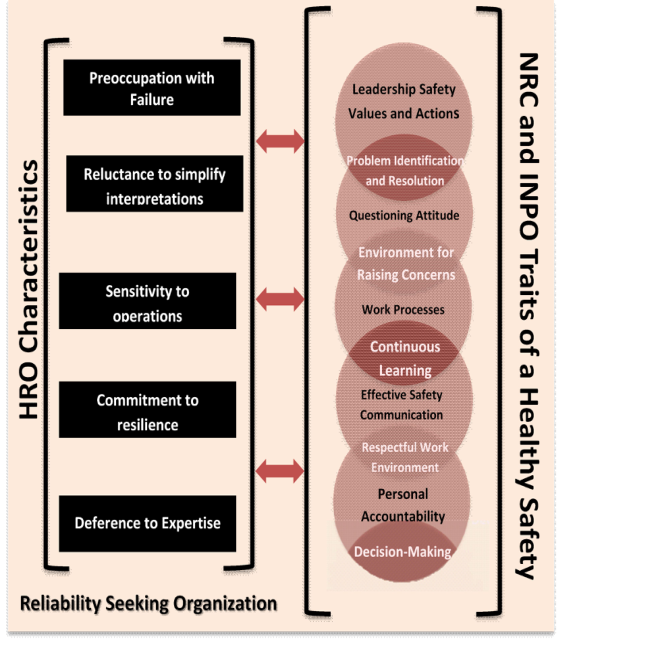
According to Weick and Sutcliffe (2001), “hallmarks of high reliability” or major characteristics of HRO while “anticipating and becoming aware of the unexpected” include Preoccupation with failure, Reluctance to sim- plify interpretations; and Sensitivity to operations. In addition, when the “unexpected occurs”, HROs attempt to contain it by Deference to expertise, and Commitment to resilience.
High Reliability Organizing, Resiliency and Safety Culture 35
Preoccupation with Failure: “HROs have a mindset of chronic wariness. Hubris is the enemy of system reliability.” (Earl Carnes). “Hubris” has deva- stating effects for system safety, any lapse is a symptom that something may be wrong with the system; near misses provide opportunities to improve; and error reporting is highly encouraged.
Reluctance to Simplify Interpretations: Given the complex nature of work, HROs accept that systems can fail in ways that have never happened before, and that it is not possible to identify all the ways systems will fail in the future. Moreover, failures or near misses do not necessarily result from a single and simple cause. Work context constantly changes, meaning there is no such thing as “routine” work. Different situations require alertness, sensitivity, and a good dosage of educated and improvised problem solving capability.
Sensitivity to Operations: HROs have deep knowledge of the technology and management systems they operate, pay close attention to the front line where the actual/real work is done, and are aware of emerging local opera- ting practices. HRO recognizes that systems are not necessarily deterministic, orderly, stable or routine; but are rather dynamic, complicated and the result of continuous social construction.
Deference to Expertise: In HROs, expertise is distributed and the system controller typically defers to the person with the expertise relevant to the issue they are confronting. An expert is not necessarily the most experienced or the highest ranked person; it is usually someone at the “sharp end” -- where the real work is done. In other terms, this characteristic of HRO refers to empowering expert people closest to a problem and shifting leadership to people who have the answer to the problem at hand.
Commitment to Resilience: HROs can detect, contain, and rebound from unexpected events. An HRO is not necessarily error free, but errors do not disable it; the system absorbs or adapts to disruptions without fundamental breakdowns. The system absorbs or adapts to perturbations and disruptions without fundamental breakdown. Through fast, real time communication, feedback, and improvisation, the system can restructure or reconfigure in response to external (or internal) changes or pressures. Worst-case scenarios are always imagined, modeled, and rehearsed. (Chapanis, 1996).
High Reliability Organizing and Resiliency The Presidential Policy Directive (PPD) 21 (Office of the Press Secretary, 2013), defines resilience as the ability to “prepare for and adapt to changing conditions and withstand and recover rapidly from disruptions.” This is simi- lar to the generic definition of resiliency, as “the power or ability to return to the original form, position, etc., after being bent, compressed, or stretched; elasticity.” Without understanding, the vital role of human and organizati- onal factors in technological systems and proactively addressing/facilitating their interactions during unexpected (“beyond design basis”) events, recovery will be a sweet dream and resiliency will only be an unattainable mirage.
A High-Reliability Organization is a resilient organization. These organi- zations are ready to respond to unforeseen events by fostering characteristics
36 Khashe and Meshkati
like flexibility, creativity, and spontaneity, which are filtered through indivi- duals’ capacity to perceive, understand, and make sense of events. (Grøtan, Størseth, Rø, & Skjerve, October 2008) Sense making is one the main chara- cteristics of HROs. Studies show that HROs strive to develop the ability to identify situations that had the potential to evolve into safety critical situati- ons by learning from previous events. (Dekker & Woods, 2010) Experience provides individuals with a valuable pool of information and knowledge to draw on when engaging in pattern recognition, which could consequently enable them to identify advantage points to create a successful improvised solution (Trotter, Salmon, & Lenne, 2014).
Complex and safety-critical organizations emphasize on order and con- trol and reliance on routine to reduce the probability of error could suppress creativity and innovation when faced with an unexpected situation. Impro- visation in such organizations could be affected by the “chronic temptation to fall back on well-rehearsed fragments to cope with current problems even though these problems don’t exactly match those present at the time of the earlier rehearsal.” (Weick K. E., 1998, p. 551) Ambiguity triggers innovation. If individuals and organizations shy away from ambiguity in the workplace and relationships, they would only be able to reproduce routine actions (Ahmed, 1998). “Requisite imagination” is a required principle for a resilient organization. (Grøtan, Størseth, Rø, & Skjerve, October 2008)
Furthermore, it has been empirically validated that experts in high stress demanding situations do not usually operate using a process of analysis. Even their rules of thumb are not readily subjected to it, whereas most of the exi- sting artificial intelligence-based automated systems always rely on analytical decision process. If operators of complex systems rely solely on computer’s analytic advice, they would never rise above the level of mere competence -- the level of analytical capacity -- and their effectiveness would be limited by the inability of the computer systems to make the transition from analysis to pattern recognition and other more intuitive efforts (Dreyfus & Dreyfus, 1986). Finally, Meshkati and Khashe (2015), based on their extensive analysis of two noteworthy cases: The 2009 astonishing emergency water ‘landing’ and safe evacuation of US Airways Flight 1549, as well as the restora- tion of Fukushima Daini Station after the 2011 To−hoku earthquake and tsunami, contended that front-line operators’ improvisation via dynamic pro- blem solving and reconfiguration of available recourses provide the last resort for preventing a total system failure. Despite advances in automation, opera- tors should remain in charge of controlling and monitoring of safety-critical systems. Furthermore, at the time of a major emergency, operators will alw- ays constitute the society’s both the first and last layer of defense; and it is eventually their improvisation and ingenuity that could save the day.
Safety Culture at HROs Over time, organizations learn how to approach and eliminate visible and routine problems, and the positive feedback that they receive creates a culture
High Reliability Organizing, Resiliency and Safety Culture 37
that directly influence organizational performance. The same concept does not apply to high-risk operations, since in these organizations risks are not clear. Studies show that the serious events are often the result of systemic failures, human errors, or organizational weaknesses. Some of these factors may seem inconsequential when evaluated in isolation. (IAEA, 2012) According to an analysis of high-reliability systems such as flight ope- rations on aircraft carriers by Weick and Roberts (1993), a culture that encourages individualism, survival of the fittest, macho heroics, and can- do reactions is often, counterproductive and accident-prone. Furthermore, interpersonal skills are not a luxury, but a necessity in high-reliability orga- nizations. The culture of a HRO is one that anticipates failures within its organization and sub-systems and works diligently to avoid error and mini- mize its impact. This preoccupation with the possibility of failure leads to a continual state of ‘mindfulness’ combined with a strong desire to be a ‘learning organization’. (Weick, Sutcliffe, & Obstfeld, 2008) HROs Com- munication, paying attention to systems interfaces, organizational culture, and flexibility are major factors in risk mitigation of large-scale complex organizations (Grabowski & Roberts, 1996).
However, to encourage a culture of high reliability and mindfulness, peo- ple within an organization should believe that “their leaders are genuinely committed to safe operations and have taken appropriate measures to com- municate safety principles and ensure adherence to safety standards and procedures” (Zohar, 1980). Studies show that employees individual perce- ption of safety practice is related to the organizations safety performance. (Desai, Roberts, & Ciavarelli, 2006) Research on organizational culture and safety has outlined five organiza- tional processes that are useful in developing HROs (Wong, Desai, Madsen, Roberts, & Ciavarelli, 2005): 1) develop a system of process checks to spot expected and unexpected safety problems, 2) develop a reward system to incentivize proper individual and organizational behavior, 3) avoid degrada- tion of current process or inferior process development, 4) develop a good sense of risk perception, and 5) develop a good organizational command and control structure.
On June 14, 2011, US Nuclear Regulatory committee (NRC) issued its final Safety Culture Policy Statement. In this report, Safety Culture refers to “an organization’s collective commitment, by leaders and individuals, to emphasize safety as an overriding priority to competing goals and other considerations to ensure protection of people and the environment.” (NRC, 2011) In this report NRC introduces nine traits for a positive safety culture: 1) Continuous learning, 2) Problem Identification and Resolution, 3) Work Processes, 4) Environment for Raising Concerns, 5) Personal Accountability, 6) Effective Safety Communication, 7) Questioning Attitude, 8) Leadership Safety Values and Actions, 9) Respectful Work Environment. On April 2013, Institute of Nuclear Power Operations (INPO) published a report on Traits of a Healthy Nuclear Safety Culture (INPO, 2013). This report was built on NRC statement, and added “decision making” as the 10th trait of a safety culture.
38 Khashe and Meshkati
Figure 1: HRO characteristics vs. INPO traits of a healthy safety culture.
We mapped HRO principles and safety culture traits side by side to better illustrate their relationship. The comparative analysis conveys that, although there is not an exact linier relationship between the two, there exists a strong positive relationship. In other word, improving upon one set of features would enhance and improve the other and vice versa. (Figure 1) Organizational culture is the organizations common knowledge that has been acquired through learning (Bierly & Spender, 1995). Most practical approach towards learning is by trial and error; however, it is not feasible in high-risk organizations due to their complexity, tight coupling, and the dan- gerous outcome. Organizations often learn as much about themselves and their internal relationships as they learn about the critical event itself.
CONCLUSION
High-risk organizations are organizations operating technologies sufficien- tly complex to be subject to catastrophic accidents. HROs are a subset of high-risk organizations designed and managed to avoid such accidents. These organizations strive to avoid catastrophic events, while performing dynamic tasks under strict time constraints, operating technology posing large-scale
High Reliability Organizing, Resiliency and Safety Culture 39
physical hazards. However, achieving such goal is not possible with solely investing in improvement of the technical elements of the system.
Achieving High reliability is a journey. Merely implementing the HRO characteristics does not guarantee High reliability. US Department of Energy published a report on the Assessment of Safety Culture at the Pantex Plant on November 2012. The stated that although the organization has been trying to communicate and implement the HRO principles for years, they failed to internalize those principles due to lack of effective communication, absence of learning organization and long-term safety solutions. This report highligh- ted the importance of a “healthy safety culture” in order to internalize HRO principles and foster the culture of respect and trust within the organization. (DOE, 2012).
It is a proven fact that the HRO characteristics constitute the “secret of success” for a safe, sustainable, and result-oriented system, which must operate in a high-risk, non-routine, and rapidly changing environment. Implementing these principals from the design stage of the system, would reinforce the pillars of the organization and enhance resiliency.
REFERENCES
Ahmed, P. K. (1998). Culture and climate for innovation. European Journal of Innovation Management, 1(1), 30–43. Bierly, P. E., & Spender, J. C. (1995). Culture and High Reliability Organizations:
The Case of the Nuclear Submarine. Journal of Management, 21(4), 639–656. Bigley, G. A., & Roberts, K. H. (2001). The Incident Command System: High- Reliability Organizing for Complex and Volatile Task Environments. The Aca- demy of Management Journal, 44, 1281–1300. Dekker, S. W., & Woods, D. D. (2010). The High Reliability Organization Perspe-
ctive. In E. Salas, F. Jentsch, & D. Maurino (Eds.), Human Factors in Aviation (2nd ed., pp. 123–143). Academic Press. Denyer, D., Tranfield, D., & Aken, J. E. (2008). Developing Design Propositions through Research Synthesis. Organization Studies, 29(3), 393-413. Desai, V. M., Roberts, K. H., & Ciavarelli, A. P. (2006). The Relationship Betw-
een Safety Climate and Recent Accidents: Behavioral Learning and Cognitive Attributions. Human Factors, 48(4), 639–650. DOE. (2012). Independent assessment of nuclear safety culture at the Pantex plant. US Department of Energy. Retrieved from http://energy.gov/sites/prod/files/2013/05/f0/Nov_2012_Pantex_IRR- Assessment_of_Nuclear_Safety_Culture_at_Pantex.pdf Dreyfus, H. L., & Dreyfus, S. E. (1986). Mind over machine. New York, NY, USA: The Free Press. Grabowski, M., & Roberts, K. H. (1996). Human and organizational Error in Large
Scale System. IEEE Transactions on Systems, Man, and Cybernetics – PART A: Systems and Humans, 26(1), 2–16. Grøtan, T. O., Størseth, F., Rø, M. H., & Skjerve, A. B. (October 2008). Resilience, Adaptation and Improvisation - increasing resilience by organizing for successful improvisation. the 3rd Symposium on Resilience Engineering. Antibes, Juan-Les- Pins, France. IAEA. (2012). Safety Culture in Pre-operational Phases of Nuclear Power Plant
Projects - Safety Reports Series 74. International Atomic Energy Agency.
40 Khashe and Meshkati
INPO. (2013). Traits of a healthy safety culture. Institute of Nuclear Power Operations. Meshkati, N., & Khashe, Y. (2015). Operators’ Improvisation in Complex Technolo-
gical Systems: Successfully Tackling Ambiguity, Enhancing Resiliency and the Last Resort to Averting Disaster. Journal of Contingencies and Crisis Management, 23(2), 90–96. N. Meshkati. (2010, January). A High Reliability, Resilient Foreign Policymaking (HR2FP). Office of the Science and Technology Adviser to the Secretary of State and the Administrator of USAID (STAS), Jefferson Science Fellow. Washington D.C.: U.S. Department of State. NRC. (2011). Final Safety Culture Policy Statement. Washington, DC: U.S. Nuclear
Regulatory Commission. Office of the Press Secretary. (2013, February 12). Presidential Policy Directive -- Critical Infrastructure Security and Resilience. Retrieved Octoer 2014, from The White House: http://www.whitehouse.gov/the-press- office/2013/02/12/presidential-policy-directive-critical-infrastructure-security- and-resil Rasmussen, J. (1980). What can be learned from human error reports? In K. D.
Duncan, M. M. Gruneberg, & D. Wallis, Changes in working life (pp. 97–113.). New York, NY: Wiley. Roberts, K. H. (1990). Some Characteristics of One Type of High Reliability.
Organization Science, 160–176. Roberts, K. H., & Rousseau, D. M. (1989). Research in Nearly Failure-Free, High-Reliability Organizations: Having the Bubble. IEEE TRANSACTIONS ON ENGINEERING MANAGEMENT, 32(2), 132–139. Trotter, M. J., Salmon, P. M., & Lenne, M. G. (2014). Impromaps: Applying Rasmus-
sen’s Risk Management Framework to improvisation incidents. Safety Science, 60–70. Weick, K. E. (1998). Introductory Essay: Improvisation as a Mindset for Organizational Analysis. Organization Science, 543–555. Weick, k. E., & Roberts, K. H. (1993). Collective mind and organizational reliability:
The case of flight operations on an aircraft carrier deck. Administrative Science Quarterly, 38, 357–381. Weick, K. E., & Sutcliffe, K. M. (2001). Managing the Unexpected: Assuring High Performance in an Age of Complexity. Jossey-Bass. Weick, K., Sutcliffe, K., & Obstfeld, D. (2008). Organizing for high reliability:
Processes of collective mindfulness. Crisis management, 81-123. Wong, D. S., Desai, V. M., Madsen, P., Roberts, K. H., & Ciavarelli, A. (2005).
Measuring Organizational Safety and Effectiveness at NASA. Engineering Mana- gement Journal, 17(4), 59–62. Retrieved from Daniel S Wong; Vinit M Desai; Peter Madsen; Karlene H Roberts; Anthony Ciavarelli. Zohar, D. (1980). Safety climate in industrial organizations: Theoretical and applied implications. Journal of Applied Psychology, 96–102.
LISTED IN THE AHFE DIGITAL BOOKSTORE CATALOGUE
Explore the complete digital volume
Human Factors and Systems Interaction
Read this individual research paper free through the original publisher, or explore the full digital proceedings book.
ISBN 978-1-958651-28-5
Explore this ISBN in the AHFE Bookstore ↗Listed in the July 2026 bookstore catalogue; search by ISBN to confirm current availability · Digital book purchase optional