Jiaqi Qian (2022). Construction of the localized knowledge production model based on social design method in the post-epidemic era. In: Cross-Cultural Decision Making. AHFE Open Access, vol. 44, pp. 96–101. https://doi.org/10.54941/ahfe1001861
During the period when the new crown epidemic spreads and coexists with human beings on a large scale around the world, the process of globalization has been impacted. The existing international order, geopolitical order, and social order have also been challenged to a certain extent. Globalization is not homogenization that eliminates differences. Tracing the roots of diverse cultures requires that the research object be transferred to the most basic unit, knowledge production in localized communities. This paper expounds on the connotation and opportunities of the post-epidemic era from the micro and macro levels, combined with the method of social design, analyzes and draws the principles for the construction of the localized knowledge production model, and constructs the model.
Since the new crown epidemic outbreak, individuals in every social life, economy, society, country, and international relations have been severely impacted. The old homogeneous and single economic model that pursues large-scale development is not enough to meet the challenges of the new crown epidemic. The opportunity for transformation lies in focusing on the smallest unit of globalization, the localized community, and reconstructing its knowledge production model to develop a differentiated, diversified, and ecological order. Designers with a sense of social responsibility and social imagination from the perspective of social design can be an effective driving force for constructing patterns and behavioral frameworks. By analyzing the macro-level and micro-level of the epidemic, the theoretical research, and the method application of social design, this paper summarizes the two princi- ples for the construction of the localized community knowledge production model and initially constructs the model.
Changes and Opportunities in the Post-Epidemic Era Since the outbreak of the new coronavirus, all human beings have been fighting against the epidemic. This is not a trivial matter of a region, a coun- try, or a nation, but a significant matter of the entire community with a
Construction of the Localized Knowledge Production Model 97
shared future for mankind. The world under the background of globaliza- tion, modernization, and industrialization has long been different from any era in history. The impact of this epidemic is both a challenge and an opportu- nity: it will expose the shortcomings of the original rough development and, at the same time, be exposed to localization and globalization. This chapter will qualitatively analyze the transformation and opportunities of globali- zation brought about by the epidemic at the macro and micro levels and summarizes the core “leverage points” that turn challenges into opportuni- ties, that is, the localization to reconstruct the smallest unit of differentiation and diversification—knowledge production.
Transformation of Development Model and Order Reconstruction at the Macro Level The Real Economy is in Urgent Need of Reform and Restructuring The difficulties of the real economy come from institutional difficulties and the relationship between supply and demand: on the one hand, the real eco- nomy is affected by the blockade policy to prevent and control the epidemic, and on the other hand, the overall market demand has declined due to the impact of the economic downturn. With high operating costs, a single ope- rating model, separation from local communities, and an intensive bidding model, the entire economy industry’s upgrading, reform, and reorganization are imminent.
Social Factors are Taken Into Consideration Only taking economic development indicators as the standard and ignoring social, cultural, and other factors, and only pursuing the rapid growth of indicators derails economic and social development and reduces community stickiness and social stability. A development model that abandons social factors is like self-castration, and only pursuing capital circulation and circu- lation efficiency is like castrating a more complex long “ecological chain” into a shorter “ecological chain,” and the stability and risk resistance of the economy and society are greatly reduced.
The Large-Scale Development Model is Impacted Grouping related functions into large-scale partitions have become a routine way of modernization and industrialization. On the one hand, the efficiency improvement of this method at the micro level when individuals work alone is undoubted. However, from the perspective of cities and regions, the time and energy consumption brought about by the increased mobility of people in this model also reduces efficiency. On the other hand, in the face of such a highly contagious new crown epidemic, the movement of people in cities and regions has dramatically increased the risk of virus infection and transmission.
Reintegration of Individual Habits and Needs at the Micro-Level Thinking From Consumerism to the Bottom Line Since its birth in the last century, consumerism has continued to influence people’s daily life as a value and a way of life. Consumerism advoca- tes the supremacy of consumption that indulges in material desires and is
98 Qian
often accompanied by behaviors such as excessive consumption and over- consumption. As the epidemic continues, people’s lifestyles have changed, and the consumption orientation has shifted from satisfying material desires and gaining identity to green ecological health and those that are sufficient to deal with risks, and from consumerism to green and sustainable bottom-line thinking.
Multiple Outlets of Individual Emotions Humans are social creatures, and individual value derives largely from social relationships. Limited by the spatial properties of three-dimensional objects, there is a relationship between people and the localized communities in which they grow and live. With the popularization of the Internet, the virtual com- munity with interest as the core of cohesion also provides people with more emotional value. This epidemic has demonstrated the possibility of compa- tibility and balance between localized and virtual communities. Individual emotions can have more diverse outlets, which is beneficial to physical and mental health.
Return to the Localized Community Returning to the localized community has two meanings. On the one hand, young people whose social identity is overly dependent on virtual com- munities are forced to change their living habits and return to localized communities to seek basic security. On the other hand, in the large-scale economy, migrant workers who had to leave their hometowns due to the concentration of resources in big cities returned to their localized communi- ties where they were born and raised under the circumstances of increased living costs and reduced work income caused by the epidemic. What they have in common is that both bring more diversified and advanced capital back to the localized community and complete the return of technology and capital.
Opportunities and Leverage Points in the Post-Epidemic Era Through the above six-point analysis of the macro-level and micro-level changes in the post-epidemic era, this paper summarizes the trends and opportunities in the post-epidemic era in the following four points: First, ecological industrial transformation: multi-factor influence, multi- subject, sustainable;
Second, from quantification of scale to “small and beautiful”: having a “full variety” of systems that meet bottom-line needs in a smaller physical space; Third, compatibility and balance between localized community and virtual community;
Fourth, rebuild the localized community with the help of “reflow tide”: localize knowledge production, and tap the smallest unit of differentiation and diversification.
The fourth point is to reconstruct the smallest unit of differentiation in localized knowledge production, which is not only a supplement to globali- zation but also a lever point to complete the transformation in response to
Construction of the Localized Knowledge Production Model 99
challenges. The functions and values ⣋⣋of the re-empowered localized community can be diverse: the basic unit of material security, the recharge of the physical industry through demand binding, the basic unit of individual identity and social value acquisition, and the differentiated remodeling: the minimum service unit and regulatory unit for the tourism value, ecological sustainability goals.
Research Methods and Principles Based on Social Design Development and Research Process of Social Design When the design is a problem-solving idea, in the Neolithic Age, human beings polished stones and creatively transformed things with natural attri- butes into tools, which is the germination of design. When design emerged as a discipline, it was influenced by industrialization and financialization for a long time to serve industrial efficiency and commerce. With the adva- ncement of industrialization and financialization, the shortcomings of its development model have gradually been exposed: a series of problems such as deterioration of ecological resources, the polarization of social classes, and unfair resource distribution. This prompts designers to think more about society and human beings, which brings about a change in design concepts.
Victor Papanek, Nigel Whiteley, and Victor Margolin are the founders of social design theory. Victor Papanek believes that the social responsibility of design includes responding to the real needs of human beings, reducing the waste of resources, and creating a safe and equal environment as one’s own responsibility, rather than meeting the needs of the few (1985). Nigel Whiteley also mentioned the responsibility of designers again: to design use- ful to the society; to redesign the original resources of the community to give full play to localized advantages; to serve everyone in the community; to pay attention to safe production; to pay attention to sustainable develo- pment and reduce Destruction of Nature (2014). Victor Margolin advocates that design research should be international and cross-border and proposes new responsibilities for designers in the face of social transformation: inclu- ding responsibilities to users, sustainability issues, and how to set advanced technology settings to solve complex The Frontiers of Human Life Problems (2002).
With the participation of the design service industry, design professional companies, and design schools in the field of social design, more designers with different design backgrounds have in-depth thinking about the social responsibility of designers based on their personal life experiences. In the past decade, social design has been given more themes. From a cross-disciplinary perspective, while advocating the rich connotation of “design +” , it also serves as a methodology to provide a template for the application of traditi- onal theories, such as the connection with sociology and philosophy; in the scope of design products, it not only focuses on The design of specific things, including scenario design, interaction design, service design, system design and so on. Social design offers a possibility: as co-ordination and collection of a series of design concepts and activities.
100 Qian
Table 1. Relevant theories and main viewpoints.
Table available in the original PDF paper.
The main points Relevant theories
Sociological Imagination
C. Wright Mills argues in The Sociological Imagination that having a sociological imagination can closely link personal troubles in the situation with the public issues in the social structure. Community members gradually form the empathy and sympathy that each other is the main body of each other, and the horizons are integrated. It also further develops a rational knowledge basis for understanding, interpreting, and criticizing social life’s subjective initiative and structural limitations. (1959) Socio-Material Practice
Bruno Latour in Where Are the Missing Masses? The Sociology of a Few Mundane Artifacts proposed the idea of “artifact society” and advocated weaving the factors of objects into sociological ethics. (1992) Social Responsive Design
Matt Malpass believes in Critical Design in Context: History, Theory, and Practice that Social Responsive Design is increasingly focusing on the design process of user participation. This collaborative design practice transforms design from designing for the user to designing for the user together, even including user-led design in collaborative design practice. (2017) Design Activism Focuses on and speaks out for marginalized, unfairly, and exploited disadvantaged groups.
Design Principles of Localized Knowledge Production Mode Based on the Social Design Method Based on the review of social design disciplines, the relevant viewpoints and concepts are summarized, and the following six principles can be applied to the design of localized knowledge production models:
First, taking into account the marginalized groups, taking into account all stakeholders in the localized community, and adopting a fair model with multiple subjects working together; Second, effectively use the design process and design output to help the localized community build an equal communication system and create a fair environment for the participation of multiple stakeholders;
Third, localize the knowledge production modeled by community residents to empower communities and residents; Fourth, designers provide technical and service support for the implemen- tation of knowledge production in localized communities;
Fifth, recognize the dynamic nature of knowledge production models, and design an inclusive stock space for the model; Sixth, it is not limited to the design of objects but provides effective gui- dance for localized communities through the design of objects, services, and scenarios.
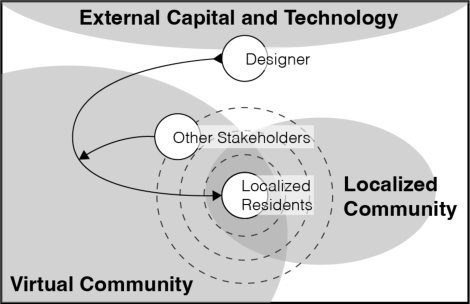
Construction of Localized Knowledge Production Model Based on the principles of the post-epidemic era and social design methods analyzed in the first two sections, the theoretical framework of localized knowledge production is constructed, as shown in the figure.
Construction of the Localized Knowledge Production Model 101
Figure 1: The construction of localized knowledge production model.
This model takes localized residents as the core, and the interaction between localized residents and their localized communities and virtual com- munities continues to influence; with designers as the assistance, design forces are used as external forces to integrate external social resources, including technical and financial assistance Localized residents transform tacit know- ledge hidden in life experience and folk customs into differentiated explicit knowledge, and at the same time integrate other stakeholders with virtual communities and localized communities. The specific way of design is not limited to objects, systems, services, and scenarios, but the products of design are targeted and specific.
REFERENCES
C. Wright Mills. (2000) The Sociological Imagination, 40th anniversary edition.
Oxford: Oxford University Press. Latour, B. (1992) Where Are the Missing Masses? The Sociology of a Few Mundane Artifacts, Bijker & Law, Chapter 8, 225–258. Malpass, M. (2017) Critical Design in Context: History, Theory, and Practice.
London: Bloomsbury Visual Arts. Margolin, V. (2002) The Politics of the Artificial:The Politics of the Artificial-Essays on Design and Design Studies. Chicago: University of Chicago Press. Nigel, W. (2014) Design for Society. YOU Wanlai, YANGMinying, Translated. China
Tai wan Linking Publishing Co., Ltd. Papanek, V. (1985) Design for the Real World: Human Ecology and Social Change, Chicago: Academy Chicago Publishers.
LISTED IN THE AHFE DIGITAL BOOKSTORE CATALOGUE
Explore the complete digital volume
Cross-Cultural Decision Making
Read this individual research paper free through the original publisher, or explore the full digital proceedings book.
ISBN 978-1-958651-20-9
Explore this ISBN in the AHFE Bookstore ↗Listed in the July 2026 bookstore catalogue; search by ISBN to confirm current availability · Digital book purchase optional