Lekan Amusan, Terdoo Udendeh, Clinton Aigbavboa (2022). Application of Industry4.0 Tools: Integrated Building Site Payment Management Portal for Construction Works. In: Cognitive Computing and Internet of Things. AHFE Open Access, vol. 43, pp. 37–49. https://doi.org/10.54941/ahfe1001837
Management of construction site financial engagement is one of prerequisite of an effective site management. In recent times Building informatics concept has been useful in developing state of art equipment and process. In this study therefore, building informatics planning was generated that could be used for financial management purpose on site. The research was carried out using qualitative and quantitative research method, quantitative research method involved the use of structured questionnaire developed in Likert scale 1 to 5. Therefore with the aid of purposive sampling method, fifty (50) samples were picked using purposive sampling method. Construction professional constitute the nucleus of the respondents. The statistical inference was carried out on the data with Relative agreement Index and presented in tables. Qualitative method was used to develop the proposed integrated system. The study developed an integrated system that could assist in overcoming the negative vices of payment on site. The following task was carried out in line with aim of the study: identification of existing web-based financial platform, critical success factor in deployment of payment interface, methods of preventing financial conflict on site, challenges of web- interface, critical success factor in deployment of payment interface, identification of strengths and weaknesses of existing web-based financial platforms, among others. The interface can help solve basic problem about financial payment difficulty on site. The direction of choice should be in automating different aspect of building and construction for maximum productivity. The system that was developed in the context of this study can help prevent cost overrun on site, payment conflict, and delay payment among others.
Managing financial transactions on site is one of the important facets of con- struction site management. It ensures hitch free flow of funds on the site to concerned parties. Therefore, selecting an effective method of application
through which the distribution of fund could be carried out could not be ove- remphasized. There have been reports about conflict and unrest on site on account of delayed payment of wages and entitlements on sites as documen- ted in some studies such as (Kenley, 1999; Cheetham et al., 1996; Rodriguez, 2017). Therefore there is a need for a platform that could facilitate effective disbursement of funds and fund management on sites. This platform came up on account of shortcomings identified with some payment methods iden- tified on site, such as manual payment, queue up-and-take methods being used on sites among others. It is on this note that this study carried out an exploratory highlights into exploratory approach to integrated building site payment management portal for construction works
MANAGEMENT OF PAYMENT SYSTEMS ON SITE One of the core activities on site that is fundamental to the success of project is maintaining fund flow on sites, and getting right the payment system on site is as equally important. Also, definite achievement in term of successful execution of project without financial hitch often depends on the appropria- teness of chosen payment method. Similarly there are ingredients of successful payment system o sites, they include: pricing systems, payment systems, chain of payment and cash flow. Njie et al. (2005) and Sherif and Kaka (2003) in the summary of their studies categorized cash flow processes on site into two phases as include; cash flow forecasting and cash flow management. Cash flow research relating to construction is categorized into two major processes. They are; cash flow forecasting and management of the cash flow (Kenley, 1999; Cheetham et al., 1996; Sherif and Kaka, 2003) cash flow forecasting has more input in term of research than the aspect of cash flow management and this has created a gap in the study of cash management on site. There have been dearth of literature as relating to the form, process and configuration of applications that tend to combine developing payment system on site that could be used for all category of clients and professional on site as done in this (Agbaje et al., 2013; The Constructor, 2016; Amusan et al., 2018).
Planning Financial Payment On Sites There are different methods that could be used to create planning system for payment activities on site. The following are discussed in this section. Some of the methods according to Blyth and Kaka (1999) and Rodriguez (2017) include stage/milestone payment, direct payment, advance payment and interim payment. Direct payment includes contractors to be paid wholly or on instalment basis either monthly or periodically. (Blyth and Kaka, 1999) Submitted that ordinary practice in conventional practice involves execu- ting payment on monthly basis while the construction works progresses. The amount payable would have been resolved among the parties concerned while the Quantity surveyors prepared the interim certificate on behalf of the pro- ject client. Similarly, direct payment, another types of payment system on sites. In direct payment system the project client relates directly with the con- tractors on builder in charge of the project through clients Quantity surveyor,
Application of Industry4.0 Tools: Integrated Building Site Payment Management Portal 39
the contractor or builder then receives direct lodgement from the client. In this scenario, client also relates directly with subcontractors on sites paying them directly from his payment agents, the payment is for all categories of work and services rendered on site. According to (Gidado and Miller, 1992) clients relates with contractors and subcontractors while the workers relates with their employers for financial compensation as regards services rendered. Also, Advance payment is another method of financial payment on site which involves paying contactor executing a Research Methodology
Research Design Survey research design was adopted in this study. The population sample in this stud involves construction skill workers such as architects, builders, quantity surveyors, civil engineers contractors of some selected site. Sample size of 60 respondents was chosen using convenience sampling technique.
Primary Data Collection Data collection instrument is a device for collecting data or measuring the variables which are used for answering research questions and/ or testing for hypothesis. The purpose of this study, the data collection instrument used was coded questionnaire making use of the 5-point Likert scales ranging from strongly agree to strongly disagree, also interviews with some professionals on site.
Secondary Data Collection Secondary data are data that have been collected and well processed into meaning for and usable form by other individuals. It gives information alre- ady existing on a subject matter or study. This study incorporated the use of secondary data in the literature review making use of journals, articles, research paper, textbooks, and internet sources amongst others.
Data Analysis Data analysis basically involves collation and organization pf collected data. Analysis of data for the purpose of this research was done using means of tables, statistical calculation methods aided by the use of the Statistical Package for Social Scientists for windows (SPSS). Table 1 shows profiling financial processing.
Some financial processing system were profiled and presented in Table 1. They involve applications that could be used in data processing and spre- adsheet formulation and management. Some of them were profiled based on their current state of application at respective research location. Some of them include Sage Spread sheet system RAI 0.892 which was ranked 1st, Financial spread sheet (CostMC) RAI 0.874 ranked 2nd, Store/office inven- tory application RAI 0.873 ranked 3rd, MS Word Excel sheet RAI 0.873 was ranked 4th, BIM application RAI 0.768 was ranked 5th while Integrated MS Project En-suite with RAI 0.754 was ranked 6th. Sage spreadsheet system
Table 1. Profiling financial processing system in practice.
Table available in the original PDF paper.
S/N Platforms RAI Rank a Sage Spread sheet system 0.892 1st
b Financial spread sheet (CostMC) 0.874 2nd c Store/office inventory application 0.873 3rd d MS Word Excel sheet 0.873 4th
e BIM application 0.768 5th f Integrated MS Project En-suite 0.754 6th
g Builder trend payment package 0.748 7th h Quick cash 0.698 8th
Legend: RAI-Relative Agreement Index.
and CostMC spreadsheet top the list of the applications. The sage allows for multi-functionality in the process application of cost applications on site. Also MS. Word based spreadsheet and Excel spread sheet formed the basis for most of the spreadsheet application worksheet that many mathematical application uses. This view was supported by Agbaje and Ayambadejo (2013) and Njie et al. (2005) that payment system could provide a way of rethinking ways of reformulating payment system on site.
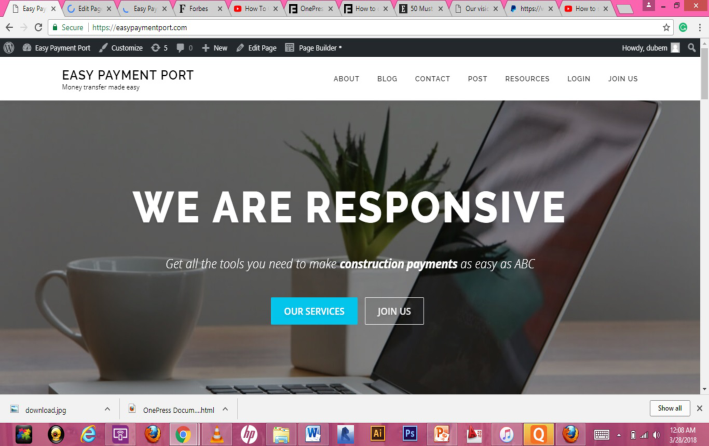
EXPLORING PAYMENT INTERFACE FRAMEWORK The payment interface is presented in Fig. 1. The interface contained icons that could allow users to know about the platform, to contact the admini- strators at the back end, to post comments and items on the portal. Also, there is icon on resources. All the icon has drop down features that would allow for different actions that could be carried out. Some of such actions include payment types, facility available and link to client. Link to subcontractor, access point for client and link for professional to lodge their details.
The resources menu which processes the requests of users has drop down menu consisting of departments such as; accounting, central installation, cli- ent, health and safety department, material purchase and supply/ payment, proprietary items, store, subcontracting and tendering.
Factor influencing successful application of financial management frame- work on site was presented in Table 2. The factors were arranged based on the magnitude of the Relative agreement index(RAI). Earlier submission of financial claims with RAI 0.915 was ranked 1st, Effective communication among the parties RAI 0.900 ranked 2nd, Keeping of financial records/ tran- saction on site RAI 0.87 ranked 3rd, Making financial payment information accessible to all stakeholders RAI 0.865 ranked 4th, Making money available on time for disbursement to workers RAI 0.83 was ranked 5th, Progress pay- ments must be paid to contractors as when they are due with RAI 0.825 was 6th while Updating financial commitment from time to time with RAI 0.775 was ranked 10th . The highest ranked factors was Earlier submission of fina- ncial claims. Financial claims shoiuld be submitted earlier from time to time
Application of Industry4.0 Tools: Integrated Building Site Payment Management Portal 41
so as to ensure prompt payment. Also, effective communication among the parties is also essential for proper documentation sos as to ensure proper fina- ncial document compilation, this would eliminate grievances among parties
Table 2. Factor influencing successful application of financial management framework on site.
Table available in the original PDF paper.
S/N Factor Parameters RAI RANK
0.865 4
I Earlier submission of financial claims 0.915 1 II Effective communication between the parties 0.900 2 III Keeping of financial records/ transaction on site 0.870 3 IV Making financial payment information accessible to all stakeholders
0.830 5
V Making money available on time for disbursement to workers
0.825 6
VI Progress payments must be paid to contractors as when they are due
0.825 7
VII Prompt preparation of interim certificate by the cost expert
0.815 9
VIII Regular scheduling of financial commitment on site 0.825 8 IX The ability to understand terms and contract and expectations of the parties X Updating financial commitment from time to time 0.775 10 Source: Field survey
Table 3. Challenges of web-interface.
Table available in the original PDF paper.
S/N FACTORS RAI RANK
0.900 2
I Challenge of Computer literacy 0.950 1 II Difficulty in having ease of access to internet facility
0.858 5
III Incessant flunctuation in power supply 0.875 3 IV Dearth of Trained professional in ICT 0.875 3 V Unavailability of training modules for online application
0.790 7
VI Scarcity of computer system 0.855 6 VII Un availability of tablets, ipads and other devices IX High Initial financial cost 0.795 8 X High Maintenance and running cost 0.775 9 XI Resistance to change 0.685 10
Source: field survey.
concerned. the submission above toes the line of submission in Gidado and Miller (1992), Agbaje and Ayambadejo (2013), and Amusan et al. (2018).
There is no perfect system without challenges, all applications especi- ally the online and webbased applications comes with associated challenges, some of such challenges are presented in Table 3. The cahllenges covers design, configuration and application of some of the payment system that are in use in the construction section.In this study the callenges are profi- led in the following order: Computer literacy with RAI 0.950 was raked by respondents as 1st, Difficulty in having ease of access to internet facility RAI 0.900 2nd, Incessant flunctuation in power supply RAI 0.875 3rd, Dearth of Trained professional in ICT RAI 0.875 3rd, Unavailability of training
Application of Industry4.0 Tools: Integrated Building Site Payment Management Portal 43
Table 4. System requirements for payment software efficiency.
I Prescribing goals prescription 0.950 1 0.925 1 0.871 1 II Clarification of agents and actors
0.875 3 0.827 3 0.789 3
III Setting boundary between software goals and domain property
0.875 3 0.789 4 0.732 4
IV Negotiating the goals and software boundary
0.858 5 0.678 9 0.698 5
V Granularization of goals before software design
0.855 6 0.854 5 0.653 6
VI Setting sotware behaviour parameters
0.795 8 0.723 6 0.539 10
VII Exploring worse case scenarios 0.790 7 0.783 8 0.5621 9 VIII Setting up levels of software goals desirable
0.775 9 0.689 7 0.687 8
IX Setting up case diagram in software development
0.685 10 0.623 10 0.6901 7
X Benchmarking pre-and postconditionrequirements in system design Source: Field survey.
modules for online application RAI 0.858 5th, Scarcity of computer system RAI 0.855 6th, Unavailability of tablets, I-pads and other devices RAI 0.79 7th, while High Initial financial cost with RAI 0.795 was ranked 8th. Lite- racy in computer application is necessary for any user to be able to operate a computer system and application, likewise availability of internet supply is an additional advantage for effective deployment of an online and webbased application. Similarly continous tarining is needed for knowledge entrenh- ment and application, the submission above toes the line of submission in Gidado and Miller (1992), Agbaje and Ayambadejo (2013), and Ejohwonu et al. (2016).
System requirement is one of the basic procedures in the developmental stage of software. It entails the software developer having joint consultation with stakeholders’ perspective. This would enable development of inclusive and robust software. Therefore, System requirements for payment software efficiency was profiled and presented in Table 4. Prescribing goals prescri- ption was ranked 1st, Clarification of agents and actors was ranked 2nd, Setting boundary between software goals and domain property also was ranked 3rd, Negotiating the goals and software boundary ranked 4th, while Granularization of goals before software design was ranked 5th by the pro- fessionals. Goal performance setting is very necessarywhen planning Apps development and configuration. Detail about the scope and limitation of system tobe devloped is usually taken into consideration while deloping software. Similarly, there shouldbe delinaetion of actors and agents. Actors
refers to the users of the facility while agents refers to the means and system interface of the software. Also,domain and securityissue that borders one- ncryptionand cyber security systemis necessary for the protection of software, thus its is of essence in effective adoption and apploication of softwares (Feng and Tan, 2012).
Statistical Analysis on System Requirements for Payment Software Efficiency There is no variation in the mean of respondents as regards opinion variation on mean ranking of Statistical Analysis on System Requirements for Payment Software Efficiency.
P-value: 0.05 The test was performed at 95% confidence interval and all variables pre- sented exhibited P-value less than 0.05 i.e. P<0.05. The result statistics implies that there is significant difference in the means value the samples of the professionals, therefore, the Null hypothesis is rejected, implying that there is variation in the mean values of System Requirements for Payment Sof- tware Efficiency. The reasons behind the difference could be linked to the background experience of the professionals.
In designing web-based applications, the first stage in Factors influencing requirements elicitation in the designing of payment interface is presented in Table 6. Removal of inconsistency in requirement specification, Preventing consistency rule violation, Adopting group discussion in software develo- pment, Early detection of inconsistency in stakeholders elicited requirements are part of requirement elicitation parameters.
Ho: There is no variation in the mean of respondents as regards opinion variation on mean ranking of Factors Influencing Requirements Elicitation in Payment Interface Design P-value: 0.05 Pearson’s T and Student T test was carried out on mean of responses col- lated from the professionals as presented in Table 7 The test was carried out to compare the difference in means of the professionals’ opinion. This is to check whether there variation among the group observed. The test results of equality of variance are as presented in the table. The test was performed at 95% confidence interval and all variables presented exhibited P-value less than 0.05 i.e. P<0.05. The result statistics implies that there is significant difference in the means value the samples of the professionals, therefore, the Null hypothesis is rejected, implying that there is variation in the mean values of Factors Influencing Requirements Elicitation in Payment Interface Design. The reasons behind the difference could be linked to the background experi- ence of the professionals. Individual respondent can only judge a situation in line with their professional duties, hence the variation observed in the mean between groups.
ICT in the Construction Industry The construction industry is looked with the progressing test of changing and enhancing current work hones so as to wind up noticeably more customer
Application of Industry4.0 Tools: Integrated Building Site Payment Management Portal 45
Table 5. Students-T test and analysis of variance table on statistical analysis on system requirements for payment software efficiency.
Table available in the original PDF paper.
ANOVA of Statistical Analysis on System Requirements for Payment Software Efficiency F Sig.
System Parameters Sum of Squares
Df Mean Square
Prescribing goals prescription
Between Groups 0.006 3 0.002 Within Groups 0.000 0 Total 0.006 3 Setting software boundary goals
Between Groups 0.077 3 0.026 Within Groups 0.000 0 Total 0.077 3 Negotiating the goals and software boundary
Between Groups 0.100 3 0.033 Within Groups 0.000 0 Total 0.100 3 Granularization of goals before software design
Between Groups 0.007 3 0.002 Within Groups 0.000 0 Total 0.007 3 Setting sotware behaviour parameters
Between Groups 0.002 3 0.001 Within Groups 0.000 0 Total 0.002 3 Exploring worse case scenarios
Between Groups 0.031 3 0.010 Within Groups 0.000 0 Total 0.031 3 Setting up levels of software goals desirable
Between Groups 0.018 3 0.006 Within Groups 0.000 0 Total 0.018 3 Setting up case diagram in software development Between Groups 0.032 3 0.011
Between Groups 0.004 3 0.001 Within Groups 0.000 0 Total 0.004 3 Benchmarking pre-and post-condition requirements in system design maintenance Within Groups 0.000 0 Total 0.032 3 Between Groups 0.019 3 0.006
oriented; more aggressive and also beneficial through reception of ICT as a fundamental piece of the construction procedure. Despite the fact that correspondence is a fundamental incentive in development extends, the construction industry is defied with the significance and utilization of infor- mation and communication technology (ICT). As most firms in developed nations have expanded and will increase their investments in ICT, this inclu- des raised profitability inside their development industry and brought about an expansion in the quality and speed of work, financial related controls, interchanges and access to regular information. Firms in the underdeveloped
Table 6. Factors influencing requirements elicitation in payment interface design.
Table available in the original PDF paper.
BLDR Rank ARCH Rank QSURV Rank
S/N Requirement Elicitation Parameters
0.950 1 0.920 1 0.891 1
I Removal of inconsistency in requirement specification
0.900 2 0.900 2 0.882 2
II Preventing consistency rule violation
0.875 3 0.876 3 0.859 3
III Adopting group discussion in software development
0.875 3 0.869 4 0.836 5
IV Early detection of inconsistency in stakeholders elicited requirements
0.858 5 0.834 5 0.857 4
V Adopting win-win aproach in incorporating stakeholders requirements
0.855 6 0.831 6 0.796 6
VI Adopting joint requirement planning in developing software
0.790 7 0.689 7 0.683 7
VII Identifying and resolving systemic risk
nations are yet to comprehend this fundamental esteem and its significance to the advancement of their development segment (Sherif and Kaka, 2003).
The main aim of ICT is to provide information and analytical tools for construction stakeholders in order to facilitate the project delivery process. Communication at both international and local level is made easy with ICT which includes; computer software, hardware and communication devices. To stay competitive, all industries need to review the emerging technolo- gies carefully and associations in the construction industry are no exceptions (Amusan et al., 2018; Maria et al., 2012) stated that the use of internet- enabled technology can result in quantifiable advantages in terms of increased revenues, decreased overheads, greater efficiency and satisfied customers. One of the ways to achieve these quantifiable advantages is the adoption of e-payment through e-business.
E-Business Blyth and Kaka (1999) defined e-business as a term often used to describe internet-enabled systems that provide information, facilitate transaction or provide share business processes. E-business is the creation of commercial efficiency with subsequent benefits for all stakeholders (Njie et al., 2005) E-business involves all the business activities associated with the electro- nic exchange of data including the exchanges that help internal activities operating inside associations and their utilization units and furthermore the exchanges that help external activities conducted to interact with the business
Application of Industry4.0 Tools: Integrated Building Site Payment Management Portal 47
Table 7. Statistical analysis on factors influencing requirements elicitation in payment interface design.
Table available in the original PDF paper.
ANOVA of Satisfaction Level of Factors Influencing Requirements Elicitation in Payment Interface Design F Sig.
Requirements Elicitation Parameters Sum of Squares
Df Mean Square
Removal of inconsistency in requirement specification
Between Groups 0.003 3 0.003 Within Groups 0.000 0 Total 0.003 3 Preventing consistency rule violation
Between Groups 0.077 3 0.026 Within Groups 0.000 0 Total 0.077 3 Adopting group discussion in software development Between Groups 0.007 3 0.002
Between Groups 0.100 3 0.035 Within Groups 0.000 0 Total 0.100 3 Automated Early detection of inconsistency in stakeholders elicited Between Groups 0.002 3 0.001
Within Groups 0.000 0 Total 0.007 3 Adopting win-win approach in incorporating stakeholders requirements Between Groups 0.031 3 0.010
Within Groups 0.000 0 Total 0.002 3 Adopting joint requirement planning in developing software
Within Groups 0.000 0 Total 0.031 3 Identifying and resolving systemic risk
Between Groups 0.019 3 0.007 Within Groups 0.000 0 Total 0.019 3
partners such as customers and suppliers. According to the department of commerce, the advantages of the e-business supersede either paper-based systems or Electronic Data Interchange (EDI) in providing a better commu- nication channel between partners. The use of computers, internet access, order placement using internet, making internet payments, receiving electro- nic payments are the initial steps towards e-business adoption. Despite the short history of e-business, it is changing most industries and is evolving into a major component of business operations (Feng and Tan, 2012). E-business is able to change the basic structure of the business through engineering the work process and the way data is shared which suggest numerous favourable circumstances for advancement in the area of procurement, correspondence and project management.
However, the adoption of e-business in construction industry has been relatively limited and ineffective compared to other engineering sectors, for example, automotive or aerospace. The limited resources available is Small And Medium Enterprises (SMEs) to invest in ICT and absence of readi- ness of people, process and legal systems are generally factors that impeded reception (Rodriguez, 2017; Blyth and Kaka, 1999). Rodriguez (2017)
and Ejohwonu et al. (2016) lists four processes related to e-business. They are; e-procurement, e-transactions, e-logistic and e-collaboration. E-business systems are created using supportive ICT such as software application s, computer hardware and networks. At the point when a business has com- pletely incorporated data and information and communication technology (ICT) into its operations, possibly updating its business forms around ICT or totally reexamining its plans of actions. E-business is every one of these exercises with the inside procedures of a business through ICT.. From an innovative point of views, e-business is upheld with a scope of data and inte- rchanges advances, primarily web-based advances. From the procedure point of view, e-business changes the business forms through mechanization, reen- gineering and mix. This proposal embraces this more extensive meaning of e-business (Feng and Tan, 2012).
CONCLUSION
There are issues that surrounds the application of payment interface on site, some of cogent factors according to Sherif and Kaka (2003) they include: cost uncertainty, time constraint, scope and arc of coverage of project. According to Gidado and Miller (1992), Amusan et al. (2018), Amusan et al. (2018), and Maria et al. (2012) cost certainty is of paramount importance. An effective platform ensures that the cost of project is effectively fulfilled, on the con- trary, if an adequate system is not used it can lead to cost allocation disparity and lead to project abandonment at the long run. Timeliness is also ano- ther desirable attribute of payment system, the schedule should be able to deliver the cost effectiveness in the various aspect cost programming on site. The benchmarked schedule often guaranteed timely completion of project work. Similarly, the scope and largeness of a project can determine the. Com- plex nature of a project comprised of the following parameters, the structure; scale and extent of construction, site requirements (Gidado and Miller, 1992). Finally, parameters for system and software calibration was censored, they includes, prescribing goals prescription, clarification of agents and actors, setting boundary between software goals and domain property, negotiating the goals and software boundar and granularization of goals before software design this was supported in (Feng and Tan, 2012).
ACKNOWLEDGMENT
I appreciate the Covenant University Centre for Research Innovation and Discovery (CUCRID) for sponsorship of this research publication.
REFERENCES
Agbaje and Ayambadejo (2013) Electronic Payment and Economic Growth in Nigeria. Journal of Buildings. Vol8(9). Pg 3–4. Amusan, Lekan, Dosunmu Dolapo, Afolabi Adedeji, Ojelabi, Rapheal A. Omuh,
I. O. and Okagbue, H. I. (2018) Data Exploration On Factors That Influences Construction Cost And Time Performance on Construction Project Sites. Data In Brief, 17. pp. 1320–1325.
Application of Industry4.0 Tools: Integrated Building Site Payment Management Portal 49
Amusan, L.M., Charles, A.K., Adeyemi, E., Joshua, O., Raphael, O.A. (2018) Data on expert system-econometric entropy informatics model for adjudicating residential building project costs. Data in Brief, 20, pp. 1721–1729. Akinwumi, I.I., Ajayi, O.O., Joshua, O., ...Ogunwole, D.A., Afolayan, O.D. (2019)
Housing crisis: Waste glass-stabilized clay for use as fired clay bricks. IOP Conference Series: Mate-rials Science and Engineering, 2019, 640(1), 012072. Awoyera, P.O., Nworgu, T.A., Shanmugam, B., ...Romero, L.M.B., Hu, J.-W.
(2021)Structural retrofitting of corroded reinforced concrete beams using bamboo fiber laminate. Materials, 14(21), 6711 Blyth, K., and Kaka, A. (1999) The Industry’s View of Stage Payments and the Latham Recommendations. In H.W(Ed), 15th Annual ARCOM Conference, 2, Pg. 636–637. Cheetham, D.W, Kaka, A.P and Humphreys, G.(1996). Implementing a System of
Financial Planning Techniques for a Medium Size Building Contractor: A Case Study 12th Annual Conference of ARCOM. Vol1, p. 237. Ejohwonu O., Oshodi, O.,and Onifade, M (2016) Causes of Conflict in Construction Projects in Nigeria: Consultants and Contractors Perspetive. Higerian Journal of Technology, Vol 35(2). Gidado K.I and Miller, A.J (1992) The Effect of Simple Overlap of the Stages of
Building Construction on the Project Complexity and Contract Time In: Eastham, R and Skitmore, R.M(eds) Procs 8th Annual Conference, ARCOM, Isle of Man September, 307–317. Kenley R (1999) Cash Framing in Building and Construction: A stochastic Analysis.
Construction Management and Economics.17 (3). L.ekan M. Amusan, Ayo K. Charles, Ebunoluwa Adeyemi, Opeyemi Joshua, Ojelabi A. Raphael(2018) Data On Expert System-Econometric Entropy Informatics Model For Adjudicating Residential Building Project Costs. September. Data in Brief. Volume 21. Maria, A.. Md.Kaiser,A., Md.Zahid, H (2012) Web-based Management for Online
Finance System. Asian Journal of Information Technology (11). 201–2015. Ming Bin Feng1, Ken Seng Tan(2012) Coherent Distortion Risk Measures in Portfolio Selection The First 3-C Risk Forum & 2011 International Conference on Engineering and Risk Management (ERM). Njie, A., Langford, D., Kaka, A., and Fortune, C. (2005) Rethinking Construction
Using Payment System: Towards a Theoretical Analysis Framework. CIB W92 International Symposium on Procurement Systems. Rodriguez, J. (2017) 4 Common types of Construction Contracts. Retrieved October 12 2019 from The Balance: https://www.thebalance.com/common-types-of-const ruction-contracts-844483. Sherif, E and Kaka, A (2003) Factors Influencing the selection of payment systems
in Construction projects: In: Greenwood, D.J (ED), 19th Annual ARCOM Conference, University of Brighton. Association of Reserachers in Constriction Management, 1,63–70. The Constructor (2016, November 24) Types of Construction Contracts and their Comparisons.retrieved October 14, 2018) from The constructor:https://www.th econstructor.org.
LISTED IN THE AHFE DIGITAL BOOKSTORE CATALOGUE
Explore the complete digital volume
Cognitive Computing and Internet of Things
Read this individual research paper free through the original publisher, or explore the full digital proceedings book.
ISBN 978-1-958651-19-3
Explore this ISBN in the AHFE Bookstore ↗Listed in the July 2026 bookstore catalogue; search by ISBN to confirm current availability · Digital book purchase optional