Brain disorders caused by Gaming Addiction drastically increased due to the rise of Internet users and Internet Gaming auditory. Driven by such a tendency, in 2018, World Health Organization (WHO) and the American Medical Association (AMA) addressed this problem as a “gaming disorder” and added it to official manuals. Scientific society equipped by statistical analysis methods such as t-test, ANOVA, and neuroimaging techniques, such as functional magnetic resonance imaging (fMRI), positron emission tomography (PET), and electroencephalography (EEG), has achieved significant success in brain mapping, examining dynamics and patterns in different conditions and stages. Nevertheless, more powerful, self-learning intelligent algorithms are suitable not only to evaluate the correlation between gaming addiction patterns but also to predict behavior and prognosis brain response depending on the addiction severity. The current paper aims to enrich the knowledge base of the correlation between gaming activity, decision-making, and brain activation, using Machine Learning (ML) algorithms and advanced neuroimaging techniques. The proposed gaming behavior patterns prediction platform was built inside the experiment environment composed of a Functional Near-Infrared Spectrometer (fNIRS) and the computer version of Iowa Gambling Task (IGT). Thirty healthy participants were hired to perform 100 cards selection while equipped with fNIRS. Thus, accelerated by IGT gaming decision-making process was synchronized with changes of oxy-hemoglobin (HbO) levels in the human brain, averaged, and investigated in the left and the right brain hemispheres as well as different psychosomatic conditions, conditionally divided by blocks with 20 card trials in each: absolute unknown and uncertainty in the first block, “pre-hunch” and “hunch” in the second and third blocks, and conceptuality and risky in the fourth and fifth blocks. The features space was constructed around the HbO signal, split by training and tested in two proportions 70/30 and 80/20, and drove patterns prediction ML-based platform consisted of five mechanics, such as Multiple Regression, Classification and Regression Trees (CART), Support Vector Machine (SVM), Artificial Neural Network (ANN), and Random Forest. The algorithm prediction power was validated by the 5- and 10-fold cross-validation method and compared by Root Mean Squared Error (RMSE) and coefficient of determination (R Squared) metrics. Indicators of “the best” fit model, lowest RMSE, and highest R Squared were determined for each block and both brain hemispheres and used to make a conclusion about prediction accuracy: SVM algorithm with RBF kernel, Random Forest, and ANN demonstrated the best accuracy in most cases. Lastly, “best fit” classifiers were applied to the testing dataset and finalized the experiment. Hence, the distribution of gaming score was predicted by five blocks and both brain hemispheres that reflect the decision-making process patterns during gaming. The investigation showed increasing ML algorithm prediction power from IGT block one to five, reflecting an increasing learning effect as a behavioral pattern. Furthermore, performed inside constructed platform simulation could benefit in diagnosing gaming disorders, their patterns, mechanisms, and abnormalities.
Internet Gaming Disorder (IGD) is an addiction that was officially admit- ted by American Psychiatric Association in 2013 (APA) and World Health Organization in 2018 (WHO). During the last decade, IGD affected audie- nces raised significantly to more than 3% in global prevalence (Stevens et al., 2021) and was already called a “new phenomenon” (Przybylski et al., 2017). Determining such a syndrome and its factors, such as depression, anxiety when the game is taken away, loss of interest in normal daily activities, edu- cation, work, family life, loss of behavior control and ability to resist the game, clinical professionals placing IGD to the same raw with substance addiction, such as cocaine or tobacco (APA, 2013). Preferring short-term rewards instead of long-term winnings and risk-acceptance strategy was used as impairment behavioral patterns in decision-making analysis named Iowa Gambling Task (Bechara and Damasio, 2002). To accelerate gaming acti- vity, experiment participants had chosen cards one by one from four decks,
followed by developed rules (Bechara et al., 1994). IGT has several dimen- sions used to estimate gaming decision-making impairment numerically: 1) cards have different win/loss values, and total game score can be increased or decreased depending on chosen strategy; 2) the game has 100 card choi- ces trials conditionally separated on five blocks by 20 trials each that have different psychosomatic conditions and meanings, and 3) decks have diffe- rent rewards/punishment probability and responsible for choosing short-term or long-term winning strategy (decks A and B have high rewards and loses probability and called “bad” decks; decks C and D have low rewards and loses probability, called “good’ decks and preferred in terms of long-term perspective). Healthy participants begin the game in the condition of totally unknown and uncertainty (first 20 trials, block 1), understanding the game logic somewhere at the middle of the task, passing through “pre-hunch” and “hunch” conditions (trials 21-60, blocks 2 and 3), testing different winning approaches in the “conceptual” and “risky” periods (trials 61-100, blocks 4 and 5), and achieving rewards at the end, calculated in dollars and as a dif- ference between the sum of “bad” and “good’ decks (Bechara et al., 1994; Bechara and Damasio, 2004).
For more than 20 years, IGT has been used in different applications and experiments with brain disease and decision-making disorders, but in combi- nation with modern neuroimaging techniques, such as functional magnetic resonance imaging (fMRI), functional near-infrared spectroscopy (fNIRS), electroencephalography (EEG), and others significant achievements have been made in the cognitive analysis of human brain activation during gaming and gaming behavioral biomarkers (Aram et al., 2019). Thank its invasivity, ability to provide measurements in motions, and relevant low cost, fNIRS is utilized in different applications as an extension of IGT: correlation analy- sis of changes in brain activity, measured as oxy-hemoglobin (HbO) levels and IGT performance (Ono et al., 2015; Li et al., 2019), effect between IGT blocks and its reflection on HbO signal measured by ANOVA in left and right brain hemispheres (Balconi et al., 2018; Kora Venu et al., 2020), t-test of HbO changes during low-risk and high-risk card selection (Bembich et al., 2018) and difference in HbO activation from participants with low and high IGT score (Suhr and Hammers, 2010). At the same time, statistical analysis methods used in these applications are based on estimation of the variables relation power and their mutual impacts and fail in less control- led experiment environments and low degree of freedom. But constructed based on “wide data,” artificial Machine Learning (ML) algorithms, widely used in different applications (Aram et al., 2020; Aram et al., 2021), are suitable to predict variables health and behavior, prognosis models performa- nce, and evaluate correlation results (Bzdok et al., 2018; Kumar and Chong, 2018). The current study proposes the intelligent ML platform to predict gaming behavioral patterns of healthy participants based on brain activa- tion during decision-making simulation. Gaming activity will be generated by IGT and predicted by HbO signal features space. The task will be divided into five blocks and brain hemispheres to estimate differences in behavioral patterns.
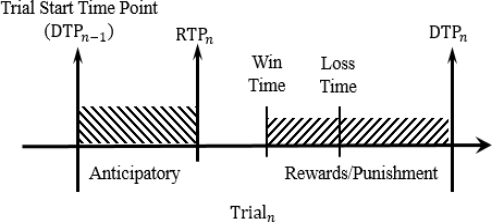
Figure 1: IGT experiment design with fNIRS synchronization time points.
METHOD
Experiment Design Thirty young adults (25 females) in the age range 19 – 26 (M = 21.8, SD = 1.77) were hired voluntarily to participate in the data collection, approved by Southwest University (Chongqing, China) Institutional Review Board. Before the experiment, all participants reported in writing about right- handing, absence of neurological, psychiatric issues history, and problems with vision. IGT score distribution of the whole sample (N = 30) is calculated by equation (Bechara et al., 1994; Bechara and Damasio, 2004) and demon- strates the learning curve of gaming experience transition corresponding to healthy patients (Li et al., 2019; Kora Venu et al., 2020).
Following the IGT paradigm (Bechara et al., 2004), participants recei- ved $2000 virtual money before the experiment and performed 100 card choosing trials while connected to the functional near-infrared spectrome- ter FOIRE-3000/16 (Shimadzu Corp., Japan). The cap with 16 transmitters and 16 receivers connected by 52 channels was worn on the testee’s head, covering target brain regions of interest (ROI) and positioned using Mon- treal Neurological Institute (MNI) standard space. Light beam propagation through human tissue in accordance with Beer-Lumber Law with waveleng- ths 780 nm, 805 nm, 830 nm, and frequency 4 Hz was registered by fNIRS in target ROI in the left brain hemisphere, covered by 28, 35, 36, 42, and 43 channels, and by channels 25, 32, 33, 40, and 41 in the right hemisphere for measurements stability and the result reliability. Raw data were filtered from noise, breathing, moving, or other experiment artifacts using Wavelet-MDL detrending algorithm from the NIRS-SPM software package (Ye et al., 2009).
The records of HbO were synchronized with the IGT timeline (Figure 1). For each n trial, changes of HbO levels were registered in two critical time points, responsible for gaming decision-making: 1) Reaction Time Point (RTPn) at the end of each decision-making period, and 2) Trial Start Time Point matching with Task Duration Time Point (DTPn-1) at the end of each trial. Thus, RTPn and DTPn-1 are timestamps that determine boundaries of the anticipatory interval, during that experiment, participants make their card choice in accordance with the adopted strategy. The HbO signal cor- responding to these points has been processed, divided by features, and used to evaluate gaming behavior prediction by the ML platform.
Features Extraction HbO signal features space was constructed for prediction improvement in decision-making time window points RTP and DTP for the left and the right brain hemispheres (LH and RH) separately, reflecting to signal shape, distri- bution, average error from the actual value, etc.: 1) mean value (LHmean, RHmean); 2) variance (LHvar and RHvar); 3) standard deviation (LHsd and RHsd); 4) kurtosis (LHku and RHku); 5) skewness (LHsk and RHsk).
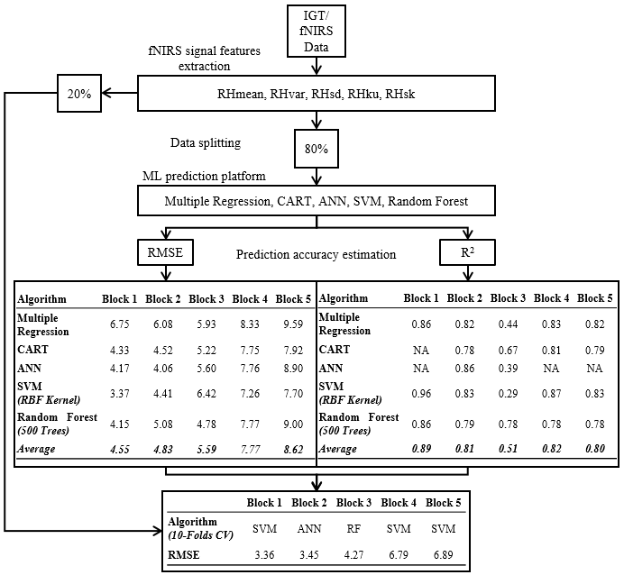
Machine Learning Models ML gaming behavior prediction platform was run in R 4.0.3 (R Core Team, 2018). In the first stage, 80% of normalized HbO signal features were used for training, and 20% were used for testing ML algorithms: Multiple Regres- sion, Classification and Regression Trees (CART), Artificial Neural Network (ANN), Support Vector Machine (SVM), and Random Forest. In the second stage, two metrics were estimated prediction accuracy: coefficient of determi- nation (R Squared) and Root Mean Squared Error (RMSE). Lastly, classifiers with R squared closed to 1 and the lowest RMSE tested gaming behavior prediction power in each IGT block by the signal from the left and right hemispheres. ML-based gaming behavior prediction pipeline separated by the left and right brain hemispheres is presented in Figure 2.
RESULT
Performed research identified several tendencies that illustrate patterns of gaming behavior, predicted by ML-based platform (Figure 2): 1) RMSE incre- ase from IGT block 1 to block 5 in both hemispheres; 2) R Squared decrease from IGT block 1 to block 5 in both hemispheres; 3) in each IGT block, the best model is the model with the lowest RMSE (in units of IGT score) and highest R Squared; 4) RMSE of best fitted model decrease from IGT block 1 to block 5 in both hemispheres; 5) the prediction accuracy of best fitted models more robust than training model in all IGT blocks and both hemispheres.
DISCUSSION AND CONCLUSION The current paper and previous research (Bembich et al., 2010; Suhr and Hammers, 2010; Ono et al., 2015; Balconi et al., 2018; Li et al., 2019; Kora Venu et al., 2020) illustrate the significant difference in gaming behavioral patterns depending on participant psychosomatic condition. Pattern transfer from the uncertainty condition to certainty and risk inside IGT simulation is not smooth, not limited by blocks, and boundaries are not clearly defi- ned. Performed research does not contradict such tendencies, but spreading pattern correlation by fNIRS signal features allows to estimate prediction power more pressingly and prognosis behavior more reliable. The ML-based platform was constructed to evaluate the correlation between brain activa- tion and gaming activity during five conditions and both hemispheres. SVM with RBF showed one of the best accuracies: lowest RMSE 3.37 – 7.84 and highest R Squared 0.29 – 0.96 (Figure 2). The best fitted model was selected
A
B
Figure 2: ML-based gaming behavior prediction pipeline: A – the left hemisphere, B – the right hemisphere.
and applied to the testing data set, showing a pattern that keeps the original learning effect transition, following healthy participants behavioral effect. Experiment participants are adding risk to decision-making, increasing the standard deviation of quantified card selection score and a measure of predi- ction error RMSE. The achieved mechanics illustrates the human behavioral pattern during gaming, predicted by activity in the brain.
REFERENCES
American Psychiatric Association (APA, 2013). Internet Gaming. Retrieved from ht tps://www.psychiatry.org/patients-families/internet-gaming Aram, S., Kornev, D., Han, Y., Ekramnia, M., Sadeghian, R., Sardari, S.E., Dash-
testani, H., Kora Venu, S., and Gandjbakhche, A. (2020). Machine Learning in Cognitive Neuroimaging. J. Liebowitz (eds.). Data Analytics and AI. Data Analytics Applications, CRC Press. Aram, S., Kornev, D., Sadeghian, R., Sardari, S.E., Kora Venu, S., Dashtestani, H., and Gandjbakhche, A. (2021). Machine Learning Approaches and Neuroimaging in Cognitive Functions of the Human Brain: A Review. International Confe- rence on Applied Human Factors and Ergonomics (AHFE 2020), Advances in Neuroergonomics and Cognitive Engineering. Aram, S., Levy, L., Patel, J.B., Anderson, A.A., Zaragoza, R., Dashtestani, H., Cho-
wdhary, F.A., Gandjbakhche, A., and Tracy, J.K. (2019). The Iowa Gambling Task: A Review of the Historical Evolution, Scientific Basis, and Use in Functional Neuroimaging. SAGE Open, 9(3). Balconi, M., Siri, C., Meucci, N., Pezzoli, G., and Angioletti, L. (2018). Personality Traits and Cortical Activity Affect Gambling Behavior in Parkinson’s Disease. Journal of Parkinson’s Disease, 8. Bechara, A. and Damasio, A. (2004). The Somatic Marker Hypothesis: A Neural
Theory of Economic Decision. Games and Economic Behavior, 52. Bechara, A., Damasio, A., Damasio, H., and Anderson, S. (1994). Insensitivity to Future Consequences Following Damage to the Human Prefrontal Cortex. Cognition, 50. Bechara, A. and Damasio, H. (2002). Decision-Making and Addiction (Part I):
Impaired Activation of Somatic States in Substance Dependent Individuals When Pondering Decisions with Negative Future Consequences. Neuropsychologia, 40. Bembich, S., Clarici, A., Vecchiet, C., Baldassi, G., Cont, G., and Demarini, S. (2014).
Differences in Time Course Activation of Dorsolateral Prefrontal Cortex Associ- ated with Low or High Risk Choices in a Gambling Task. Frontiers in Human Neuroscience, 8(464). Bzdok, D., Altman, N., and Krzywinski, M. (2018). Statistics versus Machine Learning. Nature Methods, 15. Kora Venu, S., Sadeghian, R., Sardari, S.E., Dashtestani, H., Gandjbakhche, A., and
Aram, S. (2020). Neural Correlation of Brain Activities and Gaming Using Functi- onal Near-Infrared Spectroscopy and Iowa Gambling Task. In: Ayaz H., Asgher U. (eds) Advances in Neuroergonomics and Cognitive Engineering. AHFE 2020. Advances in Intelligent Systems and Computing, 1201. Springer, Cham. Kumar, S. and Chong, I. (2018). Correlation Analysis to Identify the Effective Data in Machine Learning: Prediction of Depressive Disorder and Emotion State. International Journal of Environmental Research and Public Health, 15(2907). Li, Y., Chen, R., Zhang, S., Turel, O., Bechara, A., Feng, T., Chen, H., and He, Q.
(2019). Hemispheric mPFC Assimetry in Decision-Making under Ambiguity and Risk: An fNIRS Study. Behavioral Brain Research, 359.
Ono, Y., Kikuchi, M., Hirosawa, T., Hino, S., Nagasawa, T., Hashimoto, T., Munesue, T., and Minabe, Y. (2015). Reduced Prefrontal Activation During Per- formance of the Iowa Gambling Task in Patients with Bipolar Disorder. Psychiatry Research: Neuroimaging, 333. Przybylski, A. K, Weinstein, N., and Murayama, K. (2017). Internet Gaming Disor-
der: Investigating The Clinical Relevance of a New Phenomenon. The American Journal of Psychiatry, 174. R Core Team (2018). R: A Language and Environment for Statistical Computing. R Foundation for Statistical Computing, Vienna, Austria. Stevens, M.W.R., Dorstyn, D., Delfabbro, P.H., and King, D.L. (2021). Global Pre-
valence of Gaming Disorder: A Systematic Review and Meta-Analysis. Australian & New Zealand Journal of Psychiatry, 55(6). Suhr, J. and Hammers, D. (2010). Who fails in Iowa Gambling Test (IGT)? Personality, Neuropsychological, and Near-Infrared Spectroscopy Findings in Healthy Young Controls. Archives of Clinical Neuropsychology, 25(4). The World Health Organization (WHO, 2018). Gaming Disorder. Retrieved from
https://www.who.int/features/qa/gaming-disorder/en/ Ye, J.C., Tak, S., Jang, K.E., Jung, J., and Jang, J. (2009). NIRS-SPM: Statistical Parametric Mapping for Near-Infrared Spectroscopy. NeuroImage, 44.
LISTED IN THE AHFE DIGITAL BOOKSTORE CATALOGUE
Explore the complete digital volume
Neuroergonomics and Cognitive Engineering
Read this individual research paper free through the original publisher, or explore the full digital proceedings book.
ISBN 978-1-958651-18-6
Explore this ISBN in the AHFE Bookstore ↗Listed in the July 2026 bookstore catalogue; search by ISBN to confirm current availability · Digital book purchase optional