Yunjuan Liu (2022). Assistive relief tool for special psychological symptom groups during pandemic - pressure clothing design based on virtual contact principles. In: Human Factors for Apparel and Textile Engineering. AHFE Open Access, vol. 32, pp. 224–233. https://doi.org/10.54941/ahfe1001559
During the COV-19 pandemic, some special populations - groups of early childhood and people with autism, among others - faced more profound challenges than the common people. The lack of real physical contact such as embracing greatly affected the effectiveness of development, psychiatric treatment and other processes for these populations. This study aims to develop clothing with appropriate contact pressure based on the contact comfort principle of psychology, provide a type of pressure clothing that can relieve the wearer’s tension by simulating hugging, alleviating the lack of physical contact for early childhood education and special education groups during the pandemic. First, the elementary requirements of clothing design are attained using a questionnaire survey and test method. The analysis revealed that clothing should fulfil the four requirements of pressure comfort, fabric softness, wearing and taking off comfort, and visual beauty. Second, we realized the performance requirements in the fabric and accessories, style design, structure design, and functional design. Finally, the product experience is proposed through a fitting, and the reasonable opinions were fed back to the product design to enhance the functionality of clothing. The research shows that clothing can simulate hugging and can ease the loneliness of the wearer. This study can be used as a good tool to assist during the pandemic for early childhood education and special psychological symptom groups, as well as a broader group of people living alone at home, to play an adjunctive treatment and loneliness relief functions.
During the pandemic, the closed and isolated educational environment posed a significant challenge to the effectiveness of online virtual education, especially for the early childhood population and the particular education population (autism, depression, and some elderly). Unlike adolescents and adults, this group has a greater need for physical contact during the edu- cational process. Contact comfort, a psychological term, is defined by the American Psychological Association as the positive emotional response of infants and young animals when they come into contact with soft materi- als; this theory stems from a series of renowned rhesus monkey experiments
Assistive Relief Tool for Special Psychological Symptom Groups During Pandemic 225
conducted by American psychologist Harry Harlow (1959,1958). Physical contact like hugging and touching, can regulate people’s emotions (Field, 2002; Kuhn et al., 1991). Specifically, hugging can give people a sense of security and support, decrease people’s sense of fear and loneliness (Cady and Jones, 1997; Shulman and Jones, 1996), and has several medical functi- ons such as protecting the heart and lowering blood pressure (Litao et al., 2018). Some scholars use wearable devices to simulate touch and hug, which are primarily used in online socializing and health. Online socializing is a novel human social organizing and survival mode in the twenty-first century. Based on virtual technology, the communication between people is mostly indi- rect communication, which lacks physical contact and relies solely on video phone and voice chat that affect the maintenance of existing human emotions, especially long-distance lovers, left-behind children, and empty-nest elderly groups (Kuss and Griffiths, 2011; Bakeman and Brown, 1980) . Smart clo- thing of this field simulates hugging pressure by regulating the tight sense of clothing applied to the wearer’s body through electronic information techno- logy to make the wearer feel hugged or touched. For instance, a smart pajama system is available for children called Huggy Pajama (Teh et al., 2008), which allows parents to control the pajamas worn by their children via the Internet and adjust the air pressure device and heating device in the pajamas, which simulates the pressure and warmth of being hugged, providing children with the feeling of being hugged. Meanwhile, the printing patterns of unique mate- rials used by the clothing can alter the color based on children’s emotions, enabling parents to understand children’s emotional changes. Similar smart clothes include Sense-Roid (Akahash et al., 2011), HaptiHug (Tsetserukou, 2010), and The Hug (Disalvo et al., 2003). In the health domain, mental and psychological issues, such as depres- sion, autism, infantile autism, and mania, have garnered increasing attention. Indeed, some studies have demonstrated that the clinical effect of combi- ned psychotherapy with adjuvant therapy is better than that of conventional drugs, and intelligent clothing with contact comfort is a new auxiliary tre- atment method (Krauss, 1987; Zissermann, 1992). Taptap (Bonanni et al., 2006) is a wearable tactile system that uses different driving devices to simulate the leading human touch forms—tapping, pressing, fondling, and touching, and can be used to train the human tactile sensing system and emo- tional therapy. Besides, the system can be applied to the pocket scarf, which can be worn on the human body in various ways and can simulate the action of people being hugged and patted around the neck. Based on the investi- gation and analysis of human hugging behaviour and hugging contact stress tests, this study aims to design an item of clothing that simulates human con- tact and hugging to aid in online education for early childhood, people with depression and autism, and other special populations.
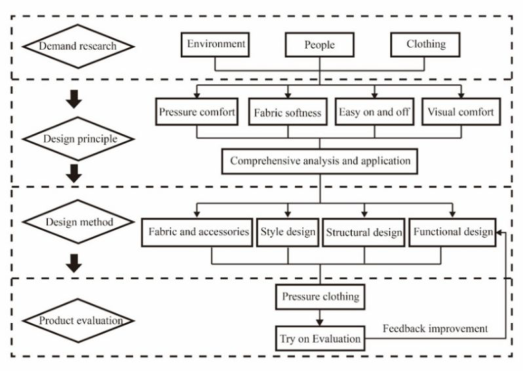
RESEARCH PROCESS First, demand research around two factors: the target audience and cloth- ing. Based on the people’s subjective feeling and the function of clothing, as
226 Liu
Figure 1: Research process.
well as considering the clothing comfort, we deduced that the pressure clo- thing with the function of relieving emotion should have the following four characteristics: providing constant contact pressure; having soft skin touch; being convenient to put on and off, and the color can relieve the emotion. Second, based on the demand analysis, pressure clothing characteristics were realized through the following four aspects: fabric and accessories design; patten and color design; structure and process design; and functional design. Finally, we conducted an evaluation study of the pressure clothing prototy- pes. By trying on two groups of target users, early childhood and depression patients and another group of healthy people, we proposed modifications to the product and fed back to the product design process to improve the design (see Figure 1).
DESIGN METHODS Hugging Behavior Survey
A: Investigation contents and methods In this study, patients with mild depression and healthy people were selected as research respondents. The questionnaire survey was conducted around personal information, hugging posture, hugging time, and hugging feeling. The key factors to realize the simulation of hugging behavior in pressure clothing design were obtained by investigating and analyzing the information related to hugging behavior.
A total of 14 questions were designed, including 2 personal informa- tion questions, 5 hugging behavior questions, and 7 hugging psychological feeling questions. We distributed 206 online questionnaires and paper que- stionnaires, and obtained 206 valid questionnaires, with a 100% response rate. Among them, the effective questionnaire respondents included 52 males and 154 females (age: 18–35 years), of whom 42 were patients with mild
Assistive Relief Tool for Special Psychological Symptom Groups During Pandemic 227
Figure 2: Analysis results of ‘hug posture preference’.Figure 3: Diagram of face-to-face hugging at the waist.
depression. Of note, the random selection of people enabled observing the difference between different ages and genders in the feeling of hugging.
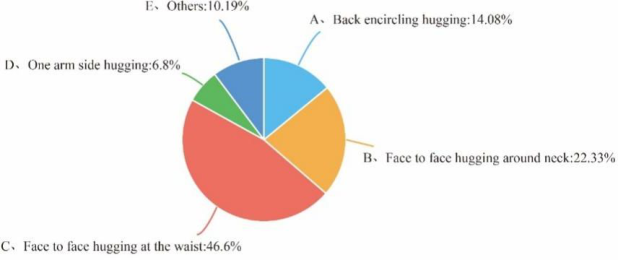
B: Results and Discussion Taking the survey results and analysis of the question of hugging posture as an example, we presented the analysis process of hugging behavior. The question was designed as ‘which cuddle position do you find particularly comfortable and enjoyable?’ The answer had five options. The results revea- led that 46.6% of people thought that face-to-face hugging at the waist was the most comfortable of all (see Figure 2).
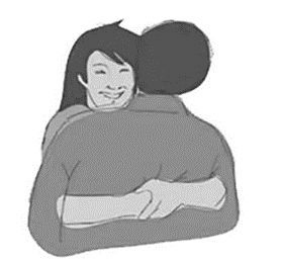
In addition, face-to-face hugging at the waist is called patting hug (see Figure 3), which represents friendship and loyalty. Patting also assists in giving comfort to the other party; however, such embrace does not have any special intimacy and reveals more about friendship. Thus, hugging psycho- logy is a type of silent communication. Hugging increases our empathy for others and helps the social connection. Perhaps, our results can provide refe- rence information for the distribution of airbags in pressure clothing and that the pressure area should be concentrated in the back of the waist and the front chest.
The overall analysis results of the questionnaire survey revealed that people usually lack hugs in their daily life, but everyone uses a tactile impression to attain environmental information and establish social contact with each
228 Liu
Figure 4: Distribution of body contact pressure in the face-to-face hugging at the waist.
other. The most crucial psychological feeling of hugging behavior is warmth, followed by comfort, encouragement, and joy, and few people feel sad after hugging. Hence, hugging can play a vital role in comforting people’s tension, and appropriate hugging posture, pressure, and soft-touch play a critical role in the comforting effect of hugging and touching.
Embrace Contact Stress Test A: Testing instruments and methods We used the AMI airbag contact pressure tester made in Japan. In the face-to-face hugging posture, the body contact position was chosen as the pressure test points, including three areas of the front chest, with a total of 9 test points, and four areas of the back waist, with a total of 12 test points.
In this study, we selected a total of 53 participants (13 males and 40 fema- les). They hugged each other in pairs to avoid the discomfort caused by hugging a person of the opposite sex. First, the airbag was fixed at 21 test points on a participant, and the participants held each other face-to-face at the waist to find comfort state and keep it for >30 s. Then, the pressure of 21 test points was read out by contact pressure testing instrument, and the pressure results of each group were read three times, and the mean value was evaluated.
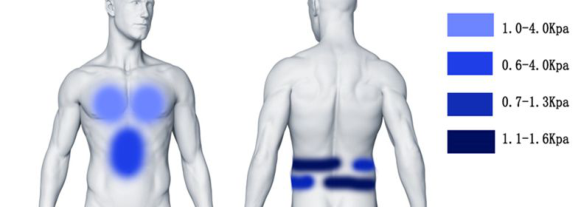
B: Results and analysis The test demonstrated the distribution of body contact pressure in the face- to-face hugging at the waist (see Figure 4).
The experimental results revealed that the pressure exerted on the arm was markedly higher than that on other contact parts. Although the palm often falls on the body of the person being hugged, the arm is the primary force. In the front part of the body, the waist circumference pressure is marginally higher than that of the abdomen and chest, when embracing, the arms around and forcefully increase the contact pressure of the contact area.
Based on the analysis of the test results of hugging contact pressure, the pressure should be >1 kPa in the design of pressure clothing, and the pressure distribution should be adjusted according to body parts.
Assistive Relief Tool for Special Psychological Symptom Groups During Pandemic 229
Figure 5: Schematic diagram of airbag design.
PRESSURE CLOTHING DESIGN Airbag Design
Pressure clothing with the function of relieving tension is a type of functional clothing, which can give the pressure touch of the human body by inflating the airbag inside the clothing. Together with the test results of the pressure distribution of hugging contact in the previous paper, it is acknowledged that the pressure distribution of the hugged person from large to small is as fol- lows: the back waist of the arm contact part, the back waist of the palm contact, the abdomen, and the chest. Overall, the airbag design should fulfill the following three conditions: (i) the airbags should be equipped at the part of the hug contact; (ii) the airbags can regulate the contact pressure generated by different parts; and (iii) the airbags can be adjusted per the wearer’s body characteristics.
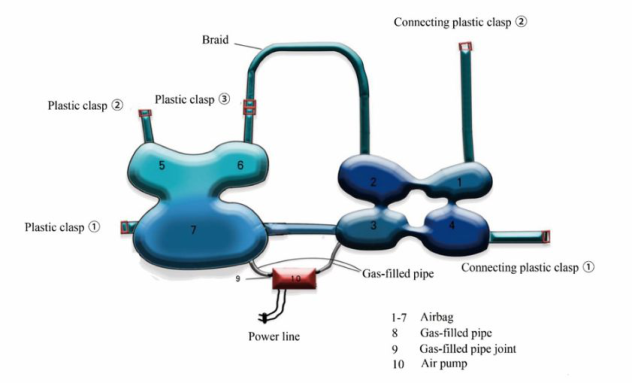
Figure 5 shows the design of the airbag of this clothing. The airbags include the chest and the back, and are connected through webbings. While the front and rear airbags are ventilated separately, the size and thickness of the air- bags are different. The skin contact pressure is regulated by the amount of inflation. To adapt to the requirements of different body types and easy to put on and off, the length of the webbings is adjusted by the buckles, which regulates the front and rear connection to make the airbags fit the human body better. The airbags are made of white nylon double-bonded TPU (Ther- moplastic polyurethanes) film composite fabric, and the double-layer fabric is segmented into different air storage spaces by hot-melt method. Notably, different gas storage spaces are not communicated with each other, and are connected with the micro air pump by using a gas transmission hose.
Style Design
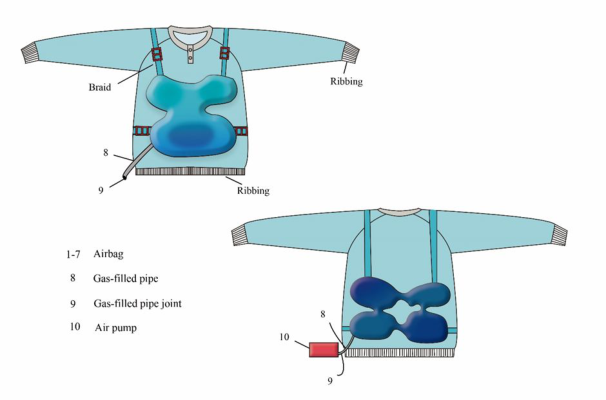
Figure 6 shows the style. The style features of pressure clothing with relieving emotion function can be summarized as follows: loose blue raglan sleeve
230 Liu
Figure 6: Style diagram.Figure 7: Fabric layer distribution diagram.
sweater, half-open front and middle, and rib edge at collar, cuff, and hem. The style design primarily considers that the participants should feel comfortable after wearing the clothes and, meanwhile, it can match the airbag well. Thus, choosing blue, the favorite color for nervous people, can calm down their mood. The style should be loose and casual, giving the wearer a relaxed visual sense of ease, while being easy to put on and take off. Moreover, the collarless design also decreases the sense of bondage. The half-open design primarily considers the integration of the front chest airbags, and the rib edge has good elasticity, which is convenient to put on and take off without the feeling of tight.
Fabric Design The fabric structure is categorized into three layers—outer layer fabric, sandwich adjustable airbags, and lining (see Figure 7). The outer layer is pre- pared of blue elastic knitted fabric, which has good skin touch; its elastic performance can fulfill the requirements of space expansion after the interla- yer is inflated. Blue gives people a sense of peace, tranquility, and aloofness, which calms anxiety. The inner layer is made of blue polyester cotton-blended microfiber flannelette, which has the advantages of soft touch and warm fee- ling. When touching the skin, it can give the wearer a good touch similar to skin contact, which assists in pacifying emotions.
Assistive Relief Tool for Special Psychological Symptom Groups During Pandemic 231
FUNCTIONAL EVALUATION AND TEACHING AID EFFECTIVENESS EVALUATION Functional Evaluation
The functional evaluation was primarily conducted through the question- naire survey on the subjective wearing feeling of the participants. The study participants were the same as those in the previous stress testing experi- ments. The survey contents included the feeling of contact pressure, softness of the fabric, comfort of the style, freedom of putting on and taking off, and presence of the feeling of being hugged.
The feedback is as follows. Regarding clothing acceptance, most people echo that the appearance and color of the clothing are comfortable and beau- tiful, and it is convenient to put on and take off. It is comfortable to touch by hand. Elastic knitted fabric has good skin touch, flannelette has a soft touch and warm feeling; it can feel the pressure exerted by the airbags of clothing, feel hugged, and feel relaxed after wearing. However, the clothing pressure feeling differs from person to person; it takes a long time to adjust the pressure, and the pressure contact area is small.
Adjunctive Treatment Effectiveness Evaluation Early childhood children who were home isolated for online education during the pandemic and special education students with autism were selected for this research. Feedback was obtained through interviews with parents and psychologists in response to the use of pressure clothing as an aid to online education.
The scenario of the use of the pressure clothing is usually accompanied by the psychologists’ assessment of the students, instructional activities, etc. The simulated hugging behaviour is mostly used to encourage and praise the participants. When virtual hugging behaviours occur in virtual interactions between psychologists and participants, the acceptance rate of participants is high and also psychologists are more likely to receive good feedback. In contrast, the acceptance rate of the teaching and learning process was gene- rally low if the interaction process was purely online, and there were more instances of non-response from the participants.
Secondly, through case studies of incidents of virtual hugging contact behaviour occurring during virtual interactions, it can be found that the pro- duction of physical contact behaviour is mostly not pre-determined and has a contextual generative character, and that virtual physical contact behaviour during participants and psychologists interactions helps two sides to establish intimate relationships to a certain extent.
Thirdly, most users like to be hugged virtually and are eager for virtual hugs to happen. In fact, all treatment is based on emotional communication. Timely and affectionate hugs from psychologists deliver messages of inte- raction, making participants feel more secure, eliminating the loneliness of online communication, generating a feeling of being cared for and pampe- red, and helping learners build confidence. At the same time, to a certain extent, it will not only stimulate participants’ desire to communicate emoti- onally, but will also satisfy participants’ need to socialise as a result of being
232 Liu
isolated by the pandemic. In addition, the psychologists give the virtual hug a greater connotation when it is accompanied by an appropriate evaluation of the participants.
SUMMARY AND THE WAY FORWARD The virtual contact pressure clothing is an effective attempt to complement the special online education for isolation during a pandemic. The design and development of pressure clothing that can relieve the wearer’s emotion is based on the contact comfort principle of physiological psychology. The con- tact pressure and contact softness are the two factors that play the role of skin contact comfort. By adding airbags in the garment interlayer and soft touch of fabric, the human body feeling of hugging was simulated in this study, and the design was executed from the aspects of clothing comfort and visual beauty. This garment principally realizes and the wearer feels embra- ced, making the wearer feel comfortable and secure to some extent. Both the functional evaluation and the actual teaching effectiveness evaluation studies have been positively evaluated by users.
The analysis of the feedback results of the fitting experiment deduced that there exist some aspects to be enhanced in this functional clothing design. First, the pressure-increasing speed of airbags inside the garment is slow. Second, the garment can only simulate one touch and hug posture. Third, the clothing lacks the parts that can provide the head and neck support, which decreases the comfort. To solve these problems, the intelligent con- trol module should be added in the subsequent design to materialize the objective of rapid pressure increment and flexible pressure control. Meanw- hile, in the style design, the airbag distribution position should be enhanced, multi-channel pressure should be applied to realize the purpose of simula- ting all types of hugging posture, and the neck support component should be added to make the wearer’s head feel dependent on the shoulder of the other party.
REFERENCES
Akahash N, Okazaki R, Okabe H, et al. (2011) ‘Sense-roid: emotional haptic communication with yourself’, Proceedings of Virtual Reality International Conference, Laval, France. Bakeman, R. and Brown, J. (1980). Early Interaction: Consequences for Social and
Mental Development at Three Years. Child Development, 51(2), pp. 437–447. Bonanni L, Vaycelle C, Lieberman J, et al. (2006) ‘TapTap: a haptic wearable for asynchronous distributed touch therapy’, Proceedings of CHI’06 extended abstracts on Human factors in computing systems, Montréal, Canada. Cady, S. and Jones, G. (1997). Massage Therapy as a Workplace Intervention for
Reduction of Stress. Perceptual and Motor Skills, 84(1), pp. 157–158. Disalvo C,Gemperl F,Forlizzi J,et al. (2003) ‘The hug: an exploration of robotic form for intimate communication’, Proceedings of the 12th IEEE International Work- shop on Robot and Human Interactive Communication, Millbrae, California, USA. Field, T. (2002). Infants’ Need for Touch. Human Development, 45(2), pp. 100–103. Harlow, H. (1958). The nature of love. American Psychologist, 13(12), pp. 673–685.
Assistive Relief Tool for Special Psychological Symptom Groups During Pandemic 233
Harlow, H. and Zimmermann, R. (1959). Affectional Response in the Infant Monkey.
Science, 130(3373), pp. 421–432. Krauss, K. (1987). The Effects of Deep Pressure Touch on Anxiety. The American Journal of Occupational Therapy, 41(6), pp. 366–373. Kuhn, C., Schanberg, S., Field, T., Symanski, R., Zimmerman, E., Scafidi, F. and
Roberts, J. (1991). Tactile-kinesthetic stimulation effects on sympathetic and adrenocortical function in preterm infants. The Journal of Pediatrics, 119(3), pp. 434–440. Kuss, D. and Griffiths, M. (2011). Online Social Networking and Addiction—A Review of the Psychological Literature. International Journal of Environmental Research and Public Health, 8(9), pp. 3528–3552. Litao D, Qiuxia W, Cuiqun S, Xuefeng L. (2018). Application of human touch as a
nursing intervention for neurosurgical patients with agitation after brain injury. Nursing of Integrated Chinese and Western Medicine, 4(4), pp. 32–35. Shulman, K. and Jones, G. (1996). The Effectiveness of Massage Therapy Intervention on Reducing Anxiety in the Workplace. The Journal of Applied Behavioral Science, 32(2), pp. 160–173. Teh JKS, Cheok AD, Peiris RL, et al. (2008) ‘Huggy Pajama: a mobile parent and child
hugging communication system’, Proceedings of the 7th International Conference on Interaction Design and Children, New York. Tsetserukou D. (2010) ‘HaptiHug: A novel haptic display for communication of hug over a distance’, International Conference on Human Haptic Sensing and Touch Enabled Computer Applications, Berlin, Germany. Zissermann, L. (1992). The Effects of Deep Pressure on Self-Stimulating Behavi-
ors in a Child With Autism and Other Disabilities. The American Journal of Occupational Therapy, 46(6), pp. 547–551.
LISTED IN THE AHFE DIGITAL BOOKSTORE CATALOGUE
Explore the complete digital volume
Human Factors for Apparel and Textile Engineering
Read this individual research paper free through the original publisher, or explore the full digital proceedings book.
ISBN 978-1-958651-08-7
Explore this ISBN in the AHFE Bookstore ↗Listed in the July 2026 bookstore catalogue; search by ISBN to confirm current availability · Digital book purchase optional