Jorge Gil Tejeda, Lorena Olmos Pineda (2022). The Emotional Responses Obtained from the Interaction of a Person with a Mass- Distributing Virtual Product Derive from Simple Human Behaviors. In: Human Interaction & Emerging Technologies (IHIET-AI 2022): Artificial Intelligence & Future Applications. AHFE Open Access, vol. 23. https://doi.org/10.54941/ahfe100873
It has been observed the need to understand the effects that are being derived from the mass-distribution virtual products. It is clear that these products affect in various dimensions to the users from the activation of the sensory mechanisms, anatomical responses until various cognitive processes. Through the observation of the interaction processes made by a group of normal vision users in a Website with the assignment of a task was detected: 1. A hierarchy on the process 2) Minimal activation of two sensory mechanisms 3) The type of experience that is obtained from the interaction with the mass-distributed virtual products is basically integrated of kinetic components and cognitive models 4) Virtual products generate aesthetic experiences. Networks were used to display and represent the information. The intention of these studies is to describe the type of emotional responses generated with virtual products and to reflect on how complex responses are obtained from simple human behaviors.
Today there is a very deep interest not only in relation to the factors that integrate the generation of user experience (UX) in relation to the processes of interaction with virtual products of mass distribution., but also in the detection of hierarchical processes and consequences in human behaviors. In previous studies (Gil and Olmos 2020) it was observed that the interaction processes with Virtual Products (VP) generate Emotional Responses (Em-R). In general terms, the interaction processes in relation to Virtual Products (VP) of mass distribution can be conceived as complex, and can be described from cycles that begin with certain human behaviors and culminate in user experiences determined by specific emotional responses. Talking about emotional responses is not easy, there is a great work developed by thinkers and researchers along the time. We have a special interest in reflections made by Kant in 1790, who related aesthetic experiences with knowledge that happen in the mind and are highly complex (Kant, 1996). Plutchik defined to the emotions like a integrative response (Plutchik, 1965)., Frijda exposed in 1988 that emotions are subject of laws (Frijda, 1988)., Picard observed that the interaction of a user with a computer generated emotional responses (Picard, 1999). In our studies we observed that Em-R obey to a hierarchical process which start with a gross motor interaction to continue with finer processes such as a precise localization of the components of the technological device, activation of Focal Attention-subsystem (FA-s) is directed related with the VP which tends to affect the exploratory activity. The result is a range of responses that can be classified like categorical. But this kind of responses are not only detected in the process of interaction with Work System (WS) but also with the Meta-Representations of the new media viewed as virtual products (Pineda and Tejeda 2020). In fact, it is observed that users today delegate a strong emotional charge to the virtual product and not to the WS., Possibly to an evolution in technological devices which has generated better adaptive behaviors and habituation of users in relation to WS. Because of this, the Em-R given by the user in relation with the device that function like WS must be differentiated from the Em-R given by the user in relation with the VP. The variations are observed from the spatio-temporal until the emotional ones. For this reason in the stimuli derived from VP must be considered the objects parameters, language´s typology, physical characteristics, the technological device as a working system and the precision spatial-localization that requires the WS and VP (Tejeda and Pineda 2020).,
Which demands highly visuospatial skills from the users. The aim of these studies is to explore the constructions of Em-R with the interaction of VP and the most important components close to them.
IMPORTANT CONSIDERATIONS WITH NEW MEDIA META-REPRESENTATIONS We have conceptualized virtual products, specifically belonging to a technological devices of industry 4.0, as meta-representations of new media and meta-media, In the concept are considered the perceptual and cognitive characteristics that involves a human meta- representation like a product. These type of Meta-Representations are visible with a great range of configurations constituted by their sensitive elements which are determined by the designers and by technology., Is well known that the sensitive factors will tend to be partially perceived by a user and they will generate experiences in a person, thanks to important researchers like Marliave and Posner (Posner et al., 1971, Marliave, 1973). Each user performs different processes of interaction with the VP versus a technological device, it is because the perception about sensory information of these objects will be determined, in part, by the senses and their activation; and factors determined by the attention processes directly related with the particular characteristics of the user and the virtual object. In addition, in previous works it has been observed that the processes of interaction with the work systems with flat screen technology were executed from a variety of Temporal Micro-processes of interaction (TMP-I) interrelated (Pineda and Tejeda 2021)., generating a complex phenomenon that takes place in cycles of human interaction.
METHODOLOGY
The methodology used was the comparative analysis of data and the use of static networks for the visualization of information. In the construction of the networks, the interaction processes determined by the interrelation of the User-Virtual Product were considered. Likewise, the user's activity was delimited from the assignment of three tasks: 1) Locate the class´ Website, 2) Enter into the virtual product, 3) Explore the virtual product. The technological device that integrated the work system was the user's smartphone so was a clear habituation with the WS by users. The observation of processes were carried out in a learning environment with special interest on the individual interaction cycles carried out by a group of Normal Vision (Nv) users., The individual interaction cycles were observed on the maximum time as well as the minimum time.
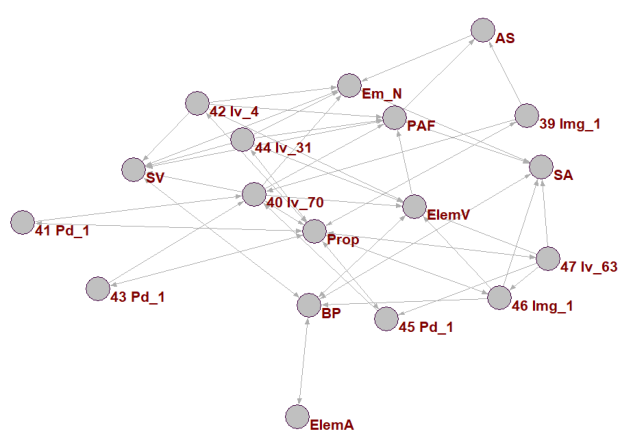
Figure 1 shows an example of the relationship between sensory mechanisms (SM) during the interaction process with the VP and emotional responses in the maximum time of the cycle of interaction. The active SM during the cycle were Propioception (Prop), gross motor Interaction (Img), visual Interaction (Iv) and digital Preassure (Pd). In a first phase hierarchical factors internal to the user were perceived, which included the activation of the interaction subsystems: spatial location of the WS -conformed by the activation of the SM of Prop, Img, Iv-, and the activation of the Focal Attention sub-system (FAP-s). This phase had the purpose of reducing the distance between the user and the device. In this phase, a dependence of FA is shown in relation to the spatial location and this in turn to the movement of the person. In a second phase an interaction process with the WS was generated with the following characteristics: haptic and contact interaction -the activation of the Prop, Iv and Pd were involved-. The second phase occurred after a precise spatial location in relation to the components of the WS. In a third phase the interaction process with the virtual product were carried out -the active SMs were Prop and Iv-. With this mechanisms two processes were carried out: spatial location of virtual objects and the activation of FAP-s. This phase had the purpose of explore and locate objects of interest. Emotional responses showed close to the linguistic system integrated by Visual Elements (ElemV) and Visual Symbols (SV) and these in turn with FAP-s. Also was observed that emotional responses showed far to the physical interaction with the object.
Figure 1. Shows the cycle of interaction on T.Max. in a WebSite with flat screen technology with a normal vision User (U10). Elaboration Olmos P.L & Gil T.J. 2020
In this sense the Em-R behave like small cycles that begin with the activation of the person's motor system, later with the selection of the reality´s fragment with the activation of the FAP-s and culminate in a breaking point (BP). In other words, the processes are not executed continuously but from a large number of TMP-I. The total time required for the user to enter in the virtual product was 8 seconds, on this time user executed a variety of gross motor movements., The average time of interaction with the virtual product was 13.33, the maximum time cycle on this example was close to 70 sec. The Em-R were given in each user, but not related with all the processes and where not given with all kind of objects. In Table 1 it is observed that the most dynamic MS were Prop and Iv related with virtual products. With this a dependency of Em-R is observed on PAF-s. The phenomenon related to attentional processes forms an important part not only in the processes of interaction and interrelation but also in the affectation in Em-R. Table 1 shows variations in relation to the interaction cycles performed by each user through the activation of SM, as well as variation in the average attention time in each user. Additionally, three constants were observed in the group: the first related to the activation of the SM of Prop, Img, Iv., The second was related with the closeness of Em-R to the predominant linguistic system on the Wabesite: SV and ElemV on TMax. The third constant detected was that most of the BP were caused by factors internal to the user.
Table 1: U=User; G=Gender, W=Woman, M=Man, T/Max= Maximum Time. PAF-s= Average attention time on T/Max. Elaboration Olmos P.L & Gil T.J. 2021
Table available in the original PDF paper.
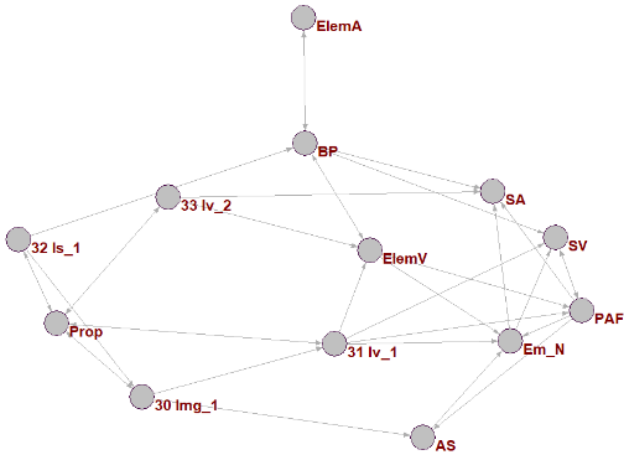
Figure 2 shows the relationship between SM during the process of interaction with the VP and emotional responses in the minimum time of the cycle of interaction. The active SM during the cycle were Prop, Img, Iv and sonor Interaction (Is). In a first phase hierarchical factors internal to the user were perceived, which included the activation of the interaction subsystems: spatial location of the WS -conformed by the activation of the SM of Prop, Img, Iv-, and the activation of FAP-s. This phase shows again a dependence of FA in relation to the spatial location and this in turn to the movement of the person. In a second
Human Interaction & Emerging Technologies (IHIET-AI 2022) Artificial Intelligence & Future Applications https://openaccess.cms-conferences.org/#/publications/book/978-1-7923-8989-4 phase visual exploring process with the VP was realized, only with a visual interaction with the VP - the active SMs were Prop and Iv-. This phase showed no physical interaction with VP. The most dynamic MS was the vision and the FAP-s was close to Em-R. In this sense, a dependence of the reality’s selection is shown in relation to the spatial location and the user´s preference in the content of the meta-representation. Therefore it was observed that in the exploratory stage the characteristics of the linguistic system of the object were relevant, and in figure 2 stand out ElemV and SV that integrate a linguistic system. This process was executed close to 1 sec.
Figure 2. Shows the cycle of interaction on T.Min. in a WebSite with flat screen technology with a normal vision User (U10). Elaboration Olmos P.L & Gil T.J. 2021.
Table 2 shows variations in relation to the interaction cycles performed by each user through the activation of SM, as well as variation in the average attention time in each user. Additionally, the BP were caused by factors internal and external to the user., this last factor related with the activations of two input channels: Is and Iv. Also was observed the constant in activation of SM of: Prop, Img, Iv. And the closeness of Em-R to the predominant linguistic system on the Website: SV and ElemV on TMin. Also, it is important to notify that the linguistic system that integrated this VP allows the user to explore it in a short time but also understand the information., and under this understanding is how Em-R are given.
Table 2: T/Min=Minimum Time. Elaboration Olmos P.L & Gil T.J. 2021
Table available in the original PDF paper.
CONCLUSIONS
These studies show a complexity in the interaction processes that are compounded in small cycles that can be understood as Temporary Micro-processes of Interaction. Within this complexity was observed: 1) The Em-R were given in each user, but were not related with all the processes and were not given with all kind of objects. 2) In both cases the Em-R showed close to a linguistic system. 3) It was observed a dependence of the Em-R in focal attention processes 4) At the Max. Focal Attention times was observed that the process was executed for spatial and visual components. 5) In less Focal attention times was observed more activation in the input channels like: Iv and Is., both correlated with a spatial component. From these observations we could enunciate that the understanding of the linguistic system originates a special experience named as Esthetic which is, based on Kant [2], related with Knowledge. Also all this complexity starts with a simple human behavior: gross motor interaction of a person, that behaves like a kinetic component that starts all the complexity and culminates on special cognitive models.
REFERENCES
Frijda, Nico H. (1988). The laws of Emotion. American Psychologist. 43(5), pp. 349-358. Gil T. J. and Olmos P. L. (2020). Comparative Studies of the Behavior of Sensory Mechanisms in a Weak-visual Person and a Normal-vision Person with an Object of the New Media. In: Ahram and T., Falcão C. (eds.) AHFE. Springer. 1217(121), pp. 914-919 Kant, I. (1996). Critique of Pure Reason (1787 ed. W.S. Pluhar, Trad.) Indianapolis:
Cambridge: Hackett Publishing Company. Marliave, R. (1973). Selective attention and cognitive learning. Theoretical Paper. ERIC No.45. Picard, R. W. (1999). Affective Computing for HCI. In HCI. 1, pp. 829-83.
Pineda L.O. and Tejeda J.G. (2020). Analysis of the Behavior of a User’s Sensory Mechanisms During the Interaction Processes with an Object of the New Media and Its Work System. In: Nunes I. (eds.) AHFE. Springer. 1207(44), pp. 326-331. Pineda, L. O. and Tejeda, J. G. (2021). The Hierarchy in the Temporary Interaction Micro-processes
408. Tejeda, J. G. and Pineda, L. O. (2020b). Analysis of the Work System in an Object of the New Media and the Effects Generated in the Processes of Interaction with a Weak-Visual Person. In: Ahram T. et al. (eds.) IHIET. Springer, 1152 (105). pp. 696-701.
Read this individual research paper free through the original publisher, or explore the full digital proceedings book.
ISBN 978-1-7923-8989-4
Explore this ISBN in the AHFE Bookstore ↗Listed in the July 2026 bookstore catalogue; search by ISBN to confirm current availability · Digital book purchase optional