Jussi Okkonen, Matti Jalava, Heikki Masikka, Jaakko Hakulinen, Markku Turunen (2022). Cognitive Dissonance Affecting Information Ergonomics in AI Supported Situational Awareness Context. In: Human Interaction & Emerging Technologies (IHIET-AI 2022): Artificial Intelligence & Future Applications. AHFE Open Access, vol. 23. https://doi.org/10.54941/ahfe100855
Simple algorithms are a promising avenue to enhance the state of situational awareness in time-critical operation control context. In non-time critical setting the excellent situational awareness in built on complete information with sufficient time to process it is prerequisite. Making sound judgement with limited time the flight controllers suffer poor information ergonomics as demanding situations cause cognitive load as well as incoming information start to cumulate. This paper brings about the experimental setting of flight controllers operating with support of AI in filtering and highlighting information in their mission control system. This paper further develops the way to augment humans for better SA. Paper presents results of design, implementation and expert assessment of the method concentrating on acceptance of AI and trust in technology pertaining to its designated effect on SA. The acceptance is especially critical when considering the role of AI. Above, the role of AI was set as an assistant enhances human information processing capability and augments knowledge related processes. Despite the augmenting role of the AI, human technology interaction perspective should be considered when implementing it. Acceptance and trust are related to several factors such as motivation, user perception of the presence, and expectations on performance and utility. Expectations of human-like behaviour and delivery of process virtues as well as the securing of operations also relate to acceptance. If there is a lack of trust, there will be a high risk of cognitive dissonance and double checking, which leads to vicious cycle of increased cognitive load and poor information ergonomics. The issues of trust and acceptance should also be taken on the agenda and examined through different personality factors. The pilot user study will also provide important data on several knowledge-processing related factors. The increased accuracy of SA along better information ergonomics is the proposition for the test phase. Cognitive The possible conflict between detected experienced and projected is an highly relevant issue to investigate as source for cognitive dissonance, i.e. is it caused by technology or mental factors.
Simple algorithms are a promising avenue to enhance the state of situational aware- ness in time-critical operation control context. In non-time critical setting the excellent situational awareness in built on complete information with sufficient time to process it is prerequisite. Making sound judgement with limited time the flight controllers suffer poor information ergonomics as demanding situations cause cognitive load as well as incoming information start to cumulate. This paper brings about the experimental setting of flight controllers operating with support of AI in filtering and highlighting information in their mission control system. This paper further develops the way to augment humans for better SA. This paper presents results of design, implementation and expert assessment of the method concentrating on acceptance of AI and trust in technology pertaining to its designated effect on SA. The acceptance is especially critical when considering the role of AI. Above, the role of AI was set as an assistant enhances human information processing capability and augments knowledge related processes. Despite the augmenting role of the AI, human technology interaction perspective should be considered when implementing it. Acceptance and trust are related to several factors such as motivation, user perception of the presence, and expectations on performance and utility. Expectations of human- like behaviour and delivery of process virtues as well as the securing of operations also relate to acceptance. If there is a lack of trust, there will be a high risk of cognitive dissonance and double checking, which leads to vicious cycle of increased cognitive load and poor information ergonomics. The issues of trust and acceptance should also be taken on the agenda and examined through different personality factors. The pilot user study will also provide important data on several knowledge-processing related factors. The increased accuracy of SA along better information ergonomics is the proposition for the test phase. Cognitive The possible conflict between detected experienced and projected is a highly relevant issue to investigate as source for cognitive dissonance, i.e. is it caused by technology or mental factors. Decision- making depends on accurate information to enable good situational awareness (SA). Good SA is a state when an individual has all relevant information about what is going on when the full scope of the task is considered. It is about what is happening as well as what is, and is about to be, the status of factors considered, i.e., a perception of the factors within the environment and a comprehension of their meaning and a perception of their status in a near future.
Methodologically, this paper follows the principles of constructive research as positioned in Kasanen et al. (1993). This paper is normative and aims to provide new information which is applicable in practice for implementation or designing information management system for military aviation. Information ergonomics in the context of situational awareness. Taking the definition of information ergonomics discussed in Franssila et al (2015) and Okkonen et al (2021), the load of information processing, the amount of information, and time pressure affect the ergonomic state of an operator. The foundation of sound judgement and decision-making is accurate, sufficient and targeted information about the key factors. SA is highly dependent on
Human Interaction & Emerging Technologies (IHIET-AI 2022) Artificial Intelligence & Future Applications https://openaccess.cms-conferences.org/#/publications/book/978-1-7923-8989-4 available time. The role of AI in supporting SA links the OODA-loop (Observe, Orient, Decide, Act) and SA levels discussed by Endsley (1995) AI supports the Observation and Orientation stages by improving perception and comprehension, i.e., SA levels 1 and 2. The quicker and less cognitively demanding it is to reach the Observe and Orient stages, the more time and cognitive resources are available for projection, i.e., Decide and Act stages. As stated by Endsley (1995), for naturalistic decision-making, it is most relevant to extract relevant information fast and to make quick yet well-justified decisions.).
USING 3D MODELLING AND AI DRIVEN CLUSTERING TO ENHANCE INFORMATION Enhancing information ergonomics is about a more balanced cognitive load and better SA. As discussed in Okkonen et al (2021), this could be achieved by shifting from 2D presentation to 3D presentation and/or representing AI driven information to the operator. A fighter controller (FC) is a military qualification given to a person trained to provide early warning (EW) and command and control (C2) services to military aircraft. As such, the FC is engaged in an operation control task. FC bases his/her control decisions mainly on aircraft position and speed. These are traditionally presented in 2-dimensional visuals. The user interface of the operation control software has been developed such that it supports the FC’s SA and decision-making. However, when the complexity of the displayed air combat situation increases, the 2D visual can become cluttered, causing unbalanced cognitive load and reduced SA – and eventually degraded task performance.
The role of AI in the demonstration is twofold. Firstly, it is utilised to rank simulation entities and their relations. Ranking is done according to the entities' position, heading and altitude. Based on a certain set of rules, all objects are visible, yet the different threat statutes are presented differently. Secondly, AI is utilized to calculate and display relative qualities of the entities. For example, the time it takes for one entity to reach another entity can be calculated and displayed when appropriate. Thirdly, AI enables automated switching of viewpoint, i.e., scenarios could be presented from alternative viewpoints based on AI rules. Table 1 summarises the key features.
Table 1. Expected outcomes of certain features [2] Feature Function Outcome 3D easier perception less cognitive load and better SA Clustering automated analysis less cognitive load and better SA Relation information Different modalities
Table available in the original PDF paper.
automated analysis Attention
less cognitive load and better SA Attention at critical moments Automatically highlighted objects easier perception Attention to relevant items Automated rendering several viewpoints Better understanding on relative positions
2.1 Use scenario
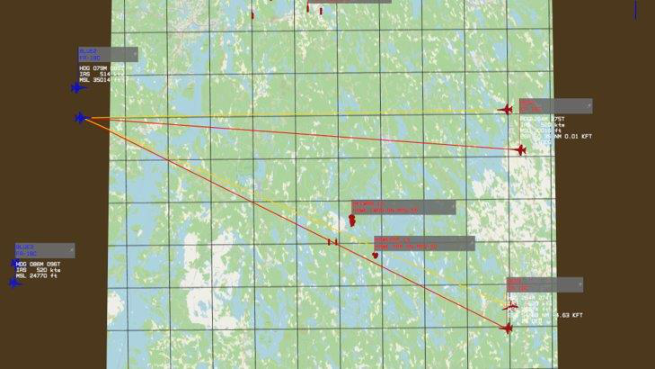
In real life, the FC relies on a recognized radar picture (RAP) to support the friendly, i.e., blue, aircraft. In this study, a RAP was generated using a Modern Air Combat Environment (MACE) simulation and threat environment (see, https://www.bssim.us/mace/). Two alternative apparatus were used to represent RAP to the FC. One apparatus was a 2D visual and the other one was 3D from right above (cf. 2D) and 90 degrees side view. the FC with a 3D view of the RAP. When the 2D visual is used, FC is limited to a viewpoint directly above the blue and red. However, the FC was able to zoom his viewpoint in and out and to move it to any compass point. In 3D FC utilised 3D-moouse hand controller, which the FC could use to change his viewpoint freely and to ‘move’ around the simulated environment. The simulation did not include audio.
Figure 1 illustrates the scenarios and how those looked. The coloured lines present the possible threat level by each red aircraft. The level are determined by aircraft radar, information processing delay and imaginary, generic air-to-air missile. Green is situation when red could acquire yellow stage by changing direction. In yellow stage red has possibility to detect blue. In orange stage red has track potential on blue, i.e. it has been able to detect it for over 5 second. In red stage has track potential and potential to launch air-to-air missile.
Figure 1: 2D view and 3D view Two air combat test scenarios, both with four blue and four enemy, i.e., red, aircraft are programmed into the Modern Air Combat Environment (MACE) -simulation environment. All aircraft are constructive simulation entities and scripted to follow predetermined behaviours. As a result, there is no differences in the scenarios between the different simulation runs. The blue aircraft are programmed to intercept the red aircraft and vice versa. Both scenarios are designed similarly in terms of SA demands and mission complexity. In both scenarios, the blue and red aircraft were initialized 100 nautical miles apart.
Before the pilot testing, the FCs were given a briefing and they were allowed to train with both the 2D and 3D displays and controls until they feel comfortable using them. In the air combat scenarios, FC’s task is to observe the scenarios and to build and maintain SA such that he could provide EW and C2 services to the blue aircraft
Human Interaction & Emerging Technologies (IHIET-AI 2022) Artificial Intelligence & Future Applications https://openaccess.cms-conferences.org/#/publications/book/978-1-7923-8989-4 if needed. The scenarios were seen in the same order the types of apparatus used by the FCs.
RESULTS AND CONCLUSIONS Based on several iteration rounds the initial idea presented in Okkonen et al (2021) that flight controllers could use virtual reality presentation for 3D. Idea was discarded because it was truly unpractical and unconventional. The problems with 3D arise from difficulties to maintain orientation in three-dimensional space, also VR-sickness was found as an issue. Also, it was difficult to decide what was the relevant and most feasible perspective in VR. Therefore, it was replaced by two viewpoint 3D presentation in normal monitor. However, the pilot users pointed out that VR could be applicable if several monitors are needed in limited space in mobile operation command centre.
The key findings related to modalities and use of AI are promising. In 2D the maintaining SA has great cognitive load. The role of presented threat levels eased the load as it was easier to detect the status of each aircraft by glimpse. It was also considered that it is easier to focus on attention on the most relevant aircraft in the scenario. In general, the pilot test subjects stated that 2D provides better control on information, yet with cost of poor information ergonomics.
3D-presentation was considered extremely useful when cross-checking the threat levels, i.e. controlling if AI provides accurate information. 3D was not considered demanding per se, yet it might require long period for training to become as natural as 2D. The pilot test subjects assessed 3D-presentation as a feasible way to have less cognitive load and acquiring and maintaining sufficient situational awareness. However, a risk for missing some information was considered significant with 3D. It was due the fact that there was no cues or alarms on changes in the scenario.
The algorithmic filtering was welcomed as key element to ease cognitive load. The test subjects were in doubt about the presentation of the threat levels even those were thoroughly discussed in the briefing before the test sessions. In general, the participants had confidence on this kind of technology, and they supposed it will be even easily accepted through positive user experiences.
The pilot testing confirmed the propositions about information ergonomics and cognitive dissonance. Based on the findings it is possible to explicate design principles for user interface design and how algorithms could be utilised. The test subject brought about the central role of a human in military context. They emphasised that it is not possible to externalise decision making to technology with somewhat mechanical decision-making principles. The feedback was also about the need for deliver consumable information, i.e. only relevant and critical information should be delivered on the top.
This paper further developed the way to augment humans for better SA. Future quasi-experiment will provide a better understanding of acceptance of AI and trust in technology pertaining to its designated effect on SA. The acceptance is especially
Human Interaction & Emerging Technologies (IHIET-AI 2022) Artificial Intelligence & Future Applications https://openaccess.cms-conferences.org/#/publications/book/978-1-7923-8989-4 critical when considering the role of AI. Above, the role of AI was set as an assistant enhances human information processing capability and augments knowledge related processes. Despite the augmenting role of the AI, human technology interaction perspective should be considered when implementing it (Crowder, Scally & Bonato 2012). Acceptance and trust are related to several factors such as motivation, user perception of the presence, and expectations on performance and utility (Jarrahi 2018). Expectations of human-like behaviour and delivery of process virtues as well as the securing of operations also relate to acceptance (Duan, Edwards, & Dwivedi 2019; Gursoy, Hengxuan Chi, Lu,& Nunkoo, 2019; Mahadevaiah, Bermejo, Jaffray, Dekker & Wee 2020). This is also an important factor when assessing the performance effect as productive utilisation requires acceptance. If there is a lack of trust, there will be a high risk of cognitive dissonance and double checking, which leads to vicious cycle of increased cognitive load and poor information ergonomics. In future experiments, the issues of trust and acceptance should also be taken on the agenda. The first order condition for utilisation is delivering utility with key features or functionalities. The intention of this technology itself is not solely self-sufficient as user’s role in operating environment also has great significance, especially making the critical decisions about engaging, using force or similar.
The forthcoming user study will also provide important data on several knowledge-processing related issues. The increased accuracy of SA along better information ergonomics is the proposition for the experimental phase. Also, the subjective sense of workload while operating in different visual modalities is significant. The effect of cognitive dissonance, i.e. possible conflict between detected experienced and projected is an interesting issue to investigate. There should also be some independent variables acknowledge in order to better understand e.g. how personality affect information ergonomics or cognitive dissonance.
ACKNOWLEDGMENTS
The research for this paper is part of the AHJO-project supported by the Finnish Sci- entific Advisory Board for Defence (MATINE) grant.
REFERENCES
Crowder, J., Scally, L., & Bonato, M. (2012). Applications for intelligent information agents (I2As): Learning agents for autonomous space asset management (LAASAM). In Proceedings of the International Conference on Artificial Intelligence, ICAI’12, Las Vegas, NV Duan, Y.;Edwards, J. S.;& Dwivedi, Y. K. (2019). Artificial intelligence for decision
making in the era of Big Data - evolution, challenges and research agenda. International Journal of Information Management, 63-71 Endsley, M.R. (1995b). Toward a theory of situation awareness in dynamic system".
Human Factors. 37 (1): 32–64. doi:10.1518/001872095779049543. S2CID 8347993.
Franssila, H., Okkonen, J., Savolainen, R. (2015): Developing measures for information ergonomics in knowledge work, Ergonomics, Vol 58 DOI:10.1080/00140139.2015.1073795 Gursoy, D.;Hengxuan Chi, O.;Lu, L.;& Nunkoo, R. (2019). Consumers acceptance
of artificially intelligent (AI) device use in service delivery. International Journal of Infor-mation Management, 157 - 169. Jarrahi, M. H. (2018). Artificial Intelligence and the Future of Work: Human-AI Symbiosis in Organizational Decision Making. Business Horizons, 577-586 Kasanen, E., Lukka, K., & Siitonen, A. (1993). The Constructive Approach in Man-
agement Accounting Research. Journal of Management Accounting Research l Mahadevaiah, G.;Bermejo, I.;RV, P.;Jaffray, D.;Dekker, A.;& Wee, L. (2020). Artificial intelligence- based clinical decision support in modern medical physics: Selection, acceptance, commissioning, and quality assurance. Medical Physics, 228-235. Okkonen, J., Hakulinen, J., Jalava, M., Keskinen, T., Mansikka, H., Turunen, M.
(2021) Design for AI-enhanced operator information ergonomics in time- critical environment in Advances in Neuroergonomics and Cognitive Engineering, Proceedings of the AHFE 2021 Virtual Conferences on Neuroergonomics and Cognitive Engineering, Industrial Cognitive Ergonomics and Engineering Psychology, and Cognitive Compu-ting and Internet of Things in Lecture Notes in Networks and Systems (LNNS, volume 259)
Read this individual research paper free through the original publisher, or explore the full digital proceedings book.
ISBN 978-1-7923-8989-4
Explore this ISBN in the AHFE Bookstore ↗Listed in the July 2026 bookstore catalogue; search by ISBN to confirm current availability · Digital book purchase optional