Martin Laun, Daniel Friemert, Christian Czech, Ulrich Hartmann (2022). The Use of Smart Glasses in the Assembly Industry Can Lead to an Increase in the Local Maximum Values of the Forehead Temperature. In: Intelligent Human Systems Integration (IHSI 2022): Integrating People and Intelligent Systems. AHFE Open Access, vol. 22. https://doi.org/10.54941/ahfe1001022
Smart glasses are an emerging digital technology designed to assist employees at a variety of industrial workplaces (1,2). This study applied facial thermography to examine the change of the forehead temperature after having worked on an assembly task with smart glasses for 30 min.METHODSTwelve adults (29.0±9.0 yrs) took part in this study. All participants had to complete a complex construction task realized by a toy model consisting of 75 parts. Two different smart glasses (Microsoft HoloLens and MagicLeapOne) and a tablet (Lenovo) were used to provide the subjects with visual instructions. The forehead temperature was measured before and after the assembly task using a thermal camera system (FLIR-ThermaCam-SC3000). The local maximum forehead temperature was determined using the ThermaCAM-RP software. A two-way rmANOVA (α= 0.05) with factors time (tpre and tpost) and medium (Tablet, HoloLens, MagicLeap) was carried out. RESULTSWorking with three media resulted in the following changes of forehead temperatures (mean and SD): Tablet: (34.95±0.52)°C to (34.41±0.81)°C, HoloLens: (34.95±0.45)°C to (34.67±0.58)°C and MagicLeap: (35.02±0.50)°C to (35.53±0.48)°C. The two-way rmANOVA revealed a statistically significant interaction between medium and time at temperature (p<0.01). The effect of medium was significant at tpost (p<0.001). The post-hoc tests showed significant differences at time tpost between MagicLeap and HoloLens (p<0.05) and between MagicLeap and tablet (p < 0.05). The effect of timing was significant for MagicLeap between tpre and tpost (p <0.05).CONCLUSIONOur findings revealed that assembling component models using smart glasses might increase the local maximum forehead temperature of the user. The differences between the smart glasses support the view that any type of smart glasses models must be thoroughly tested before using it for assembly tasks. The influence of data glasses on temperature during prolonged work should be clarified with future studies.REFERENCES(1)Glockner, Jannek, Mahn, Mahn, & Theis, 2014(2) Berkemeier, Werning, Zobel, Ickerott, & Thomas, 2017
Intelligent Human Systems Integration (IHSI 2022): Integrating People and Intelligent Systems https://openaccess.cms-conferences.org/#/publications/book/978-1-7923-8988-7
INTRODUCTION
Smart glasses have been tested in industry as part of pilot studies, especially in the areas of assembly and logistics in large companies (Glockner et al., 2014). They have also been used under real conditions at assembly and picking workstations (Borisov, Weyers and Kluge, 2018; Berkemeier et al., 2017, pp.781-794; Friemert, Ellegast and Hartmann, 2016, pp.281-289). Their continuous development enabled a more intuitive operation and led to a better performance (Büttner et al., 2016). Smart glasses allow information to be displayed directly in the user's field of view, resulting in optimized workflows (Friemert, Ellegast and Hartmann, 2016, pp.281-289). The impact of smart glasses on workers can be studied from different perspectives. Many studies have already addressed efficiency, subjective strain, or acceptance (Rauschnabel and Ro, 2016, pp.123-148; Basoglu, Ok and Daim, 2017, pp.50-56; Blattgerste et al., 2017, pp.75-82). Koelle et al. (2017, pp.28712-28732) did not find a measurable change in the predominantly negative attitudes toward smart glasses during a multi-year study. The additional survey of 51 experts showed that increased acceptance of smart glasses is expected by the year 2026. Usefulness, functionality, and usability were identified as the most important factors for long-term acceptance. Existing usability problems need to be solved by using novel interaction methods and visualization techniques, according to this study. Our study addresses the problem of skin warming when smart glasses are used as a new digital work tool. To answer the research question, a laboratory study was conducted in which twelve employees from the assembly industry had to repeatedly complete realistic design tasks using different digital work tools. Temperature measurements were taken before and after each task using a thermal imaging camera. There are few studies that already have addressed the issue of thermal radiation and heating associated with smart glasses (Matsuhashi, Kanamoto and Kurokawa, 2019, pp.96-99; LiKamWa et al., 2014; Repacholi, 1998, pp.1-19). Due to the fact that smart glasses exhibit direct contact with the face and head, the device has a negative impact on human health at high temperatures (Matsuhashi, Kanamoto and Kurokawa, 2019, pp.96-99). The thermal management of smart glasses appears to be essential for the safety and comfort of the users and their physical health (Matsuhashi, Kanamoto and Kurokawa, 2020). For this reason, Matsuhashi, Kanamoto and Kurokawa (2020) proposed a way to optimize thermal counter-control when heat is generated at the head and introduced a thermal network model for smart glasses. Heat measurements on the forehead after working with the smart glasses, however, have not yet been performed at all, especially not with different models of smart glasses. In the future, heat issues will become more serious because smart glasses will require faster central processing units (CPU) and larger memory to deal with enormous amounts of data. Therefore, thermal design is becoming one of the key technologies for future wearable devices.
Intelligent Human Systems Integration (IHSI 2022): Integrating People and Intelligent Systems https://openaccess.cms-conferences.org/#/publications/book/978-1-7923-8988-7
METHODS
PARTICIPANTS Twelve participants voluntarily participated in this study. The ethics review board of the University of Applied Sciences Koblenz approved the study. Prior to the measurements, all participants signed a written informed consent. The age of the participants (10 men, 2 women) ranged from 21 to 55 years with a mean of 29.0 ± 9 years. Their mean height was 182.0 ± 7.9 cm and mean weight was 79.8 ± 12.7 kg. Two participants (16.6%) reported a pre-existing condition and six candidates (50%) reported a visual impairment. None of the participants was dependent on a visual aid during the measurements. Eleven participants (91.6%) were right-handed, one participant (8.3%) was left-handed, and one participant (8.3%) was ambidextrous. All twelve candidates reported German as their native language, of which eight candidates (66.6%) were in education at the time of the study and four candidates (33.3%) were employed. Twelve participants (100%) with an average duration of 1.8 ± 1.1 years reported experience in assembly. None of the participants had previous experience with smart glasses as an assembly aid.
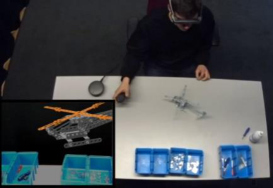
EXPERIMENTAL DESIGN AND TASK DESCRIPTION In this study, two different binocular smart glasses and a tablet as an established reference system were investigated. The two smart glasses (Microsoft HoloLens, 1st generation and the Magic Leap One) were compared with the Lenovo Tab M10 tablet. The design task consisted of assembling miniature models from the Eitech Company from individual parts. The setup corresponded to a model-like replica of a standardized assembly workstation (Fig. 1).
Figure 1. Illustration of the assembly workstation. A participant is performing the helicopter assembly task with the Magic Leap One. The participant's field of view is shown in the lower left corner. The next new component to be added is displayed in orange.
In a well-lit and separated area of the laboratory, a height-adjustable assembly table was set up, equipped with four visual storage boxes and the necessary tools. The
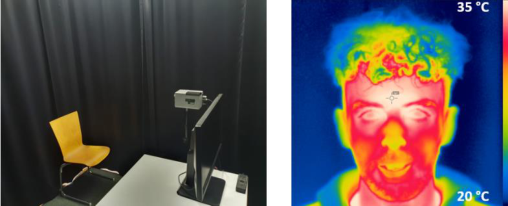
Intelligent Human Systems Integration (IHSI 2022): Integrating People and Intelligent Systems https://openaccess.cms-conferences.org/#/publications/book/978-1-7923-8988-7 boxes were filled with the components for the construction task and sorted by component type. The open fronted storage boxes were located at the front of the table. The test series took place in the laboratory for biomechanics and ergonomics at the Koblenz University of Applied Sciences in Remagen. A thermal camera system (20mK, FLIR – ThermaCAM SC3000, Sweden) was installed in proximity to the assembly workstation (Figure 2).
Figure 2. Illustration of the setup for taking thermal images (left). The thermal camera (FLIR, ThermaCam SC3000) is located at a distance of one meter from a chair. The right image shows an exemplary thermal image of a participant. The scale corresponds to a range of 20°C
(blue) to 35°C (white).
At the beginning of the measurement day, the participants were introduced to their tasks. After having filled out the necessary forms required by data protection law, a socio-demographic questionnaire was completed. A thermal image of the participant's head (Figure 2) was taken before and immediately after each assembly task (30 min.). For this purpose, the candidate took a seat facing forward at a distance of one meter from the thermal imaging camera. When the entire procedure was completed for one instructional system, a 30-minute break was taken. The Latin square scheme was used to randomize the order of the work tools and the miniature models. A schematic drawing represented the current state of the model. Newly added components were projected onto the current state of the model in exploded view and displayed in orange. Speech and gesture recognition algorithms were used to select individual steps. In addition, the models could be rotated, scaled, and positioned in space. DATA ANALYSIS Data analysis was performed using Python (Software Spyder, Version 3.7.5, Python Software Foundation, Delaware, USA). The thermal images (pre and post) were read into Python using the openCV library. Subsequently, the temperature values of the individual pixels of the forehead were written into a matrix and the respective maxi- mum value was determined.
Intelligent Human Systems Integration (IHSI 2022): Integrating People and Intelligent Systems https://openaccess.cms-conferences.org/#/publications/book/978-1-7923-8988-7
STATISTICS Statistical analysis was performed using R (version 1.4.1717, RStudio, Inc., Boston, MA). A two-way repeated measures ANOVA (α= 0.05) with factors time (pre and post) and medium (Tablet, HoloLens, MagicLeap) was carried out. Normal distribution of the residuals was visually audited via Q–Q (quantile-quantile) plots. Boxplots were used to detect outliers and sphericity was analyzed through Mauchly test (α=0.05) with a Greenhouse–Geisser correction, whenever necessary. Statistical significance level was 0.05 and post-hoc pairwise comparisons were done with Student’s t-test. The P-values were adjusted with the Bonferroni multiple test correction method.
RESULTS
Data analysis yielded the following results for temperature change after working with three different instructional systems (Table 1).
Table 1: Results for the temperature values before (pre) and after (post) performing the assembly task with the respective instructional system Tablet, Magic Leap One and Microsoft HoloLens.
Table available in the original PDF paper.
Mean values with standard deviation are reported.
Time Tablet Magic Leap HoloLens Pre (34.95 ± 0.52) °C (35.02 ± 0.50) °C (34.95 ± 0.45) °C Post (34.41 ± 0.81) °C (35.53 ± 0.48) °C (34.67 ± 0.58) °C
The analysis revealed a statistically significant interaction between the instruction system and the time at temperature, F (2, 22) = 7.3, p < 0.01, η²p = 0.14. The effect of the medium was significant at time post, F (2, 22) = 11.5, p < 0.001, but not at time pre F (2, 22) = 0.166, p = 0.848. Using the Magic Leap One for assembly task led to significant higher values for maximum temperature comparing to the Microsoft HoloLens and the tablet (Table 2).
Table 2. Results of post hoc tests of the effect of the instructional system on maximum values of forehead temperature at the time post. P values are reported with mean difference and 95% confidence interval. Bold font highlights significant effects (p < 0.05). The abbreviations Microsoft HoloLens (HL), Magic Leap One (ML) and Tablet (TAB) are used.
Intelligent Human Systems Integration (IHSI 2022): Integrating People and Intelligent Systems https://openaccess.cms-conferences.org/#/publications/book/978-1-7923-8988-7
The effect of timing was significant for the Magic Leap One, F (1, 11) = 9.78, p=0.03, but not for the tablet (p=0.054) and the Microsoft HoloLens (p=0.741) (Figure 3).
Fig. 3. Boxplots of the maximum temperature values for the three experimental conditions: HoloLens, Magic Leap and tablet at time pre and post. Statistically significant differences are indicated with asterisks (* p < 0.05, ** p < 0.01, ***p<0.001).
DISCUSSION
The statistical analysis showed that after an assembly task of 30 min, there were significant differences regarding the maximum forehead temperature between specific smart glasses models and the tablet. It is remarkable that there were no significant differences between the Microsoft HoloLens and the tablet at time post. Furthermore, the analysis showed significant differences for the Magic Leap instructional system between the pre-assembly and post-assembly time points. This reinforces our conclusion that performing complex assembly tasks with smart glasses can lead to local heating of the skin surface, but the results are not generalizable to all smart glasses models. Supporting this hypothesis, the data for the Microsoft HoloLens showed no significant heating at time post. Surprisingly, the forehead temperature values even decreased slightly, but not significantly, on average after working with the HoloLens and the tablet. Studies confirmed, that electromagnetic radiation can locally increase the temperature in tissues and even damage them (Matsuhashi, Kanamoto and Kurokawa, 2019, pp.96-99). Based on our findings, we recommend that prior to the introduction of smart glasses into organizations, the arrangement of heat-producing hardware components should be investigated thoroughly. It became clear that the thermal load of humans working with smart glasses is highly dependent on the particular smart glasses model. When smart glasses are going to be introduced in a company, this aspect should be urgently considered due to the potential impact on long-term safety and health of the employees in the workplace.
Intelligent Human Systems Integration (IHSI 2022): Integrating People and Intelligent Systems https://openaccess.cms-conferences.org/#/publications/book/978-1-7923-8988-7
STUDY LIMITATIONS A few limitations of this study should be considered when interpreting the results. The participants have performed the task in a sitting position. Further investigation is needed to determine whether the same results can be obtained with a setup in which participants engage in additional physical activity. In addition, the effect of the smart glasses was analyzed after only half an hour of work. It is therefore unclear whether the results are transferable to a situation in which people work with the instruction systems for much longer. Also pending is a study on thermal well-being, which could play a role in the acceptance of smart glasses among assembly workers.
CONCLUSION
In this study, the difference of local forehead temperature after construction tasks was investigated with three different instructional media under laboratory conditions. The observed effects presented in this study are strongly dependent on the hardware implementation. This means that the results of further temperature studies with bin- ocular smart glasses need to be thoroughly evaluated, focusing on the model type, and should not be generalized to all kinds of smart glasses. In terms of temperature, differences between the smart glasses and the tablet are evident. This could have implications for long-term occupational safety and health.
ACKNOWLEDGMENTS
This study was financially supported by the German Accident Prevention and Insurance Association for Trade and Distribution of Goods (BGHW). DECLARATION OF COMPETING INTEREST The authors declare that they have no known competing financial interests or personal relationships that could have appeared to influence the work reported in this paper.
REFERENCES
Basoglu, N., Ok, A., & Daim, T. (2017). What will it take to adopt smart glasses: A consumer choice-based review. Technology in Society, 50, pp. 50-56. doi:10.1016/j.techsoc.2017.04.005 Berkemeier, L., Werning, S., Zobel, B., Ickerott, I., & Thomas, O. (October 2017).
The customer as service provider: acceptance and usability of smart glasses in self-service. HMD Praxis der Wirtschaftsinformatik, 54(5), pp. 781-794. doi: https://doi.org/10.1365/s40702-017-0342-1
Intelligent Human Systems Integration (IHSI 2022): Integrating People and Intelligent Systems https://openaccess.cms-conferences.org/#/publications/book/978-1-7923-8988-7
Comparing conventional and augmented reality instructions for manual assembly tasks. In Proceedings of the 10th international conference on pervasive technologies related to assistive environments (pp. 75-82). Borisov, N., Weyers, B., & Kluge, A. (2018). Designing a Human Machine Interface for Quality Assurance in Car Manufacturing: An Attempt to Address the "Functionality versus User Experience Contradiction" in Professional Production Environments. Advances in Human-Computer Interaction, 2018. doi: https://doi.org/10.1155/2018/9502692 Büttner, S., Funk M., Sand O., and Röcker C.. 2016. Using Head-Mounted Displays
and In-Situ Projection for Assistive Systems: A Comparison. In Proceedings of the 9th ACM International Conference on PErvasive Technologies Related to Assistive Environments (PETRA '16). Association for Computing Machinery, New York, NY, USA, Article 44, 1–8. DOI: https://doi.org/10.1145/2910674.2910679 Friemert, D., Ellegast, R., & Hartmann, U. (2016). Data glasses for picking workplaces. International Conference on HCI in Business, Government, and Organizations (pp. 281-289). Toronto: Springer. Glockner, H., Jannek, K., Mahn, Mahn, J., & Theis, B. (2014). Augmented Reality
in Logistics, DHL Research 2014. Retrieved on February 24, 2019, from http://www.delivering-tomorrow.de/wp-content/uploads/2015/08/dhl-report- augmented-reality-2014.pdf Koelle, M., El Ali, A., Cobus, V., Heuten, W., & Boll, S. (2017). All about Acceptability?: Identifying Factors for the Adoption of Data Glasses. Proceedings of the 2017 CHI Conference on Human Factors in Computing Systems (pp. 295-300). Denver: ACM. (pp. 28712-28732). doi: 10.1109/ACCESS.2018.2831081. LiKamWa, R., Wang, Z., Carroll, A., Lin, F. X., & Zhong, L. (2014). Draining our
glass: An energy and heat characterization of Google Glass. In Proceedings of 5th Asia-Pacific Workshop on Systems, APSYS 2014 (Proceedings of 5th Asia-Pacific Workshop on Systems, APSYS 2014). Association for Computing Machinery. https://doi.org/10.1145/2637166.2637230 Matsuhashi, K., Kanamoto, T., & Kurokawa, A. (2019, October). Thermal resistance model and analysis for future smart glasses. In 2019 14th International Microsystems, Packaging, Assembly and Circuits Technology Conference (IMPACT) (pp. 96-99). IEEE. Matsuhashi, K., Kanamoto, T., & Kurokawa, A. (2020). Thermal model and
countermeasures for future smart glasses. Sensors, 20(5), 1446. Rauschnabel, P., & Ro, Y. (2016). Augmented reality smart glasses: An investigation of technology acceptance drivers. International Journal of Technology Marketing, 11(2), pp. 123-148. Repacholi, M. H. (1998). Low- level exposure to radiofrequency electromagnetic
fields: Health effects and research needs. Bioelectromagnetics: Journal of the Bioelectromagnetics Sciety, the Society for Physical Regulation in Biology and Medicine, the European Bio-lectromagnetics Association, 19(1), 1-19.
Intelligent Human Systems Integration (IHSI 2022): Integrating People and Intelligent Systems https://openaccess.cms-conferences.org/#/publications/book/978-1-7923-8988-7
LISTED IN THE AHFE DIGITAL BOOKSTORE CATALOGUE
Explore the complete digital volume
Intelligent Human Systems Integration (IHSI 2022): Integrating People and Intelligent Systems
Read this individual research paper free through the original publisher, or explore the full digital proceedings book.
ISBN 978-1-7923-8988-7
Explore this ISBN in the AHFE Bookstore ↗Listed in the July 2026 bookstore catalogue; search by ISBN to confirm current availability · Digital book purchase optional