Leonhard Rainer Glomann (2019). Natural Human Interaction - The Future of Social Media. In: Advances in The Human Side of Service Engineering. AHFE Open Access, vol. 8. https://doi.org/10.54941/ahfe100295
In the future, major social networks will become personal “Social Dashboards”, being at the core of people’s lives in the global village. Human Relationships will no longer be as physically dependent and we will befriend and hang out with people from all over the world and all walks of life, all ethnicities and all beliefs, creating a worldwide melting pot. All the same, the future is anything but information overload. The future is information customization. There will be no need to search for information. The information will find us. It will be specially tailored to individual interests and needs, saving all a lot of time, effort and energy. There will be no difference between a physical and a digital world. There will be no division between user experience and consumer experience. There will be a human experience. The future of social media is natural human interaction, pure and simple.
The term “internet of things” was coined by the British technology thought leader Kevin Ashton back in 1999 (Ash- ton, 1999). He considered the question of what would happen if not humans but computers were to produce the ma- jority of data. It was in 2006 when the slogan “data is the new oil” started being used, meaning that gathering infor- mation would be the key for future business success (Palmer, 2006). Today, the term “big data” is used to describe the changing importance and fields of application of constantly growing myriads of data – referring to the connec- tions between all types of individual information such as location, buying behavior, social background or motiva- tion. Humans are producing these data with the help of “things” – and today is just the starting point of this develop- ment, as the “internet of things” is not expected to become firmly established before the year 2023 (Gartner Inc., 2013).
By the beginning of the third decade of this millennium, the world around us will be dominated by screens of vari- ous sizes, allowing us to control online communication and information-seeking at any time in any place – this, at least, is how Microsoft envisages the future (Microsoft Corporation, 2010 and 2013). At the same time, screens are recognized by their viewers as electronic devices, displaying digital content – and therefore are nothing “natural”. There are many reasons to believe that the coming years will evolve in a quite different direction than towards a world full of screens. Rather than dealing with a growth in complexity by controlling more and more devices, this Human Side of Service Engineering (2019) article will sketch an alternative path to that of the linear inflation of today’s media consumption and communica- tion. With the help of today’s and tomorrow’s technology, the internet of things, big data and ubiquitous informa- tion, the future way of living and working will in my opinion become what is here referred to as “Natural Human In- teraction” (NHI). The basic message of what NHI is trying to outline is that there will be no sensible difference be - tween digital and non-digital interaction. Taking this thought one step further, there will also be no sensible differ- ence between a human to human and a human to machine interaction. Before describing this thought model in fur- ther detail, it’s necessary to understand communication and the changing ways of interaction from three aspects: The human, commercial and technology aspect.
CHANGING WAYS OF INTERACTION Communication Over Time
“Nothing would work in the absence of communication.” (Hauser, 1997) At the same time, “you cannot not com- municate.” (Clevenger, 1991) Seems like a pretty stable situation – so, what is subject to change?
In 1844 the editor of the highly respected New York Herald, James Gordon Bennett, predicted that the telegraph would "blend into one homogenous mass ... the whole population of the republic ... it could do more to guard against disunion than all the most experienced, most sagacious, and the most patriotic government, could accomplish." (Carroll, 2000) After a period of 36 years, 32 million messages had been sent between 12,000 US American telegraph offices. On average that means a number of 24,353 messages per day in North America.
The first telephone was invented by Elisha Grey and Alexander Graham Bell back in the 1870s. 20 years later, Hein- rich Hertz, Oliver Lodge, and Guglielmo Marconi succeeded in transforming electric signals into electromagnetic waves – which can be seen as the foundation of our today’s digital communication (Ensmenger, 2006).
The speed of adopting new technologies is accelerating with each new innovation: The diffusion of innovation shows the distribution of technology adoption types in a normal curve (Rogers, 2003). While the distribution stays similar over time, the pace accelerates increasingly: To reach a general consumer adoption rate of 50%, it took 70 years for telephones, 28 years for radios, 10 years for the internet (Ingelton et at, 2011) and 6 years for smartphones1 in major markets (eMarketer Inc., 2013).
Looking at a special event between January and March 2011, the Arabic Spring, the number of messages sent rose to 230,000 daily – counting just those sent through one of many communication channels (Twitter) and specifically re- lating to Arabic Spring (#algeria, #egypt, #feb14, #morocco, #sidibouzid, #yemen) (Howard et al, 2011). Bennett’s above mentioned vision of communication which is not enabled by government therefore became true – if not through telegraphy, so through tweets. Why is the amount of daily sent messages rising? Why is the adoption of new media and communication means increasingly accelerating? The answer lies with the people who are doing so.
Social Media Interaction – The Human Aspect In earlier times, the internet was accessed by information seekers who looked up information like news, weather and sports and internet communication took place predominantly via email. It slowly evolved into a medium used for en- tertainment and leisure purposes. With this shift, the digital interaction between people also evolved, moving from communication dominated by mail and instant-messaging towards a multi-connected, social environment. In 2011, webmail usage declined by 31% amongst teenagers and by 34% within the age group of 18-24 year olds (Radwanick and Lipsman, 2012). Today, there is a generation which spends 55 minutes per day on Facebook and more than 15 hours a week actively on the internet with communication. 80% of them base their decision-making on peer recom- mendations, only 14% on advertisements. This generation is called Generation Y2. Unlike previous generations,
1 Taking the launch of the first iPhone in 2007 as the starting point of today’s era of smartphones. 2 People born between 1978 and 1989: “They're young, smart, brash. They may wear flip-flops to the office or listen to iPods at their desk. They want to work, but they don't want work to be their life.” (Armour, 2005) Human Side of Service Engineering (2019)
Generation Y should not be seen as “a uniform group but as an evolving mindset”. Focusing on Generation Y has the advantage of getting an impression of future developments as well. It will be the only generation that grows in population – and that by 7% between 2007 and 2016 (Ingelton et at, 2011). Speaking of population, Stephen Wol- fram offers a “Personal Analytics” tool for Facebook based on the data from his search engine “Wolfram|Alpha”. It generates reports that take the information of millions of Facebook users as a basis to do analysis across a high num- ber of different fields with the newest one being the people’s personal lives as exhibited on their Facebook. If you compare this data with US census data, the result reveals that the majority of Facebook users are members of Gener- ation Y (Wolfram, 2013). Social media have also become the means of choice with regards to their communication (TNS Infratest, 2013).
In 2012, the U. S. population using social networking amounts to 171.8 million (Nielsen Company GmbH, 2012). The main argument for them to join is to connect and keep in touch with people who they already know – family, friends and colleagues. In many cases, the communication is “passive”, e. g. checking status updates or looking at other peoples pictures (Estes et al, 2012. Of the time spent online, social networking and forums have the highest share with 27% across US, UK and Australia (Experian Information Solutions Inc., 2013). During the time spent on social media, users are not acting aimlessly: The power of social media users is not to be underestimated, as internet memes3 are showing. Internet memes, which are usually humor- or art-based, like for example “Where the Hell Is Matt Harding? Dancing around the World”, “LOLcats” or “Gangnam Style”, (Gil, 2014) can spread within hours across the globe (Marshall, 1998). Memes that are spread via the internet can, in contrast to any other media, be ini- tiated by virtually anyone who is connected to the internet and – through social media – very quickly develop a high degree of virality.
Today’s social media interaction is not just a question of the way of communication but also of the devices used to do so. On-hand digital mobile communication has become a self-evident means that shapes an integral part of users’ lives. The determining differences to other devices are the location and frequency of consumption. There’s a term for people, consuming digital content through various and changing channels in their everyday life: The “digital om- nivores” (Radwanick and Lipsman, 2012).
Beyond the well-known state of today’s social media usage there is a trend to be mentioned in this context: The trend towards self-optimization. It started as self-tracking one’s weight, sporting activities, sleep rhythm and nutri- tion. Through wearable technologies, connected user profiles and sharing achievements via social media, the possi- bilities have advanced from tracking to self-optimization. This in turn is likely to grow into what is referred to as Human Augmentation, leading to a “Human 2.0” (Gartner Inc. IT Glossary, 2013). Why would someone be inter- ested in that? The reasons are of clear psychological nature as David DeGrazia explains: “Human beings have al- ways been interested in self-improvement. We diet, exercise, color our hair, and modify work habits to bring about changes in ourselves that we consider improvements. Technologies have long played a role in self-improvement projects; diet pills, weight machines, and hair dye are hardly new. Somewhat newer are certain biomedical means to perceived self-improvement – or enhancement, as it’s often called today.” (DeGrazia, 2005) The human need for betterment and progress is an important factor to help explain the willingness to reveal and share personal information – because only on the basis of available data, benchmarking and improvements are possible.
To sum up, social media plays the key role in today’s communication for Generation Y. Updating oneself about friends’ day-to-day life via Facebook, re-tweeting messages from idols, connecting to companies hiring managers via LinkedIn, sharing most current experiences visually via Instagram or saving and sharing findings via Pinterest – the social media platform is virtually interchangeable. But all of them serve the same need: The human need for catching up, joining in, listening, telling, sharing – or summarized – the need for recognition and attention in a haz- ardously fast-moving and increasingly anonymous world.
Consumer Experience – The Commercial Aspect Around the turn of the millennium, the consumer’s engagement took place on a purely transactional level, buying for the most part in department store chains. Though eCommerce began to emerge in 1995, social networks around 2002-2004, and meaningful mobile engagement only after 2010, today’s B2C4 channels are still separated from each
3 Meme is “an idea, behavior, style, or usage that spreads from person to person within a culture” (Merriam-Webster Inc., 2014) 4 Business-to-Consumer Human Side of Service Engineering (2019) other. On the other side of that, today’s youngsters are growing up with social media and are therefore self-evidently expecting instant, personalized and convenient communication – including all their other communication channels as well. It has always been natural for them to be personally “known” by a company and they would even feel frus- tration when not being able to finish a transaction in a store which they’ve begun online. These “advanced” con- sumers, the so-called “prosumers”, are commercially very interested and post, like, comment, tweet and share infor- mation about brands, products and services. They record themselves while unwrapping newly bought technical equipment and upload videos like this or self-recorded tutorials or reviews to YouTube (Ingelton et at, 2011). They also show a different kind of buying behavior: After browsing products on a mobile app while commuting to work and comparing price information at night on their tablet in the living room, they finally purchase next day on their PC at work. While being in a store, prosumers consult their most popular shopping mate – their mobile – to grant them access for example to competitors. The consequences for retailers are to strategically address the customer across devices, channels and touch points. At the same time, the ubiquitous connectivity offers new opportunities for companies to reach their customers (Radwanick and Lipsman, 2012). Generally speaking, it is obvious that compa- nies are no longer in sole control of the communication. Instead it is essential to recognize the shift to a two-way conversation. The key for success is not to just realize but to take advantage of this shift by engaging with con - sumers (Estes et al, 2012). An opportunity is for example to invite the consumer to participate in the research & de- velopment, design and go-to-market phases or to crowd-source customer support. Some companies incentivize the opinion-leading prosumers as multipliers of marketing messages or as authentic support channels to other customers. This again allows the empowered consumer to shape the image of a brand and – through their power in social media conversation – to even create new products. Consequently, the link and the relationship between company and con- sumer get stronger and more intertwined. Most companies have recognized that, as there are only few that do not have an elaborate CRM5 and customer loyalty strategy in place. Still, this is in its very early stages, as a true Omni- Channel approach towards a holistic and at the same time consistent and individualized consumer experience is a vi- sion for most companies. Information customization in an Omni-Channel communication is essential in order to be ready for the future. Planning and building a holistic customer experience strategy will be the key to win the battle for successful CRM and customer loyalty. Between 2015 and 2020, the currently still detached touch points between a company and a consumer will need to become more and more interlinked - networks, applications, devices, con- tent and channels will need to be converged in order to create one seamless and meaningful experience (Ingelton et at, 2011).
To bring this thought into comprising relation: As it is of little help to split people’s social behavior in physical real- ity from digital social media interaction, it is also not rewarding to differentiate these from the people’s buying be- havior and consumption. Instead of speaking of a user experience, a social media experience, a consumer experi- ence, it’s important to recognize what they refer to: These experiences belong to the same individual and thereby create one experience – the human experience.
Big Data – The Technology Aspect By 2020 there will be 50bn internet enabled devices (Telefonaktiebolaget LM Ericsson, 2011). Because these ubiq- uitous devices are all connected with each other they will make the internet of things become meaningful reality. Whereas in the first decade of this century, only phones came to be smart, now is lamps, scales, fridges, homes, cars, gyms, schools, etc. Through sensors of various kinds, these “things” will produce myriads of data – in addition to all the tracked data produced by people living their day-to-day lives. Google’s executive chairman Eric Schmidt brings this amount in relation: “From the dawn of civilization until 2003, humankind generated five exabytes 6 of data. Now we produce five exabytes every two days… and the pace is accelerating.” (Marr, 2013). The shrinking costs in data storage and increasing computational performance will not limit the trend to gather, save and consolidate more and more data. Instead of that, the challenge will be to deduct meaningful and instructive information from this huge mountain of data.
So what might be done with this vast amount of data? Here are some examples of what is already being done today with big data: Politicians, such as Barack Obama, build their whole election campaign on a combination of demo- graphic, social media and other data and can hereby anticipate not only which states and cities but which neighbor- hoods, streets and families can be persuaded by which kind of contact and content (Rutledge, 2013). Another exam- ple is the prediction of unexpected and therefore dangerous or surprising traffic situations on the basis of mobile phone GPS data, weather reports, calendar information and major events, such as a football match (Horvitz et al, 5 Customer-Relationship-Marketing 6 One exabyte is equal to one billion gigabytes Human Side of Service Engineering (2019)
2012). Furthermore, day-to-day mobile apps, such as the “personal assistant” Google Now offers its users informa- tion based on their current location in connection with their personal internet surfing history, calendar data and other information (Sokolov, 2012). These examples only show a fraction of what awaits us in the future when combining even more intertwined and complex data sources to make even more astonishing calculations and predictions. For good or bad, this will touch virtually every aspect of our lives.
Big Data, Pervasive and Ubiquitous Computing will mark the “third paradigm” of computing after mainframes and the PC era (Weiser, 1996). It has just gone off the starting blocks and will result in extensive consequences for the world’s society, above all in the fields of perceived and actual privacy and security: The question is where the free- dom to collect data ends. Interestingly, the attitudes to privacy on the one hand and readiness to publish data on the other differ amongst members of Generation Y: 26% have uninstalled an app by the simple reason that it collects and shares personal information and 51% have even ignored certain apps because of privacy concerns. 46% disable location tracking in apps or their mobile for the same reason (Madden et al, 2013). Next to the privacy aspect, big data security questions will also need to be approached: Who is responsible for security flaws? Who is responsible if a technical system malfunctions? Aspects associated with the mentioned ones are also to be considered, such as con- flicts between the freedom of speech and other fundamental rights and the increasingly blurred border between intel- lectual property and public information. All this might be seen as slowing down the developments and adoption of new technologies but are necessary considerations and nevertheless will not stop progress.
Today, there is more information available through the little device in everybody’s pockets than in any encapsulated computer system – no matter whether one is at home or takes a walk in the woods. Computers often times create frustration while a walk in nature is relaxing. Technologies that don’t force people to enter an artificial environment but which adapt to the human way of living don’t create the feeling of frustration that today’s computers do. These technologies will feel natural and will preserve us from information overload (Weiser, 1991). They won’t be seen as computer systems but as natural enhancement of human capabilities.
Summary Communication changed over time, resulting in instant and ubiquitous information, shared globally through diverse channels. The actual interaction in social media is a way for humans to address their needs for betterment and progress, for recognition and attention. Individuals have a new spectrum of impact towards brands and markets and companies need to address this commercial power by human-centered strategies. Information and services need to be customized fully to individual human needs allowing natural interaction between the parties.
But what does natural interaction mean? What is the common thread for interaction in general? In the world as de- scribed above, who or what is a meaningful interaction partner?
The next section describes a theoretical framework to put interaction, which is felt as being “natural”, and its associ- ated parties into relation to each other.
NATURAL HUMAN INTERACTION (NHI) “Hundreds of computers in a room could seem intimidating at first, just as hundreds of volts coursing through wires in the walls did at one time. But like the wires in the walls, these hundreds of computers will come to be invisible to common awareness. People will simply use them unconsciously to accomplish everyday tasks.” (Weiser, 1991) The internet will instantaneously be fed into the flow of our experiences – without the need to make a conscious request (Rosenfelder, 2013).
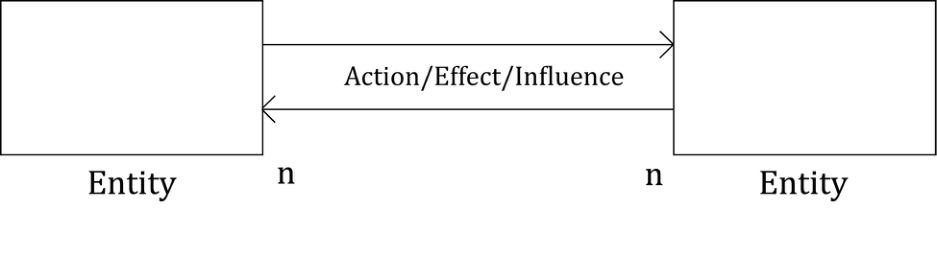
The Natural Human Interaction (NHI) model aims to provide an abstracted and simplified framework to explain the merging perception and meaning of three kinds of interaction: Human to human, human to machine and machine to machine.
Definition Natural Human Interaction (NHI) is defined as:
A mutual or reciprocal action, effect or influence between multiple entities according to their expectations. Human Side of Service Engineering (2019)
The definition is explained as follows, starting with the description of the intended meaning of its components: “Mu- tual or reciprocal” refers to a direction and reception by each toward the other or to a characteristic which is pos- sessed in common. Consequently, the channel in which the interaction takes place needs to fulfill the criteria of a two-way conversation. “Action” is the state or process of doing something and is triggered by at least one entity and directed towards at least another entity. “Effect” is something that is brought about by a cause and is targeted by at least one entity towards another entity. “Influence” is the power to produce an outcome or to achieve a result and is owned by at least one entity, directed towards another entity. “Multiple” means the involvement of more than one part or individual. The smallest number of entities involved in the interaction is two. No matter whether the action, effect or influence is meaningful to the receiving entity, it needs to be directed towards at least one. “Entities” refers to something that exists as a particular, distinct or self-contained unit and is able to communicate with another, in this definition referring to humans and machines. “According to their expectations” refers to the state or act of ex- pecting. ‘Their’ refers to the entities involved in the interaction and includes the specific context, needs and tasks of the entities.
The name of the model itself consists of three parts, which are explained in the following:
Natural: Referring to the expectations of the entities: In accordance with the nature of things. ‘Natural’ refers to what is seen as normal or to be expected, ordinary and logical, in accordance with human nature. Referring to a dialogue principle of human-computer interaction, ‘conformity with user expectations’, this can be described as “predictable […] concerns, emerging from the application context and in accordance with generally accepted conventions” (International Organization for Standardization, 2008).
Human: Referring to the entities. The ‘Human’ aspect of the definition is not to be understood as a refer- ence to Homo sapiens directly. Instead, in this definition, the term ‘Human’ refers to a measuring factor of an entity to fit into the described kind of interaction: It refers to entities acting in accordance with or not distinguishable from human behavior. Having and showing those aspects of nature and character is re- garded as the distinguishing feature between humans and animals.
Interaction: Referring to the mutual or reciprocal action, effect or influence. Triggered, targeted or owned by at least one entity and directed to at least one other entity.
Figure 1. The NHI model
Applicability & Scope The applicability of the model is extremely broad and relates to any kind of human to human, human to machine (HCI7) or machine to machine (M2M8) interaction, allowing blended communication in a true Omni-Channel set- ting. The channel itself is not mentioned in the model as it is interchangeable: The expectations of the entities decide the best channel to use.
Human to Human The human to human interaction is already natural by definition. There are various models that explain communica- tion in a generic way, e. g. the Shannon-Weaver-Model of communication, which speaks of a source of information
7 Human-Computer Interaction 8 Machine-to-Machine interaction Human Side of Service Engineering (2019) that transports a message via a transmitter through a certain channel (which may alter the message and may get dis- turbed) to a receiver that transports the message to its destination (Hollnagel and Woods, 2005). This amongst many other communication models is usually used to define communication between senders and receivers in an ab- stracted way. Practically speaking, an interaction between two humans involves various sociologic and emotional aspects that are usually not covered by models like the mentioned ones. Another one, the four-ears-model (Schulz v. Thun, 2014), identifies four dimensions of a message: Factual information, relationship indicator, self-statement and appeal. Factual information refers to what the sender informs about. It can be verified by three aspects: Truth, rele- vance and sufficiency. The relationship indicator refers to what the sender thinks of the receiver and how she relates to her. Aspects that influence the relationship are phrasing, intonation, facial expression, gestures and body posture. Self-statement is what the sender shows of herself by sending the message. The receiver therefore experiences the sender in a certain way: What is she like? What mood is she in? What is she thinking? And the appeal reveals what the sender wants to do. It is about desires, suggestions and instructions. The factors which influence each of the four layers are hard to measure and are – by definition – of subjective nature for both the sender and receiver.
All this is not new – as it is ‘natural’. In the NHI model, this kind of communication is set as expectation baseline to- wards a human to machine interaction that is perceived as being ‘natural’.
Human to Machine The human to machine and machine to human interactions are objects of research in the HCI field. HCI is defined as “a discipline concerned with the design, evaluation, and implementation of interactive computing systems for human use and with the study of the major phenomenon [sic] surrounding them” (Hewett et al, 1996). The discipline is linked to information technology, psychology, design, ergonomics, cognitive science and labor studies – amongst others. Aspects that research focuses on are computers, humans, interaction between human and computer, special usage and special user groups.
To fit human to machine interaction into the NHI model, it is necessary to apply the same “quality standards” as for a human to human interaction. These quality standards follow the above mentioned four-ears-model with its aspects being subjective – as in a human to human interaction. In basic terms: As soon as a human to machine interaction feels ‘natural’, it is an interaction according to the definition of NHI.
Machine to Machine The emphasis is laid on the similarity of human to human and human to machine interaction. The similarities with M2M interactions are briefly touched in the following as the above definition speaks of entities, regardless of whether they represent humans or machines. The reason for that definition is that the point in time is near when the behavior displayed by a machine is equal to or indiscernible from human behavior. One way to measure that ability of a machine is the Turing test. It tests whether a human judge, who witnesses a conversation between a human and a machine, cannot reliably recognize differences from a human to human conversation (Turing, 1950). The futurist Ray Kurzweil predicted that machines, which pass the Turing test, will be produced by the year 2029 (Kurzweil, 2005). According to his prediction, machines will be in a position to optimize themselves by the year 2050. After that, general progress will no longer depend on humans and their ability to deal with rising complexity (Reißmann, 2013). Asked or not, machines will provide us with ideas and associations – which basically is the good old job of the brain (Rosenfelder, 2013). In this scenario, machines that are reasoning and acting in a similar way as humans do, will also have similar expectations towards interaction.
Summary To sum up, there will be no difference in quality standards between the interaction of a human to a human, a human to a machine or a machine to a machine. The interaction needs to follow the expectations of the interaction partners (entities).
NHI in Practice An interaction following the NHI model does not include anything in addition to the elements as described in the model. Any supplement which is perceived as artificial or as detouring from the actual interaction would result in a non-natural interaction. Only that kind of interaction which is in line with the expectations of the entities, which show human aspects of nature and character, is defined as NHI.
For example NFC9, which is supposed to offer the most simple wireless payment service, is as, Jack Dorsey ex- plains, just “another thing you have to do. It’s another action you have to take. And it’s not the most human action to wave a device around another device and wait for a beep. It just doesn’t feel right.” (Dorsey, 2012) Another example: A smartphone has a user interface (UI) that is needed to allow the activity of speaking to some- one. What the smartphone user wants to do is to speak to someone else who is physically not present but instead of just speaking, she first has to 1) take her smartphone from her pocket, 2) unlock it, 3) access the ‘phone’ functional- ity, 4) look for the person she wants to call, 5) select this person and to 6) wait for the connection to be provided. An approach for simplifying this, is through a “Natural User Interface” (NUI), which “relies on a user being able to carry out relatively natural motions, movements or gestures that they quickly discover control the computer applica- tion or manipulate the digital content.” (NUI Group, 2014) As this explicitly speaks of a computer appli- cation, which is recognized as such, the “No UI” approach takes this thought even further: “The real problem with the interface is that it is an interface. Interfaces get in the way.” (Laurel, 1990) Instead, the user wants to focus on the job and does not want to think how to use a machine. In this example, the smartphone it - self is the user interface which is also recognized as such. Even if the graphical user interface would work in the most simplistic way, the device itself is still very present and forces the human to artificial steps needed to do the job. A NHI in this context would not allow a device like a smartphone. Instead, it would use non-invasive or in other words imperceptible technology and would thus allow to satisfy the need in the simplest way: The human – as basic as it sounds – would start talking. The quality standard for this NHI is that it feels to be as natural as a conversation from fact-to-face, including all necessary sensory impressions.
Designing a NHI requires to simplify to the maximum. It is not sufficient to know how things are currently being done and to find a better way of doing the same. But it is also not the idea to reduce the complexity of an existing user interface to a less complex one. Instead of that, various design methods do exist when it comes to designing a ubiquitous information system. Janzen, Kowatsch and Maaß analyzed various methods and created a new “Methodology for Content-Centered Design of Ambient Environments” (Janzen et at, 2010). Al- though this methodology describes various interesting approaches, the necessary activities to design a NHI follow something which is defined as ISO standard: Human Centered Design (HCD) (International Organization for Stan- dardization, 2010). Designing a NHI requires the following human-centered activities: Firstly, analyzing the context in which the current interaction takes place. The outcome of this activity is the identifi- cation of true human needs – beyond the consciously expressed wishes and ideas from one of the interaction part- ners. Secondly, specifying the human requirements for natural interaction. This means to take the needs and to de- rive certain requirements from them. The derivation is one of the most crucial activities in the design of NHI as in this step the solution is already being shaped. Thirdly, creating the design solution based on requirements. This re- sults in a prototypic realization of the interaction by describing or visualizing the interaction steps in detail. The fourth activity is the evaluation of the created design solution. The prototype is tested with the interaction partners. Depending on the results, the previous activities are iterated until the evaluation proves the interaction to be seam- less, meaningful and natural.
The following example explains the above in practice: Textual communication between two interaction partners in transit resulted in the use of a mobile phone firstly by sending SMS10 text messages with a numeric keypad, then in a Blackberry mobile with QWERTY11 keypad and later in smartphones with the SwiftKey12 system. The evolving so- lutions are trying to make the interaction less painful and reduce the complexity of the user interface. In the NHI model, the task would be to analyze, why the interaction partners communicate textually while underway. Is it the need for communicating to someone and the textual aspect is only a workaround? Or is it the need for asynchronous, more sophisticated or less emotional communication? Having analyzed that, the derived requirements will be very different than if the task would be “to improve the keyboard”. It might result in completely new approaches to com- munication which will be evaluated by the help of prototypes to find out whether the solution really fits the needs. Iterating and thus optimizing the solution might result in something really disruptive. As following the design ap- 9 Near-Field-Communication: A wireless communication technology used in close proximity between two mobile devices to ex- change data, e. g. for payment transactions. 10 SMS: Short Message Service 11 QWERTY: A keyboard, with keys for each letter of the alphabet. The abbreviation refers to the order of letter keys on the key- board, in this case the US American layout. 12 SwiftKey: Allows the user to write phrases without lifting the finger from the touchscreen and uses a prediction engine to pre- dict the next word. Human Side of Service Engineering (2019) proach of NHI is not about getting at the core of a problem but at the core of a human need, this is the basis for truly game changing innovation.
CONCLUSION
It is time to take a step back from inventing constantly improved solutions. Instead, the focus on the true human mo- tivation drivers and needs, such as self-betterment, recognition and attention, helps us to understand the potential for innovation. In order to understand them, it is essential to know about the various aspects of communication. Further- more technological developments in the fields of mobile devices, social media, big data, sensors and location-based services will converge into something changing the way we live today (Israel, 2013). This also gives us an idea how similar a human to machine interaction will need to be, compared to a human to human interaction. The digitization of everything is a step change even greater than the invention and adoption of the internet, primarily because of its scale and pace of change (Ingelton et at, 2011). The Natural Human Interaction model describes a digital world merged seamlessly with the rest of the world: There is no perceptible split between digital and non-digital experi- ences.
REFERENCES
Armour, S. (2005): “Generation Y: They’ve arrived at work with a new attitude”, in: USA Today, Website: http://www.riverregionchamber.net/AboutChamber/Media/GenerationY.pdf, accessed 7 September 2013 Ashton, K. (1999): “That ‘Internet of Things’ thing.”, RFID Journal Website: http://www.rfidjournal.com/articles/view?4986,
accessed 26 August 2013 Carroll, M. T. (2000): “Popular Modernity in America: Experience, Technology, Mythohistory”, p. 12, SUNY Press Clevenger, T. (1991): “Can One Not Communicate? A Conflict of Models”, in: Communication Studies 42. p. 351 DeGrazia, D. (2005): “Enhancement Technologies and Human Identity”, in: Journal of Medicine and Philosophy, 30:261–283, Routledge Taylor & Francis Group Dorsey, J. (2012): “Jack Dorsey Explains Square's Pay-by-Voice Technology”, YouTube Website: http://www.youtube.com/
watch?v=2zoeiNBdPdo#!, accessed 26 August 2013 eMarketer Inc. (2013): “Smartphone Adoption Tips Past 50% in Major Markets Worldwide”, eMarketer Website: http://www.emarketer.com/Article/Smartphone-Adoption-Tips-Past-50-Major-Markets-Worldwide/1009923, accessed 7 September 2013 Ensmenger, N. (2006): “History of Communications.”, The Franklin Institute Website: http://www.fi.edu/learn/case-files/com-
munication.html, accessed 26 August 2013 Estes, J., Schade, A., Nielsen, J. (2009), “Social Media User Experience”, Nielsen Norman Group, Fremont, CA Experian Information Solutions Inc. (2013): “Experian Marketing Services Reveals 27 Percent of Time Spent Online is on Social Networking “, Experian Website: http://press.experian.com/United-States/Press-Release/experian-marketing-services-re- veals-27-percent-of-time-spent-online-is-on-social-networking.aspx, accessed 26 August 2013 Gartner Inc. (2013): “Gartner's 2013 Hype Cycle for Emerging Technologies Identifies Maps Out Evolving Relationship Between
Humans and Machines”, Gartner Website: http://www.gartner.com/newsroom/id/2575515, accessed 8 September 2013 Gartner Inc. IT Glossary (2013): “Human Augmentation”, Gartner Website: http://www.gartner.com/it-glossary/human-augmentation, accessed 12 September 2013 Gil, P. (2014): “The Best Memes of the Last 15 Years”, About.com Website: http://netforbeginners.about.com/od/weirdwebcul-
ture/tp/The-Best-Internet-Memes.htm, accessed February 26, 2014 Hauser, M. D. (1997): “The Evolution of Communication”, p. 1 MIT Press Hewett, T., Baecker, R., Card, S., Carey, T., Gasen, J., Mantei, M., Perlman, G., Strong, G., & Verplank, W. (1996): “ACM SIGCHI Curricula for Human-Computer Interaction”, SIGCHI Website: http://sigchi.org/cdg/cdg2.html#2_1, accessed 6 September 2013 Hollnagel, E., Woods, D. (2005): “Joint Cognitive Systems: Foundations of Cognitive Systems Engineering”, p. 12, CRC Press Horvitz, E., Apacible, J., Sarin, R., Liao, L. (2012): “Prediction, Expectation, and Surprise: Methods, Designs, and Study of a
Deployed Traffic Forecasting Service”, Cornell University Library Howard, P. N., Duffy, A., Freelon, D., Hussain, M., Mari, W., Mazaid, M. (2011): “Opening Closed Regimes”, pITPI Ingelton, R., Ozler, Y., Thomas, P. (2011): “The digitization of everything”, Ernst & Young Human Side of Service Engineering (2019)
International Organization for Standardization (2008): “Ergonomics of human-system interaction - Part 110: Dialogue principles (ISO 9241-110:2008)” International Organization for Standardization (2010): “Ergonomics of human-system interaction - Part 210: Human-centred de-
sign for interactive systems (ISO 9241-210:2010)” Israel, S. (2013): “Age of Context Draft Introduction”, Forbes Website: http://www.forbes.com/sites/shelisrael/2013/02/24/ageof-context-draft-introduction-2/, accessed 26 August 2013 Janzen, S., Kowatsch, T. & Maaß, W. (2010): “A Methodology for Content-Centered Design of Ambient Environments”, in:
DESRIST 2010: Global Perspectives on Design Science Research, St. Gallen, Switzerland Kurzweil, Ray (2005): “The Singularity is Near”, Penguin Books Laurel, B. (1990): “The Art of Human-Computer Interface Design”, p. 210, Addison-Wesley Pub. Co. Madden, M., Lenhart, A., Cortesi, S., Gasser, U. (2013): “Teens and Mobile Apps Privacy”, Berkman Center for Internet & Society at Harvard University, Pew Research Center Marr, B. (2013): “What The Hell is… Big Data?”, Website: http://www.linkedin.com/today/post/article/20130527063838-
64875646-what-the-hell-is-big-data?trk=mp-author-card, accessed 25 August 2013 Marshall, G. (1998): “The Internet and Memetics”, School of Computing Science Website: http://pespmc1.vub.ac.be/conf/ memepap/Marshall.html, accessed 4 September, 2013 Merriam-Webster Inc. (2014): “Meme”, Merriam-Webster Website: http://www.merriam-webster.com/dictionary/meme, ac-
v=55p3vNCF4JQ, accessed 26 August 2013 Microsoft Corporation (2013): „Microsoft's New Envisioning Center: Live, Work, Play“, YouTube Website: http://www.youtube.com/watch?v=ho00x7ZvDLw&feature=youtube_gdata_player, accessed 26 August 2013 Nielsen Company GmbH (2012): “The Social Media Report 2012”, Nielsen Website: http://www.nielsen.com/us/en/reports/
2012/state-of-the-media-the-social-media-report-2012.html, accessed 1 September 2013 NUI Group (2014) Website: http://nuigroup.com/go/lite/about/, accessed 26 February 2014 Palmer, M. (2006): “Data is the New Oil”, Website: http://ana.blogs.com/maestros/2006/11/data_is_the_new.html, accessed 7 September 2013 Radwanick, S., Lipsman, A. (2012), “U.S. Digital Future in Focus 2012”, ComScore Reißmann, Ole (2013): “‘Present Shock‘: Vom Leben in der Echtzeit-Falle“, Spiegel Online Website: http://www.spiegel.de/netzwelt/web/buch-von-douglas-rushkoff-present-shock-a-892095.html, accessed 23 April 2013 Rogers, E. M. (2003): “Diffusion of Innovations”, Free Press Rosenfelder, A. (2013): “Google und wie wir die Welt sehen werden”, in: Welt am Sonntag, p. 23, Issue 15 2013 Rutledge, P. (2013): “How Obama Won the Social Media Battle in the 2012 Presidential Campaign”, in: The National Psycholo-
gist, January Issue Schulz v. Thun, F. (2014): „Das 4 (Vier) Ohren Modell“, Schulz v. Thun Website: http://www.vier-ohren-modell.de/, accessed 26 February, 2014 Sokolov, D. (2012): “Google Now: Privatsekretär aus der Wolke”, Heise Online Website: http://heise.de/-1627534, accessed 7
September 2013 Telefonaktiebolaget LM Ericsson (2011): “More Than 50 Billion Connected Devices”, Whitepaper, Ericsson Website: http:// www.ericsson.com/res/docs/whitepapers/wp-50-billions.pdf, accessed 1 September 2013 TNS Infratest (2013): „Relevanz der Medien für die Meinungsbildung“, Bayerische Landeszentrale für Neue Medien Website:
http://www.blm.de/apps/documentbase/data/pdf1/Studie_Relevanz_der_Medien_Meinungsbildung_PM.pdf, accessed 7 September 2013 Turing, Alan (1950): “Computing Machinery and Intelligence”, Mind Weiser, M. (1991), “The Computer for the 21st Century”, in: Scientific American, pp. 94-10, September Issue Weiser, M. (1996), “Ubiquitous Computing”, Website: http://www.ubiq.com/hypertext/weiser/UbiHome.html, accessed 15 August 2013 Wolfram, S. (2013): “Data Science of the Facebook World”, Website: http://blog.stephenwolfram.com/2013/04/data-science-of-
the-facebook-world/, accessed 15 August 2013
LISTED IN THE AHFE DIGITAL BOOKSTORE CATALOGUE
Explore the complete digital volume
Advances in The Human Side of Service Engineering
Read this individual research paper free through the original publisher, or explore the full digital proceedings book.
ISBN 978-1-4951-2091-6
Explore this ISBN in the AHFE Bookstore ↗Listed in the July 2026 bookstore catalogue; search by ISBN to confirm current availability · Digital book purchase optional