Lorena Trebbi, Chiara Del Gesso (2022). Hybrid Sensory Surfaces: Biological meets Digital. In: Intelligent Human Systems Integration (IHSI 2022): Integrating People and Intelligent Systems. AHFE Open Access, vol. 22. https://doi.org/10.54941/ahfe100938
The re-design of interactive devices in response to needs in terms of environmental sustainability and enrichment of user experience combines two core topics of contemporary design: biological and digital. Through the design project we can twist material and immaterial, physical and virtual, integrating different modalities of interaction, stratifying the information on multiple levels and conferring to surfaces a perceptual plus involving multiple sensory stimulations. In this scenario microbial nanocellulose represent a promising material because of its technical-performative features which make it usable as biological interface and capacitive sensor, but especially because of its aesthetic-sensory features which can be controlled and programmed through the interaction with the fabrication process, affecting the intensity and richness of the interactive experience.
FROM VIRTUAL TO PHYSICAL The digital revolution and the consequent computerisation process that hit our society in the last century, was accompanied by the idea of dematerialisation of the outside world, reduced to surfaces that convey messages. With the spread of smartphones and mobile devices multi-touch displays assumed a dominant role, a typology of surface in which the haptic and sensory perception is almost non-existent, resulting in the
Intelligent Human Systems Integration (IHSI 2022): Integrating People and Intelligent Systems https://openaccess.cms-conferences.org/#/publications/book/978-1-7923-8988-7 proliferation of devices not equipped with a stabilized materic feedback which is essential to the perceptual and reflective process (Zannoni, 2016).
The Interfaces through which we connect our physical body to the digital world are not able to provide a multisensory and multidimensional experience, but rather a flat mono-sensory one mainly focused on the sense of sight. However as human beings “we live in a society of feelings, not visions” (Gerritzen & Lovink, 2019), and we experience a multi-sensory reality, made of things that we can touch, smell, see, hear and taste, where the materials represent the building blocks: “basic elements each equipped with a specific set of sensory attributes that interact with light, air and people around it” (Schifferstein & Wastiels, 2014). Then, with the post- digital era the spotlight was brought back on matter, physicality of objects, tactility and craft, “returning design to its haptic origins” (Gerritzen & Lovink, 2019). In designing interfaces for a long time, the focus has been mainly on technical-functional aspects, at the expense of perceptual and semantic ones. Material surfaces, though, represent “osmotic membranes” able to favour or inhibit the exchange between inside and outside (Manzini, 1986; Dal Buono & Scodeller, 2016), a sensory casing equipped with sensitive areas which allow information exchange (Zannoni, 2016). With the growing attention given to the semantic-sensory dimension of the interactive experience, new typologies of materials – beyond glass-based transparent materials – are taken into consideration for the creation of interfaces, through which intersect the physical world of atoms with the digital world of bits. In this way we can overcome the dichotomy between the optical-visual dimension dominated by the distance between humans and artifacts, and the tactile-bodily dimension related instead to proximity and contact (Carullo & Pagliarulo, 2016).
There have been developed several examples of tactile interfaces where the interaction takes place through gestures and body movements without the presence of a screen. In 2012 Bare conductive collaborated with the Liverpool design agency Uniform for the project “The listening Post: interactive gig poster” a paper poster which allows people to listen to music clips from artists of a music festival directly touching the poster’s icons. JooYoun Paek too used paper as material interface shifting from bi-dimensional to three-dimensional in its installation “Fold Loud”, where he used conductive inks and paper origami to activate musical artifacts: folding the diverse paper elements activates different vocal notes composing a melody which will change according to how we move them. This provides the user with a synesthetic experience where the interaction takes place according to gestures and it is related to the specific behavior of the material (as paper in this case) or technology, as in the case of zips with his project “Zipper Orchestra”: an installation consisting of nine zippers on a canvas and nine people on a video. Using conductive thread able to sense the speed and motion of opening and closing, the users can control the zippers movements giving rise to a string instrument sound. Many researches in the field of conductive textiles have also been conducted by MIT Media Labs who developed “SensorKnits”, knit structure made with conductive and dielectric yarns which can be programmatically controlled and can be used at home and in wearables (the
Intelligent Human Systems Integration (IHSI 2022): Integrating People and Intelligent Systems https://openaccess.cms-conferences.org/#/publications/book/978-1-7923-8988-7 prototypes included a tablecloth with light dimmer and a back- pack with led light). A similar project is “KnittedKeyboard”, a textile-based interactive surface fabricated through machine knitting technology combining non-functional and functional yarns connected to a sensing mechanism able to convert the sensor data into musical instrument digital interface (MIDI). The project “Cilllia”, 3D printed hair consisting in a micro-pillar structure, translates the natural sensing ability of hair into everyday interactive objects which can be activated through touch and caress.
BIOLOGICAL DEVICES The downside of the apparent dematerialization process which was associated with the digital revolution is a massive resource consumption and the production of piles of harmful waste as a consequence of the use of durable expensive materials for ephemeral applications because of planned obsolescence. With advances in science and the consequent blurring of the boundaries between natural and artificial, the artifacts populating our world begin to become more and more similar to living organisms, not only in their behavior during the use (as with bionics and biomimicry), but all over their lifespan with materials that are born, grown and die turning into nutrients for the ecosystem. Biofabrication technologies allow us to fabricate materials not harmful for the environment in their disposal, with a low impact because of the production process and resources used, and with a shorter lifespan which could better fit the “accelerated” society we live in: we should stop producing waste at a speeder rate than the one it needs to be returned to the environment.
A promising biofabricated material in the field of material interfaces is microbial nanocellulose, the result of the fermentation process of a Symbiotic Culture of Bacteria and Yeasts (SCOBY), traditionally used for Kombucha production. The material presents a nanoscale fiber network architecture and a crystalline morphology, which confer it strong mechanical properties (Gatenholm & Klemm, 2010; Lay et al., 2017). Unlike cellulose obtained from vegetable sources, which requires chemical treatments and the use of highly polluting chemicals to remove other components (lignin, hemicellulose, pectin), cellulose fabricated from microbial sources is produced in its pure form, providing higher flexibility and hydrophilicity (Dima et al., 2017). In combination with additives such as metal powders, graphene or polypyrrole, it is possible to produce highly conductive and stretchable nanocomposites, provided with the electrical and mechanical characteristics that cannot be reached by the single materials (Laing et al., 2012; Lay et al., 2017).
One of the issues with e-textiles is that when they lose their resistance or conductivity over time they get thrown away as electronic waste, while replacing fabric with a bio- fabricated material as nanocellulose would allow to biodegrade the bio-based parts and therefore recycle the electronics into new e-textiles (Fontana, 2018). The Designer Giulia Tommasello has explored the use of microbial nanocellulose as a sustainable alternative to e- textiles with the project “Bio Conductive Skin”, where
Intelligent Human Systems Integration (IHSI 2022): Integrating People and Intelligent Systems https://openaccess.cms-conferences.org/#/publications/book/978-1-7923-8988-7 conductive particles such as graphite and copper have been inserted into the material in order to obtain a conductive textile to be used as a second wearable skin. Also the German biotechnology company ScobyTec has started exploring the application of nanocellulose in the field of wearables and soft electronics with “Natural Action Shoe'', a barefoot shoe equipped with controller hardware to explore VR/AR environments and facilitate a hands free experience. An interesting project exploring the interactive potential of this biofabricated material is “Intra-Action”, microbial nanocellulose synth Created for New Instruments for Musical Expression (NIME). The synth is able to generate sound from wet sheets of material which work as capacitive touch sensor, changing currents depending on how it’s touched. During the live performance the material gets twisted, caressed, folded, pressed, lifted and even bit, blending the physical and digital experience. Microbial nanocellulose can also be bio-engineered to acquire additional features, as demonstrated in the research project by Imperial College London and MIT where yeast strains were engineered to secrete NanoLuc, a luciferase reporter enzyme which makes the material respond to optical inputs (Gilbert et al., 2021). Through this process it has been possible to create a sort of “light printing” on the material visible in the dark, highlighting the potential of this engineered biofabricated material and of its possible applications.
HYBRID MATERIAL INTERFACES The research1 aims at exploring alternative solutions that can meet both the needs in terms of circularity/sustainability and those related to experience/fruition, through the design of microbial nanocellulose-based material interfaces. As interface or “carrier of meaning”, the material surface assumes a mediating role where technological, synesthetic and cultural aspects coexist, integrating in the project the functional sphere and the symbolic-communicational one (Dal Buono & Scodeller, 2016). Besides the technical-performative properties highlighted in the previous chapter, a strong role is played by tactile, visual and olfactory qualities which constitute the sensitive features of the material able to deeply influence its perception. Therefore, we can interact with the fabrication process in order to act on such properties to determine the perceptual experience arising from the interaction with the user.
The standard Kombucha brewing process produces microbial cellulose of a brownish colour which can vary from light to dark according to the typology and colour of the tea used. Moreover, it keeps the strong vinegar smell typical of the fermentation process also once dried and therefore, despite the many advantages in terms of 1 The sensory exploration of microbial nanocellulose was part of the PhD thesis research “Evolving Matter. The future of Materials and Design in the Biofabrication Era” conducted by the author Lorena Trebbi
Intelligent Human Systems Integration (IHSI 2022): Integrating People and Intelligent Systems https://openaccess.cms-conferences.org/#/publications/book/978-1-7923-8988-7 technical, performative and productive features, from the aesthetic-perceptual point of view the final material doesn’t seem to be very appealing. Acting on the chemical environment of the culture, and therefore on the food used to feed the microbial metabolism in terms of quality and quantity, it is possible to control and modify the sensory properties of the resulting material affecting at the same time different features: the colour of the sugars eaten or rather transformed by the microbes determines the final colour of the material but also its smell (which can range from acidic to sweet), as well as the growth velocity and uniformity which determines the material texture. Furthermore, although starting from the same “recipe” or protocol, the material can acquire different sets of characteristics according to the different techniques and tools used in each step of the production process. Besides acting during the growth stage indeed, we can interact with the material also after the harvest through several kinds of processing techniques.
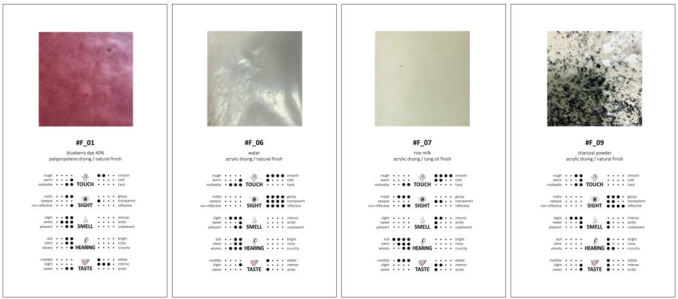
Figure 1. Microbial Nanocellulose Material Archive, mixed samples and sensory evaluation charts. Developed within the PhD thesis “Evolving Matter. The future of Materials and Design in the Biofabrication Era” by Lorena Trebbi, PDTA Department, Sapienza University of Rome When harvested, the wet material is like a spongy mat full of liquid culture and while drying the nanocellulose filaments bind together creating a strong unique layer. This ability to “self-seal” and stick together can be used for stratification, overlapping several layers to adjust the thickness and create relief geometries, but also to control and modify the transparency. Analogously, placing the material on an embossed surface while drying is possible to create folds, plisse, bumps and 3d shapes, and it is possible to imprint any surface texture on the material through the texture of the surface used for the drying stage, which will be transferred to the material giving it a finish which can range from glossy to rough.
Intelligent Human Systems Integration (IHSI 2022): Integrating People and Intelligent Systems https://openaccess.cms-conferences.org/#/publications/book/978-1-7923-8988-7
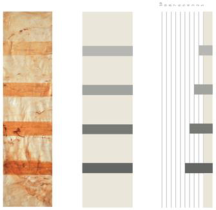
Figure 2. Microbial Nanocellulose Sensory Scales: thesis work by Maira Campanella, Laura Laricchiuta and Camilla Summa from Politecnico di Bari, in collaboration with Inmatex research lab. First supervisor Prof. Rossana Carullo, second supervisor Prof. Sabrina Lucibello, co-supervisors Giuseppe Modeo, Mariangela Stoppa and Lorena Trebbi.
The dry material on the other side, can be modified through surface treatments able to reduce its porosity and hydrophilicity such as Tung oil, which at the same time change the surface texture and the material’s sensory properties. Also, laser-cutting and engraving can be used to affect the visual and tactile properties of the material and build three- dimensional elements, as well as other processing techniques such as folding, embossing and printing.
Table 1: Type of processing techniques and sensory properties which they affect.
Table available in the original PDF paper.
In the emerging trans-disciplinary scenario of biofabrication, at the intersection of design and biology, design research can identify the unexpressed potential and innovative ways of fruition and application of new biofabricated materials. With respect to technically similar materials, the most interesting aspect of microbial nanocellulose is the possibility to design its aesthetic-perceptual features, interacting during and after the growth process to determine variations in colour, texture, thickness and finishing. Rather than identifying applications finalised to the mere replacement of existing materials in order to address sustainability needs, the goal is to enrich the sensory experience provided by digital devices, enhancing the tactile features as well as the overall haptic perception.
Intelligent Human Systems Integration (IHSI 2022): Integrating People and Intelligent Systems https://openaccess.cms-conferences.org/#/publications/book/978-1-7923-8988-7
REFERENCES
Carullo, R. & Pagliarulo, R.: Tassonomie a fior di pelle. Dal textile design alle soft surfaces. MD Journal, (1) 2016, 92--105 (2016) Dal Buono, V. & Scodeller, D.: Integumentary design. Involucri sensibili e
sinestesie di superficie. MD Journal, 1, 14--19 (2016) Dima, S., Panaitescu, D., Orban, C., Ghiurea, M., Doncea, S., Fierascu, R., Nistor, C., Alexan- drescu, E., Nicolae, C., Trică, B., Moraru, A., Oancea, F.: Bacterial Nanocellulose from Side- Streams of Kombucha Beverages Production: Preparation and Physical-Chemical Properties. Polymers, 9(374), (2017) Fontana, F.: L’empowerment femminile passa dai batteri. Intervista con Giulia
Tommasello. Digicult (2018) Gatenholm, P. & Klemm, D.: Bacterial Nanocellulose as a Renewable Material for Biomedical Applications. MRS Bulletin, 35(3), 208--213 (2010) Gerritzen, M. & Lovink, G.: Made in China, Designed in California, Criticised in
Europe. De- sign Manifesto. BIS Publishers, Amsterdam (2019) Gilbert, C., Tang, T., Ott, W., Dorr, B.A., Shaw, W.M., Sun, G.L., Lu, T.K., Ellis, T.: Living materials with programmable functionalities grown from engineered microbial co-cultures. Na- ture Materials, 20, 691--700 (2021) Laing, H., Guan, Q., Zhu-Zhu, Song, L., Yao, H., Lei, X. and Yu, S.: Highly
conductive and stretchable conductors fabricated from bacterial cellulose. NPG Asia Materials, 4, e19 (2012) Lay, M., González, I., Tarrés, J.A., Pellicer, N., Ngun Bun, K., Vilaseca, F.: High electrical and electrochemical properties in bacterial cellulose/polypyrrole membranes. European Polymer Journal, 91, 1--9 (2017) Manzini, E.: La Materia Dell’Invenzione. Arcadia, Milano (1986) Schifferstein, R. & Wastiels, L.: Sensing Materials. Exploring the Building Blocks
for Experien- tial Design. In Karana, E., Pedgley, O., Rognoli, V. (eds.) Materials Experience: Fundamentals of Materials and Design, pp 15--26. Elsevier (2014) Zannoni, M.:Un approccio materico all’interazione tattile per il design delle interfacce. MD Journal, (1) 2016, 92--105 (2016)
Intelligent Human Systems Integration (IHSI 2022): Integrating People and Intelligent Systems https://openaccess.cms-conferences.org/#/publications/book/978-1-7923-8988-7
LISTED IN THE AHFE DIGITAL BOOKSTORE CATALOGUE
Explore the complete digital volume
Intelligent Human Systems Integration (IHSI 2022): Integrating People and Intelligent Systems
Read this individual research paper free through the original publisher, or explore the full digital proceedings book.
ISBN 978-1-7923-8988-7
Explore this ISBN in the AHFE Bookstore ↗Listed in the July 2026 bookstore catalogue; search by ISBN to confirm current availability · Digital book purchase optional