Santiago Felipe Luna Romero, Christian Salamea Palacios (2022). Noise pattern definition methodology for noise cancellation in coughs signals using an adaptive filter. In: Intelligent Human Systems Integration (IHSI 2022): Integrating People and Intelligent Systems. AHFE Open Access, vol. 22. https://doi.org/10.54941/ahfe100983
Cough is the body’s defense mechanism to respond to foreign materials that are accidentally inhaled or caused internally by infections to clean the respiratory system. The cough also contains essential information about the airways of the lungs that helps in the diagnosis of diseases related to the lungs. The cough information contains important information as it is responsible for various respiratory diseases such as bronchitis, asthma, pneumonia, etc. Within the study of cough as an audio signal, different acquisition techniques have been created for its analysis. In these audios, there is the possibility of acoustic contamination of cough signals, interferences such as environmental ones, noise when a cough is registered. The sound of teeth, saliva when a person opens and closes their mouth, etc. Acoustic systems for noise cancellation and audio signal enhancement have become a major area of concern in the scientific community because noise drastically reduces the sound quality of cough signals, in addition, that, from a medical point of view, acoustic noise cancellation is vital, as a contaminated cough signal can lead to misdiagnosis by healthcare professionals. Therefore, it is necessary to filter out these noisy signals for proper and accurate analysis of cough signals. In this field, different filtering and noise cancellation techniques have been developed to obtain the cleanest possible cough audio signal. Within the scientific community, but it has been detected that these techniques present a generalization problem because they are configured to eliminate a single type of noise and the same acquisition environment. Therefore, this work proposes a methodology to create a reference signal (noise pattern) that can be used in adaptive filtering to minimize the noise produced in a cough record. This noise pattern is can incorporate information of all types of noises that contaminate a record cough signal. This reference signal has been created using a dataset of cough audio signals. The signal-to-noise ratio (SNR) has been used as the evaluation metric of the filtering quality. A system able to minimize the noise across all the record cough files using this methodology with an adaptive filtering technique has been created obtaining results closely to 0db, demonstrating the efficiency and generalization of the proposed technique that is part of the preprocessing phase in a system of characterization and classification of cough records.
Intelligent Human Systems Integration (IHSI 2022): Integrating People and Intelligent Systems https://openaccess.cms-conferences.org/#/publications/book/978-1-7923-8988-7
INTRODUCTION
Cough is the sound produced as a response of the human body as a cleaning mechanism of the respiratory system in the face of accidental situations, infections, and throat irritations (Amrulloh et al, 2015). This sound has important information since it is also a clinical symptom to detect different diseases such as bronchitis, asthma, pneumonia, etc (Shankar et al, 2020). During a consultation, a doctor is able to listen this sound obtaining essential data (qualitative information) and diagnose these diseases (Abeyratne et al, 2013).
In automatic cough acquisition systems, some noise interferences in cough signals could appear, such as ambient noise, teeth, the sound of saliva when a person opens their mouth, etc. Therefore, it is necessary to filter out these interferences for proper and accurate analysis of cough signals (Shankar et al, 2020). In previous works, various filtering methodologies, such as low-pass filters have been used (Aggarwal et al, 2011). Empirical mode decomposition (Liang et al, 2005, Blanco-Velasco et al, 2008) and time-lagged state vectors (Liang et al, 2005), Kalman filters (Yan et al, 2010), mean-shift algorithm (Shamsollahi, 2008).
The conventional techniques mentioned above are only useful when the cough sound signals are contaminated with only one type of noise and the acquisition environment is the same. In recent years, different approaches have been derived to remove noise from cough sound signals, such as Gabor's Fourier transform (Tary et al, 2018). The wavelet transforms (WT) have been widely implemented (Poornachandra, 2008).
Acoustic systems for noise cancellation and audio signal enhancement and have become an area of primary interest in the scientific community because noise drastically reduces the sound quality of cough signals, in addition to that, from a medical point of view, acoustic noise cancellation is vital, as a contaminated cough signal can lead to misdiagnosis by health professionals (Haykin, 2008).
Noise cancellation procedure according to (Rafique et al, 2013) requires an additional input signal (correlated noise signal) that is the input to the adaptive filter to produce a noise signal equal to the interference signal into the original audio. This filtered signal is then subtracted from the original audio, theoretically canceling the noise. So, then the general idea of this technique is to generate a noise signal equal in amplitude and phase to the original noise in the cough audio, but with opposite phase.
So, to implement an adaptive filter denoising technique is necessary to define a correct reference signal to make it equal to the noise added to the original cough signal pretended to filter. In this context, the main approach of this work is to implement a methodology to define a general reference signal that provides correct adaptive filtering on a cough audio record. We use the database proposed by Brown (Brown, 2020) to validate the methodology proposed.
Intelligent Human Systems Integration (IHSI 2022): Integrating People and Intelligent Systems https://openaccess.cms-conferences.org/#/publications/book/978-1-7923-8988-7
This paper is organized as follows: Section 2 explains the proposed background and related works. Section 3 explains the proposed methodology. Section 4 presents the application and validation of the proposed methodology. Finally, some conclusions are drawn in Section 5.
BACKGROUND AND RELATED WORKS
Background
This section presents an overview of the denoising cough signal techniques, the classical digital filters, and the adaptive filters. Besides, works related to the adaptive filters are described.
Digital Filters for Denoising- An audio signal can be considered a combination of interference signals with the pure audio signal. The digital filter's main idea is to separate this combination and restore the pure signal (Mills et al, 1978). In general, digital filters are classified as Weiner and Kalman (Krishnan, 2015, Dixit et al, 2017).
Adaptive Filters for Denoising- This type of filter is considered as a model restricted by variables or adaptive parameters that can be adjusted according to an optimization algorithm during signal processing, in order to generate an output signal free of unwanted components (interferences) (Ram et al, 2011, Park et al, 2013). Optimization algorithms have been deeply studied in recent years, least mean squares (LMS) algorithm and recursive least squares (RLS) algorithm are the most used. The best performance of adaptive filtering occurs when interference is minimized with low computational capacity and a fast convergence rate (Chandrakar et al, 2012).
Related works In (Amrulloh et al, 2015) use record files of pediatric patients admitted on respiratory complaints in a hospital in Yogyakarta, Indonesia to try filtering noise. They use two types of filters, the first one is a simple digital fourth-order filter Butter-worth with cut off frequency FC = 10 Hz. The particular FC was selected based on the low-frequency noise profile in dataset MDD. The second filter is a power spectral subtractions (PSS) filter, it was employed to reduce the Gaussian noise. In this work, they do not quantify the efficiency of their proposed technique filtering, because this is based on the idea that only Gaussian noise is the interference in acquired cough signals, but it is not absolutely truth due to the interference signal can be generated from other types of noise as previously described.
In (Shankar et al, 2020) use a Continuous wavelet transform combining it with a Thresholding Technique to try to remove the noise from the cough signals. The SNR signal has been used as a metric to quantify the efficiency of the technique. Their experiment consists of the addition of white gaussian noise to a clean cough signal. White gaussian
Intelligent Human Systems Integration (IHSI 2022): Integrating People and Intelligent Systems https://openaccess.cms-conferences.org/#/publications/book/978-1-7923-8988-7 noise appears when cough is recorded but it is not the unique interference. In (Fong et al. 2020) use a self-calibration technique to standardize the reception properties of the microphone of the device to record the cough signal. Their system is based on the use of adaptive filters and the objective is to eliminate the “sound suitable” components that different smart devices from any manufactured of variable quality can produce when the microphone catches the cough. The self-calibrations consist of determining the “sound suitable” noise previously to record the cough and use this noise as an input of the adaptive filter. They use signal to interface and noise ratio (SINR) to evaluate the results. But in this work, they do not analyze another kind of interference like environmental, the noise like lips, teethes, or saliva.
METHODOLOGY
The methodology proposed to create a reference signal (noise pattern) that can be used in adaptive filtering to minimize the noise produced in a cough record, this methodology is made up of four phases that can be seen in figure 1.
The first stage involves cough data collection, for this purpose, historical coughs records data set will be selected to guarantee the capacity of generalization of the proposed technique. The second phase carries out three processes corresponding to the Detection and Separate Cough and noise from an audio file, the separation of typical and atypical data in said groups, and finally the definition of a pattern of noises that represent the interferences in a Cough record file. The third phase corresponds to the use of an adaptive filtering technique to minimize the interferences in a cough record file. Finally, in phase 4 the results are presented.
Figure 1. Flow diagram of the adaptive filter methodology
Figure available in the original PDF paper.
Intelligent Human Systems Integration (IHSI 2022): Integrating People and Intelligent Systems https://openaccess.cms-conferences.org/#/publications/book/978-1-7923-8988-7
Cough data collection In this work, the cough audio records were taken from a large-scale crowdsourced dataset of respiratory sounds collected to aid diagnosis of COVID-19 (Brown, 2020). It is composed of 452 cough records of different people using a web page application.
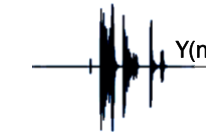
Adaptive filter Denoising This approach involves the use of adaptive filters to minimize the interferences in cough signals. The adaptive filter needs a base noise reference signal that is associated with the original noise present in the cough record that is pretending to filter. To prove the adaptive filtering functionality (figure 2), the system input corresponds to an ideal signal without noise represented as Y(n). This signal is perturbed with a noise signal represented as R’(n) which is the result of an “f” process application of a reference noise signal R(n). Thus, the sum of signals Y(n) and R’(n) is the signal to be corrected by adaptive filtering. The signal R’(n) is the input signal for the adaptive filter too, consequently, the adaptive filter will replicate the “f” process between the signals R(n) and R’(n) to minimize the noise in the end of the process. The adaptive filter uses the signal e(n) as an orientation to optimize itself using an optimization algorithm. In (Salamea et al, 2019), different types of algorithms have been analyzed finding the optimal option using RLS recursive least square algorithm (Cruz, 2011).
Y(n)
Y(n)+R n) + + R n)
f
Filtered R n)
R(n)
Adaptive
Signal
+ - Filter e(n)
Figure 2. Flow diagram of the adaptive filter methodology As mentioned before the key to this approach is to obtain the noise reference signal R(n). This work proposes a statistical methodology to create this noise reference that involves a noise pattern definition using the cough dataset.
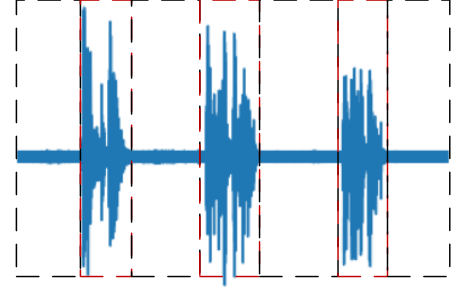
Detect and separate noise from cough records Originally in the record audio data files, we have two important signals, the first one corresponding to the cough signal and the second one corresponds to the noise. We assume the noise is present before an expectoration of the cough as can be seen in figure 3. To separate this noise and the cough signal is necessary to analyze the energy of the signal, thus using a decision umbral we can separate the signals. Thus, we create a new dataset of
Intelligent Human Systems Integration (IHSI 2022): Integrating People and Intelligent Systems https://openaccess.cms-conferences.org/#/publications/book/978-1-7923-8988-7 noises present in the records of coughs.
Noise Cough Noise Noise Noise Cough Cough
Figure 3. Cough and noise signals
Separate Typical and outlier’s data The dataset described in the previous section is necessary to process the outliers’ values, thus a value is considered an outlier when it is out of the 95% confidence interval in a normal distribution function and it is defined by the mean plus-minus two standard deviations approximately. This procedure has been performed and the mean value and standard deviation of all datasets have been obtained.
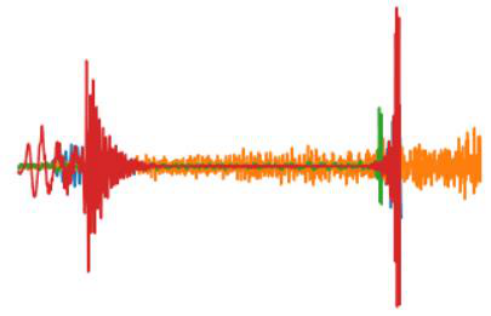
Noise pattern creation Finally, the noise pattern called ‘final pattern signals’, is formed by the set of signals that belong to the typically noises dataset. To conform the reference signal for the adaptive filter the mean of the noise pattern is calculated. (Figure 4).
Figure 4. Noise pattern definition
Intelligent Human Systems Integration (IHSI 2022): Integrating People and Intelligent Systems https://openaccess.cms-conferences.org/#/publications/book/978-1-7923-8988-7
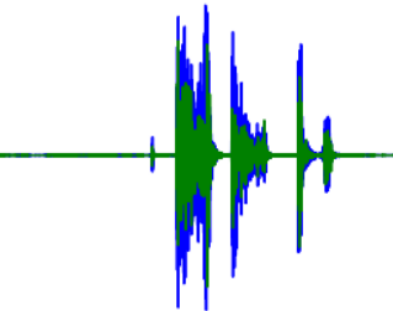
APPLICATION OF THE METHODOLOGY In Figure 5, it seems that the noise on previously and during the expectoration was reduced, demonstrating the functionally of the adaptive filter.
Figure 5. Adaptive filter on cough signal
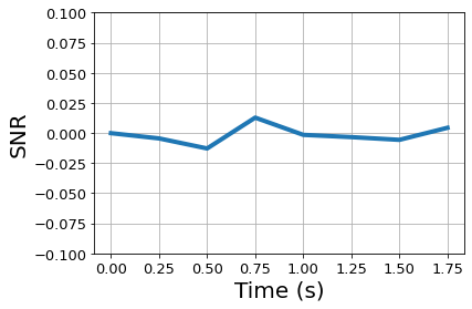
The efficiency of the adaptive filter has been measured analyzing the signal-to-noise ratio through the time in the filtered signal. In figure 6, it seems that the signal-to-noise ratio (SNR) is relatively the same through all record signals, and it is relatively close to 0 dB, on approximately two seconds of cough record.
Figure 6. Signal to noise ratio evolution
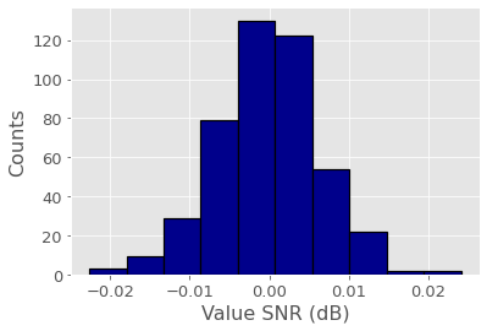
To demonstrate the generality of the proposed methodology we use the adaptive technique with the same reference signal that we obtained on all cough datasets and we capture the SNR value of each record. In figure 7, we present a histogram in which the bins axis corresponds to the numbers of cough signals that contain similar values of SNR. For the
Intelligent Human Systems Integration (IHSI 2022): Integrating People and Intelligent Systems https://openaccess.cms-conferences.org/#/publications/book/978-1-7923-8988-7 analysis, we started with the idea that in an ideal case all signals share the same SNR value, but in an acceptable case, the SNR value does not have a relative variation, and as can be seen in Figure 7, the SNR value for the majority numbers of cough records share the same value centered in approximately 0.0001 dB.
Figure 7. Dataset SNR Histogram
CONCLUSIONS
In this work, we proposed a methodology to create a reference signal that can be used in adaptive filtering to minimize the noise produced in a cough record. The mentioned methodology consists of the definition of a “noise pattern” that can contain the information of all types of noises that contaminate a record cough signal. For that propose we considerate noise to the record information previous a cough expectoration. Using this methodology with an adaptive filtering technique we have created a system that can minimize the noise across a record cough file close to 0db, and to verify the generality of the proposed methodology we tested this on all dataset, and we verify that all records files share the same SNR value closely to 0 db. Due to all the above, we can recommend this methodology as preprocessing technique on an intelligent cough characterization and classification system.
ACKNOWLEDGMENTS
To the Corporación Ecuatoriana para el Desarrollo de la Investigación y Academia, CEDIA, for the financing provided to research, development, and innovation through the CEPRA projects, especially the project CEPRA-XV-2021-011: Caracterización de la tos provocada por el COVID-19 en pacientes con diagnóstico positivo. The authors thank to Universidad Politécnica Salesiana, Escuela Politécnica Nacional, and Pontificia Universidad Católica del Ecuador.
Intelligent Human Systems Integration (IHSI 2022): Integrating People and Intelligent Systems https://openaccess.cms-conferences.org/#/publications/book/978-1-7923-8988-7
REFERENCES
Abeyratne, U. Swarnkar, V. Setyati, A. Triasih, R. (2013). Cough sound analysis can rapidly diagnose childhood pneumonia. Biomed. Eng., vol.41, no.11, pp. 2448–2462. Aggarwal, R. Singh, J. Gupta, V. Rathore, S. Tiwari, M. Khare, A. (2011). Noise reduction
of speech signal using wavelet transform with modified universal threshold. Int. J. Comput. Appl., vol. 20, no. 5, pp. 14–19. Amrulloh, Y. Abeyratne, U. Swarnkar, V. Triasih, R. Setyati, A. (2015). Automatic cough segmentation from non-contact sound recordings in pediatric wards. Biomed. Signal Process. Control, vol. 21, pp. 126–136. Blanco-Velasco, M. Weng, B. Barner, K. (2008). ECG signal denoising and baseline
wander correction based on the empirical mode decomposition. Biol. Med.,vol. 38, pp. 1–13. Brown, C. et al, (2020). Exploring automatic diagnosis of covid-19 from crowdsourced respiratory sound data. Proceedings of the 26th ACM SIGKDD, pp. 3474–3484. Chandrakar, C. Kowar, K. (2012). Denoising ECG signals using adaptive filter algorithm.
Int. J. Soft Comput. Eng., vol. 2, no. 1, pp. 120–123. Cruz, P. (2011). Inteligencia artificial con aplicaciones a la ingeniería. Alfaomega. Dixit S. Nagaria, D. (2017). LMS Adaptive Filters for Noise Cancellation: A Review. Int.
J. Electr. Comput. Eng., vol. 7, no. 5. Fong, B. (2020). A Microphone Calibration Scheme for Cough Sound Analysis and Diagnosis. IEEE 2nd Workshop on System Biology and Biomedical Systems. Haykin , S. (2008). Adaptive filter theory. Pearson Education India. Krishnan, V. (2015). Probability and random processes. John Wiley & Sons. Liang, H. Lin, Q. Chen, J. (2005). Application of the empirical mode decomposition to the
analysis of esophageal manometric data in gastroesophageal reflux disease. IEEE Trans. Biomed. Eng., vol. 52, no. 10, pp. 1692–1701. Liang, H. Lin, Z. Yin, F. (2005). Removal of ECG contamination from diaphragmatic EMG by nonlinear filtering. NATMA, vol. 63, pp. 745–753. Mills, W. Mullis, C. Roberts, R. (1978). Digital filter realizations without overflow
oscillations. IEEE Trans. Acoust., vol. 26, no. 4, pp. 334–338. Park, S. Meher, P. (2013). Low-power, high-throughput, and low-area adaptive FIR filter based on distributed arithmetic. Circuits Syst, vol.60, no.6, pp.346–350. Poornachandra, S. (2008). Wavelet-based denoising using subband dependent threshold
for ECG signals. Digit. Signal Process., vol. 18, no. 1, pp. 49–55. Rafique, A. Ahmed, S. (2013). Performance Analysis of a Series of Adaptive Filters in Non-Stationary Environment for Noise Cancelling Setup. Proceedings of World Academy of Science, Engineering and Technology, no. 74, p. 332. Ram, M. Madhav, V. Krishna, E. Komalla, N. Reddy, K. (2011). A novel approach for
motion artifact reduction in PPG signals based on AS-LMS adaptive filter. IEEE Trans. Instrum. Meas., vol. 61, no. 5, pp. 1445–1457. Salamea C. Romero, S. (2019). Calibración Automática en Filtros Adaptativos para el Procesamiento de Señales {EMG}. RIAI Ind.1, vol. 16, no. 2, p. 232. Shamsollahi, M. (2008). ECG denoising and compression using a modified extended
Kalman filter structure. Trans. Biomed. Eng., vol. 55, no. 9, pp. 2240–2248. Shankar, A. Bhateja, V. Srivastava, A. Taquee, A. (2020). Continuous wavelets for preprocessing and analysis of cough signals. Smart Intelligent Computing and Applications, Springer, pp. 711–718.
Intelligent Human Systems Integration (IHSI 2022): Integrating People and Intelligent Systems https://openaccess.cms-conferences.org/#/publications/book/978-1-7923-8988-7
Tary, J. Herrera, R. Van der Baan, M. (2018). Analysis of time-varying signals using continuous wavelet and synchrosqueezed transforms. Philos. Trans. R. Soc. A Math. Phys. Eng. Sci., vol. 376, no. 2126, p. 20170254. Yan, J. Lu, Y. Liu, J. Wu, X. Xu, Y. (2010). Self-adaptive model-based ECG denoising
using features extracted by mean shift algorithm. Biomed. Signal Process. Control, vol. 5, no. 2, pp. 103–113.
Intelligent Human Systems Integration (IHSI 2022): Integrating People and Intelligent Systems https://openaccess.cms-conferences.org/#/publications/book/978-1-7923-8988-7
LISTED IN THE AHFE DIGITAL BOOKSTORE CATALOGUE
Explore the complete digital volume
Intelligent Human Systems Integration (IHSI 2022): Integrating People and Intelligent Systems
Read this individual research paper free through the original publisher, or explore the full digital proceedings book.
ISBN 978-1-7923-8988-7
Explore this ISBN in the AHFE Bookstore ↗Listed in the July 2026 bookstore catalogue; search by ISBN to confirm current availability · Digital book purchase optional