Zih-Ling He, Jui-Hung Cheng, Jia-Hong Shen, Yu-Xuan Hsueh (2022). Improvement of Robot Service Route. In: Intelligent Human Systems Integration (IHSI 2022): Integrating People and Intelligent Systems. AHFE Open Access, vol. 22. https://doi.org/10.54941/ahfe100970
With the development of intelligent robots in modern society, the application of robots has speedily spread from industry to service industry and enhance the quality and convenience of life. However, when practically applied in restaurants or coffee shops, it is easy to meet problems, including overlong delivery time, wrong location, challenging setting, etc. Most service robots adopt SLAM technology, which is for localization and map construction simultaneously. This research explores optimizing the service robot's time and space axis parameters using ZENBO Robot in experiments. Furthermore, through 6σ architecture to refine by the Taguchi method to optimize SLAM technology and the time axis parameter of the user interface. In the actual use situation, experiments with other impact factors to improve UI/UX problems to make the service robot minimize error when advancing. After improvement, the UI/UX of the service robot has improved. Moreover, the delivery time is improved by 47%, accuracy and stability are improved by 65%, and it provided users with simplified setting steps and the environment's best parameters. This research proves that using the Taguchi method can effectively improve the performance of service robots in actual applications.Keywords: Service Robot · SLAM · UI/UX · Taguchi method
Intelligent Human Systems Integration (IHSI 2022): Integrating People and Intelligent Systems https://openaccess.cms-conferences.org/#/publications/book/978-1-7923-8988-7
INTRODUCTION
The current service robots usually adopt the positioning system by SLAM (Simulta-neous Localization and Mapping) technology. SLAM technology uses to solve the robot map- constructing problems in an unknown environment during migrating [1]. Let the robot start from any place in an unknown environment. In the process, it locates and adjusts its position by repeating the observed map features. Then build the map incrementally based on the current location. So as that robot finishes the jobs of simultaneous localization and mapping [2]. However, service robots have the following problems when working in restaurants and coffee shops—long delivery time, inability to arrive at the target position, and unstable delivery routes. Users were demanding to rely on service robots to assist meal delivery cause these prob-lems [3]. The test equipment is ZENBO Robot in this paper. The reason is basing on the Android system, which has high compatibility, simple program editing, and a complete operational interface. Executing two experiments, time and space axis, through Taguchi method to improve UI/UX of service robot [4]. The factors and level refer to parameters of SLAM and set up interface. The result of the analysis and process apply the SOP of set up steps, better UI/UX, optimized setting parameter, and environment set up [5]. It decreases the time for service robot migrating time and increases the accuracy of positioning. Furthermore, provide the guide for users suggested used in the service field.
DESIGN OF EXPERIMENTAL The time and accuracy is the primary consideration of service robots applying in restaurants. Therefore, the experiment was designed to enhance UI/UX and focus on the two problems of a long time and unstable position. Found that most service ro-bots are adopted SLAM technology to set the map construction after preliminary investigations. SLAM technology bases on the development of visual sensors and image processing algorithm. It makes service robots compute delivery distance and mapping in three dimensions through the information of visual sensor with the algo-rithm. Users can give instructions to service robots and achieve service-related ac-tions by the result of the map setting and parameters adjusting.
Intelligent Human Systems Integration (IHSI 2022): Integrating People and Intelligent Systems https://openaccess.cms-conferences.org/#/publications/book/978-1-7923-8988-7
OPTIMAL SYSTEM BY TAGUCHI METHOD This paper executed two experiments, time and space axis, by the Taguchi method to solve service robots' UI/UX problems. The first experiment started with system set-tings and used optimized settings to execute the accuracy improving experiment. Use three levels and the L9 (34) orthogonal array since there was no related interac-tion among each factor in the time axis, as table I. The result analysis can reduce the delivery time of service robots by the optimized system settings.
In the part of the space axis, it may easily cause interaction between factors. Thus use the L16 (215) orthogonal array to find the best environmental parameters. Each factor selects at two levels for the experiment, and interactions among factors were to be experimental factors to reduce the complexity of the experiment, as table I. Receive the best settings, suggested environments, and other valuable information by analyzing the results from two experiments.
FACTOR OF TAGUCHI METHOD Analyze the factors that may affect the time and space axis in the factors selecting of the Taguchi method. The research found that system settings of service robots will affect delivery time, and environmental changes will affect accuracy. Thus use four factors of time control in the setup interface. Find five factors and set the interaction between ten factors as a secondary factor after an adequate analysis of the different environments in restaurants, as Table 1.
Table 1. Service Robot Parameters and Levels Factor Level 1 Level 2 Level 3 Time Factors Service Position Range(A) Aisle Table Aisle & Table Circle Size (B) Small Middle Large Service Route (C) Less Middle Large Set Up Limit Range (D) Less Middle Large
Table available in the original PDF paper.
Space Factors
Weight(E) 3 Kg 5 Kg Light (F) Strong weak Take the seat (G) No Yes Aisle width (H) 50 cm 100cm Stop Point (I) Short Side Long Side
Intelligent Human Systems Integration (IHSI 2022): Integrating People and Intelligent Systems https://openaccess.cms-conferences.org/#/publications/book/978-1-7923-8988-7
EXPERIMENTAL METHOD A simulated restaurant classroom select be the experiment site. According to the factor configuration of the orthogonal array, the experiment was fixing the setup of start datum points, instructions, arrival datum point, and recording the arrival time and the distance from arrival position to datum point every time of the service robot. Each group of factor configurations executed the same steps three times to average the results and analyze them.
EXPERIMENTAL RESULTS ANALYSIS Users found that the arrival time and positions are uncertain when the service robot moves on the route. Therefore, using the Taguchi method to understand the regular work pattern. Furthermore, determine the effects among system settings, user envi-ronments, and arrival positions and time. The results of the Taguchi method can obtain the best using environment and other information, which can avoid mistakes design in the sequent application services.
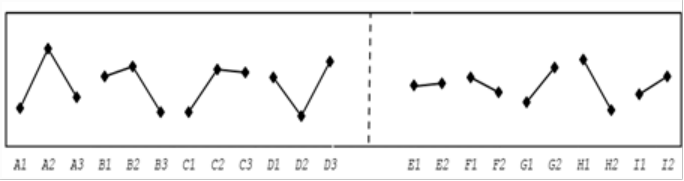
EXPERIMENTAL RESULTS According to the results of the Taguchi method derived the theoretical optimal time axis parameters, which are A1, B3, C1, D2, and the optimal space axis parameters are E1, F1, G1, H2, I1, as Table 2.
Table 2. Optimal Factor and Instruction
Table available in the original PDF paper.
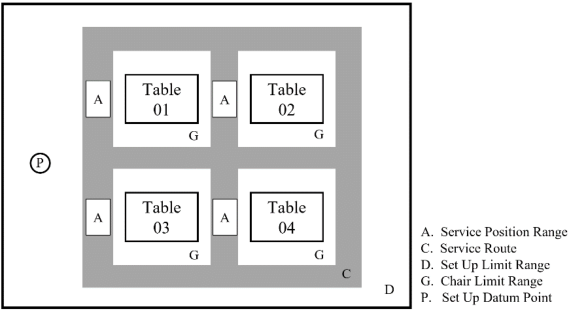
Optimal Factor Instruction A1 The best parameter is that the aisle should be selected. B3 The circled size of the best parameter must be large, as Fig. 2. C1 The service route selected for the movable range is as small as possible. D2 The set up limit range is middle, as Fig. 2. E1 The maximum load value is 5Kg. *Approaching the maximum value will cause the travel time to increase. F1 The strength or weakness of the light has little effect on the time and space axis. G1 The best service location in an area is not affected by chairs. H2 The best aisle width is 100 cm. I1 Stop on the short side of the rectangular table.
Intelligent Human Systems Integration (IHSI 2022): Integrating People and Intelligent Systems https://openaccess.cms-conferences.org/#/publications/book/978-1-7923-8988-7
The purpose of the experiment is to obtain the shortest arrival time, so it is the STB quality(smaller-the-better), which means selecting the smallest S/N ratio and η (fac-torial affect value). Use the best setting parameters to calculate. The estimated S/N ratio is 38.4, less than the average S/N 2.8 point, as in: S/N=S/N(A1)+ S/N(D2)-S/N(AVE) (1)
Therefore, inferentially selecting the best parameters will save 15% of the time, about 95 seconds. To execute the practical experiment, verified that using the best parameter of the time axis obtained 92 seconds proves that the error of inferred val-ue is only 3%.
In the experiment of the space axis, set the service positions (G) and aisle width (H) to be essential factors because the factors have an essential effect. The theory to calculate η the theoretical factorial effect value (η) is 2.3965, as in: η=η(G1)+ η(H2)-η(AVE) (2)
The optimal arrival position will deviate the last time by under 25 cm after the index conversion. To execute the practical experiment, verified that using the best parame-ter of the space axis can obtain 22 cm, which proves that the actual value is within the inferred value. This paper improves service robots' UI/UX effectively after two certification experiments.
EXPERIMENTAL DISCUSSION Obtained L9 (34) orthogonal array, in the time axis experiment, data are sorting, as Table 3. Calculated effect values of the time factor in the orthogonal array and graphed the S/N ratio, as Fig. 1 (Time Factors Part). Service position range(A) and set up limit range (D) in the service robot are the main factors in the time axis. The restaurant users usually select the tabless area as service position range, but it makes the longest service time. Because the service robot will try to enter the inner of the table, which is an obstacle, it cannot move forward—caused needing to reposition and calculate continuously. Use the optimal system parameter setting will have the best experience after the experiment, as Fig. 2.
Intelligent Human Systems Integration (IHSI 2022): Integrating People and Intelligent Systems https://openaccess.cms-conferences.org/#/publications/book/978-1-7923-8988-7
Table 3. The Orthogonal Array Data of Time Axis.
Table available in the original PDF paper.
y1 y2 y3 S/N
1 98.0 92.0 93.0 39.5
2 98.0 104.0 104.0 40.2
3 101.0 110.0 105.0 40.4
4 190.0 191.0 188.0 45.6
5 182.0 180.0 179.0 45.1
6 86.0 82.0 90.0 38.7
7 99.0 100.0 103.0 40.1
8 123.0 128.0 103.0 41.3
9 105.0 97.0 111.0 40.3
AVE 41.2
Figure 1. Example of a figure captionFigure 2. Schematic diagram of optimized time axis parameters
Intelligent Human Systems Integration (IHSI 2022): Integrating People and Intelligent Systems https://openaccess.cms-conferences.org/#/publications/book/978-1-7923-8988-7
After the space axis experiment, data sorting obtained L16 (215) orthogonal array, as Table 4. Calculated effect values of space factor in the orthogonal array and graphed the η value, as Fig. 1. Take the seat (G) and aisle width (H) are the main factors, affect the service robot arriving at the accuracy of the specified position, finding in the space experiment. Observing the η value of weight (E) and light (F) found that, when they performed separately, the optimal effect occurring in the heavyweight (E2) and weak light (F2). However, the interaction effect between these two factors is five times more tremendous than the independent effect. So interaction needs to be analyzed. After calculating the practical value of the interaction between weight (E) and rays of light (F), the interaction effect graph found that selecting the load of 3 Kg (E1) and intense light (F1) will obtain the optimal accuracy.
Table 4. The Orthogonal Array Data of Space Axis. y1 y2 y3 y(AVE) η S/N
46.807 The level of weight (E) was 3 kg and 7 kg during the experiment design phase. How-ever, the robot was unable to move forward when the load of 7 kg. The robot just started moving until the load reduces to 5 kg. So concluded is that the total weight of supports and food cannot exceed 5 kg when designing the sequent supports. Then also analyzed the interactions of nine other factors after founding the interaction between weight and light. Found that there are only two groups which are the factors of weight (E) with taking the seat(G), light (F) and stop point (I) have weak interac-tion, the rest groups are strong interactions. In conclusion, each experimental factor almost interacts with other factors, then after calculating the practical value of each factor, the expected accuracy of the addition formula (2) is obtained.
Intelligent Human Systems Integration (IHSI 2022): Integrating People and Intelligent Systems https://openaccess.cms-conferences.org/#/publications/book/978-1-7923-8988-7
RESULTS AND CONTRIBUTIONS This research enhances the UI/UX of the service robot, and the problems of efficien-cy and accuracy are improved. Through the Taguchi method, service robots have been decreased delivery time and increased the accuracy of positioning. When using results to service robots, it turned out unexpected effects. The migrating time of service robots has decreased in 85 seconds, from 3 minutes to 95 seconds. The accu-racy has improved by 65%. The maximum arriving range was originally within 5650 cm2, till after improving the average range of 650 cm2. The service robots have refined better UI/UX, optimized setting parameters, and environment set up. As mentioned in part A of Chapter 3, Experimental Results, it offers users to apply in the future. Through this research, it has an outstanding contribution to reconstructing ZENBO robots to the service robots. The limited weight of the original motor is 5 kg, and there is a great reference value for bracket design and the loading of meal weight. Through the research, it solves the complex operating problems by the Taguchi method. This article can be the performance testing of the former research for the service robot development. Without increasing cost, it has the optimal envi-ronment and setting for developers and users.
REFERENCES
Filipenko, M., & Afanasyev, I. (2018, September). Comparison of various slam systems for mobile robot in an indoor environment. In 2018 International Conference on Intelligent Systems (IS) (pp. 400-407). IEEE.J. Clerk Maxwell, A Treatise on Electricity and Magnetism, 3rd ed., vol. 2. Oxford: Clarendon, 1892, pp.68–73. Mishra, R., & Javed, A. (2018, April). ROS based service robot platform. In 2018 4th International
Conference on Control, Automation and Robotics (ICCAR) (pp. 55-59). IEEE Huang, M. H., & Rust, R. T. (2021). Engaged to a robot? The role of AI in service. Journal of Service Research, 24(1), 30-41. Ismail, N. A., Ismail, M. I. S., Radzman, M. A. M., Ariffin, M. K. A. M., & As' arry, A. (2019).
Parametric Optimization of Robot-based Single Point Incremental Forming Using Taguchi Method. International Journal of Integrated Engineering, 11(1). Goharimanesh, M., Mehrkish, A., & Janabi-Sharifi, F. (2020). A fuzzy reinforcement learning approach for continuum robot control. Journal of Intelligent & Robotic Systems, 100(3), 809-826.R. Nicole, “Title of paper with only first word capitalized,” J. Name Stand. Abbrev., in press.
Intelligent Human Systems Integration (IHSI 2022): Integrating People and Intelligent Systems https://openaccess.cms-conferences.org/#/publications/book/978-1-7923-8988-7
LISTED IN THE AHFE DIGITAL BOOKSTORE CATALOGUE
Explore the complete digital volume
Intelligent Human Systems Integration (IHSI 2022): Integrating People and Intelligent Systems
Read this individual research paper free through the original publisher, or explore the full digital proceedings book.
ISBN 978-1-7923-8988-7
Explore this ISBN in the AHFE Bookstore ↗Listed in the July 2026 bookstore catalogue; search by ISBN to confirm current availability · Digital book purchase optional