Mona Mohamed (2022). Industrial Perspectives on Government Open Data Strategy Effectiveness. In: Intelligent Human Systems Integration (IHSI 2022): Integrating People and Intelligent Systems. AHFE Open Access, vol. 22. https://doi.org/10.54941/ahfe100965
The main objective of this paper is to impart new insights into the factors influencing the effectiveness of Open government data (OGD) strategy and build a predictive model for promoting strategy effectiveness. In the realm of OGD, presently, there is no de facto standardized strategy framework for the government to create open data in response to users’ needs and there is no predictive model that can be used to forecast the OGD effective strategy. Fifteen factors from four themes that shape the OGD strategy were prudently chosen from the literature and included in a survey distributed to the OGD users in the private sector in the US. The four themes identified from the literature are: data quality, technical standards, capacity building and measurements and maturity modeling. Then the most effective factors from these four themes are selected to build a mixed model for the prediction of OGD strategy. Overall, the effect of the models from the individual four themes were found to have significant impact on the effectiveness of the OGD strategy. Where there are only five factors from these four themes are found to have significant impact on strategy effectiveness and used to develop a predictive five-factor model. These results set the scene for the government to direct its resources to the concomitant barriers and the most effective TTPs. These observations should be considered when building new OGD strategy. The development of such model is critical for remediating OGD formidable challenges that are continually changing due to the inherit dynamism in the policies associated with the OGD.
Intelligent Human Systems Integration (IHSI 2022): Integrating People and Intelligent Systems https://openaccess.cms-conferences.org/#/publications/book/978-1-7923-8988-7
INTRODUCTION
Open government data (OGD) is perpetually available, universally accessible, fully discoverable, and readily usable data by humanity-at-large with no restrictions to generate economic values. By and large, many investigators found that OGD improves transparency, efficiencies, economic growth, and engagement and collaboration (Fitriani et al. 2017). OGD is defined as “all stored data of the public sector which could be made accessible by government in a public interest without any restrictions for usage and distribution” (Geiger and von Lucke 2012). The current major factors that affect the OGD strategies can be summarized into four pillars, namely, data quality (Behkamal et al. 2014) technical standards (Zuiderwijk, Janssen, and Dwivedi 2015), capacity building and measurements and maturity modeling model and measurements (Dawes and Helbig 2010). Presently, there is no de facto standardized strategy framework for government to create open data in response to users’ needs and there is no predictive model that can be used to forecast the OGD effective strategy. This study draws on research conducted by other investigators in determining the effective factors on OGD.
METHODOLOGY AND HYPOTHESES A survey was carried out using an online tool, (Qualtrics), emails, phone calls and face to face interviews. The survey is created using Likert scale based on levels from 1 to 5, where 1= strongly disagree, 2 = disagree, 3 = neither disagree nor agree, 4 = agree, and 5 = strongly agree. The survey has been distributed to 112 OGD consuming companies, with 68 responses were returned, representing a 61 percent response rate, while 7 participants data have been thrown away due to incomplete answers. The 61 responses were subjected to analysis using JMP of SAS. The following hypotheses have been tested to determine the significance of each of the themes and their associated factors:
H1: Selected data quality factors have a direct effect on OGD strategy effectiveness. H2: Technical standards of the government on OGD have positive effects on its strategy effectiveness. H3: The capacity building has a direct relationship with the open data strategy effectiveness. H4: Measurements and maturity modeling factors have significant effects on the strategy effectiveness.
Intelligent Human Systems Integration (IHSI 2022): Integrating People and Intelligent Systems https://openaccess.cms-conferences.org/#/publications/book/978-1-7923-8988-7
RESULTS
The results indicate that all the four themes are significantly but variably impacting OGD strategy effectiveness. However, not all fifteen factors incorporated in these themes are significant to the same cause.
Theme 1: Data Quality Theme The data quality theme model has three factors (data completeness, consistency, and accuracy) fits with high significance α = 0.01. This result supports the first hypothesis (H1). However, only completeness shows high significance with P < 0.003.
Theme 2: IT Technical Standards The technical standards theme consists of four factors that have variant effects on the OGD strategy effectiveness. These factors are easy access, data availability, technology infrastructure and one-stop-shop portal. The model fitting with the four selected factors showed a high significance, (α = 0.01. This result supports H2. However, out of the four contributing factors only ‘easy accesses’ was found to be significant (P < 0.0016) compared to other three factors.
Theme 3: Capacity Building The fitting of the model for the effect of the four capacity building factors, namely analytical tools, technical support, invitation to gathering and training provision, on strategy effectiveness is significant at α = 0.01. This result supports H3. Furthermore, out of the four capacity building factors that have impact on OGD strategy effectiveness, two have highly significant effects, viz. the invitation to gatherings (P < 0.0032) and training (P < 0.00054).
Theme 4: Measurements and Maturity Modeling The fitting of the model for the selected measurements and maturity factors against OGD strategy effectiveness is significant (α = 0.05). These results are in line with the hypothesis H4. Notwithstanding, out of this theme five factors, namely, completeness, easy to access, invitation to gatherings, training provision, clear measurements only the clear measures is significant P < 0.0212.
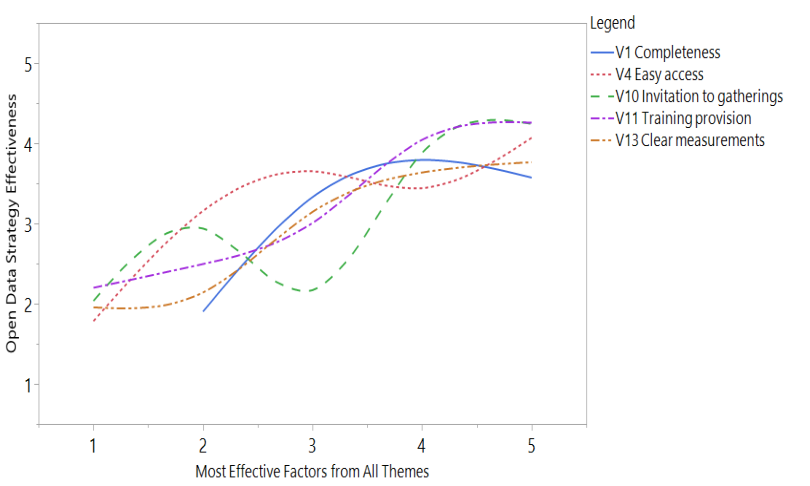
Mixed Model The mixed model combines the pooled effects of the most significant factors of the four themes constructs on the OGD strategy effectiveness. These factors are completeness, easy access, invitations to gatherings, training provision and clear measurements. The fitting of the overall mixed model is highly significant (α = 0.01). The resultant cumulative relationship all factors is visualized in Fig.1.
Intelligent Human Systems Integration (IHSI 2022): Integrating People and Intelligent Systems https://openaccess.cms-conferences.org/#/publications/book/978-1-7923-8988-7
Figure 1. The pooled effect of the most effective factors from all themes on the effectiveness of the open data strategy.
Including themes, the relationship between the variables and the strategy effectiveness is depicted in Fig. 2.
V1 V2 Theme 1 Data Quality V3
V4 V5 Theme 2 IT Infrastructure V6
V7 V8 V9 Theme 3 Capacity Building
V10 V11
The Mixed Model Legend
Theme 4 Measurement & Maturity V12 V13 V14
V15
Equation reproduced from the original PDF.Figure 2. The contributions of the most effective factors to the effectiveness of OGD strategy
Figure available in the original PDF paper.
Intelligent Human Systems Integration (IHSI 2022): Integrating People and Intelligent Systems https://openaccess.cms-conferences.org/#/publications/book/978-1-7923-8988-7 through their themes. The most effective factors of the mixed model are highlighted.
DISCUSSION
The above analysis supports the hypotheses about the themes extracted from the literature. Furthermore, form these results it is reasonable to infer that the selected themes are effective in OGD strategy building in different degrees. However, within the fifteen factors of these themes only five factors are significantly impacting the OGD strategy effectiveness. The findings support the hypothesis that the factors pertaining to the data quality have significant impact on the effectiveness of OGD strategy. In the first relationship, the completeness covers many different aspects of OGD value to the industry. On the other hand, it may be difficult for the government to satisfy the completeness criteria for all data consumers. The other two factors of consistency and accuracy may be considered as complementary to the meaningfulness of the data to the industry.
Easy access factor is the most significant factor that affect the OGD strategy effectiveness, this factor needs to be strengthened by the other three factors of data availability, technology infrastructure and one stop shop portal. These results are in line with (Roman et al. 2018). But data availability depends on the portal availability. Furthermore, one-stop-shop portal should not be a single point of failure for the government, it needs to be supported by an alternative portal in case of disasters.
The significance of the capacity building theme focusses on building knowledge and communication among companies regarding the OGD environment. The results indicate that the two most effective factors of training and gatherings, are socially constructed activities to build knowledge and skill. It is possible that the OGD users may not have the proper analytical or visualization tools to make use of the OGD. However, even if the user possessed the right tools, they may not have the proper technical support that back up the OGD usage. The provision of information about the analytical tools, including visualization, and the technical support by the government will help the industry to make full use of the open data.
In line with the fourth hypothesis, the results indicate that the measurements and maturity modeling theme found to have significant association with the effectiveness of the OGD strategies. This is also indicative to the continual improvement on OGD program that may result in new methodologies for measurement and more effective indicators that lead to better OGD policy and standards. Clear measurement is critical for proper analysis and interpretation. However, the establishment of measurements are exceedingly difficult, especially if they are reflecting the usability of the OGD by users. The best practices and lessons learned are accumulated experiences that can contribute to the continual improvement of the OGD program. Similar observations have been reported by (Vetrò et al. 2016).
Intelligent Human Systems Integration (IHSI 2022): Integrating People and Intelligent Systems https://openaccess.cms-conferences.org/#/publications/book/978-1-7923-8988-7
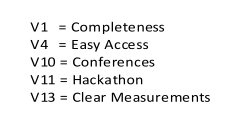
Within the tested themes there are only five out of fifteen factors that are significantly affecting OGD strategy. This resultant relationship can be represented in the following model: Y = 0.01 - 0.01V1 + 0.25V4 + 0.20V10 + 0.30V11 + 0.23V13
Where Y represents the effectiveness of the data strategy, V1 completeness, V4 easy to access, V10 invitation to gatherings, V11 training provision and V13 clear measurements.
CONCLUSIONS
The main aim of this research was to determine the industry perspective on OGD strategy effectiveness. To take the advantages of the OGD strategies, companies should align their open data usage strategies to benefit from OGD. This calls for the development of new business models to determine data dimension with considerable potential reusability in different business spheres. Accordingly, this study provides a practical insight into the interplay between the identified factors effectiveness of the open data strategy in the industry sector. The model in this study will provide a general roadmap for governments to establish specific strategies in their own environment to satisfy the industry needs
"A Metrics-Driven Approach for Quality Assessment of Linked Open Data." Journal of Theoretical and Applied Electronic Commerce Research 9 (2): 64- 79. https://doi.org/10.4067/S0718-18762014000200006. Dawes, S.S., and N. Helbig. 2010. " Information Strategies for Open Government: Challenges and Prospects for Deriving Public Value from Government Transparency " Electronic Government, Wimmer M.A. Fitriani, Widia Resti, Achmad Nizar Hidayanto, Betty Purwandari, Bobby A. A.
Nazief, and Bob Hardian. 2017. "Evaluating the implementation of open data principles on government websites in Indonesia." ICACSIS Bali, Indonesia. Geiger, C.P. , and J. von Lucke. 2012. "Open Government and Linked Open Government Data." Journal of eDemocracy - JeDEM 4 (2): 265-278. https://doi.org/10.4018/ijepr.2015040104. Roman, D. , N. Nikolov, A. Putlier, D. Sukhobok, B. Elvesæter, A. Berre, X. Ye,
M. Dimitrov, A. Simov, M. Zarev, R. Moynihan, B. Roberts, I. Berlocher, S. Kim, T. Lee, A. Smith, and Heath. T. 2018. "DataGraft: One-Stop-Shop for Open Data Management." Semantic Web Journal 9 (4): 393-411. Vetrò, Antonio, Lorenzo Canova, Marco Torchiano, Camilo Orozco Minotas, Raimondo Iemma, and MorandoFederico. 2016. "Open data quality measurement framework: Definition and application to Open Government Data." Government Information Quarterly 33: 325-337.
Intelligent Human Systems Integration (IHSI 2022): Integrating People and Intelligent Systems https://openaccess.cms-conferences.org/#/publications/book/978-1-7923-8988-7
Zuiderwijk, Anneke, Marijn Janssen, and Yogesh Dwivedi. 2015. "Acceptance and use predictors of open data technologies: Drawing upon the unified theory of acceptance and use of technology." Government Information Quarterly 32: 429- 440.
Intelligent Human Systems Integration (IHSI 2022): Integrating People and Intelligent Systems https://openaccess.cms-conferences.org/#/publications/book/978-1-7923-8988-7
LISTED IN THE AHFE DIGITAL BOOKSTORE CATALOGUE
Explore the complete digital volume
Intelligent Human Systems Integration (IHSI 2022): Integrating People and Intelligent Systems
Read this individual research paper free through the original publisher, or explore the full digital proceedings book.
ISBN 978-1-7923-8988-7
Explore this ISBN in the AHFE Bookstore ↗Listed in the July 2026 bookstore catalogue; search by ISBN to confirm current availability · Digital book purchase optional