Liwei Chen, Ning Zhang (2022). Layout Evaluation of Luban Banner Interface Elements Based on Aesthetic Calculation. In: Intelligent Human Systems Integration (IHSI 2022): Integrating People and Intelligent Systems. AHFE Open Access, vol. 22. https://doi.org/10.54941/ahfe100935
The layout design of the human-machine interface is to make it an effective information input and output medium through a reasonable layout of the interface elements. The quality of its design not only affects the user's visual sense but also affects the work performance of the human-machine interface system. Although the main factors that affect interface design are user tasks and user capabilities, with the development of the times, users' aesthetics and needs are also advancing with the times, and designers should not be limited to considering the realization of functions. Nowadays, under the background of similar functions, how to stand out from many products in the human-machine interface, product aesthetics has become an increasingly important factor. At present, there is no clear standard to guide interface design, nor can it be applied to actual interface design.In the exploration of the beauty standard, Ngo et al. proposed a bottom-up method to objectively measure the beauty of the interface, combining the characteristic elements of the interface design with the user's perception of visual beauty. The evaluation model consists of 13 measurement features. Ngo also verified the impact of these features on the aesthetics of the interface and obtained the most influential evaluation index of the aesthetics of the interface. However, the number of features is too large and it is not easy to calculate. At the same time, for interfaces with different functional properties, the relative importance of aesthetic indicators is not consistent, which may affect the objectivity of the calculation results of interface aesthetics.This research is based on Ngo's beauty calculation theory. After screening, we select 4 representative beauty indicators: balance, symmetry, integrity, and simplicity, and quantify them separately, and introduce the analytic hierarchy process to calculate each indicator. Finally, a comprehensive beauty calculation formula method for the layout of interface elements is proposed. Taking Luban banner design as an example, this research verifies the objectivity and accuracy of this method for measuring the beauty level of the layout of interface elements and can reflect the influence of a single evaluation index on the comprehensive beauty, which is helpful to guide designers to design and improve the interfaceIn this study, four indicators and formulas for beauty evaluation were selected to verify the effectiveness and reliability of the method. However, there are still shortcomings in this research. The emotional impact of interface elements, the personal preferences of subjective reviewers, and interface colors are not taken into consideration. In-depth research will be carried out in the future.
Intelligent Human Systems Integration (IHSI 2022): Integrating People and Intelligent Systems https://openaccess.cms-conferences.org/#/publications/book/978-1-7923-8988-7
INTRODUCTION
The layout design of the human-machine interface is to make it an effective information input and output medium through a reasonable layout of the interface elements. The quality of its design not only affects the user's visual sense but also affects the work performance of the human-machine interface system. Although the main factors that affect interface de- sign are user tasks and user capabilities, with the development of the times, users' aesthetics and needs are also advancing with the times, and designers should not be limited to consid- ering the realization of functions. Nowadays, under the background of similar functions, how to stand out from many products in the human-machine interface, product aesthetics has become an increasingly important factor. At present, there is no clear standard to guide interface design, nor can it be applied to actual interface design.
In the exploration of the beauty standard, Ngo et al. proposed a bottom-up method to ob- jectively measure the beauty of the interface, combining the characteristic elements of the interface design with the user's perception of visual beauty. The evaluation model consists of 13 measurement features. Ngo also verified the impact of these features on the aesthetics of the interface and obtained the most influential evaluation index of the aesthetics of the interface. However, the number of features is too large and it is not easy to calculate. At the same time, for interfaces with different functional properties, the relative importance of aesthetic indicators is not consistent, which may affect the objectivity of the calculation results of interface aesthetics (Ngo et al., 2003).
This research is based on Ngo's beauty calculation theory. After screening, we select 4 representative beauty indicators: balance, symmetry, integrity, and simplicity, and quantify them separately, and introduce the analytic hierarchy process to calculate each indicator. Finally, a comprehensive beauty calculation formula method for the layout of interface el- ements is proposed. Taking Luban banner design as an example, this research verifies the objectivity and accuracy of this method for measuring the beauty level of the layout of interface elements and can reflect the influence of a single evaluation index on the compre- hensive beauty, which is helpful to guide designers to design and improve the interface.
AESTHETICS EVALUATION METHOD The evaluation of the beauty of the interface layout reflects the user’s perception of subjec- tive perceptuality. The perceptual needs have some complex, vague, and abstract charac- teristics. In order to better select representative cognitive vocabulary for interface evalua- tion, after interviews with designers, In this study, four representative and objective evalu- ation indicators of balance, integrity, simplicity, and unity are selected as the evaluation indicators of the interface (Bauerly and Yili, 2006).
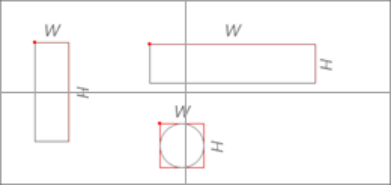
According to some theories of cognitive psychology, humans tend to treat multiple objects that are close together as a whole, so they abstract the elements as cubes, so that they can be positioned more accurately. Using the upper left corner of the rectangle as the starting
Intelligent Human Systems Integration (IHSI 2022): Integrating People and Intelligent Systems https://openaccess.cms-conferences.org/#/publications/book/978-1-7923-8988-7 point, set the upper left corner of each element as the initial X, Y coordinates; set W and H as the total width and height of the interface, and set the beauty value Between 0-1(see Figure 1).
Figure 1. Characterization and positioning of interface elements
BALANCE Refers to the distribution of visual weight in the interface. Elements with a large area will feel heavier than elements with a small area.
(1) (2)
(3)
The interface is divided into four equal parts according to the cross, L, R, T and B respec- tively refer to the left, right, top and bottom 4 different areas of the interface; aij represents the area of the element i in the j area; dij represents the element center line to the interface The distance between the center lines; nj represents the number of elements in the j area.
SYMMETRY Symmetry refers to the degree of symmetry of the interface along the vertical, horizontal and diagonal directions.
(4) Svertical,Shorizontal and Sradial represent the vertical, horizontal and radial symmetry respectively, where
Intelligent Human Systems Integration (IHSI 2022): Integrating People and Intelligent Systems https://openaccess.cms-conferences.org/#/publications/book/978-1-7923-8988-7
(5)
(6)
(7)
X’j,Y’j,H’j,B’j,θ’j and R’jare the values of Xj,Yj,Hj,Bj,θ j and Rjafter orthogonal parameterization, respectively.
(8) (9)
(10) (11)
(12)
UL, UR, LL and LR are the upper left, upper right, lower left and lower right areas of the interface respectively; (xij,yij) and (xc,yc)are the coordinates of the ob- ject i at the center of 1/4j and the center of the interface respectively; bij and hij are the width and height of the abstracted element, respectively; nij is the total number of objects in 1/4 part (counted within the area).
Intelligent Human Systems Integration (IHSI 2022): Integrating People and Intelligent Systems https://openaccess.cms-conferences.org/#/publications/book/978-1-7923-8988-7
INTEGRITY Refers to the continuity of the distribution of interface elements and the overall degree of uniformity.
(13)
(14) Among them, ai is the area of the element; alayout and aframe respectively rep- resent the area of the element in the layout and the overall interface, and n represents the number of objects in the interface.
SIMPLICITY Refers to the simplicity of interface elements. The higher the simplicity of the interface, the more it can reduce the cognitive load of users[3].
(15) Among them, nvertical and nhorizontal have several points aligned in the vertical and horizontal directions respectively, and n represents the number of objects in the interface.
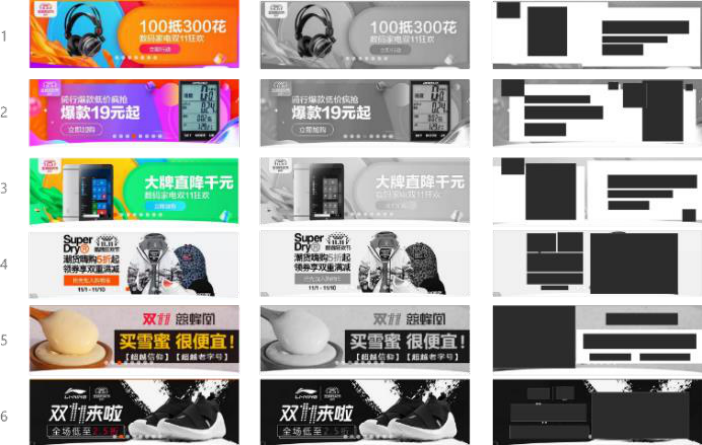
INTERFACE USABILITY In order to verify the method of the paper, three posters designed by Luban and the posters designed by the designer were selected for interface beauty evaluation and machine evalu- ation. The serial numbers 1, 2, 3 are posters designed by Luban, and 4, 5, and 6 are posters designed by designers.
The heavy colors of the interface may be a relatively large interference factor. In order to prevent the color from affecting the beauty, the interface is changed to grayscale mode, and the interface elements are divided into background, decoration elements, LOGO, product main image, and copywriting, which will be different The element is abstracted as a rec- tangular parallelepiped, (see Figure 2) (Altaboli and Yingzi, 2011).
Intelligent Human Systems Integration (IHSI 2022): Integrating People and Intelligent Systems https://openaccess.cms-conferences.org/#/publications/book/978-1-7923-8988-7
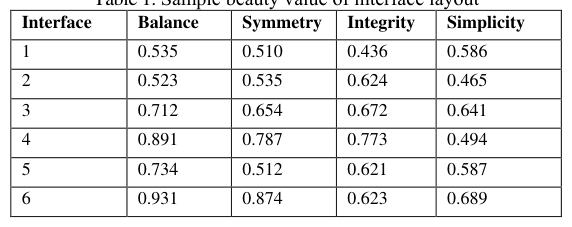
Figure 2. Posters and designer posters generated by Luban According to the calculation formula of the beauty of the interface elements, the balance, symmetry, integrity, and simplicity of the elements are calculated, as shown in Table 1. The calculation result shows that interface 6 > interface 4 > interface 5 > interface 3 > interface 2 > interface 1.Table 1: Sample beauty value of interface layout Interface Balance Symmetry Integrity Simplicity
Next, select 10 design students to make a subjective evaluation of the banner. The score is evaluated in four aspects from 1 to 7. The overall evaluation result is interface 6 > interface 4 > interface 3 > interface 5 > interface 1 > interface 2. The score of interface 6 is relatively the highest, and the ranking is also beautiful. The calculated results are relatively consistent; it proves that the beauty calculation method can more reliably reflect the beauty of the interface.
Intelligent Human Systems Integration (IHSI 2022): Integrating People and Intelligent Systems https://openaccess.cms-conferences.org/#/publications/book/978-1-7923-8988-7
CONCLUSION AND REFLECTION It can be seen that the design styles of the Ali Luban system are very similar, and they are mainly used in the main product image. The emergence of Luban also allows designers to engage in their own design work and deepen their creativity. The emergence of AI design platforms is an inevitable product of modern society. It can not only increase productivity, but also enable people to be more involved in more creative work. Design is essentially a commercial issue. Design is affected by history, culture, life and other aspects. The colli- sion of different elements can often bring many different ideas. It is people who determine the upper limit of the design, and the machine is to help us design better.
In this study, four indicators and formulas for beauty evaluation were selected to verify the effectiveness and reliability of the method. However, there are still shortcomings in this research. The emotional impact of interface elements, the personal preferences of subjec- tive reviewers, and interface colors are not taken into consideration. In-depth research will be carried out in the future.
REFERENCES
Ngo, D. C. L., Teo, L. S., & Byrne, J. G.. Modelling interface aesthetics. Information Sciences, 152, 25-46 (2003) Bauerly, Michael, and Yili Liu. "Computational modeling and experimental investigation
of effects of compositional elements on interface and design aesthetics." Interna- tional journal of human-computer studies 64.8: 670-682 (2006) Mati Mõttus,David Lamas,Maarja Pajusalu,Rui Torres. The evaluation of interface aesthetics[P]. Multimedia, Interaction, Design and Innovation(2013) Altaboli, Ahamed, and Yingzi Lin. "Investigating effects of screen layout elements on in-
terface and screen design aesthetics." Advances in Human-Computer Interac- tion (2011) Lei, Z. H. O. U., et al. "Aesthetic evaluation method of interface elements layout design." Journal of Computer-Aided Design & Computer Graphics 5 (2013)
Intelligent Human Systems Integration (IHSI 2022): Integrating People and Intelligent Systems https://openaccess.cms-conferences.org/#/publications/book/978-1-7923-8988-7
LISTED IN THE AHFE DIGITAL BOOKSTORE CATALOGUE
Explore the complete digital volume
Intelligent Human Systems Integration (IHSI 2022): Integrating People and Intelligent Systems
Read this individual research paper free through the original publisher, or explore the full digital proceedings book.
ISBN 978-1-7923-8988-7
Explore this ISBN in the AHFE Bookstore ↗Listed in the July 2026 bookstore catalogue; search by ISBN to confirm current availability · Digital book purchase optional