Rossana Gaddi, Giovanni Maria Conti (2022). Design through the layers: Smart textiles for contemporary design solutions and sustainable consumption processes. In: Intelligent Human Systems Integration (IHSI 2022): Integrating People and Intelligent Systems. AHFE Open Access, vol. 22. https://doi.org/10.54941/ahfe100952
"As individual consumers, one of the most responsible actions we can take to protect the planet is to extend the life of the things we already use." Taking under advise-ment the indication of Rose Marcario, CEO of Patagonia, the Salewa Metro System project aims to analyse and understand which aesthetic, functional and technical char-acteristics must be integrated in a garment to ensure maximum longevity, counteract-ing the trend towards massive consumption of contemporary society. Today the tex-tile and fashion industry is the least sustainable and most polluting among the entire industrial system, both considering the production side where "every phase of its production chain threatens our planet" (Shen, 2014), and that of consumption, which hardly adopts or induces habits that contribute to the cause of a more equitable fash-ion system. Starting from a stylistic and product analysis of the so-called "vintage" sector, the aesthetic and functional characteristics that allow a garment to remain de-sirable, regardless of the fashion cycles, have been defined. Quality, functionality, style and sustainability are critical factors both from an environmental and also a commercial point of view, if we consider the ever-increasing sensitivity of the market to issues related to the protection of the planet. In the hyper-connected contemporary society, the ever-increasing search for technologies and materials related to well-being and health, in contrast with an extremely tiring urban environment, have been ana-lysed together with the latest growing fashion trends as “athleisure”, where the de-mand for stylistic freedom, comfort and sporting performance is central. The Salewa Metro System project is a collection of urban and sporty, convertible and multifunc-tional outerwear composed of three layers of fabric that can be coupled according to the conditions of the external environment. The technical analysis of the layering system, that is the technical garments with which mountaineers are equipped, has generated the guidelines for the development of a collection that starts from pure technical performance, smoothing out the most extreme accents (useful only in situa-tions of extreme meteorological hostility) to then propose itself to an urban and low mountain market. The use of smart materials and nano textile technologies has made it possible to create a layered system of garments with different functions that can always guarantee the best conditions in which to make the human body work. Used correctly, a good sequence of layers provides protection from environmental atmos-pheric agents and pollutants, perfect skin transpiration as well as the conservation and dissipation of body heat. The project was carried out in collaboration with the Salewa sportswear company, and the garments are designed to remain intact as long as possi-ble, prepared for care, repairs and replacement of parts. They remain aesthetically at-tractive in the long term thanks to the classic stylistic choices that can be modified according to the occasion. They are always upgradeable in performance: the individual textile components are always replaceable. They tolerate aging well, have a long-life cycle and hit the market objectives together with increasingly design inputs for a more sustainable fashion process.
INTRODUCTION. THE CONTEMPORARY SCENARIO BETWEEN FASHION, CONSUMERISM AND SUSTAINABILITY.
“[…] being a sustainable tout court company means respect for the environment, saving raw materials and economic resources, and the health of workers and consumers, respect for human rights, rationalization of creative and productive processes, stimulating innovation” (SMI, 2016).
Intelligent Human Systems Integration (IHSI 2022): Integrating People and Intelligent Systems https://openaccess.cms-conferences.org/#/publications/book/978-1-7923-8988-7
Within a socio-cultural scenario in profound change which influences the dynamics of industrial design, highlighting the need for a change aimed at preserving natural capital and therefore creating social well-being, an urgent need arises for those who deals with university training to act in the preparation of future fashion designers able to integrate sustainability in their projects.
It is therefore necessary that new designers acquire a design process capable of providing them with tools that will allow them to assimilate and promote a design ethics aimed at preserving social and environmental values.
The fashion industry, in particular the production of clothing, is part of one of the sectors most associated with the exploitation of resources and people. In the last thirty years (AA.VV, 2021), awareness of the impact of consumption and production of fashion on both people and the environment has grown. Fashion companies have a responsibility to address sustainability issues in their sphere of influence. However, the integration of sustainable fashion also depends on a change in the values, attitudes and dominant behaviours of consumers. While consumers often have a positive view of socially and environmentally compatible products, are these attitudes rarely transformed into concrete buying and consuming behaviours?
Furthermore, due to non-transparent supply chains, consumers are often not aware of the consequences of their buying behaviours and, therefore, are not willing to pay a premium for sustainable fashion. Bridging the current knowledge gap is necessary for sustainable fashion to have a future; this makes it important to discuss potential means of promoting a more sustainable fashion consumption culture.
Being a designer in the fashion industry involves carrying out a design activity with a strong social and cultural impact. If on the one hand the item of clothing preserves physical safety, on the other it also affects the psychological one because, as Conti writes: "fashion always means looking, being looked at and communicating" (Conti, in Bertola & Colombi, 2010, p. 217).
METHODOLOGY. HYBRIDIZATIONS OF STYLES.
Fashion is the mirror of a society. The society has infinite different facets but at the same time widespread characteristics. Today people now must obtain various degrees, be able to speak many languages, always be connected and always updated on everything. The analysis of the latest trends, in relation to the conditions of contemporary society, allows us to clarify what the human being is living and what he or she desires in a conscious way, also allowing us to hypothesize and identify what could be the scenarios of near future, and consequently, the fashion of tomorrow. Research methodology
Intelligent Human Systems Integration (IHSI 2022): Integrating People and Intelligent Systems https://openaccess.cms-conferences.org/#/publications/book/978-1-7923-8988-7
This explanatory exploratory research is qualitative and involves inductive and deductive processes (Conti and Rech, 2021, p 93). Consequently, the research approach was systemic- constructivist, whose assumption was based on the object of study, providing the basis for a transdisciplinary approach and becoming relevant in the current complexity of design. The methodology was composed of Grounded Theory (Glaser and Strauss, 2017), whose investment as a research reference influences this method’s most crucial procedure: the data coding stage. Triangulation was also used (Kawamura, 2015), whose form of multiple operationalization, or convergent validation, is generally used to describe various data collection techniques to build a concept different qualitative or a mix between qualitative and quantitative procedures.
Athleisure and Gorpcore: new technical and hybrid clothing typologies Athleisure is the result of the union of the words athletic and leisure, or sports and free time respectively, and describes a fashion trend for which clothing designed for sports activities is worn in alternative situations, such as in the workplace, at school or other social occasions (Bellan G., 2019, p. 42).
The first concerns the technological improvement in the textile sector, capable of guaranteeing more flexible, durable and easy to wash synthetic fibres (Marzotto, G., 2006) which have replaced most of the natural fabrics, the second consists in the growing interest in having good health that has prompted more and more people to try their hand at physical activities, or at least to prove themselves as sportsmen by purchasing clothing as equipment or as a status symbol (Canella, M., Giuntini, S., Turinetto, M., 2011, p.35). The last is the decline in formality in the workplace and in fashion in general, which has resulted in greater aesthetic relaxation and in the mix of sportiness and elegance in all situations.
The recent phenomenon called Gorpcore, a new style inspired by outdoor sports activities, has in turn collected the two trends to take them to the next level by adding functionality to the garments which serves to respond to the environmental stimuli of the natural landscape and climatic conditions of winter weather. Gorpcore takes its name from “good old raisins and peanuts” or a type of snack mix (Madden, A., 2018) a combination of muesli, dried fruit, nuts and sometimes chocolate, developed as a food to take with you on excursions. As a trend that dominated fashion from the second half of 2018 onwards (Madden, A., 2018, idem), it started out on the streets around the world with that ever-attentive fashion audience eager to stand out, and very soon was picked up and reinterpreted on the catwalks of the fashion capitals.
The enormous success of Athleisure first and then Gorpcore is due to the fact that these two phenomena seem to have different characteristics from those of all the other passenger trends; they tell of a path of liberation from the classic canons of fashion in the face of maximum comfort and functionality as well as referring to a composite way of dressing, not necessarily mono-material but, sometimes, composed of textile
Intelligent Human Systems Integration (IHSI 2022): Integrating People and Intelligent Systems https://openaccess.cms-conferences.org/#/publications/book/978-1-7923-8988-7 layers whose characteristics bring together when combined, the properties of all the materials involved stand out.
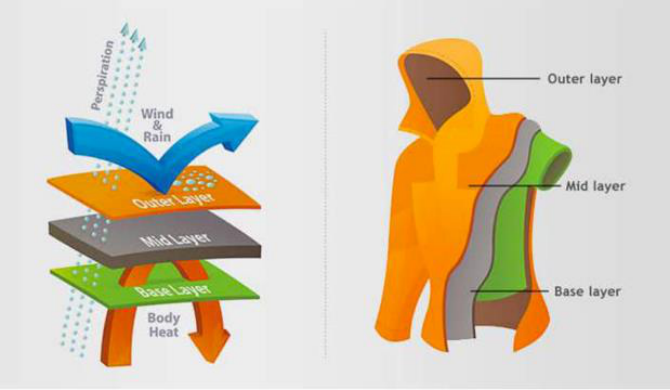
Layering is the name used to identify the way of dressing according to the various activities and conditions in the world of technical outdoor clothing. It is a system of garments with different functions, in collaboration with the aim of ensuring the best conditions in which to make the human body work (Ruckman, J., 2005). Provided they are used correctly, a good sequence of layers provides protection from atmospheric agents, sweat away from the body towards the outside and conservation or dissipation of heat. All with maximum effectiveness in the shortest time.
Figure 1. Explanatory diagram of the layering system THE SALEWA METRO SYSTEM PROJECT
The design method applied to the SALEWA METRO SYSTEM project involves the study of the longevity characteristics of vintage and proposes, through the garments, to challenge the limits of time with the knowledge of contemporary needs. Therefore, the need to think of multi-functional and versatile garments arises, in order to meet the needs of the largest possible number of occasions of use and finally, by means of in-depth materials, it guarantees the best technical performance. The project was carried out in collaboration with the Salewa brand, a leader in the outdoor clothing sector in which the metropolitan style manifests itself through conscious technical choices with respect to how much, whether in the city, as in the mountains or in other conditions, the body must be protected.
Intelligent Human Systems Integration (IHSI 2022): Integrating People and Intelligent Systems https://openaccess.cms-conferences.org/#/publications/book/978-1-7923-8988-7
Project scenario The SALEWA METRO SYSTEM capsule collection SYSTEM is aimed at a predominantly male audience between 16 and 30 years of age; the target expands to include girls, if we consider that the volumes and colours of the proposed models, actually originally masculine characteristics, are appreciable by all, falling within the fickle boundaries of the genderless category.
Reflected in this collection are those who are divided between the city and the valley, who love and frequent the mountains, who look for it in their free time, whether it is enough to reach it or not. They are students or young workers, who share a healthy and sporty lifestyle. We are not talking about an extremely fashion-conscious audience but certainly not indifferent to it; an audience that needs slower rhythms, accustomed to becoming attached to the item of clothing because of its quality.
Description of Salewa Metro System project The strategy used to make the Salewa Metro System lasting over time was to break it down into three levels (underwear, intermediate thermal layer, shell) in such a way as to create a physical division between function and aesthetics. This choice in fact allows to entrust to the intermediate layer the aesthetic sphere while everything related to the intimate and the shell the performance so that the components, released from each other, they should not suffer because of the various changes in fashion or declines of performance.
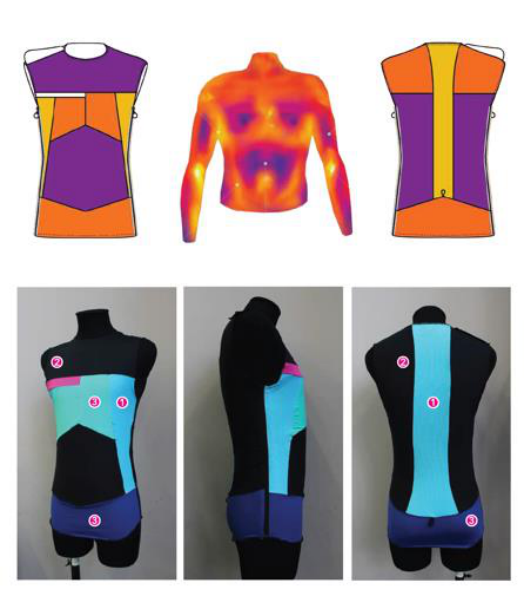
The parts afferent to the inner layer exploits the body mapping technology by providing different performances (thermal effect, breathability and thermoregulation) and functions to the various parts of the body through the fabric. Through the design of the openings, the base layers are easily wearable under the main garment even without the latter having to be taken off, proving to be ready for all occasions.
Intelligent Human Systems Integration (IHSI 2022): Integrating People and Intelligent Systems https://openaccess.cms-conferences.org/#/publications/book/978-1-7923-8988-7
Figure 2. The inner layer (1- Maximum breathability and anti-odour effect with Dyamond X- Statics by Borgini Jersey; 2 - Warmth protected with Nilit Heat technology; 3- Maglificio Ripa’s nanofiber, in two weight variants, guarantees thermoregulation).
Salewa Metro System mid layers are all reversible garments, a feature that plays important roles both from the point of view technical and aesthetic. The garment is divided into a sportier side and a more classic one, which in terms of performance means a direction made of a blend of 50% recycled polyester, 41% merino wool and 9% elastane and the other in 100% cashmere wool. A feature that allows in the sportier version to have great thermoregulation, limitation of bad smells and removal of sweat from the body and in the more classic version, great heat and perfect thermoregulation. Aesthetically, the garment reflects its organization technical, the sporty side shows up with two big ones Napoleonic pockets and numerous anti- abrasion inserts, unlike of the classic one that is limited to a few cuts and a line more discreet. The key feature of the mid layers is the presence of two back pockets that allow you to place the inner and outer layers inside.
Intelligent Human Systems Integration (IHSI 2022): Integrating People and Intelligent Systems https://openaccess.cms-conferences.org/#/publications/book/978-1-7923-8988-7
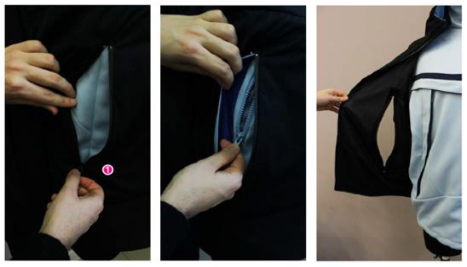
Figure 3. (left). The mid layer (1- sport version; 2- classic version; 3- two back pockets that allow to place inside the inner layer and the outer layer) Fig. 4 (right). The shell layer (1- cuts finished with waterproof zips to access the underlying layers)
Salewa Metro System shells are extremely minimalist to save weight and volume. Consequently, they allow through cuts finished with waterproof zips to access the underlying pockets of the thermal layer instead of having their own pocket bags. In this way, the usual comfort of the pocket can be reconciled with maximum impermeability and lightness. Speaking of performance, it is possible to imagine that the advancement of technology will leads to more innovative proposals. For this reason, in the Salewa Metro System project, performance is guaranteed by minimalist elements made with small quantities of fabric, which when they lose their effectiveness can be eliminated or replaced without irreversibly compromising the garment.
CONCLUSIONS
“Design is a need, a necessary and valuable process of invention and innovation, with the potential to bring us closer to a sustainable society - a society in which we design for sustainable consumption” (Gant & Chapman, 2007, p. 7) In the contemporary fashion system, there are different sustainable practices that are adopted by companies; in the clothing sector, the practice of reuse such as that of vintage starts a new life cycle starting from distribution and then moving on to the use phase.
In June 13th 2012, the National Chamber of Italian Fashion drew up a decalogue that follows global challenges with the aim of directing and encouraging the adoption of responsible management models along the entire fashion value chain, for the benefit of Italian system and addressed to associated companies but also to those that, in a different way, contribute to the excellence of Italian products. The first theme
Intelligent Human Systems Integration (IHSI 2022): Integrating People and Intelligent Systems https://openaccess.cms-conferences.org/#/publications/book/978-1-7923-8988-7 introduces concerned the principle of a product and its design starting from the original idea: “Design quality products that can last a long time and minimize the impact on ecosystems”.
It could not be more evident how much the one who can first determine the sustainability of a product is the designer who conceives it; the value of this profession in relation to a more ethical consumption is then immeasurable.
Even if sustainable fashion can be seen as an oxymoron, it is possible to interpret it starting from different realities and incorporating different aspects. The choice of materials, the reduction in the use of pesticides, the promotion of a cradle-to-cradle chain, as well as designing responsibly starting from the characteristics of the materials, as it has been done in the Salewa Metro System project, are only the first step to encourage more conscious behaviours.
ACKNOWLEDGMENTS
Authors thank Salewa for participating in the research and development phases of the product presented as a result of the Thesis in Design for the Fashion System by Gabriele Bellan, “Salewa Metro System”, Supervisor, Giovanni Maria Conti, Co- supervisors, Rossana Gaddi and Maurizia Botti, School of Design, Politecnico di Milano, academic Year 2018-2019. The Project was selected and published in the ADI Design Index 2020 Youth Targa Category. Giovanni Maria Conti is the author of paragraphs 3 and 4. Rossana Gaddi is the author of paragraphs 1 and 2. Both authors are authors of the Abstract.
REFERENCES
AA.VV, The State of Fashion 2020, (2020), “Report by BOF – Business of Fashion and McKinsey & Company” AA.VV, The State of Fashion 2021, (2021) “Report by BOF – Business of Fashion
and McKinsey & Company” Bellan G., Salewa Metro System, (2019) Tesi in Design for the Fashion System, Politecnico di Milano, Milano Bertola, P., (2008)” La Moda Progettata: le (sette meno una) vie del design.” Bologna,
IT: Pitagora Canella, M., Giuntini, S., Turinetto, M., (2011) “Sport e stile. 150 anni d’immagine al femminile”, Milano: Skira, Caruso, C., (10 Oct. 2018) Gorpcore: come ha fatto l’abbigliamento da montagna a
diventare cool, https://www.nssmag.com/it/fashion/16387/gorpcore-come-ha- fatto-l-abbigliamento-da-montagna-a-diventare-cool Chapman J., Gant N., (2007), “Designers Visionaries and Other Stories. A Collection of Sustainable Design Essays”, Routledg: London,
Intelligent Human Systems Integration (IHSI 2022): Integrating People and Intelligent Systems https://openaccess.cms-conferences.org/#/publications/book/978-1-7923-8988-7
Conti, G. M., (2010), “Permanenze storiche: l’approccio storiografico per il progetto della moda”. In Bertola, P., Colombi, C., Metamoda. Percorsi di Ricerca per il Design del Prodotto Moda. (pp. 206 - 231) Santarcangelo di Romagna, IT: Maggioli Editore Conti, G.M., Rech S. R., (2021) “Fashion and Work Organizational Ecosystem
Prospects and Post-COVID-19 Scenarios”. PAD. Pages on Arts and Design, ISSN 1972-7887 #20, Vol. 14, June 2021., pp.85-108 DeLong, M., Heinemann, B. and Reiley, K., (2005), “Hooked on vintage”. Fashion Theory, 9(1) p.23–42. Fletcher, K., & Grose, L., (2012), “Fashion and sustainability: Design for change.”
London, UK: Laurence King Publishing,. Glaser, B.G. & Strauss, A.L., (2017), “The Discovery of Grounded Theory: strategies for qualitative Research.” NY: Routledge Taylor & Francis Group. Kawamura, Y., (2015), “Doing Research in Fashion and Dress: an introduction
qualitative method”. London: Bloomsbury, Linfante, V., (2008), “Refashioning: dal collezionismo al vintage”, Santarcangelo di Romagna: Maggioli, Madden, A., (10 Aug. 2018) What the Hell Is the Gorpcore Trend, and Why Am I So
Into It? https://www.whowhatwear.co.uk/whati-is-gorpcore-trend Marzotto, G., in Bonami F., Frisa M. L., Tonchi S. (a cura di), (2006), “Human Game.
Vincitori e vinti”, Fondazione Pitti Discovery. Milano: Edizioni Charta Ruckman, J., The application of a layered system to the marketing of outdoor clothing, (2005), Journal of Fashion Marketing and Management, Vol. 9 No.1 p.122-129, SMI - Sistema Moda Italia (2016, March 23). Sostenibilità nell’Industria Tessile-
Intelligent Human Systems Integration (IHSI 2022): Integrating People and Intelligent Systems https://openaccess.cms-conferences.org/#/publications/book/978-1-7923-8988-7
LISTED IN THE AHFE DIGITAL BOOKSTORE CATALOGUE
Explore the complete digital volume
Intelligent Human Systems Integration (IHSI 2022): Integrating People and Intelligent Systems
Read this individual research paper free through the original publisher, or explore the full digital proceedings book.
ISBN 978-1-7923-8988-7
Explore this ISBN in the AHFE Bookstore ↗Listed in the July 2026 bookstore catalogue; search by ISBN to confirm current availability · Digital book purchase optional