Lee Ostrom (2021). Graduate Student Safety Culture. In: Human Systems Engineering and Design (IHSED2021): Future Trends and Applications. AHFE Open Access, vol. 21. https://doi.org/10.54941/ahfe1001102
A culture is a collective of social norms, mannerisms, religion, language, activities, environment, and other factors that help to make us who we are. Within any culture lies its safety culture. How does an organization assess its safety culture? One method is to interview every person in an organization. However, this is impractical. Properly constructed safety surveys provide information that can be used to assess and to help improve an organization’s safety culture. Laboratory experiments of varying levels of hazards are conducted every day around the world in colleges and universities. These experiments are for basic and applied research and for teaching undergraduate and graduate students how to conduct research. Generally, these experiments are conducted safely. Many accidents have occurred in University Laboratories. Some are very horrific. This paper discusses one such accident and discusses two universities’ safety culture surveys and presents some results from the surveys.
Human Systems Engineering and Design (IHSED 2021) https://openaccess.cms-conferences.org/#/publications/book/978-1-7923-8987-0
INTRODUCTION
A culture: the social norms, mannerisms, religion, language, activities, environment, and other factors that help to make us who we are; provide a good part of the basis of a country’s, community’s, companies, and/or individual’s behavior. It is of utmost importance to determine whether a culture supports safe or risk-taking behavior. Research into social culture has gone on from the dawn of time. It was and is essential for one culture to understand another's to gain maybe a military or economic edge or to understand why one country does something that might directly conflict with another country’s interests. Within any culture lies its safety culture. How does an organization assess its safety culture? This question Wilhelmsen and Ostrom asked back in 1992 and 1995 (Ostrom, Wilhelmsen, and Kaplan, 1993; Wilhelmsen and Ostrom, 1995). Organizations use different methods to evaluate safety culture. A very desirable approach is to talk with every employee and ask them about their safety concerns. Organizations need ways to measure and then determine whether improvements or decrements in safety culture have occurred. A standardized written survey instrument can be used in addition to informal employee interviews to understand the safety culture of an organization. This paper focuses on university safety and safety culture. The paper length limitations preclude a full discussion of all aspects of the surveys developed and the results. However, the following discussion does provide an overview of the topics.
UNIVERSITY LABORATORY SAFETY Laboratory experiments of varying levels of hazards are conducted every day around the world in colleges and universities. These experiments are for basic research and for teaching undergraduate and graduate students how to conduct research. Generally, these experiments are conducted safely. Many accidents have occurred in University Laboratories and with student experiments, not in laboratories. Some are very horrific. The following briefly describes two accidents that have occurred in university laboratories. The first accident happened in a Texas Tech University (TTU) on January 7, 2010 and is abbreviated from the US Chemical Safety Board (CSB) report (U.S. CSB, 2011). TTU was contracted by Northeastern University (NEU) to participate in a program titled “Awareness and Localization of Explosive-Related Threats” (ALERT). This project was funded by the U.S. Department of Homeland Security (DHS). TTU’s research was focused on the detection of unique, potentially extremely exothermic materials that could represent a future security threat. Various materials were synthesized and then tested for their chemical properties. The accident occurred on January 7. Graduate students were synthesizing a nickel hydrazine perchlorate (NHP) derivative. Small quantities were produced, but the graduate students made independent decisions to synthesize larger quantities for their convenience of testing. One student used a mortar and pestle to grind the NHP after it was produced to break
Human Systems Engineering and Design (IHSED 2021) https://openaccess.cms-conferences.org/#/publications/book/978-1-7923-8987-0 up lumps. The goal was to have a fine particle size. The student was wearing safety equipment when he started grinding the chemical. However, he walked away from the material, and when he returned, he did not put back on his goggles. He started grinding the material again. At that point, the NHP detonated. The explosion caused the student to lose three fingers, his hands and face were burned, and one of his eyes was injured. The CSB conducted a thorough investigation and produced a set of findings and recommendations to prevent a recurrence. In April 2017, four students tested a potential rocket fuel mixture they had developed (NBC News, 2017). The test was overseen by a chemistry professor. The students took a pipe of between 20 cm (8 inches) and 30 cm (12 inches) and approximately 3.8 cm (1.5 inches) in diameter. The rocket fuel mixture was packed into the pipe, and the pipe was strapped to a pallet. The pallet was placed in the middle of a parking lot. An electronic match was inserted into the fuel. The students stood back and attempted to ignite the electronic match. However, this method failed. So, a student stood over the pipe and tried to light the fuel with a lighter. This attempt worked with explosive results. All four students were transported to the hospital. Fortunately, no one was killed. However, the injuries they incurred were serious. The chemistry professor was watching the students from a distance and did not stop the experiment from occurring. These two examples demonstrate the potential for university accidents to cause serious harm.
Safety Culture Surveys The following will discuss two surveys I conducted most recently. The first was conducted at Aalto University in 2018, and the second was conducted at the University of Idaho in 2021.
Aalto University Survey My Fulbright Specialist visit to Aalto University in Finland involved performing safety assessments of the university’s physics laboratories. The Physics Department’s research focuses on Materials physics, Quantum technology, Soft & living matter, and Advanced energy solutions. Topics range from fundamental scientific research to applications. The objective of the Department of Applied Physics is to educate future generations of physics research and development professionals and other technologists (Aalto University, 2021). The department is a major user of Finland’s national research infrastructure called OtaNano. This set of facilities provides fabrication, characterization and measurement equipment and facilities for students, scientists, and high-tech businesses. The Nanomicroscopy Center and the Low Temperature Laboratory of OtaNano are critical assets for their researchers.
Human Systems Engineering and Design (IHSED 2021) https://openaccess.cms-conferences.org/#/publications/book/978-1-7923-8987-0
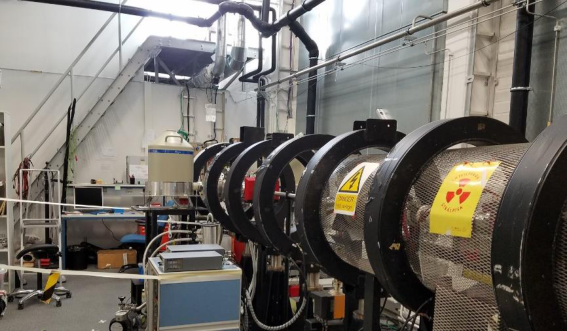
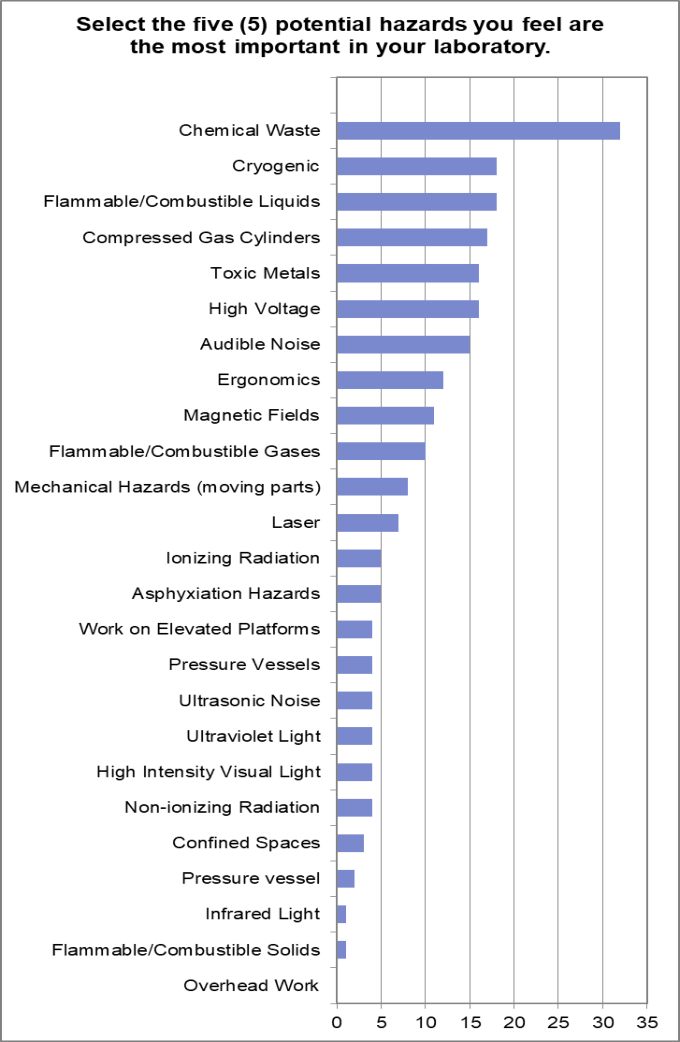
The survey I developed primarily was to determine the hazards the researchers could be potentially exposed to, the types of injuries in the laboratories and how best to provide safety training to the researchers. This survey was developed, and the data were collected in February 2018. Figure 1 shows one of the complex laboratories that are in the department. I cannot provide all the information about the survey in this brief paper. However, I will provide the survey upon email request. Figure 2 provides the data collected for the question concerning the types of hazards the researchers felt they could be exposed.
Figure 1. Example Physics Laboratory at Aalto University (Ostrom original photo).
It is clear respondents to the survey are interested in safety and desire to learn more about the potential hazards in their respective workplaces. To receive 47 survey responses is good for even a survey of a much larger organization. I made several recommendations in this report. Here is a summary of the more important ones, along with a couple more from observing the laboratories in the Applied Physics Department and in the Chemistry Department.
1. Provide posters behind the safety binders to clearly show their locations. 2. Have a member of the Applied Physics Department be on the University committee that is working on the chemical waste procedures. 3. Provide a poster, maybe the same one, with instructions to report incidents and accidents on the Aalto Website. The sign should also provide contact information for safety contacts within Aalto University and the Applied Physics Department. 4. Determine how to access the incident and accident reports from the University website. 5. Designate a safety trainer to provide most of the specific safety training.
Human Systems Engineering and Design (IHSED 2021) https://openaccess.cms-conferences.org/#/publications/book/978-1-7923-8987-0
6. The lab lead should provide specific training for their respective laboratories. 7. In some cases, like cryogenic safety, the department could develop a safety video and make it available on a website. 8. Make sure everyone knows how to actuate a fire alarm and what to do in an emergency. 9. Provide fire extinguisher training. Some fire extinguisher maintenance companies have fire extinguisher training simulators that are easy to use and provide some level of realism. 10. Provide department members information concerning how to attain first aid, CPR, and Automated External Defibrillator (AED) training.
University of Idaho, Idaho Falls Survey The University of Idaho, Idaho Falls Center (UIIF) is co-located with Idaho State University. The center primarily supports the educational needs of the Idaho National Laboratory. The faculty at UIIF conduct research in the areas of nuclear engineering, bioenergy, cybersecurity, material science, artificial intelligence, robotics, and human factors/risk assessment. There are well over 40 graduate students at the center. About half of the students are traditional graduate students. The remainder is part-time graduate students who work full-time. The purpose of the survey was to determine the level of knowledge of safety and to get an indication of the safety culture of the graduate students. The survey was designed to have a limited number of questions to help ensure it would be completed by as many of the current graduate students as possible. The survey was approved by UI’s Institutional Review Board and was distributed electronically to all the graduate students. Sixteen students completed the survey. I cannot provide a complete description of the survey or the complete results because of the limited size of the paper. The following are some interesting findings from the survey. Figure 3 shows the responses to the question concerning the level of the graduate students. Figure 4 shows the results of the types of research the students will be working on. The laboratory projects most of the graduate students work on is nuclear engineering- related. These projects include thermodynamic, mechanical engineering, and materials. The most recent materials work revolves around molten salt reactor research. Molten salts are being considered for heat transfer and cooling the reactors. In some cases, the fuel will be dissolved in molten salt. Molten salt research involves high temperatures, in some cases over 1000oC.
Summary of University of Idaho, Idaho Falls Survey The results of the survey provided very valuable information. The following are the insights the data provided:
Human Systems Engineering and Design (IHSED 2021) https://openaccess.cms-conferences.org/#/publications/book/978-1-7923-8987-0
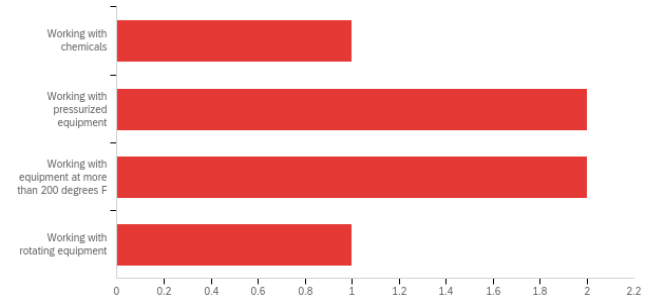
The laboratory projects most of the graduate students work on is nuclear engineering- related. These projects include thermodynamic, mechanical engineering, and materials. The most recent materials work revolves around molten salt reactor research. Molten salts are being considered for heat transfer and cooling the reactors. In some cases, the fuel will be dissolved in molten salt. Molten salt research involves high temperatures, in some cases over 1000oC (Forsberg, Peterson, and Zhao, 2004). Figure 5 is quite complex and shows the perceived level of knowledge of the potential hazards they could possibly encounter in the laboratories.
1. Most of the students had received safety training as undergraduate students, and this training included the use of personal protective equipment. 2. The students who will be working in labs understand the type of work they will be performing. However, the level of knowledge of the hazard types varies greatly. 3. Two-thirds of the major professors do not provide specific safety training. 4. All the student responders understand how to exit the buildings in the event of a fire alarm and 90% know how to operate the fire alarm. Less than half of the student responders are familiar with where the AED is in the buildings. However, they are familiar with where the fire extinguisher is located. 5. Almost two-thirds of the students have had some first aid training. 6. Most of the student responders are visual learners and like learning in a group setting. 7. The students who will be working in labs understand the type of work they will be performing. However, the level of knowledge of the hazard types varies greatly.
CONCLUSIONS
Properly constructed safety surveys provide information that can be directly used to improve the safety of laboratories in university settings. The safety efforts and information can be focused on the potential problem areas. There were some similarities in the results of the two surveys. Knowledge about how to activate the buildings’ fire alarms is not universally known. Also, where the AEDs are located is not well known.
Human Systems Engineering and Design (IHSED 2021) https://openaccess.cms-conferences.org/#/publications/book/978-1-7923-8987-0
Figure 2. Example Results from Aalto University Survey
Human Systems Engineering and Design (IHSED 2021) https://openaccess.cms-conferences.org/#/publications/book/978-1-7923-8987-0
Figure 3. Graduate Student Level
Figure available in the original PDF paper.
Figure 4. Type of Laboratory Research
REFERENCES
Aalto University Physics Department (2021) accessed March 2021, https://www.aalto.fi/en/department-of-applied-physics. Forsberg, C.W., Peterson, P.F., Zhao, H.H. (2004) An advanced molten salt reactor using hightemperature reactor technology, American Nuclear Society.
Human Systems Engineering and Design (IHSED 2021) https://openaccess.cms-conferences.org/#/publications/book/978-1-7923-8987-0
NBC News, (2017) University of Idaho Students Injured in Rocket Explosion, accessed October 2021, https://www.nbcnews.com/news/us-news/university-idaho-students- injured-rocket-explosion-n746686. Ostrom, L.T., Wilhelmsen, C.A., and Kaplan, K.: (1993) Assessing Safety Culture, Journal of
Nuclear Safety, 34(2). U.S. Chemical Safety Board (1995) Texas Tech University Laboratory Explosion, No. 2010- 05-I-TX, (1995) Wilhelmsen, C.A., and Ostrom, L.T. (1995) “Developing a Safety Culture Survey Instrument,”
presented at the ANS Safety Culture in Nuclear Installations Conference, Vienna, Austria.
Human Systems Engineering and Design (IHSED 2021) https://openaccess.cms-conferences.org/#/publications/book/978-1-7923-8987-0
LISTED IN THE AHFE DIGITAL BOOKSTORE CATALOGUE
Explore the complete digital volume
Human Systems Engineering and Design (IHSED2021): Future Trends and Applications
Read this individual research paper free through the original publisher, or explore the full digital proceedings book.
ISBN 978-1-7923-8987-0
Explore this ISBN in the AHFE Bookstore ↗Listed in the July 2026 bookstore catalogue; search by ISBN to confirm current availability · Digital book purchase optional