Lorena Olmos Pineda, Jorge Gil Tejeda (2021). Behavior patterns detection in the interaction with flat screen technology work-systems. In: Human Systems Engineering and Design (IHSED2021): Future Trends and Applications. AHFE Open Access, vol. 21. https://doi.org/10.54941/ahfe1001144
The most common work systems with flat screen technology in learning environments of Public Universities in Mexico are mainly determined by mobile devices and laptops. From comparative analysis with mathematical models, it was observed the existence of behavior patterns from the interaction processes that a group of users with normal vision performs on these technological devices. It has been detected from these studies that the interaction processes with a work system are not continuous, they are integrated by a large number of temporary interaction micro-processes which are grouped into sub-systems and they tend to vary depending on the work system in which the user interacts. In addition, it was observed that these processes are hierarchically preceded by two stages: The first stage refers to the location, where factors of spatiality and the focal attentional subsystem are involved. The second stage is integrated of temporary micro-processes of gross motor interaction. It is from the precise spatial location that the processes of fine motor interaction start and the interaction with the work system is executed. Therefore, it is concluded that they are work systems that require visuospatial skills of precision from the user. At the same time, it was detected that the continuous repetition of these patterns tends to generate in the user an habituation to these work systems, which could generate repercussions in various dimensions on the user, highlighting those mentioned as follow: accessibility, psychological and cognitive factors, health and inclusion of user groups. These studies are intended to promote reflections on the design of work systems considering user groups and the behavior models that these systems generate, as well as the inclusion of users whose dominant system is not the vision.
The complexity in the interaction processes with a variety technological device has become a topic of interest and research for various areas of knowledge. More users are incorporating technological devices into their daily life activities, not only for the execution of simple tasks but also as tools to enhance the user's cognitive skills in different fields such as academic, economic, cultural, scientific, among others. In previous studies, it has been observed that not only the characteristics of the work system of the technological device affect the user's interaction processes, but also the use of the user's dominant system in certain activities, either due to damage or for some other reason (Tejeda and Pineda 2020a). Similarly, it is clear to observe that in some devices the tasks become more repetitive than others, modifying the interaction processes in the user and consequently affecting him in multidimensional levels. However, it is important to specify that it was observed that there are two interaction processes that precede the execution of tasks in the work system and these are, in hierarchical order: the spatial location of the artifact and the generation of gross motor interaction responses. In this sense, it is emphasized that without a correct spatial location of the work system the tasks could not be performed adequately with it. Which leads us to reflect that user groups that do not have the sensory mechanisms of spatial location of precision such as sight will have problems in the interaction with this type of systems., The most common observed problems are stress and excessive attentional processes in relation to the work system (Tejeda and Pineda 2020b). In the case of people with normal vision different behavioral patterns are generated such as habituation to the work system and the generation of repetitive tasks, which could have repercussions in ligament injuries, inadequate body positions, a decrease in focal attention in the work system, among others (Gil et al., 2020, Pineda et al., 2020). On the other hand is relevant to highlight that the processes of interaction with work systems are not executed continuously but from a large number of Temporal micro-processes of Interaction Interrelated (TMI-I), which are grouped into sub-systems, for therefore, the phenomenon of interaction with technological devices is considered to be meta-systemic in nature. Based on the nature of the phenomenon, for the observation and study of the structure of the meta-system were used mathematical models from networks. These studies are intended to promote reflections on the design of work systems considering
Human Systems Engineering and Design (IHSED 2021) https://openaccess.cms-conferences.org/#/publications/book/978-1-7923-8987-0 the inclusion of user groups which dominant mechanism of interaction is not the vision.
DETECTION OF TEMPRARY MICRO-PROCESSES OF INTERACTION IN WORK SYSTEMS WITH FLAT SCREEN TECHNOLOGY Interaction processes with flat screen technology work systems are not carried out continuously. They are made from a variety of interrelated Temporal Micro-processes of Interaction (TMI-I). In this sense, TMI-I can be classified for a better study in physical processes, in which a physical contact with the work system occurs and cognitive processes, in which mental processes such as memory, reasoning, etc., are executed. Both TMIs are interrelated during the interaction process., generating a complex phenomenon that takes place in cycles of human interaction and requires multiple dimensions and responses from the user. The study was developed from the process observation carried out by 12 users with Normal vision (Nv) with one of the most common devices in a learning environment in public universities during 313.26 seconds on average. The devices used by users are intercultural artifacts with very particular characteristics belonging to the current Industry 4.0 and can be described like smartphones.
The methodology used on this study was the user modeling by networks in which individual features of each user are shown and analysis of data. In the construction of the networks, the interaction processes determined by the interrelation User - Work System of the Technological Device were considered. The user's activity was delimited from the assignment of two tasks: 1) Locate the course web page, and 2) Enter into the virtual product. The tasks allowed the user great freedom in interacting with the device. So each user had the opportunity to interact based on their preferences, emotional responses, browsing behaviors, etc., Consequently, each user modeling was analyzed in two phases which are described next. Phase 1. In which the relationship between the sensory mechanisms during the process of interaction with the Work System (WS) of the device were shown as well as the relationship with the emotional responses given by the user.
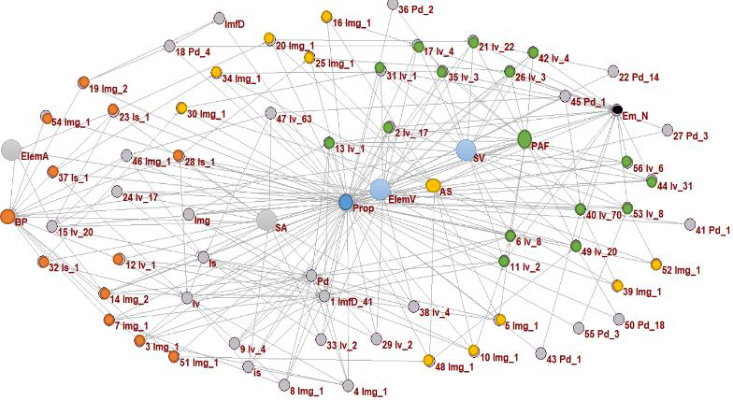
Figure 1. Shows, as an example, the interaction processes carried out by the User 10 (U10) with normal vision on the device with flat screen technology. In the network it is observed that the interaction processes can be described as meta-systems of interaction. In this complex process can be seen that TMI-I precede the physical interaction with the WS, and are stated in hierarchical order: 1) location of the artifact as an external object to the user. 2) Temporal micro-processes of gross motor interaction. In the case of localization, a meta- system was again observed integrated by the activation of spatiality factors and the activation of Focal Attention subsystem (FAPs). Sensory Mechanisms (SM) related to spatial location were propioception (Prop), gross motor interaction (Img) and visual interaction (Iv). The Focal Attention sub-system was related to the minimal activation of the SMs of Prop, Iv and
Figure available in the original PDF paper.
Human Systems Engineering and Design (IHSED 2021) https://openaccess.cms-conferences.org/#/publications/book/978-1-7923-8987-0 they were activated after the Img. It was from the activation of this subsystem that a precise location of the technological device was generated, and a second phase of gross motor interaction was carried out which involved a greater precision of the user-work system relationship and had the purpose to reduce the distance between them. From this, more complex processes were carried out that involved not only physical but cognitive processes of a higher level, likewise, the communication process with the device that were clearly observable through processes of fine motor interaction with fingers (ImfD) as well as with the digital pressure (Pd). In relation to the user, this type of artifacts requires a “high precision spatial localization” in the interaction processes with the WS also requires a high visuospatial skills from a user. It is perceived that user sectors with some damage in the visual system will have serious problems in executing precise interaction processes. In other studies, it was observed that people with impaired vision tend to replace just Iv with the activation of the SM of Img, ImfD, Pd and sound interaction (Is), (Pineda and Tejeda 2020), most of them related with mental processes.
Figure 1. Static network. Shows the relationship of the sensory mechanisms in the process of interaction with flat screen technology work system: U10. Elaboration Olmos P.L & Gil T.J. 2021.
In turn, it was observed that the interaction processes with the work system were directly related with the interaction of the virtual products. It is important to note that during the entire process regarding the interaction with the WS of the flat screen technology and the user, the SM of Prop, Img, Iv, ImfD, Pd were activated.
In Phase 2 the behavior of temporal micro-processes of interaction were observed. A total of 4082 TMI-I were recorded. From this record it was detected that: in 75% of the users, visual interaction was the most active sensory mechanism. The 66,666% of users registered the
Human Systems Engineering and Design (IHSED 2021) https://openaccess.cms-conferences.org/#/publications/book/978-1-7923-8987-0
Motor Interaction as the second most active sensory mechanism. The 33,333% of women registered the activation of visual interaction as more active while the men registered 41,666% of the use of visual interaction as the most active sensory mechanism. Women delegated more time in the Focal Attention Processes with a total of 121,677 seconds while the men registered a total of 53,748. However, women recorded having a greater amount of Break Points (BP) with a total of 52 while men recorded a total of 42. The SM mostly related with Break Points of attentional processes were originated by gross motor interaction (Img), and in second place were originated by sound Interaction. The 100% of men registered a break point originated mostly by Img, that is, a single sensory mechanism was the behavior pattern., While women presented 25% of break points originated by Img and 25% due to Is, that is, two input mechanisms were those that determined the breakdown of attentional processes. The Visual Interaction didn´t generate BP in the attentional processes. Thus the sensory mechanism that primarily disrupted the attentional processes was the gross motor interaction and it affected both genders. Likewise, a trend was detected in the reduction of the user's attention processes in relation to the knowledge and custom of use of the technological device. That is, they became mechanical tasks and Ashby clearly defined them as habituation (Ashby, 1960) which implies a reduction in the reasoning of the task and automation of it.
Table 1: Phase 2. Observation of user group behavior. Where: W=Woman; M=Man; FAP= Focal Attention Process, BP=Break Point. Elaboration Olmos P.L 2020
Table available in the original PDF paper.
Human Systems Engineering and Design (IHSED 2021) https://openaccess.cms-conferences.org/#/publications/book/978-1-7923-8987-0
HIERARCHY OF THE PROCESSES THAT PRECEDE THE INTERACTION WITH THE WORK SYSTEM The hierarchy of processes requires a distinction between the user and the artifact. That is to say, the distinction of the "self" and the object. The subject has been approached from the philosophical, psychological and physiological disciplines in its majority. In this sense, this writing involves reflections developed by Fichte and the distinction that he made between “Ich” and “Nicht-Ich” (Hatfield, 2018) in the same way with Helmholtz and his studies on the difference between the subject and the object (Hatfield, 2018). These postures give us a clear picture that we refer to the interrelationship between two independent and completely different systems, also it is natural to think that they entail limitations in relation to the structure that conforms them. In the case of users, the incorporation of external information made up of objects, the Nicht-Ich, was carried out by the senses and they are the same that determine and limit their experience (Hatfield, 2018). from which it is constructed the outside world. Therefore, during the U-WS interaction processes both systems affect each other and the particular characteristics of them converge, therefore the characteristics of both systems affect each other in an ambivalence of limitation and potentiation.
In the processes not only of interaction but of interrelation in the case of people with normal vision, they will be affected by WS with flat screen technology in a different way compared to users with some visual impairment. In previous studies it has been observed that they solve the tasks by substitution of SM, but in a longer time and generating high levels of stress since this sector does not generate habituation processes on the contrary it emphasizes the limitations of the user in the interaction with WS (Gil and Olmos 2019) compared to the experience generated by a person with normal vision. From a differentiation of the Ich / Nicht-Ich and the detection of the qualities of the user's dominant sensory system, it could be enunciated the hierarchy in the processes, dominant and subordinate systems, effects etc. In this sense, the SM that encompasses the concept of "self" is proprioception, as the sensory system that gives us a global approach to our limit as a system. Proprioception has different meanings, however one of its functions is afferent-efferent neuromuscular control [8], it also gives a user information regarding the position and movement of the body through the proprioceptors distributed throughout the body, research carried out by Charles Sherrington and which is used today as a reference (Tuthill and Azim 2018). In this sense, these proprioceptors give the user in some way the reference of the limit of his body with the external environment.
From these reflections it is clear to determine the hierarchy as down to top in the case of people with normal vision. That is, of lower cognition which implies a greater use and activation of SM observable in the first phase of localization, to the evolution in a higher level, which requires the precise interaction with the work system which implies greater cognition., It is also important to consider, in the greater or lesser activation and use of SM determined by the kind of task as well as the WS. In the case of people with some atrophy, down to top processes are also carried out with a
Human Systems Engineering and Design (IHSED 2021) https://openaccess.cms-conferences.org/#/publications/book/978-1-7923-8987-0 work system with flat screen technology, but the activation of SM remains high throughout the process compared to users with normal vision as seen before.
CONCLUSIONS
The patterns detected during the interaction processes with the WS with flat screen technology for people with normal vision – with the assignment of a task –, can be described as follows: 1) Factors internal to the user: which include: Information processing at the mental level, which involves the distinction of the Ich / Nicht-Ich and spatial localization., which includes the activation of gross motor interaction and activation of the focal attention subsystem. 2) Factors external to the user: referring to the qualities of the WS, location, tasks, content, primarily.
The processes carried out with the technological artifacts of Industry 4.0 are not only interactional but interrelated and can emphasize the limitations of various users since they require a high spatial precision for the interaction with the work system. It is important to consider that the qualities of both systems – user-work system with flat screen technology– mutually affect each other in an ambivalence of limitation and potentiation and generate different behavioral patterns.
In the case of persons with a damage on vision exist the tendency in the substitution of visual interaction by a great variety of sensory mechanisms, most of them related with mental processes which implies a cognitive expense.
The phenomenon of interaction with technological devices is considered to be meta-systemic in nature., Due to the interaction processes can be described as meta-systems of interaction.
REFERENCES
Ashby, W. (1960). Design for a brain: The origin of adaptive behavior. New York: John Wiley & Sons. Inc. Gil T. J. and Olmos P. L. (2019). Interacción háptica de una persona Débil Visual en
correlación al proceso de organización espacial de formas geométricas en una superficie. No. COMPON-2019-CINAIC-0005, pp. 23-28. UNIZAR. Gil T. J. and Olmos P. L. (2020). Comparative Studies of the Behavior of Sensory Mechanisms in a Weak-visual Person and a Normal-vision Person with an Object of the New Media. In: Ahram and T., Falcão C. (eds.) AHFE. Springer. 1217(121), pp. 914-919. Hatfield, G. (2018). Helmholtz and philosophy: Science, perception, and metaphysics, with
variations on some Fichtean themes. J. History, 6(3), pp. 11-40. Pineda L.O. and Tejeda J.G. (2020). Analysis of the Behavior of a User’s Sensory Mechanisms During the Interaction Processes with an Object of the New Media and Its Work System. In: Nunes I. (eds.) AHFE. Springer. 1207(44), pp. 326-331.
Human Systems Engineering and Design (IHSED 2021) https://openaccess.cms-conferences.org/#/publications/book/978-1-7923-8987-0
Tejeda, J. G. and Pineda, L. O. (2020a). Genesis of Attention in the Process of Interaction Weak Visual Person–Work System in a Local Environment, In: Ahram T. et al. (eds.) IHIET. Springer, 1018(24), pp. 150-156. Tejeda J.G. and Pineda L.O. (2020b). Analysis of the Work System in an Object of the New
Media and the Effects Generated in the Processes of Interaction with a User. In: Ahram T. et al. (eds.) IHIET. Springer, 1152(30), pp. 198-203. Tuthill, J. C. and Azim, E. (2018). Proprioception. Elsevier. 28(5), pp. R194-R203.
Human Systems Engineering and Design (IHSED 2021) https://openaccess.cms-conferences.org/#/publications/book/978-1-7923-8987-0
LISTED IN THE AHFE DIGITAL BOOKSTORE CATALOGUE
Explore the complete digital volume
Human Systems Engineering and Design (IHSED2021): Future Trends and Applications
Read this individual research paper free through the original publisher, or explore the full digital proceedings book.
ISBN 978-1-7923-8987-0
Explore this ISBN in the AHFE Bookstore ↗Listed in the July 2026 bookstore catalogue; search by ISBN to confirm current availability · Digital book purchase optional