Katarzyna Mleczko, Teodor Winkler (2020). Knowledge Transfer in the Lifecycle of Medical Tools and Equipment. In: Advances in Science, Technology, Higher Education and Society in the Conceptual Age: STHESCA. AHFE Open Access, vol. 10. https://doi.org/10.54941/ahfe100390
The article presents the results of research on transfer of knowledge in the life cycle of medical tools and equipment as an example surgical tools. The authors attempted to identify ambiguous areas in the process of knowledge transfer between life cycle participants like manufacturer, distributor and end user. This research was focused on causes and effects of lack of information, communication problems, ergonomic effects associated with exploitation medical tools. An important aspect is to recognize the location of problems and try to eliminate them at the roots, in order to overcome the effects and shorten the cycle time from design to finish product. These activities may be realized out by identifying ways of communication between different groups of participants of the process and to identify the forms and form of information resources and knowledge resources in the present cycle.
Knowledge is increasingly seen as a key resource, on which organizations are building their market position. In the medical field, in which the main activity is connected with the treatment and care of the patient is a particularly important aspect of the implementation of the goals. The health care area takes into account beyond the medical aspects also the legal and technical - organizational, characterized by the fact that they must have a high degree of willingness to amend and adapt the skills and knowledge resources , which is imposed by the environment of the organization. Furthermore, the effect of the healthcare system is dependent on external conditions (ie. provisions of law, progress in medical techniques, progress in the field of medical equipment, etc.), thus increasing the need to increase the competence of employees of health care. Employees of individual organizational units are required for continuous improvement and acquisition of current knowledge. It is a subject knowledge and is associated with a work specializing.
The highest interest of authors is the fact of the need for the exchange of knowledge between participants in the life cycle of medical equipment. This transfer seems to be a little obvious, but its correct course and effects are necessary for the proper performance of the treatment and care of the patient. The surgeon based in his work on the tools that are the result of design and construction engineer. This Specialist does not have experience working with human soft tissue or bone. On the other side - the surgeon does not need to know (and often does not know) the principles of mechanics, manufacturing processes, etc.
The result of such differences in competencies possessed may be lack of understanding of the needs of both principles of the life cycle tools, ie the Designer and the End User.
The aim of this paper is to analyze the process of the life cycle of surgical instruments by the participants of the process of knowledge transfer in this cycle, and an indication of problematic situations including their causes and effects in the final stage of the life cycle associated with the use of medical equipment.
DIRECTIONS OF THE KNOWLEDGE TRANSFER IN THE LIFE CYCLE OF SURGICAL TOOLS The concept of knowledge transfer has not been finally defined, and scientists and practitioners take this in their publications (Gołuchowski, 2005; Perechuda, 2005; Sveiby, 2011; Maier, 2010; Desouza, 2005; Liyanage et al.).
Literature gives different definitions of knowledge transfer, which together relate to the transmission of various forms of knowledge to stakeholders through a variety of methods (Pentland et al). Definitions of knowledge transfer indicate that it is a process wherein:
- one organizational unit, ie. group, department, division, transmits their experience to others, - systematic organization of information and skills that are exchanged between the parties, - knowledge is exchanged between two or more individuals, groups, teams or organizations (Duan et al, 2010). - The publications in the area of health care knowledge transfer is treated as a set of critical business practices that can be applied to improve the capabilities and effectiveness of an organization. It is built on the solid foundations and experiences of documentation and training (Rippy et al, 2011).
It is also said that this is a process where the relevant information from the research are made available for practice, planning and policy making through interactive involvement of the audience. Interchangeably in the literature used the concept of knowledge sharing, organizational learning or the exchange of knowledge. Not all researchers agree with the view that the transfer and sharing of knowledge are synonymous (Liyanage). Sharing knowledge occurs between participants personalized (people) who share their knowledge, by which the transfer becomes a two-way (Trucha, et al.) Mikula distinguishes the sharing of knowledge as a sub-process of knowledge transfer.
Sveiby writes that knowledge transfer refers to the wide aspects of communication in the organization environment and communication in its interior (Perechuda, 2005). Transfer of knowledge associated with its transfer, ie flows. This flow occurs between geographical spread people, participants niespersonalizowanymi (ie., knowledge bases) and organizations (Duan et al, 2010).
To analyze the process of life cycle of tools and medical equipment were carried out empirical studies covering the range of actors such as: designer of bone surgery tools, sales representative, the owner of the factory of surgical instruments, orthopedic surgeon, nurses, employee of operating sterilization department . This research took the form of structured interviews, direct observations and analysis of internal documents (such as manuals, operational techniques, manuals, catalogs, texts, such records sterilization, etc.)
Analyzing the life cycle of surgical instruments, key participants in the transfer of knowledge are: Manufacturer (understood as a Designer and Producent), Distributor / Agent and the End User (defined as a person directly involved in the process of exploitation tools, such as the surgeon, scrub nurse, the person responsible for sterilization) (More particularly, the process is described in Bartnicka et al., 2013).
However, it should be noted that these units exist in the wider environment, which forces the direct and indirect directions of knowledge transfer. Direct directions are those that occur between these participants in the life cycle of tools, and indirect directions are related to the necessity of renewing the existing resources of knowledge from external sources not directly related to the processes of design, manufacture, construction or operation. The participants exist in a certain environment industry (technical, medical, business). Observations and exchange of knowledge in these areas is a natural way to conduct business according to current criteria. They may be news on the latest operational techniques, industry training, guidance specialist, etc. Pay attention to the fact that the entities form microenvironment to each other and remain a direct line towards the transfer of knowledge, creating a cooperation areas (CA). Hence the directions of knowledge transfer in microenvironment are bilateral.
The global environment in which they remain a Manufacturer and User of surgical instruments is not a direct source of knowledge, therefore, most often these entities acquire knowledge from the environment and transmit it there unconsciously. The organizations, which for the Manufacturers are microenvironment, for the End User may belong to the environment further and indirectly affect the processes carried out by them. A similar situation looks from the point of view of the other participants. Visual diagram of the flow of knowledge in the life cycle of surgical instruments is shown in Figure 1.
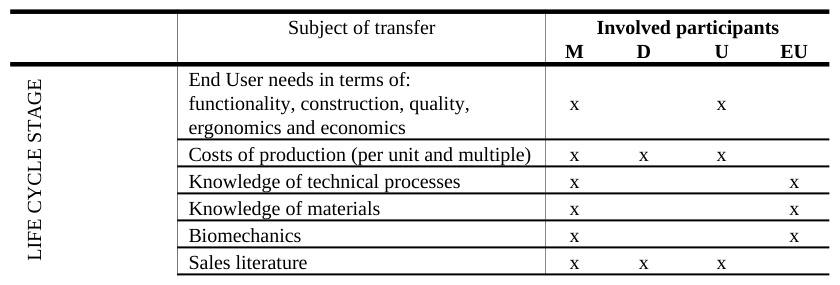
Figure 1. Scheme of knowledge transfer in the life cycle of surgical tools (Own elaboration) The basis of the flow of knowledge between participants is the need to produce a product that is specific surgical tool (P - product). This need may arise from several aspects: the need notified directly by the surgeon, manufacturer wants to introduce a new product, the reproduce of existing tools on the market competition. On the basis of of those conditions, the processes are running: identifying and defining the needs of the end user, design - construction, manufacturing, marketing and sales and exploitation. These processes taking place between different groups of participants in the cycle in the cooperation areas (CA). The flow of information resources and knowledge resources within defined areas occurs by means of available communication channels. At present, the most commonly used tools for knowledge transfer are: interpersonal communication, telecommunication network, the Internet, mass media. Table 1 contains a list of information resources and knowledge resources in the transfer process on the background of the life cycle of surgical instruments, taking into account the participants.
Figure available in the original PDF paper.
Table 1: The list of information and knowledge resources in the transfer process in the life cycle of surgical instruments (Own elaboration) Subject of transfer Involved participants M D U EU x x
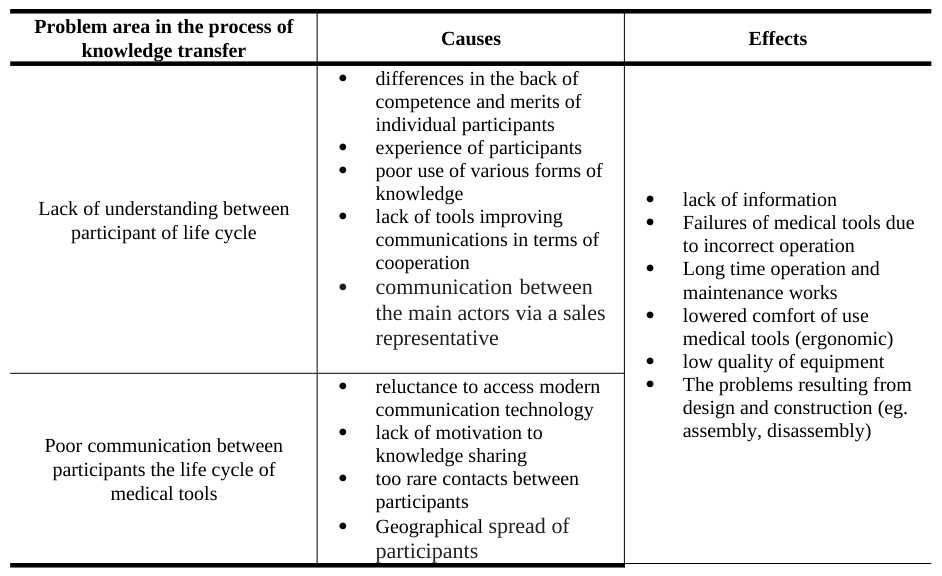
Information resources and knowledge resources may be used in various configurations by the participants in the life cycle of surgical instruments, therefore, they are necessary for the implementation of its various stages, from design to exploitation. According to research conducted by the authors of this paper, against the flow of these resources appear in the problem areas. They are related primarily to the human factor. Table 2 shows the identified problem situations and their causes and possible effects on the stages of the life cycle tools. Particular attention is focused on the exploitation stage tools, because this step takes the longest and is most noticeable by end users. The surgeon should feel the greatest comfort when using the tool, and this is also the aim of its creation.
Table 2: Problem areas and their causes and possible effects on the stages of the life cycle tools (Own elaboration) Problem area in the process of knowledge transfer Causes Effects
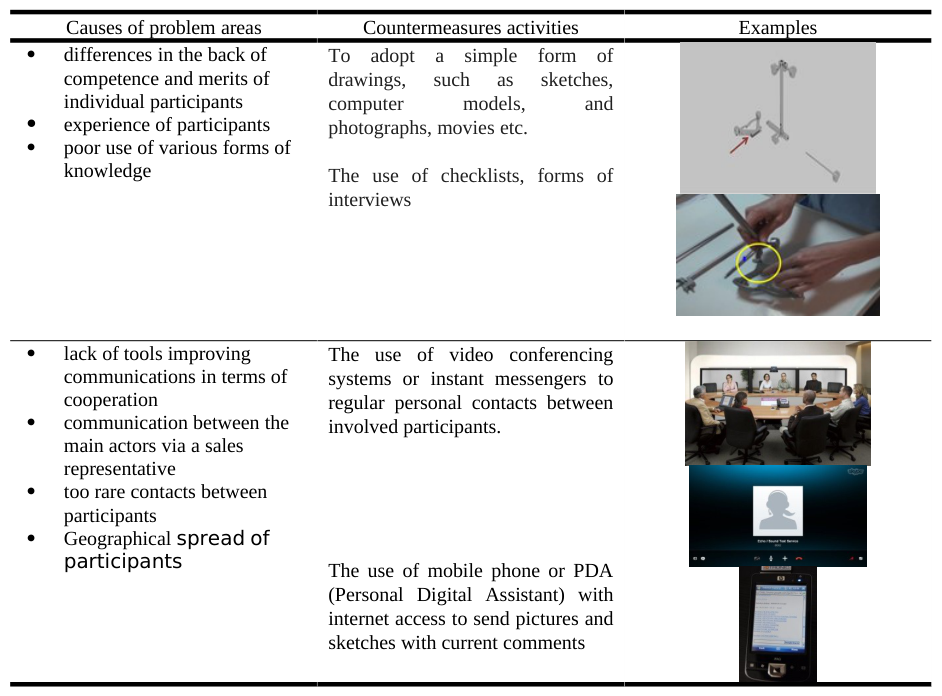
IMPROVEMENT OF KNOWLEDGE TRANSFER PROCESSES IN THE LIFE CYCLE OF MEDICAL TOOLS Responding to the identified problem areas in the field of knowledge transfer is proposed to support these processes by deliberately selected methods and tools. In addition to sociological factors influencing situations arise, there are methods to reduce their impact. These are mainly the methods and tools to support the acquisition, sharing and making available knowledge. It is believed that the use of solutions of improvement will contribute to the reduction or complete elimination of the causes of the problem areas and affect in a positive way on the motivation of the participants to exchange and share knowledge.
Countermeasures activities with an examples of using are presented in Table 3
Table 3: Countermeasures activities with an examples (Own elaboration)
Thanks to use modern technology for knowledge-sharing and communication between geographically dispersed (both at national and international ) participants in the life cycle of surgical instruments becomes possible to maintain the continuity of the work at each stage of the cycle. In addition, participant feedback between the End User and the Manufacturer may gain in importance. So far, opinions on the pros and cons of tools very rarely go to the manufacturer , which causes no reaction to the subjective opinions of direct users. Any imperfections associated primarily with aspects of ergonomics resulting from long-term operation will not affect the final product . Information about design and construction errors manufacturer receives only by the quantities and types of complaints. Knowledge of situations of discomfort in the use of tools during surgical procedures or maintenance activities can contribute to improving the quality of medical devices in the future.
CONCLUSIONS
The basis of the research undertaken was a search for threads agreement between the participants of the life cycle of surgical tools having expertise knowledge - medical and technical. The life cycle including design, engineering, manufacture, exploitation and withdrawal of the product from use, is realized based on the cooperation of various groups of users, communicate and exchange knowledge. Identifying the problem situation and the analysis of possible effects in this field allows you to take actions related to the improvement of the entire life cycle, which can translate into assurance of economic, ergonomic and exploitation criteria ready-made surgical instruments.
REFERENCES
Bartnicka J., Mleczko K., Winkler T. Models of knowledge transfer in the life cycle of surgical instruments, w: (red.)
Lewandowski J., Jałmużna I.,Walaszczyk A., Selected aspects of production systems management, Łódź 2013, Wydawnictwo Politechniki Łódzkiej, str. 17-27 Desouza K. C., Knowledge Management in Hospitals, w: Wickramasinghe N., Jatinder N.D., Gupta & Sushil K. Sharma, Creating Knowledge-Based Healthcare Organizations, Idea Group Inc., 2005 Duan Y., Nie W., Coakes E., Identifying key factors affecting transnational knowledge transfer, Information & Management 47
(2010), 356-363 Gołuchowski J., Technologie informatyczne w zarządzaniu wiedzą w organizacji, Wydawnictwo Akademii Ekonomicznej im.
Karola Adamieckiego w Katowicach, Katowice 2005 Liyanage Ch., Elhag T., Ballal T., Li Q., Knowledge communication and translation- a knowledge transfer model, Journal of Knowledge Management, Vol. 13 Iss: 3 pp. 118 – 131 Maier R., Knowledge Management Systems. Information and Communication Technologies for Knowledge Management.Third
Edition, Springer 2010 Mikuła B., Zadania organizacji w zakresie zarządzania wiedzą, E-mentor nr 5(17)/2006, www.e-mentor.edu.pl/artykul/index/numer/17/id/368; 20.05.2011 Pentland D., Forsyth K., Maciver D., Walsh M., Murray R., Irvine L., Sikora S., Key characteristics of knowledge transfer and exchange in healthcare: integrative literature review, Journal of Advanced Nursing 00(0), 000–000. doi: 10.1111/j.1365- 2648.2011.05631.x Perechuda K. (red.), Zarządzanie wiedzą w przedsiębiorstwie, Wydawnictwo Naukowe PWN, Warszawa 2005 Rippy J., Baker H., The Nurse Preceptor: Knowledge Transfer in Health Care, dostęp internetowy:
http://www.leadingtoday.org/weleadinlearning/jrapr03.htm - data dostępu: grudzień 2011 Sveiby K.E., A knowledge-based Theory of the Firm to Guide Strategy Formulation, Journal of Intellectual Capital, Vol. 2, Nr 4 – dostęp internetowy: www.sveiby.com – data dostępu: styczeń 2011 Truch, A., Higgs, M., Bartram, D. and Brown, A., Knowledge sharing and personality, paper presented at Henley Knowledge
Management Forum;
LISTED IN THE AHFE DIGITAL BOOKSTORE CATALOGUE
Explore the complete digital volume
Advances in Science, Technology, Higher Education and Society in the Conceptual Age: STHESCA
Read this individual research paper free through the original publisher, or explore the full digital proceedings book.
ISBN 978-1-4951-2110-4
Explore this ISBN in the AHFE Bookstore ↗Listed in the July 2026 bookstore catalogue; search by ISBN to confirm current availability · Digital book purchase optional