Márcio F. Catapan ab, Maria Lucia Okimoto, Mateus Villas Boas, Roberto Waldhauer (2022). Anthropometric Analysis of Human Head to Identification of Height in Proper Use of Ballistic Helmets. In: Advances in Ergonomics In Design, Usability & Special Populations: Part I. AHFE Open Access, vol. 18. https://doi.org/10.54941/ahfe100830
Studies of the physical characteristics of man and their dimensional variations have interested researchers since antiquity. In relating to the human head, the measures that are analyzed to make your sizing artifacts that protect her from possible accidents, are tied just as its circumference. In the military area, studies report that approximately half of the deaths in the battle fields is due to projectiles triggered in the soldier's head. However, other studies show that this artifact after a few minutes in continuous use, it becomes heavy and unstable for many users. Ie, proves itself that some soldiers do not wear a helmet when necessary is because it bothers them. Therefore, the objective of this paper is to research the height of the human head, in area the ballistic helmet, to verify whether this is significant or not height variation. Thus, it can be highlighted the need for a new ballistic helmet design to serve this dimensional variation of the height of the human head. For it is made a pilot survey and analyzed the anthropometric measurements of the human head using conventional instruments. Next analyzed the values and found that the means are different, proving that if the artifact of study is not adequate for use on the battlefield for all users.
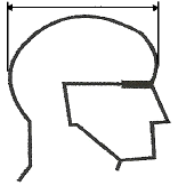
The knowledge of the human head shape is essential information for a variety of fields including design, medicine, anthropometry, among others (Kouchi and Mochimaru, 2004;. Meunier et al, 2000; Iida, 2005). The anthropometric differences of the head have been studied among the various surveys and regions (Alves et al 2011;. Ball et al, 2010;. Lee and Park, 2008; Yokota, 2005). When dealing with anthropometric measurements of the head, the patterns of these measures are referenced according to the ABNT NBR 15127 (2004) and DIN 33402 (1981 apud Iida 2005). These are:-Circumference (horizontal perimeter of the head), b-width (distance greater front head), c- length (greatest distance from the profile of the head) and cephalic index. These measures are illustratively shown in item 1.1 of this paper.
a) b) c)
Figure 1. Measurements of the human head region. (Adapted from ABNT NBR 15127, 2008) Adding to these first three shown in Figure 1, there is a question as to current studies of anthropometric measurements of the head (cephalometry), which refers to the methods and tools being used. According to studies by Alves et al. (2011) measurements are made using equipment called flexible anthropometric tape and anthropometric caliper, whose uncertainty is in the house of millimeters. Analyzing Figures 1, the question is: How do you know with precision where the points are longer lengths the width and length of the subject's head? One can get an error with the effort made by those who are measuring these regions? Here one can notice a greater uncertainty measures, which is why the current methods for anthropometric analysis of the human head can be better defined.
Problematic According to Iida (2005) , some products currently produced in certain countries , are marketed throughout the world, eg, planes, computers, television sets, weapons, cars and others, who have virtually worldwide standards . In terms of military alliances such as the Organization of the North Atlantic Treaty - NATO - and the Warsaw Pact, they demanded certain international standardization of military products, with several implications for industry in general.
According to Silva et al. (2006, quoted in Ahmed, 2012), the anthropometric survey of a given population is an important tool in ergonomic studies, providing subsidies to scale and evaluate machines , equipment , tools and jobs. Still, their suitability to the anthropometric characteristics of users will occur - in appropriate ergonomic criteria for the activity performed does not become a factor discomfort and damage to health.
Objectives The general objective of this work is to propose a method that identifies the height of the human head for use ballistic helmets.
To achieve this goal, will be held:
Current analyzes of the anthropometric measurements of the human head;
Development of a standardized method to analyze the height of the human head for use ballistic helmets;
Analyses and discussions of values for approval of the method and measures the heights observed.
STATE OF THE ART Anthropometry
To Michels (2000) and Rodrigues-Añez (2001), cited by Klein (2009), anthropometry is the branch of science that studies the human body measurements, particularly the size and shape.
According to Iida (2005) in the field of anthropometry there are tendencies of global standardization, though no reliable anthropometric measurements for the world population. Most measures available is contingent of the armed forces, because almost all refer to the measure of adult males in the 18 to 30 years. However, the factor that most contributes to these measures differ from the measures of the global population, are the selection criteria adopted by conscription, which exclude, for example, people below a certain height.
Anthropometry of the head (Cephalometric) According to Ball et al. (2010), traditionally the anthropometric measurements of the human body are one- dimensional, since the use of tape and caliper is common to survey demographics. Until then, the results shown were fruits of measurements in 1D (one dimension). Currently, other studies report that 2D data can be collected by means of computed tomography and even 3D three-dimensional scanning. However, these technologies are not completely widespread in this area.
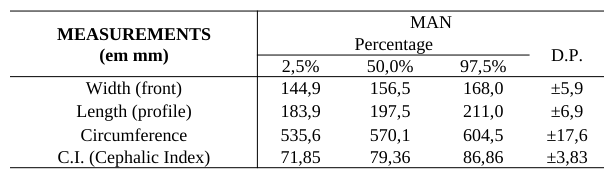
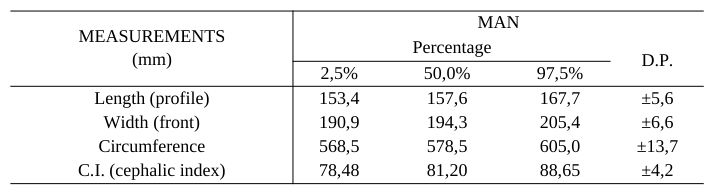
More recent studies on this subject in Brazil is done by Alves (2012) which reports the anthropometric measurements of the human head as shown in Table 1.
Table 1: Measures of human head Brazilians. (Adapted from Alves, 2012) MEASUREMENTS
With these measures of human heads, just compare the values of ballistic helmets to check the dimensional change and what needs to be improved / studied Combat Helmet
According to Alves (2012), the combat helmet is also known as ballistic helmet being used in personal shield fighter, following the standards of preparation and approval of the Brazilian Army Command . According to Samil and David (2012 ), ballistic helmet is a standard infantry equipment that provides ballistic protection from projectiles to the head , ear and neck of the soldier. Moreover, Carey et al. (2000 ) reports that the head and neck account for only 12 % of the body area that is typically exposed in a battlefield . However receive up to 25 % of all views and nearly half of all combat deaths are caused by head injuries.
Thus, one might suspect that the ballistic helmets are not being used as often as they should in combat troops . A starting point is to analyze whether this artifact is meeting their need to protect the soldier's head, while ensuring an adequate comfort for usage situations.
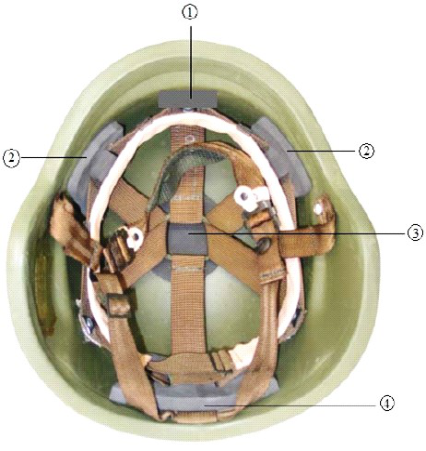
According to Alves et al. (2011), in Brazil many of the personal protective equipment are imported from other countries or when produced here , follow the anthropometric standards of the country of origin of the project . This is the case of ballistic helmets that are used by the Brazilian armed forces , the PASGT model (Personal Armor System for Troops Gound ) of U.S. origin . This helmet is made of four parts: 1 ) hull , 2) suspension system, 3 ) fixation system , and 4) pillows for comfort and protection . Figure 2 shows a bottom view of the helmet, which inside is detailed. The numbers correspond to the indications of protective pads.
Figure 2. Details of the internal ballistic helmet. (Alves, 2012)
The total mass (or weight) of installed combat helmets must meet the standards detailed in the Ministry of Defence (2008), by size, with a tolerance of plus or minus 10%. Table 2 shows these values of weight in relation to the helmet size.
Table 2: Weight of helmets on the size, (Ministry of Defense, 2008).
Table available in the original PDF paper.
DESCRIPTION SIZES S M L XL Total mass of helmets (Kg) 1,30 1,40 1,50 1,70
Is worth mentioning that the mass of helmets, presented in Table 2, is the static mode. That is, in a situation where the user is in movement, for example running, there is an increase in the force of gravity, generating a pressure / force greater than the static weight.
Also according Samil and David (2012) in their study with 70 users PASGT ballistic helmet model, it was found that the soldiers feel this added pressure in different regions of the head. In Table 3 we can observe these with their percentage of responses.
Table 3: Regions of discomfort ballistic helmets and their percentages. (Adapted from Samil and David
Table available in the original PDF paper.
(2012)
Region answer number Perceptual (%) Frontal Area 16 21,9 Occipital Area 4 5,5 Parietal Area 40 54,8 Temporal Area 13 17,8
We note that the region that the soldier feels a greater discomfort in the use of ballistic helmet is the parietal area. That is, the top of the head.
If you compare the anthropometric measurements of the ballistic helmet, PASGT model, it is known there is some dimension of helmet that is compromising the ergonomics of users. Table 4 shows these measures. We notice that the circumference values are divided into minimum and maximum values, this is due to the adjustment ballistic helmets have to leave them more or less tight as you need it.
Table 3: Anthropometric measurements in relation to the PASGT helmet sizes. (Adapted from Ministry of defense, 2012)
Table available in the original PDF paper.
DESCRIPTION/SIZE HELMET SIZES(cm) SIZE S M L Width 16,0 16,0 17,0 Length 19,0 20,0 22,0 Internal Circunference: Minimum 47,0 50,0 54,0 Maximum 52,0 56,0 59,0 Cephalic index helmel 84,21 80,0 77,27
Note also that all measures of the helmet also limit the width, length, circumference and cephalic index. However, no one is the height of the helmet as a necessity measure, which contradicting current studies, as the Samil and David (2012) reported that most of the problems of discomfort on the part of users PASGT Helmet, is related to height the head relative to the helmet.
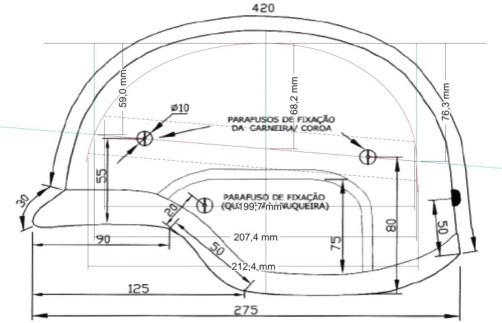
Analyzing the Figures and Tables in this session, we attempted to analyze the rule governing such measures PASGT Helmet of the Ministry of Defence (2008). Using the helmet design size "M" and, knowing the measurements of the positions of fixations, as the chamois and the thicknesses of foam for protection, it is possible to identify other measures the helmet with the use of CAD programs. These are shown in Figure 3, which shows the side view with its main steps and made some highlighted by computational analyzes.
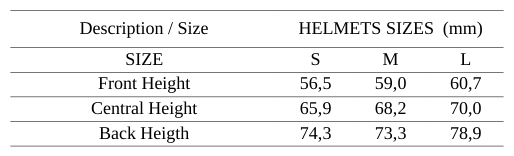
Figure 3: Measurements of height PASGT Helmet. (Adapted from Alves, 2012) Looking at Figure 3, we note that an arch was designed to represent a useful outline of the human head in ballistic helmet. That arc was developing through some information, such as , according to the Ministry of Health (2008), the PASGT helmet has a protective foam from the top of the head to the base of the helmet 10mm thick, and other information of this standard. Using an imaginary line of the fixing points of the headband on the helmet, it is possible to identify these points for the collection of measurements.Table 5: Measurements of distances from the heights of PASGT helmets.
Thus, it appears that the height of the center of the fixing support the top of the head to the center line of the headband is approximately 68 mm for the helmet PASGT "M". Knowing that the width of the ribbon chin guard illustrated in Figure 3 with a dashed line is 25 mm, it is possible to identify the location of the attachment area of the helmet on the user's head. The same analysis was also done for the P and helmets G. The final values of these analyzes are shown in Table 5.
In Table 5 it can be seen that the heights are critical in the use of ballistic helmets, since they are directly related to the fixation of the helmet on the human head.
According to the Ministry of Defence (2008) the governing standard specification of this helmet stresses that there is a height adjustment of the helmet, which is approximately 8mm for more and less.
METHODOLOGY AND APPLICATION Here the methodology and its application for analysis of the tall human head for use in ballistic helmets through photogrammetric is displayed. For a better understanding of how to achieve this it was constructed a flowchart showing the method to be used and their practical application in pilot form without the appropriate number of samples, but already possible to verify this measure, which still does not exist. This method is illustrated in the flowchart of Figure 4.
Figure 4 - Method of analysis of the human head height
With the information allocated sequentially exposed in the flowchart of Figure 4, the hereinafter it will be explained all this methodology to be combined with a structure of research in this experiment.
Step 1: Selection of Samples As there are variations of anthropometric measurements of the human head and knowing that there are no national standards for anthropometric measurements of artifacts , such as ballistic helmet here in Brazil , it takes a matter of necessity for this study.
For the selection of the samples will be randomly selected humans aged 18 to 34 years of any ethnicity and occupation , which is in apparent normal conditions and that do not have lesions in the skull . The WHO - World Health Organization (1995 ) , anthropometric dimensions should be based on a minimum sample of 200 people, however, for applications in ergonomics , as it does not require degrees of confidence greater than 95 % , 30 samples 50 subjects are generally satisfactory (measuring separately men and women , adults and children or adolescents ) . As this study is only a pilot experiment , where from this analysis will be pre- determined, statistically , the correct value of the number of samples , 44 samples were analyzed with the conditions mentioned in this article .
With selected samples, some tasks are done to identify the anthropometric measurements of the head sample. These will be treated next.
Step 2: Preparation of samples and their analysis with conventional tools To prepare the samples in this study they are divided into the following aspects:
Signing the consent form for the research, which she accepts to disclose information to their anthropometric measurements of your head;
Sit in a chair, upright and looking to its horizontal, so that the analyst can make the measurement of the circumference of your head (Figure 5a), using an anthropometric tape;
Wear cap to press your hair. This cap will be the same for all samples, and its measure of insignificant thickness for this search. Then the analyst measures, using anthropometric caliper width (Figure 5b) and length (Figure 5c) of the head.
Figure 5 - Dimensional analysis of the human head with the aid of conventional instruments
Thus, all samples are measured. The values found are tabulated and placed on a sheet where all the data of the sample are noted. Then the data will be put in a spreadsheet in excel to be able to make appropriate statistical analyzes to better define the measures of the human head using a balistic helmet.
Step3: Photograph the front and side of the sample Mullin and Taylor (2002) Apud Klein (2009) reported that morphological data collected through pictures are very common. Roebuck (1993) discusses the various methods of indirect collection by photography or videos.
For anthropometry study with photographs highlights the importance of care in the placement and orientation of the camera. The common, highlights, is the placement of the camera perpendicular to a vertical plane with brands to scale and photographed object. For anthropometric collections of body parts indicates that adaptations are developed in the setting of camera positioning and object in order to undo mistakes of scale, in agreement with Meunier and Yin (2000), Apud Klein (2009).
Barroso et al. (2005) conducted research with 891 people using anthropometry for that digital camera of 2 (two) megapixel, and to calibrate the image installed on the same plane volunteer with a stand-known brands that formed the scale.
For the study of this article has built an environment containing a camera, a fixed device where the camera is allocated a unique position with three supports and support the head and chin to always be in the same position, as well as a chair for the person sit. On the side and behind the person being examined was built a stand, also known as grid, which will serve as reference for future calibrate the image in the CAD program. This grid has equal spacing in both the horizontal and vertical directions of 100mm length. Figure 6 illustrates this environment.
Figure 6 - Environment for photographic image capture.
The position of the camera will be equidistant to the sample and the grid. The cameras will also be positioned at the height of the head center of the sample. These details make less errors have divergent images, when used measurement by photography. Figure 7 illustrates the positioning of the cameras to the sample.
Figure 7 - Front profile of Photogrammetry (a) and Side (b).
Step 4: Create the data of anthropometric measurements with the aid of CAD software Analyzing Figures 6 and 7, it is noted that both are defining environments to measure by photography. In order for the dimensional analysis can be generated by photo, it is necessary that measures the focal point between the machine and the wall where the grid is known, as the distance from the head center of the sample also. Thus it is possible to make a relationship so that you know the desired distance through the shot. An illustration of this is shown in Figure 8.
Figure 8 - Sample prepared for photogrammetric test
Also in Figure 8, you can visualize how concept for the dimensional analysis of the head shall be used. Thus, from the camera, the person will be photographed, front and laterally, and behind there the grid. As will be known to the distance between the focal point of the camera and the person, and the camera grid, can make a ratio by similar triangles, as illustrated in Figure 9.
Figure 9 - Analysis of Similarity of Triangles The relationship of distances, by similar triangles, reach the equation:
(1) where: P - A Distance is the length between the digital camera and the grid; Distance P- A 'is the length between the machine and the head center of the sample; Distance B - C is the measure of the reflected image on the grid; Distance B - C 'is the measure of the head to be obtained.
Isolating the B - C', which is the measure to be considered as the distance the head has: (2)
Thus, if you have the distance that is being requested at this step. To guarantee that the measures shown above are always constant, it has been designed and made a template for the correct position of the person and the camera being used for the test. This device can be seen in Figure 10.
Figure 10 - Place to take pictures for the experiment
It is noted that in Figure 10 over the device confectioned for the experiment has a spotlight that projects the light from the top down in grids, which are fixed to the walls, which is not designed to spare. As it was decided to work with only a single camera, the position that will be constant for all tests due to be fixed in the device. The values found in this pilot study are shown in Table 6.
Table6: Measures found in this experiment MEASUREMENTS
With the data obtained in the previous section, it is necessary to know if these are or not according to the anthropometric measurements were performed with the instruments of conventional measurements, generated in Step 3.2. All values were within a tolerance of 5%, ie, the values of the measures with conventional instruments, anthropometric tape and caliper are equal within the range of established trust.
Now, what is done is to compare the values of the measures they have today, which are presented in Table 1. Analyzing the values of this with Table 5, it is noted that only the measurement of the circumference at the smallest percentile (2.5%) is different. However, as this is a pilot experiment, one can say that the values are in agreement for continued research.
Step1.6: Analysis of the height of the human head for use in ballistic helmet With the image analysis profile photo sample, to determine the length of your head, you can do an analysis to check the height of the human head in the use of ballistic helmets. The analogy for this is simple, explained after Figure 11.
Figure 11 - Analysis of the picture to identify the head height
As the size of the helmet, not only ballistic but also other models are determined by measuring the circumference of the user's head, and that the measure is determined by the largest diameter between the front of the head and neck, it can be said the maximum length of the head is one-dimensional measure when viewed in profile. With this, by drawing a vertical line through the midpoint of this line is determined to head height to helmet use. See Figure 11.
It is important to note that the values shown in Figure 11 must be converted to the actual size, as shown in Figure 9 and shown in Equations 1 and 2. In this case, the converted values are as shown in Table 7.
Table7: Conversion of the values of the photos.
Analogously, this relationship is taken for all 44 samples analyzed in this pilot experiment. With this, it can be said that the values of the human head for use ballistic helmets, determined at this are shown in Table 8. Verifying that the method of analysis for the determination of this height in ballistic helmets, Table 5 and compare them with the values of Table 8, we note a large variation, even when it should be the lowest possible.
Table8: Measuresof human headfor useballistichelmet.
This may evidence that the current ballistic helmets are not suitable for samples of this pilot experiment.
CONCLUSION
In the presented study in this paper it was highlighted initially that anthropometry of the human head is based on measures of frontal and lateral profiles, their diameter and cephalic index. Furthermore, ballistic helmets PASGT model, which are imported and used by the armed forces of Brazil, are also scaled to these measures. As described in the introduction, was achieved with a new method of measuring the human head, with anthropometric values that had never been determined.
To confirm this pilot study is to make some additional activities. They are:
Separate groups of sizes such as S, M and L measurements of the heads to check their more accurate sizes, heights as the helmet, since each model distance;
Scale which is the minimum number of samples to confirm this experiment and redo it to see if the resulting data are the same;
Analyze three-dimensional scanning through some heads experiment with different sizes, to see if they have the same format or not;
Check if there is any relation between this time of human head with other anthropometric measures. And if there is what are these.
Thus concludes an issue that still needs to be further this line of research. However, it is important to note that work is already being confectioned in a doctoral thesis, which will heal all these unknowns shown in the above topics.
REFERENCES
Alves, H. A., et al.. Análises dos Parâmetros Antropométricos da Cabeça dos Militares da Força Aérea Brasileira no Projeto de Capacetes Balísticos. Revista Brasileira de Biomedicina, V.29, n.3, p. 472-492. 2011. Alves, H. A., Análise dos Parâmetros Antropométricos no Projeto de Capacetes Balísticos. Tese de Doutorado do Programa de
Pós-Graduação em Engenharia Biomédica da Universidade do Vale do Paraíba. São José dos Campos, SP. 2012. Ball, R., et al.. A comparison between Chinese and Caucasian head shapes. Applied Ergonomics 41, (2010). pag. 832–839. 2010 Barroso, M. P., et al. Anthropometric study of a Portuguese workers. International Journal of Industry Ergonomics, n. 35, p. 401- 410, 2005. Iida, I. Ergonomia – Projeto e Produção.2. Ed. São Paulo: Editora Edgard Blucher, 2005. Klein, A. Aplicação da fotogrametria para coleta de dados da antropometria da mão. Programa de Pós Graduação em Eng.
Mecânica (Dissertação de Mestrado) – UFPR. Curitiba. 2009. Kouchi, M., Mochimaru, M., Analysis of 3D face forms for proper sizing and CAD of spectacle frames. Ergonomics 47. (2004),
1499–1516. Lee, H.J., Park, S.J., Comparison of Korean and Japanese head and face anthropometric characteristics. Human Biology 80, (2008). pag. 313–330. Meunier, P., Tack, D., Ricci, A., Bossi, L., Angel, H., Helmet accommodation analysis using 3D laser scanning. Applied
Ergonomics 31, (2000). pag. 361–369. Meunier, P.; Yin, S. Performance of a 2D image-based anthopometric measurement and clothing sizing system. Applied Ergonomics, n. 31, p. 445-451, 2000. Michels, G. Aspectos históricos da cineantropometria – Do mundo antigo ao renascimento. Revista Brasileira de
Cineantropometria & Desempenho Humano, v. 2, n. 1, p. 106-110, 2000. Ministério da Defesa – Norma do Exército Brasileiro – Capacete Nível III A. Norma (DMI) DS / C1 II, nº 009/2008 – Elaborado pela Sec. Sup. C1 II / DS, 2008. Mullin, S. K.; Taylor, P. J. The effects of parallax on geometric morphometric data. Computers in biology and medicine, v. 32, p.
455- 464, 2002. OMS - Organização Mundial de Saúde. Physical status: the use and interpretation of anthropometry. In: Report Of A Who Study Group, 1995, Genebra. Thecnical Report Series. Rodrigues-Añez, C. R. Antropometria e sua aplicação na ergonomia. Revista Brasileira de Cineantropometria &
Desenvolvimento Humano, v. 3, n. 1, p. 102- 108, 2001. Roebuck, J. A. Anthropometric methods: Designing to fit the humam body. Santa Monica: Human Factors end Ergonomics Society, 1993. Samil, F., David, N. V., Na Ergonomics Study of a Convencional Ballistic Helmet. International Symposium on Robotics and
Intelligent Sensors 2012 (IRIS 2012). Malaysia. Engineering Procedia. Pag 1660-1666. (2012). Silva, K. R. et al. Avaliação Antropométrica em industrias do pólo moveleiro de UBÁ, MG. Rev. Árvore, Viçosa, v. 30, nº 4, p.
613-618, jul./ago. 2006. Yokota, M., Head and facial anthropometryof mixed-race US Armymale soldiers for militarydesign and sizing: a pilot study.
Applied Ergonomics 36, (2005). pag. 379–383.
LISTED IN THE AHFE DIGITAL BOOKSTORE CATALOGUE
Explore the complete digital volume
Advances in Ergonomics In Design, Usability & Special Populations: Part I
Read this individual research paper free through the original publisher, or explore the full digital proceedings book.
ISBN 978-1-4951-2106-7
Explore this ISBN in the AHFE Bookstore ↗Listed in the July 2026 bookstore catalogue; search by ISBN to confirm current availability · Digital book purchase optional