Demétrio Matos.., António Marques Pinho, Ana Margarida Ferreira, João Paulo Martins (2022). Contribution of Design in the Developmental Process of External Prosthetic Medical Devices. In: Advances in Ergonomics In Design, Usability & Special Populations: Part I. AHFE Open Access, vol. 18. https://doi.org/10.54941/ahfe100825
Aware of the importance of systemic and multidisciplinary approaches to the development of a new product but also of the synergy of variables and dimensions such as formal-aesthetic, emotional, and usability for its success and for the decision of buying, an active research based on user-centered design methods was carried out. We are seeking to find and validate, through methods such as literary review, direct observation, surveys, interviews and by designing and prototyping a new product, the variables and their relations so that issues such as user needs, as a whole, and organizational expectations, among others, be considered in the design phase. The project chosen to validate this research aims to optimize endoskeleton prosthesis for lower limb and therefore the quality of life for amputees. In the first methodological moment, i.e. analysis, several variables related to shortcomings of the current products and possible improvements were identified through interaction with users. With these data it is hoped to surpass the kind of devices limited to reproduce a walking cycle and obtain effective solutions both for the initial phase of rehabilitation as for the further active life of the patient.
Design for Health is an area with global and social dimension and importance that is characterized nowadays by higher and higher levels of demand and competitiveness. Given this reality, the subject of this study, which is part of an ongoing doctoral research in design that is in progress, focus on the importance of design and User Centered Design approaches to the development of medical devices.
The last decade has seen an increased focus on the design of medical devices, specifically in relation to patient safety, and a number of initiatives have been set up with the aim of improving such aspects (Martin, Norris, Murphy,
& Crowe, 2008). Therefore, the development of this type of device should take into account several variables such as the environment in which they are needed, what role to play, including the needs of healthcare professionals and patients. In fact, it can be seen that most multidisciplinary teams that are responsible for the development of these devices do not consider and integrate designers as key elements to the success of the project. This argument is reinforced by the perception that, too often, these products do not fully respond to the real needs of their users. Issues as aesthetic, formal or symbolic functions or, in extreme cases, ergonomic and functional ones, for example, are generally not considered so important as mechanical performance or economic and technological variables. Around the world there are millions of people with amputated legs, facing strong levels of physical and psychological vulnerability (McGimpsey & Bradford, 2010). In this sense and as a specific application of this work, we carried out the study of the universe of persons deprived of a member, either by amputation or congenital malformation (Boccolini, 2000; Carvalho, 2003; Lianza, 1985) and the replacement of same by use of a device more precisely, of a prosthesis. By prosthesis it is understood a part or device whose function partially or totally replace a missing limb or organ (Lianza, 1985). Within each category of "disability", there exist different solutions, with people and technologies interacting to solve the problems inherent to rehabilitation. In this context, the role of design should not be understood as an instrument of product differentiation in terms of competitiveness and achieving easy profit by creating consumer products that follow fashion, but as an ally. More than just exert an inclusive design, the designer cannot lose sight of its commitment to the project and make the mistake of entering an aestheticization of products.
In order to corral all these questions it is necessary to interpret some concepts such as: design and its role, competence of the same and expected to integrate these product developmental and multidisciplinar teams, which are medical devices, the standards and its importance in a developmental process, amputation, rehabilitation, prosthetic and all its universe. So, three major methodological moments were held, namely, a first phase of analysis, a second phase of synthesis and, finally, evaluation.
In the first methodological moment a non-interventionist base qualitative methodology was applied, including direct observation of users and processes involved, supported by the literature review and case studies, in order to define the problem more efficiently. To make possible all needed interaction during the second methodological point, partnerships with the Centro de Reabilitação Profissional de Gaia and the Associação dos Deficientes das Forças Armadas were performed which provided access to important stakeholders in this process and the necessary information for the success of the on-going research, with the users being actively involved. The objective of these partnerships was to understand people, end users and prosthetic technicians, as well as their daily interactions with the product. Thus, through the development of a product as a way to verify and validate this thesis, it will be possible to analyze the importance of the contribution of the design process for a more effective response to the user through social variants of the project.
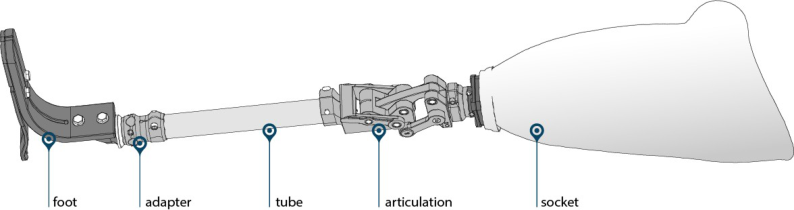
ANALYSIS Medical devices constitute a diverse group of products ranging from simple items such as gloves, to complex devices such as an artificial heart. Currently, endoskeletal prosthesis are composed of several components that are purchased and assembled as needed and according to user typology (see Figure 1). In this case, we highlight the fact that the components are not used independently, but as part of a system.
Figure 1. Prosthetic components (Matos, 2009)
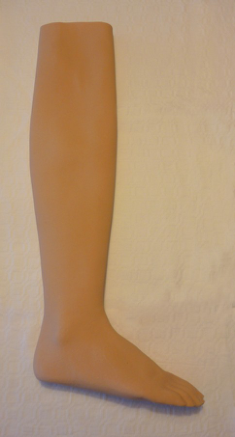
Only the sockets are performed in orthopedic centers because they are personalized, i.e., each amputee has a stump with its own geometric characteristics and requires specific care. It is also important to note that there is a great concern by some amputees, that the aesthetic aspect of prosthesis approaches that of a healthy limb. To respond to this fact there are cosmetic finishes lining the entire structure of an endoskeletal prosthesis. These finishes are made mostly by polyurethane foam (see Figure 2), which simulate the limb volume, or in Silicon coating (see Figure 3), aiming to mimic the residual limb. In both cases there is an increase in the final cost of the device, particularly with the latter.
Following the involvement of potential users, interviews were conducted and a questionnaire was developed aiming to identify and analyze situations relevant to this investigation. Being sampled and their provenance crucial factors (Creswell, 2009; Hill & Hill, 2009; Pereira, 2002; Quivy & Campenhoudt, 1998), we took a long time to solve the difficult access to patients as well as to overcome the complexity of characterizing of users considering the lack of data on the number of amputees in Portugal. To overcome these constraints, we performed a pre-test with patients of Centro de Reabilitação Profissional de Gaia, where opened and closed questions were addressed in order to get answers of qualitative and quantitative nature . After reviewing the questionnaire, the final version to members of the Associação dos Deficientes das Forças Armadas was implemented, with a reduction of open questions. When interpreting the responses of the pre-test it was also possible to optimize the situations addressed through closed questions. Thus, it was possible to reduce the overall number of issues and optimize the reading of the questionnaire.
The results were conclusive in that they showed that developing a solution of incremental innovation will be more successful in the Portuguese context than a solution of radical innovation. Also we included questions about comfort, functionality, aesthetics and price within a logical sequence of concerns of the patients. These concerns arise naturally associated with the state in which the patients are in the process of rehabilitation. At the initial stage they are only concerned with restoring the lost function, which is the march. After dominating the devices reasonably well in everyday tasks, such as the march for example, their concerns become more focused on aesthetic questions.
SYNTHESIS In accordance with Ulrich and Eppinger (2008), product development is a sequence of activities that a company should follow to create, produce and sell a product. It is equally an interdisciplinary activity that requires the participation of almost all members of a company or team. The synthesis phase requires more attention than the precedent one in the application of the methodology for User Centered Design, in order to achieve a process which will be validated later with the user in the evaluation phase. This method should be seen as an approach that combines the designer and the user (IDEO, 2009) in developing a product. Not neglecting the normative matters, all the complexity of the parameters established for the development of these products was taken into account. Namely, those by Infarmed, by ISO 10328:2006 (Prosthetics - Structural testing of lower-limb prostheses - Requirements and test methods.) and by the portuguese Law nº. 46/2006, of 28 August, concerning the essential regulatory requirements, the development and clinical evaluation of these devices. Throughout the product development process, we had to consider a number of variables which reinforced the need for a multidisciplinary team.
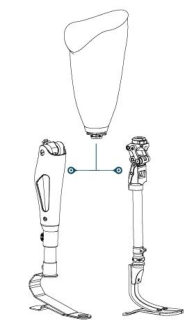
It is also important to mention that, in terms of process, the project considered two main phases. A first phase treated the technical and practical function, where issues of use, functional and mechanical performance, among others, were taken into particular attention. In the second phase, we treat issues concerning the aesthetic and formal function and the symbolic function (Bürdek, 2006), directly related to the "skin treatment" of the product in development. Ideally, prosthesis must be functional in order to assist the amputee into their physical activity. It should be comfortable, easy to put on and remove, lightweight, aesthetically pleasing, and affordable and should enjoy a longer service life. Therefore, we intended to encourage modularity of endoskeletal prosthetic lower limb, allowing a user to more than one prosthesis fitting and keeping the device change, quickly and easy (see Figure 4). In this sense, the goal of the project is defined by the ability to articulate and to provide a quick disconnection between the socket and the other prosthetic components.
Figure 4. Stage 01: Concept of modularity
We propose a number of requirements that the product must meet, among them, the security of system performance in different environments and extreme impact situations, since the system should cover any physical activity performed by the user. Thus the robustness, resilience of the system to several cycles of use and reliability is evoked, so as to ensure lasting and flawless operation. Any proposal should not interfere with the alignment of the prosthesis defined by the technicians. The density of the device is an important parameter that can limit the mobility of the user. Last, final cost is a key factor in the purchase of most products.
Once defined the objectives and the requirements, they were followed by the stage of development of concepts in order to achieve a coherent solution to the problem and design principles. Being a structural component, it has become essential to proceed to trial the final concept of the first phase, in order to prove its performance and its behavior under load conditions, according to the functions and design requirements. In this way and due to security concerns and effectiveness of the prosthetic device development, there were experimental tests based on the regulated requirements of the international standard ISO 10328 (2006) (Prosthetics – Structural testing of lower limb prostheses- Requirements and test methods). We conducted static essays of evidence and cyclic components of compressive and flexural strength of standardized testing, limit of bending and torsion essays. After conducting these essays, we made a resizing of the prototype with the conviction that its experimental performance will be successful, according to the experimental results and the analytical predictions made.
With the aid of the software Granta Design, ESC EduPack, a review of the most appropriate materials for mechanism was held\, pondered a set of essential requirements, such as mechanical strength, density, attractiveness, level of costs of raw materials and components of the processing itself, and its durability. Noteworthy is the commercially pure titanium and its alloys. Being evidenced the Ticp, were Grade 4, which in addition to mechanical strength has a low cost, compared to alloy titanium. Thus, the interface component part of all the constituents of the product will be produced in Ticp, achieving a reduction of mass that is approximately half from the preview one.
EVALUATION The aim of ergonomics is to adapt the product to the user (Pheasant, 2003), by understanding the interaction of the object with the user in order to guarantee comfort, welfare, efficiency and safety. This stage of the project aims to validate it with users, namely the concepts developed in relation to ergonomics, comfort and usability. In accordance with Tullis e Albert (2008) there are several definitions for the term usability. However, three recurring variables are always identified: (1) the user involved, (2) the completion of an activity and (3) the use of a product or system. This case study illustrates the importance of following a user-centered development process. In the next phase, the team will return to the field, to test the models with a set of amputees who participated in the field research.
CONCLUSIONS
In general, the use, when considered by the designer, is only one parameter of the product (Kasper, 2009) that comes in trying to resolve its practical and technical functions. However, a prosthesis, which is understood as an extension of the body, also requires an approach that incorporates the aesthetic-formal and symbolic functions. The importance and value of focusing on user needs has been recognized as having a number of health related benefits (Martin, 2010). The procedure outlined above, though still at a terminal stage of its development, is characterized by the emphasis given to the user and simultaneously to the product in all its functions. Therefore, the designer can improve the response to the requirements of comfort and security through a more focused approach to user, using ergonomic methods, including the user-centered design.
Assuming that the most important point in the successful development of a medical device is the proper overall design, and that the quality, safety and effectiveness of the device are established during the design phase (Colvin, 2010), with the conclusion of this research, we expect to demonstrate that the contribution of the designer is important to add value, user comfort and wellbeing to medical devices, particularly in the field of lower limb prosthesis.
REFERENCES
Boccolini, F. (2000). Reabilitação - Amputados, Amputações e Próteses. (2o ed., p. 254). São Paulo: Robe. Bürdek, B. E. (2006). Design: história e teoria e prática do design de produtos (1o ed.). São Paulo: Edgard Blucher. Carvalho, J. A. (2003). Amputações de membros inferiores: em busca da plena reabilitação. (2o ed., p. 365). São Paulo: Manole. Colvin, M. (2010). An Effective Design Process for the Successful Development of Medical Devices. Design (pp. 345–359).
doi:10.1007/978-0-387-98120-8 IDEO. (2009). Human-Centred Design Toolkit: A Free Innovation Guide for Social Enterprises and NGOS Worldwide.
ISO 10328. Prosthetics. Structural testing of lower-limb prostheses. Requirements and test methods (2006). International Organization for Standardization. Kasper, C. P. (2009). Além da função, o uso. In Arcos Design 5 (pp. 18–24). Lianza, S. (1985). Medicina da reabilitação. Rio de Janeiro: Guanabara Koogan. Manzini, E. (1993). A matéria da invenção. Lisboa: Centro Português de Design. Martin, J. L. (2010). Design for patient safety: User testing in the development of medical devices. London: National Patient
Safety Agency. Martin, J. L., Norris, B. J., Murphy, E., & Crowe, J. A. (2008). Medical device development: the challenge for ergonomics.
Applied Ergonomics, 39(3), 271–83. doi:10.1016/j.apergo.2007.10.002 Matos, D. F. (2009). Dispositivos Protésicos Exteriores: Estudo, Desenvolvimento, Produção, Ensaio e Certificação. (MSc).
Faculdade de Engenharia da Universidade do Porto & Escola Superior de Artes e Design de Matosinhos, Porto. McGimpsey, G., & Bradford, T. C. (2010). Limb Prosthetics Services and Devices - Critical Unmet Need: Market Analysis, 1–
35. Pheasant, S. (2003). Bodyspace. Anthropometry, Ergonomics and the Design of Work (2o ed.). London: Taylor & Francis. Tullis, T., & Albert, W. (2008). Measuring the user experience: collecting, analyzing, and presenting usability metrics.
Burlington: Morgan Kaufman. Ulrich, K. T., & Eppinger, S. D. (2008). Product Design and Development. (4o ed.). New York: Mc Graw Hill.
LISTED IN THE AHFE DIGITAL BOOKSTORE CATALOGUE
Explore the complete digital volume
Advances in Ergonomics In Design, Usability & Special Populations: Part I
Read this individual research paper free through the original publisher, or explore the full digital proceedings book.
ISBN 978-1-4951-2106-7
Explore this ISBN in the AHFE Bookstore ↗Listed in the July 2026 bookstore catalogue; search by ISBN to confirm current availability · Digital book purchase optional