Letícia Schiehll, Fernando Moreira da Silva, Inês Simões (2022). Dressing Autonomy for Frozen Shoulder Users: Inclusive Fashion Design Principles. In: Advances in Ergonomics In Design, Usability & Special Populations: Part I. AHFE Open Access, vol. 18. https://doi.org/10.54941/ahfe100768
Donning and doffing procedures are among of the five basic activities of daily living that define the degree of autonomy and independence. In this paper, we produce an analysis of the movements performed in donning/doffing procedures and identify which are the main difficulties in patients with frozen shoulder. Therefore, we utilized five pieces of clothing for the upper body with different characteristics that we consider relevant for the evaluation of movement and to identify range of motion limitations: poncho, tank-top, blouse with long sleeves, batwing blouse and front-opening blouse. Then, we observed a group of women during donning/doffing procedures, connecting the performed movements to the characteristics of those garments. As main results, we verified that the poncho and the batwing blouse are more appropriate for users with a frozen shoulder. Among the possible conclusions, we infer that the inclusion of users before and during the design process, through the methodology of participatory design, provides greater interaction in the whole process and increases the chances of success of the product to the real needs of the targeted user. In association, the inclusion of a kinesiological study in the design of clothes increases efficiency donning/doffing procedures, ensuring greater autonomy to the user.
Independence and autonomy are essential to maintain the quality of life of an individual. They depend on the body’s anatomy, its movements and its functional capacities, and the lack of independence or autonomy interfere directly with the way activities are performed throughout the day by an individual, reflecting in all systems: physical, psychological and social. Since all these concepts represent a cyclical systemic relationship, when one fails, the others collapse. We note that, in this paper, we refer the functional autonomy or action autonomy.
Children who around two years old already try to exercise part of their autonomy as their bodies have already acquired some control over their fine and gross motor skills (Nucci et al, 1996). Regarding elderly people, the maintenance of autonomy and independence is closely related to the quality of life.
On the other hand, Lemos and Medeiros (2002) argue that autonomy and independence are great indicators of health among older adults, and stress the need of every human being not to be dependent on others.
Soutinho (2006) realized that older women prefer to wear trousers and dresses that are more malleable, soft and looser, easier to don, doff and move, and suggests that this preference is possibly due to the joint stiffness combined with a decreased strength and motor coordination. Martins (2008, p. 325) points out that, "if children’s clothing was before the miniaturization of the adults clothes, the latter is nowadays designed under the same concept as the clothing for young people, even though the elderly do not have the same mobility, reach, biotype and needs.” From the author’s words we clearly perceive the contemporary emphasis on youth, beauty, autonomy, independence and Ergonomics In Design, Usability & Special Populations I (2022) https://openaccess.cms-conferences.org/#/publications/book/978-1-4951-2106-7 ability to be productive and reproductive, which leaves aside the individuals with any kind of limitations.
DONNING AND DOFFING WITH AUTOMOMY Donning and doffing are what relates human being and clothes. These activities are necessary procedures to the maintenance of independence and autonomy, as they are part of daily life – Katz AVD. They are actions related to one’s ease of handling combined with anatomical, anthropometric and biomechanical aspects (Martins, 2005), i.e., they are actions that depend on the body and its movements. And for clothing design, Spaine and Menezes (2010) underline the need for the body comprehention, its movements, joints, human proportions, structures, among others, before understanding the drapping, in a way of these requirements be used in drapping design.
After studying further the donning and doffing procedures, we identified six steps.
1. ‘Selection of clothes’, which is the moment of choosing or decision making, that is, when someone identifies the piece or pieces of clothing that wants to wear among his/hers wardrobe. This step involves only the issues of cognitive ability of the user.
2. ‘Getting the clothes’ from the closet. So, after selection of clothes, the user put them on lap or on the bed, with the clothes back side turned to the person. Here, besides the cognitive ability, the user needs to perform fine motor skills – such as, pincer grip – as well as gross motor skills – the extension and flexion of the arms, among others.
3. ‘Donning’ or dressing, is when the user puts the selected garment or garments on the body, which normally involves covering each segment of the body with the corresponding part of the clothing. To don a T-shirt, for example, one has to put the head into the neckline from the inside, both arms into the armholes – also from the inside – and to pull it down so that the hemline gets positioned around the hip region. So for a good performance of donning it is necessary to have a good cognitive ability as well as to have good fine and gross motor skills.
4. After donning clothes properly, it is necessary to ‘close’ them. So, the user need to handle one type or several types of closures (for example, buttons, zippers, hooks, ties, elastic bands, etc), to which fine motor skills are crucial.
5. The user ‘adjusts the clothes’ to the body by properly positioning the blouse, pants, skirt or dress, the collar, sleeves, etc, along his/her body segments. This step also requires having fine motor skills – so that the clothes serve their proper function and do not look awkward on the body –, although gross motor skills also play an important role here.
6. ‘Doffing’ is the last step of this process, which also involves, though in reverse, performing fine and gross motor activities while the individual takes off the pieces of clothing that were donned and worn that day.
We realized that people must have sufficient levels of flexibility, joint mobility and coordination of the body segments in question to perform the rather common donning procedure in its entirety (Vale et al, 2006).
In childwood the development of these skills can be used by body understanding and spatial orientation (Pfeifer, s.d.). A two-year-old child is already capable of taking clothes off the body. From the age of three a child can be encouraged to put clothes on all by herself/himself, but only around the age of five or six a child is able to don and doff without any help, for instance, to button and unbutton skirts, pants and blouses and to tie and untie shoe laces (Drescher, 1999; Papalia, 2010). Ferland (2006) points out that fastening clothing with buttons or snaps placed in the back, neck and wrists are activities that take more time to develop. Although the development of fine and gross motor skills – i.e., the coordination between what an individual wants to do and what an individual is able to do in terms of donning and doffing – is accomplished between the ages of three and six (Papalia, 2006). In other words, these skills start in childhood, but can be affected throughout life by a series of circumstances: accidents, trauma, disease, aging, among others. Therefore any person of any age at some point of his/her life can experience a limitation of movement, an occurrence that is in many cases associated with the individual’s secondary aging that Ergonomics In Design, Usability & Special Populations I (2022) https://openaccess.cms-conferences.org/#/publications/book/978-1-4951-2106-7 reduces his/her functional capacity to perform.
Diseases of the musculoskeletal system (Andrade, 2009) are the main causes of this type of incapacities, and the frozen shoulder is the most frequent in patients with relapsing difficulties in donning and doffing. This particular condition is characterized by the decreasing of the amplitude of the active and passive range of motion, which causes pain in a first stage followed by severe stiffness – or mechanical lock. The frozen shoulder, or adhesive capsulitis, is characterized by an insidious onset and in most cases is a form of reflex algoneurodystrophy located at the shoulder that causes a progressive loss of movement (Xhardez, 1990, Snider, 2000). It affects the non-dominant arm in most patients, in women between 40 and 65, and in patients with clinical depression (Snider, 2000).
After the installation stage and stiffness, we have the recovery stage can last from six to eighteen months without treatment. Where joint mobility returns gradually, being the external rotation the last motion to be recovered (Xhardez, 1990). Dependence on others for donning and doffing procedures lasts, in this case, from the stiffness stage to the final stage when total recovery of range of motion is restored.
In order to analyze the movements performed in donning and doffing procedures and to identify which are the main difficulties in patients with a frozen shoulder, we used five garments for the upper body with different characteristics that we consider relevant for the evaluation of movement and to identify range of motion limitations: a poncho, a tank top, a blouse with long sleeves, a batwing sleeve blouse and a front opening blouse.
Then, we observed a group of ten women during the procedures of donning and doffing these five tops in order to connect the performed movements to the characteristics of the selected garments. The selected group of women who are residents in “Casa do Artista” in Lisbon – a retirement home for actors – as well as patients in a physiotherapy clinic in Brazil are all undergoing treatment for the stated condition at different stages.
From the direct observation of the actions of putting on and taking off the five tops, the researchers identified the kind of difficulties undergone by the selected group with regard to the movements in both procedures and stages of wear. The assessment was made using the research methodology developed by Foddy (1994) and the answers were translated into a numerical scale from 1 to 5, where 1 stands for ‘high difficulty’ while performing the task and 5 for ‘no difficulty’.
DONNING AND DOFFING WITH A FROZEN SHOULDER: RESULTS The assessment considers the characteristics of each top in relation to the movements of the upper limbs and trunk performed during the donning and doffing procedures (table 1). Those movements were broken down using the insight of kinesiologists like Rasch and Burke (1977) and Falcão (2011) because their analyses helped to observe and define the difficulties in donning and doffing each top.
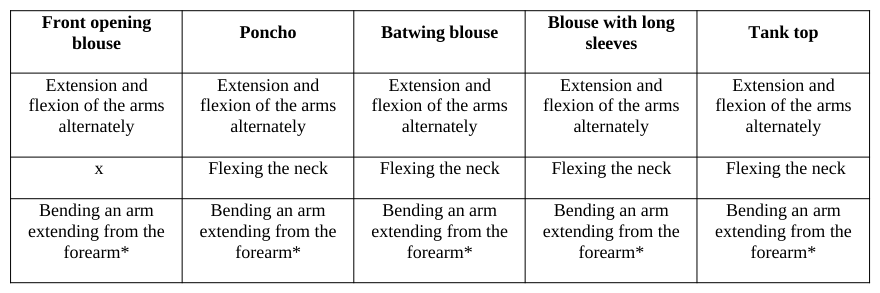
Table 1: The movements performed to don and doff the five tops (Authors) Front opening blouse Poncho Batwing blouse Blouse with long sleeves Tank top
Ergonomics In Design, Usability & Special Populations I (2022) https://openaccess.cms-conferences.org/#/publications/book/978-1-4951-2106-7
* Movements that a frouzen shoulder don’t be able to do.
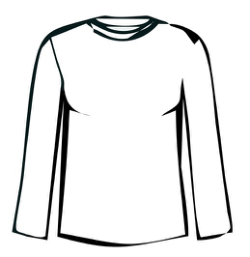
For a better understanding of the pieces (figure 1), we consider relevant to describe them: 1 The first piece is front opening blouse is a garment with sleeves. Its main characteristic is the opening along the center front, a feature that differentiates the process of donning it from the process of putting on the four garments described below, as the user puts one arm into one sleeve, the other arm into the other sleeve, buttons down the font placket while adjusting the blouse along the torso. The main difficulty to don this type of garment is to hold the second sleeve from the back.
2 The poncho is a sleeveless garment with a circular hemline and slits for the arms. To don this piece the user only has to put the head into the neckline from the inside and adjust, if necessary, its surface along the torso. Because it doesn’t have sleeves, seams or darts, this type of garment hangs from the neckline to the hemline, while resting on the shoulders.
3 The third piece is the batwing blouse. This type of garment does not have set in sleeves because the front and back pieces of the torso are combined with the front and back parts of the sleeve respectively. The donning steps also involve the arms, head and torso to put in on and adjust it.
4 The fourth piece is the blouse with long sleeves is a garment with tight fitting blouses, collar and cuffs. It has a defined armhole where long and narrow the sleeves are set. The stages required to don this type of garment are very similar to those of the tank top, as they also involve the arms, head and trunk. In most cases the user is required to adjust it along the torso, neck forearms and arms as they can get slightly displaced while it is being donned. The fact that it has a sleeve – the main characteristic of this type of garment – some extra degree of difficulty may occur while donning it.
5 Finally, the tank top is a sleeveless garment with tight fitting blouses and openings at the neckline and armholes. To don this piece the user has to put the head into the neckline from the inside, the arms into the armholes also from the inside and pull down the front and back. In most cases the user is required to adjust Ergonomics In Design, Usability & Special Populations I (2022) https://openaccess.cms-conferences.org/#/publications/book/978-1-4951-2106-7 it around the neckline and armholes as they can get slightly displaced while it is being donned. This type of garment involves the extension of the arms.
Figure 1. Front opening blouse, Poncho, Batwing blouse, Blouse whith long sleeves and Tank top (Authors)
Using direct observation, we identified which movements are required to don each top as well as the movements that patients with a frozen shoulder have greater difficulty to perform: particularly the rotation and elevation of the shoulder and the flexion and extension of the forearm, as these actions require the displacement of the humerus at the scapula cavity. By definition flexion is a bending movement around a joint in a limb that decreases the angle between the bones of the limb at the joint – i.e., a forward movement performed towards the joints of the head, neck, trunk, upper extremities and hips –, and extension is when the bending movement is done in the opposite direction, i.e., the angle between the bones of the limb at the joint increases (Kendall and Kendal, 1980; Grave, 2004). In addition, activities that require strength are difficult to perform on the affected side.
By analyzing this table we infer that the poncho and the front opening blouse are the easiest pieces to don, as their donning procedures exclude some movements involved in the tank top, the blouse with long sleeves and the batwing blouse donning procedures. We also realize that the batwing blouse requires less range of motion, for which we ranked it as the third garment that provides greater ease in donning and doffing considering the amount of implicated movements, but the second one if we think in terms of the movements’ amplitudes, coming after the poncho.
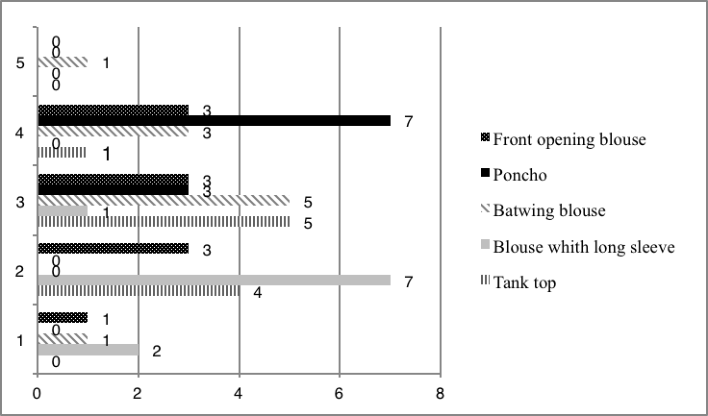
From the analysis of the implicated movements we can define the difficulty of donning and doffing each top; the difficulty of adjusting each top after donning it; and to list the tops by order of difficulty felt by the focus group during the donning and doffing procedure.
i) Donning and doffing clothes – identified by the researchers
Ergonomics In Design, Usability & Special Populations I (2022) https://openaccess.cms-conferences.org/#/publications/book/978-1-4951-2106-7
Figure 2. Difficulties identified by the researchers (Authors)
Regarding the donning and doffing procedures performed by the focus group we infer that the batwing blouse was the easiest top to don, as nine out of the ten women showed medium difficulty or no difficulty at all. However, one of the women had great difficulty, principally because of this particular garment being unfamiliar to her. But the batwing blouse was the only one to donned and doffed without any difficulty, and this fact must be highlighted.
However, we emphasize that the poncho was ranked between presenting medium and little difficulty to don. The biggest difficulties presented by the group of women respect the blouse with long sleeves – as nine of them had either little difficulty or much difficulty to don it, and one had medium difficulty.
Regarding the tank top, we observed that it presented little or medium difficulty. The same way, the opening front blouse was ranked with little or medium difficulty: three women had some, medium and little difficulty to don it respectively, and one had much difficulty, due to the difficulty of performing arm extension with forearm flexion behind the back.
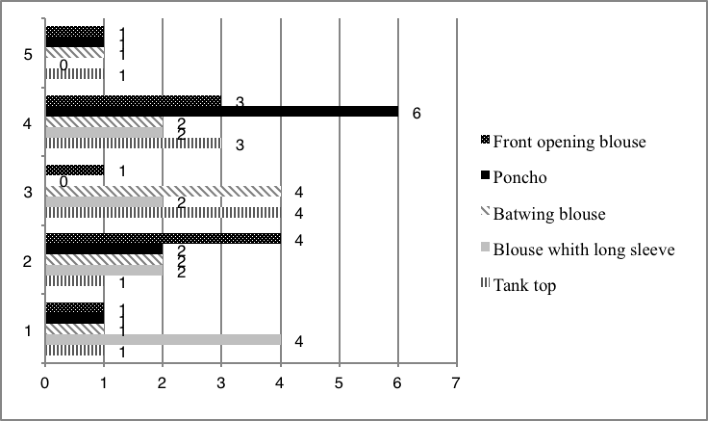
ii) Adjusting the clothes – identified by the researchers
Figure 3. Difficulties to adjust the garments to the body after donning (Authors)
Ergonomics In Design, Usability & Special Populations I (2022) https://openaccess.cms-conferences.org/#/publications/book/978-1-4951-2106-7
We noticed that most of the women had a higher degree of difficulty to adjust the donned tops than to don them. The blouse with long sleeves was the garment that presented the highest difficulty; the poncho presented little difficulty; the batwing blouse and the tank top presented medium difficulty.
The fact that the difficulty to adjust the donned tops is greater than the difficulty to don them reflects, once again, the problem of performing arm extension with forearm flexion behind the back displayed by people with a frozen shoulder. The rotation and elevation of the shoulder combined with the strength to position the garments correctly after donning is also problematic for people with a frozen shoulder.
iii) Donning and doffing the clothes – identified by the users
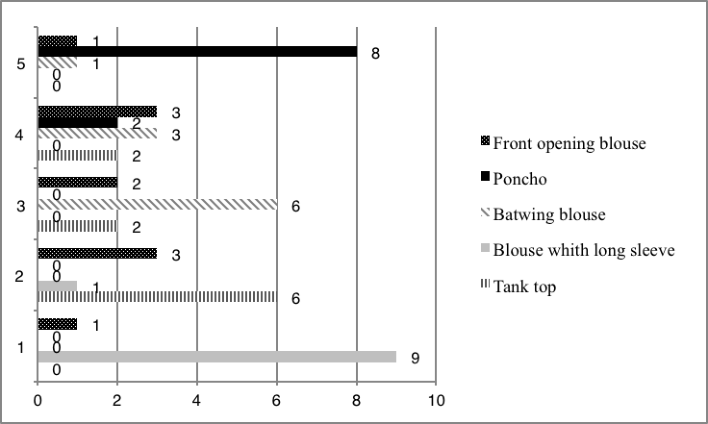
Figure 4. Difficulty identified by the user (Authors)
The blouse with long sleeves was identified by the focus group as the most difficult top to don, as nine of them pointed out. For those users, the armhole and the sleeve were the main difficulties. In contrast eight ladies considered the poncho the easiest garment to don.
The batwing blouse followed by the front opening blouse were ranked in the middle, as they presented little, medium and no difficulties. According to the users, the tank top was also one of the hardest tops to don.
DISCUSSION AND CONCLUSIONS As main result, we verified from the researchers and users’ evaluation that the poncho, batwing blouse and front opening blouse are more appropriate for people with a frozen shoulder – the targeted users –, as they provided greater autonomy and independence. The main reason is due to the styles themselves, as garments that have fewer seams an/or components – namely the poncho and the batwing blouse respectively – require fewer steps in the donning procedure by decreasing the amount of performed movements as well as the movements’ amplitude.
We emphasize the analysis of the batwing blouse and the front opening blouse, as they present similar ease in putting the arms into the sleeve, both styles allowing the armhole area to spread out more and, therefore, requiring less range of motion, particularly with reference to the elevation of the shoulder, arm and forearm.
Ergonomics In Design, Usability & Special Populations I (2022) https://openaccess.cms-conferences.org/#/publications/book/978-1-4951-2106-7
However the front opening blouse requires arm extension with flexion of the forearm behind the back and such movement presents a difficulty in the donning procedure, and in most cases requires the involvement of another person or tools to facilitate putting on the second sleeve.
On the other hand, the blouse with long sleeves and the front opening blouse, both whit titting armhole, were considered by users the most difficult garments to don.
We conclude, thus, that the easier tops to don require a smaller amount of movements as well as a smaller range of motion, and emphasize the role played by the armholes in the donning procedure: blouses with set in sleeves or sleeveless blouses are difficult to don as people with a frozen shoulder aren’t able to flex, extend and rotate the affected arm and consequently the shoulder.
We also emphasize that sleeves also increase the time to don a garment. Among the garments with sleeves batwing blouses may be easier to don than front opening blouses because the procedure includes putting one arm into the sleeve, next the head into the neckline and only then the other arm into the other sleeve. Whereas in the case of front opening blouses the second sleeve has to be reached from the back after the first sleeve was donned, a combination of movements that we identified as being one of the most complicated movements for older women with a frozen shoulder to accomplish.
From the collected data we infer that the inclusion of users before and during the design process by means of the methodology of participatory design (Muller, 2003) not only provides a valuable interaction between the designer and the targeted user throughout the whole process as well as it increases the chance of success of the product to the real needs of the targeted user. Likewise, the inclusion of kinesiological analyses in the design of clothes increases the efficiency of the donning and doffing procedures, ensuring greater autonomy to the user.
Finally we infer that the problems related to lack of strength were also critical, which means that it is necessary to consider the use of force in favor of the easy motion and to exclude critical movements caused by this particular condition in the design of clothing.
REFERENCES
Andrade, F. (2009), O Cuidado Informal à Pessoa Idosa Dependente em Contexto Domiciliário: Necessidades Educativas do Cuidador Principal. Dissertação de mestrado não publicada.Guimarães: Universidade do Minho, Instituto de Educação e Psicologia. Drescher, J.M. (1999). Sete necessidades básicas da criança. São Paulo: Mundo cristão. Falcão, S. (2011), Autonomia e Movimento do Corpo Idoso. Dissertação de mestrado não publicada. Lisboa: ULisboa | FMH. Ferland, F. (2006), O desenvolvimento da criança no dia-a-dia. Do berço até à escola primária. Lisboa: Climepsi Editores. Foddy, W. (1993), Constructing questions for interviews and questionnaires. Massachusetts: Cambridge University Press. Grave, M.F. (2004), A Modelagem sob a ótica da Ergonomia. São Paulo: Zenneex Piblishing. Kendall, H.O., Kendall, F.P. (1980), Músculos, provas e funções. SP: Editora Manole, 2° ed. Lemos, N., Medeiros, S.L. (2002). “Suporte social ao idoso dependente”. In E. V. Freitas, L. Py, A. L. Neri, F. A. C. Cançado,
M. L. Gorzoni & S. M. Rocha (Eds.), Tratado de geriatria e gerontologia, Rio de Janeiro: Guanabara Koogan. pp.892-897. Martins, S. (2008), “Ergonomia e moda: repensando a segunda pele”. In PIRES, Doroteia Baduy, org. Design de Moda: Olhares Diversos. SP: Estação das letras e cores. pp. 319-336. Menezes, M.S., Spaine, P.A.A. (2010). “Modelagem Plana Industrial do Vestuário: diretrizes para a indústria do vestuário e o
ensino & aprendizado”. In Projética, Londrina, V. 1, N. 1, pp. 82-100. Muller, M. (2003), “Participatory Design: The Third Space”. In: The human-computer interaction handbook, L. Erlbaum Associates Inc. Hillsdale, NJ, USA, pp. 1051-1068. Nucci, L.P., Killen, M., Smetana, J.G. (1996). “Autonomy and the Personal: Negotiation and Social Reciprocity”. In Adult-Child
Social Exchanges. In M. Killen (Ed.), Children ́s Autonomy, Social Competence and Interactions with Adults and Other Children: Exploring Connections and Consequences. New York: Joussey-Bass, pp. 7-24. Papalia, D.E. (2010), O mundo da criança: da infância à adolescência. Porto Alegre: AMGH. Pfeifer, L.I. (s.d.), AVD : em busca da qualidade de vida. The Website: http://www.profala.com/artto3.htm Rasch, P., Burke, R. (1977), Cinesiologia e Anatomia Aplicada: A ciência do movimento humano. 5ªed. RJ: Guanabara Koogan. Snider, R.K. (2000), Tratamento das Doenças do Sistema Musculoesquelético. Editora Manole. Soutinho, H.F.C. (2006), Vestuário desportivo – novos desenvolvimentos e novas funcionalidades. Dissertação de Mestrado de Design e Marketing. DET/EE/UM. Universidade do Minho. Vale, R.G.S., Pernanbuco C.S., Novaes J.S., Dantas E.H.M. (2006), “Teste de autonomia functional: vestir e tirar uma camisa
(VTC)”. In: R. bras. Ci e Mov. Ed. Universa, pp. 71-78.
Ergonomics In Design, Usability & Special Populations I (2022) https://openaccess.cms-conferences.org/#/publications/book/978-1-4951-2106-7
Xhardez, Y. (1990), Manual de cinesioterapia”. Editora Atheneu.
Ergonomics In Design, Usability & Special Populations I (2022) https://openaccess.cms-conferences.org/#/publications/book/978-1-4951-2106-7
LISTED IN THE AHFE DIGITAL BOOKSTORE CATALOGUE
Explore the complete digital volume
Advances in Ergonomics In Design, Usability & Special Populations: Part I
Read this individual research paper free through the original publisher, or explore the full digital proceedings book.
ISBN 978-1-4951-2106-7
Explore this ISBN in the AHFE Bookstore ↗Listed in the July 2026 bookstore catalogue; search by ISBN to confirm current availability · Digital book purchase optional