Francisco Soares Másculo* PhD, Geraldo Alves Colaço MSc, Ithyara Machado (2022). Ergonomics Solutions in the Footwear Industry: The Case of the Activity of Footwear Unmold. In: Advances in Ergonomics In Design, Usability & Special Populations: Part I. AHFE Open Access, vol. 18. https://doi.org/10.54941/ahfe100797
This work analyzed the influence of the implementation of ergonomic measures in the work conditions of the cemented assembly section in the unmold activity in a shoe industry located in the state of Paraiba. To do so it took place a comparative analysis with relationship to the ergonomic improvements previously implanted in the workstations of the company, looking for to verify if the application of those measures had influenced or not the work conditions in the assembly section mentioned. Historically, that type of industry doesn't have in its practices a culture of Prevention of Accidents and Ergonomics. Consequently it is noticed the elevation of the number of acquired diseases related to the work in that section. As methodological procedures, interviews were accomplished with workers of the Section of Assembly of the industry, looking for to make the measurement of the work conditions starting from the application of the methodologies Situation, Problem and Improvement (SPI) and of the methods Occupational Repetitive Action (OCRA), Gravity, Urgency and Tendency (GUT) and the diagram of painful areas of Corlett and Manenica (1980). As result, improvements of the work conditions were evidenced with the elimination of non ergonomic conditions in the activity, besides making possible larger motivation and better life quality to the employees of the studied section.
INTRODUCTION: The shoe industry in the last years presented vertiginous growth in the Northeast area of Brazil and it stands out for the great variety of activities involved in its productive process (Azevedo, 2002). The productive segments are constituted of fashion fine, sporting, rubber sandal, leather footwear and injected. Historically, that industry type doesn't have in its practices a prevention culture linked to the ergonomic subjects in their work places, what took the situation of activities of larger index of acquirement of diseases to the workers (Renner; Bühler, 2006). Some of the causes of that result are due to the complexity of the productive process, characterized purely by manufacturing activities, whose duration cycles are short and, therefore, very repetitive. Another factor is the limited possibility of automation of the production in some processes in the shoe industry (Hrtkopf, 2001; Vanin, 2007). The activities accomplished repeatedly and that don't request reasoning become monotonous and without sense. The Taylorist/Fordist model adopted in most of the industries of footwear assumes that the workers should be fixed in the work station, requesting, for that specialist. The accomplishment of exclusive activity and without sense tends to unchain irritability, indifference, larger sensibility to the heat, cold and to the hunger and bad posture (IIDA, 2010, p. 357). Guimarães (2012, p. 949) has indicated that it should provide several abilities in the work groups, making possible conditions of creation of so much value in the individual level as for the company, because the enlargement
Ergonomics In Design, Usability & Special Populations I (2022) https://openaccess.cms-conferences.org/#/publications/book/978-1-4951-2106-7 and the enrichment of the work, besides breaking paradigms, they are forms of reducing the dissatisfaction, monotony, repetitiveness, mistakes and diseases of the work. The characteristics of the adopted system contributed to increase still more the statistics of acquired diseases to the bad ergonomic conditions of such work stations. Consequently, the inadequate work conditions to which the workers are submitted and the increase of the pathologies due to ergonomic factors became focus of the institutions of fiscalization, such as the Department of Labor and Employment (DLE) and Public Prosecution Service of the Work. It can be affirmed that, in a certain way, that pressed the companies to analyze their positions and the environmental conditions and of life quality in the work, in the intention of adapting them to the workers' capabilities/necessities, attending to the labor legislation, seeking to reduce their social costs. A lot of organizations adopted good ergonomic practices in their industrial parks through implantation of ergonomic projects, and it is every time larger the number of ergonomic studies developed in the shoe area (Renner, 2002, p.168).
THE POSTURES ADOPTED IN THE ASSEMBLIES OF SHOES In the shoe sector, the work in most of the positions was made with the worker in the seated position. However, starting from the years 90's, the industries of the south eliminated most of the seats because these (straw chairs) didn't assist NR-17, Brazilian ergonomic norm (Brazil, 2007), which describes that the "seats should be ergonomic", with wheels, seats and back rest padded, adjustments of height of the seat and back rest. With the elimination of the chairs, more space was generated in the production line; like this, the work became usually made with the worker in standing position, and in most of the companies it ended up being the pattern adopted at the whole country (Renner, 2002, p. 85). The standing position allows corporal mobility, facilitating the dynamic use of arms, legs and trunk. The arms and legs can be used to reach controls of the machines (IIDA, 2010, p. 166). However, the stopped position standing it is highly tiring, due to the demand of the musculature to maintain the position. The body remains oscillating, demanding frequent positioning, what hinders the work accomplishment needed. A workstation that best assists to the users' needs is that which allows the alternation of the postures in standing and seated (Masculo, 2011, p. 175 to 186).
DATA COLLECTION The data collection was concentrated on the operators of the activity of shoe unmold, cells of assembly of the cemented sector of the industry, using the presuppositions of the method Situation, Problem and Improvement (SPI) (VIDAL, 2011).
THE METHOD SPI - SITUATION, PROBLEM AND IMPROVEMENT The tool SPM makes possible an ergonomic action in a short space of time, due to quickly to summarize some results and to set up a matrix of characteristics (Vidal, 2011, p. 275). Through SPM, it were used some methods and tools, like GUT (Gravity, Urgency and Tendency), the Diagram of Corlett and Manenica, the Method OCRA, the normative framing in relation to NR-17, the impacts of the existent problems in the work place and Summation of the Criticality Index - SCI.
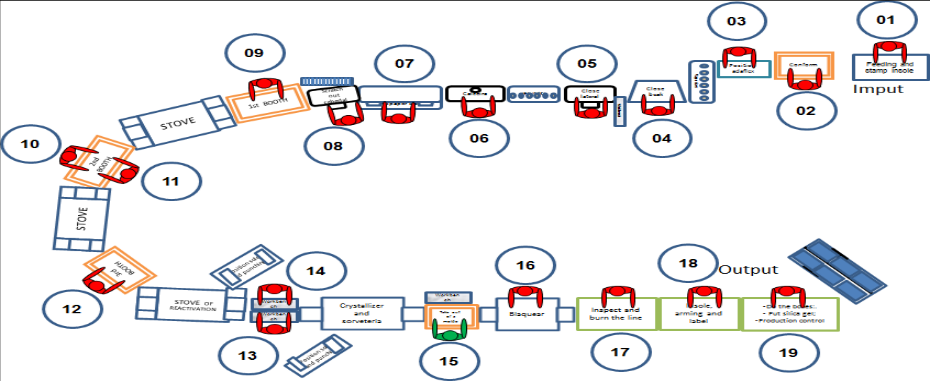
THE PRODUCTION PROCESS FLOW OF THE CELL OF ASSEMBLY OF CEMENTED The flow charter of the activities accomplished in the assembly cells in U (Figure 1) seeks to provide the visualization of the flow of the productive system, of the distribution of the work stations and of the sequences along the production line. The layout is flexible, making possible the change of equipments and positions to assist the
Ergonomics In Design, Usability & Special Populations I (2022) https://openaccess.cms-conferences.org/#/publications/book/978-1-4951-2106-7 alterations of models, in agreement with the solicitations of PPC (Production Programming and Control) (IIDA, 2010, p. 205).
Figure 1: Schematic draw of a production cell and location of the work stations of the cemented assembly sector, where the work station selected work was the number 15 (author's elaboration, 2013).
WORKERS PROFILE IN THE UNMOLD ACTIVITY The workers' of the unmold activity profile was collected and it can be seen in Table 1 below:
Analyzing the workers' profile of the unmold activity (Table 1), 100% of them are of the masculine sex. Sometimes, when the workers that use the unmold machines need to assist their physiologic needs, they can be substituted by the women in the operation. With relationship to the workers' laterality, the predominance is of right handed. With relationship to the instruction degree, 20% have the elementary school and 80% the complete high school. The workers of the cells workstation were not the same ones for the whole research.
Table 1: The workers interviewees' of the unmold activity profile (author's elaboration, 2013) Gender Quant. % Laterality Instruction
Ergonomics In Design, Usability & Special Populations I (2022) https://openaccess.cms-conferences.org/#/publications/book/978-1-4951-2106-7
LOCATION OF THE WORKSTATION IN THE CELL AND THE NUMBER OF WORKSTATIONS THAT WERE ANALYZED Inside of that universe, the sample was composed by five functions, each occupied by one worker, in which there was ergonomic intervention, with implementation of mechanical device for unmold the shoe, and in five workstations in assembly cells of the cemented section, where mechanical device was not still implemented for unmold shoe.
Figure 2: Workstations, constituted by benches with pin and machine, used for unmold shoe (own elaboration, 2013)
Figure available in the original PDF paper.
ERGONOMIC DEMANDS WITH RELATIONSHIP TO TIME AND MOVEMENT OF THE ACTIVITY ACCOMPLISHED MANUALLY According to Smidele, Vito and Fries (2009), the production cycle is the time interval necessary for the production of an unit of the product. The Table 2 specifies the activity accomplished mechanically that presented a cycle of 43,55 seconds:
Table 2: Descriptive of the actions accomplished by the superior members in the activity accomplished manually in seconds (own elaboration, 2013) Nº Required Actions Action Time (seconds) 1 Shoe catch and withdraw lace 17,25 2 Shoe unmold 7,94 3 Shoe number 6,78 4 Tag fixation 8,45 5 Shoe disposal in the matting 3,13 Total Cycle time 43,55
ERGONOMIC DEMANDS WITH RELATIONSHIP TO TIMES AND MOVEMENTS OF THE ACTIVITY ACCOMPLISHED MECHANICALLY According to NR - 17.6.1. (Brazilian Norm 17), the organization of the work should be adapted to the workers'
Ergonomics In Design, Usability & Special Populations I (2022) https://openaccess.cms-conferences.org/#/publications/book/978-1-4951-2106-7 characteristics psycho-physiological and the nature of the work to be executed. Reduction of the time of the cycle and of the requested actions provides improvement for the workers, with decrease of the lesion probability for effort musculoskeletal.
Table 3: Descriptive of the actions accomplished by the upper limbs in the activity accomplished mechanically, in seconds (author elaboration, 2013) Time Required Actions Action Time (seconds) 1 Shoe catch and pin positioning 3,52 2 Turn on the machine 9,90 3 Withdraw mold + shoe 6,35 4 Positioning TAG 8,45 5 Shoe disposal in the matting 3,13 Total Cycle time 31,35
COMPARATIVE OF THE TIMES OF CYCLE FOR THE ACTIVITY OF UNMOLD There was a reduction of times in the actions 1, 2 and 3 in a total of 12,20 seconds in the cycle of the operation. The improvement in the resulting productivity of this reduction is demonstrated in the Table 4. Even with the reduction of the cycle, there was not increased of the production, being this time used as personal pauses and better recovery of the musculature, inside of the own work day.
Tabel 4: Comparative of number of possible cycles by manual and mechanical methods (author elaboration, 2013)
That improvement is justified by the increase of the working power with the consumption of the same productive resources in effective personnel's terms (productivity of workers), for making possible an increment in the number of possible cycles during the daily day of work, what implicates in the best use of the inputs and work. Therefore, the option for inserting a device of automatic extraction reduces the effort that the worker accomplishes with the upper limbs considerably, staying the activity cycle above the minimum limit of 30 seconds for pair, in this case, 31,35 seconds. The number of possible cycles during a normal day of eight hours of work could be altered from 661 to 919, an increment of approximately 39% of the capacity.
COMPARATIVE OF THE ASPECTS SUBJECTS TO THE Ergonomics In Design, Usability & Special Populations I (2022) https://openaccess.cms-conferences.org/#/publications/book/978-1-4951-2106-7
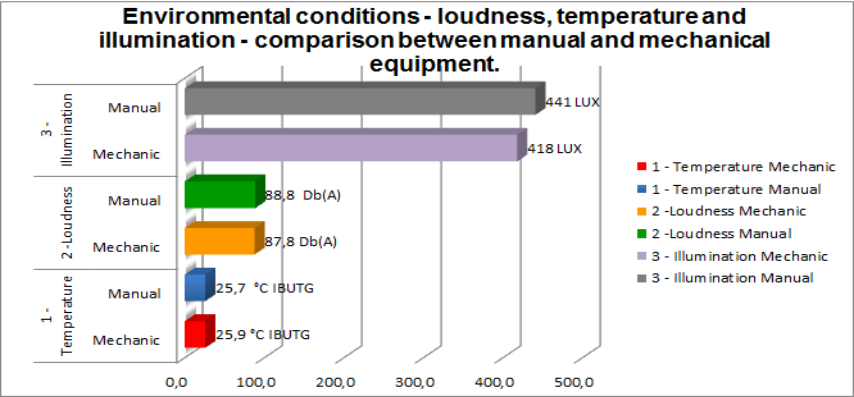
ENVIRONMENT OF THE WORKSTATIONS The items of ergonomic demand related to the workstations were compared before and after the intervention, in what concerns the noise, temperature and illumination, as expressed in the figure 3.
Figure 3: Environmental conditions, noise, temperature and illumination - comparative among the activity accomplished mechanically and manual (author’s elaboration, 2013)
The appreciation of the obtained medium values of the readings made in the workstations (Graph 1) compares the environmental conditions before and after intervention. With relationship to the heat the variation was of 0,2 °C in IBUTG (Index wet bulb globe thermometer). With relationship to the noise there is a medium variation of 1 dB (A). The medium reading of the illuminations was above recommended in the two work conditions. When of the individual research, the workers of the unmold activity with the use of the machine informed that the thermal sensation was reduced, because it is accomplished without adoption of high physical effort, besides to ventilation to be accomplished with fans positioned in the high line of air-tablet, what got better for them the sensation of heat.
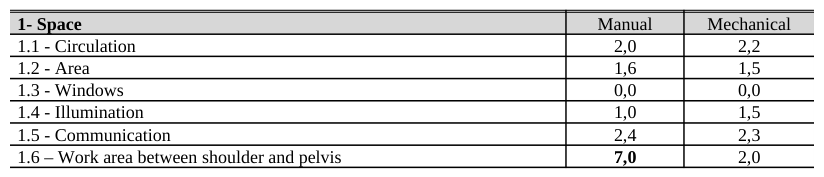
METHOD GUT The appreciation for the method GUT (Gravity, Urgency and Tendency) has as objective to verify the implementation of the unmold machine caused reduction in the bad work conditions, and in which of the aspects, as perceptible in the Table 5.
Table 5: Average of the results of the appreciation in the workstations of the activity accomplished manual and mechanically (author elaboration, 2013) 1- Space Manual Mechanical 1.1 - Circulation 2,0 2,2 1.2 - Area 1,6 1,5 1.3 - Windows 0,0 0,0 1.4 - Illumination 1,0 1,5 1.5 - Communication 2,4 2,3 1.6 – Work area between shoulder and pelvis 7,0 2,0
Ergonomics In Design, Usability & Special Populations I (2022) https://openaccess.cms-conferences.org/#/publications/book/978-1-4951-2106-7
Analyzing the presented results, with respect to the space in the activity accomplished manually, it was shown the work area between shoulder and pelvis, with an index 7,0, while the mechanically presented index 2,0. As of the assumed postures, the activity accomplished manually presented neck flexed / extended 10,2 and the mechanically 2,0. with relationship to the flexion / abduction of the arms, in the activity accomplished manually was 8,0 and for the mechanically 6,2. For the deviation of the hands, in the manual accomplishment, 16,2, and the mechanically, 7,7. In the accomplishment of the activity in the standing position, trunk twisted and flexed, in the activity manually was of 9,4 and mechanically 7,7. With relation to the work organization in the workstation, repetitiveness, in the manual accomplishment, 80,0 and the mechanically, 2. The productivity pace/control was 18,0 for the manual and 2,0 for the mechanical. For pause/ dead time in manually activity it was observed 36,0 and in the activity accomplished mechanically, 2,0. With the appreciation of those results, it was verified that the organization of the workstation and the assumed postures are the factors that affect negatively in the accomplishment of the activity manually.
METHOD DIAGRAM OF CORLETT AND MANENICA The appreciation of the results of the discomfort reports of the employees at the end of the work day, in a period of four weeks, in that to every week was accomplished questions to the employees if they felt discomfort at the end of the work shift and in what part of the body, the comparative of the summations is in the table no. 6.
Ergonomics In Design, Usability & Special Populations I (2022) https://openaccess.cms-conferences.org/#/publications/book/978-1-4951-2106-7
Table 6: Summations of informed discomfort for the workers of the activity accomplished manual and mechanically (author’s elaboration, 2013) Analyzing the results of the summation of the workers' answers, with respect to the discomfort at the end of the work day, the reports of Extreme discomfort were reduced of twelve (12) reports in the manual activity, for zero (0) in the mechanical activity. In the information of plenty discomfort there was a reduction of the manual reports with thirty three (33) reports, for three (3) reports for the activity accomplished mechanically. In the information that it feels moderate discomfort, there was an increase of manual activity with fifty (50) for fifty two (52) in the activity accomplished mechanically, indicating an increase in the discomfort reports. According to IIDA (2010, p. 359), the reduction of the fatigue can be attributed to the implementation of good practices in the postures, reach zone and reduction of physical effort above recommended.
Table available in the original PDF paper.
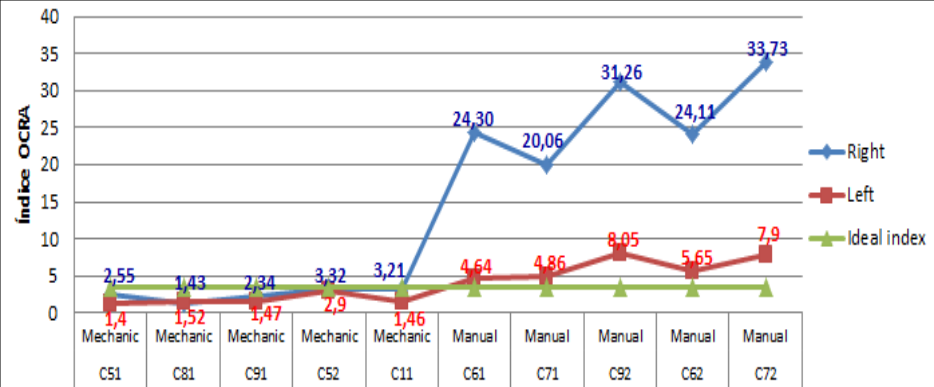
METHOD OCRA The Method OCRA was used in the positions of work of the activities of manual unmold and with use of the machine. The Figure 4 refers to the results of OCRA of the right and left superior members:
Ergonomics In Design, Usability & Special Populations I (2022) https://openaccess.cms-conferences.org/#/publications/book/978-1-4951-2106-7
Figure 4: Comparative of OCRA of the right and left superior members
Verifying method OCRA'S results, in the activity accomplished manually, the smallest score obtained in the five analyses of the left member it was 4,64 and for the right member it was 20,06. The activity accomplished manually presents risk for the right and left superior members. In the activity accomplished mechanically, the largest score obtained in the five analyses in the left superior member was 2,90 and the right was 3,32, therefore, the activity accomplished mechanically presented low risk for repetitive movements in the work day. It was verified that the implementation of the unmold machine reduced or even eliminated the conditions that can lead to musculoskeletal disorders.
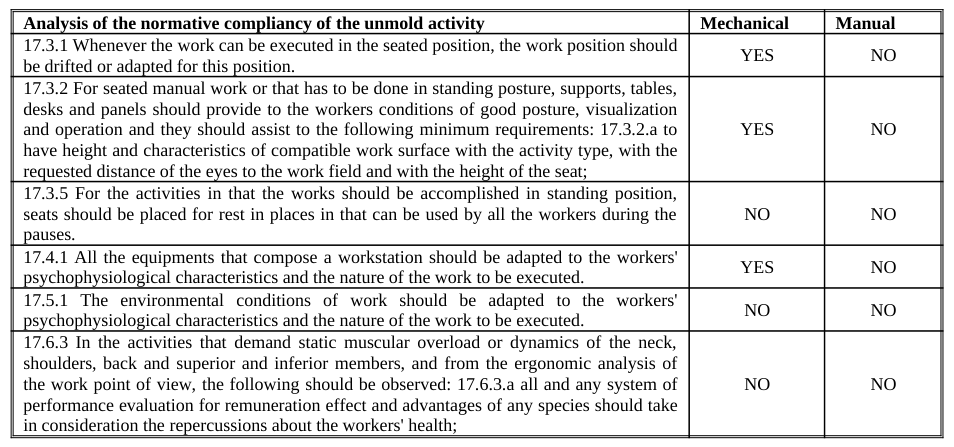
NORMATIVE COMPLIANCY TO NR-17 - BRAZILIAN NORM 17 The normative compliance is the correlation among the impacts, specifying priority roots causes observed as reference to NR-17. These were analyzed and diagnosed according to the labor legislation, according to the Table 7. The analysis of the item is accomplished according to the researcher's perception: statement YES, when the workstation attends the specified; statement NO, when the workstation doesn't assist the specified.
Table 7: Normative compliancy of the activities of mechanical and manual unmold (author's elaboration, 2013) Analysis of the normative compliancy of the unmold activity Mechanical Manual 17.3.1 Whenever the work can be executed in the seated position, the work position should be drifted or adapted for this position. YES NO
Ergonomics In Design, Usability & Special Populations I (2022) https://openaccess.cms-conferences.org/#/publications/book/978-1-4951-2106-7
The activity accomplished mechanically presented three impacts that can lead to discomfort to the worker, and in the activity accomplished manually, six impacts were verified that can lead to discomfort to the worker.
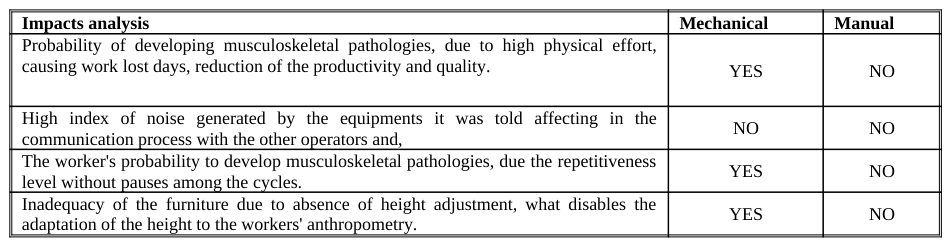
PROBLEMS PRESENT IN THE WORK PLACE - IMPACTS The impacts refer to existent problems in the work place and that harm the good course of the activity and the worker's health. In this item, the present conditions were analyzed in the workstation in agreement with the questions accomplished to the workers, as presented in the Table 8:
Table 8: Comparative of the impacts in the worker's health of the activities of mechanical and manual unmold (self elaboration, 2013).
The activity accomplished mechanically presented an impact that can lead to discomfort to the worker, and in the activity accomplished manually it came four impacts that can lead to discomfort to the worker. This way, the answer YES indicates that the item is accomplished in the activity. Yet the NO represent that the item is not assisted in the activity.
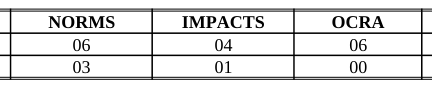
SUMMATION OF THE CRITICALITY INDEX - SCI The result of SCI refers to the appreciations of the norms that are not assisted by the work conditions present in the workstations, with relationship to the legislation for the accomplishment of the unmold activity manually and with machine use (Table 9).
Table 9: Comparative of SCI - summation of the criticality index of workstation (self elaboration, 2013) ACTIVITY NORMS IMPACTS OCRA SIC Manual unmold 06 04 06 16 Mechanical unmold 03 01 00 04
In the appreciation of the SCI data seen in the Table 9, it is observed that the result of activity of manual unmold presented a score of 16; already the unmold activity mechanically presented a score of 04, what demonstrates a reduction of 12 points, indicating activities accomplished with reduction of musculoskeletal effort and tendency to Repetitive Trauma Disorders. SCI with result above 10 requests direction of immediate actions. As way of improving the conditions of work of the activity accomplished mechanically, it is suggested that a study of the pneumatic system of the unmold machine to be accomplished by the maintenance section, in order to reduce the escape of air, that increases the noise of the environment. With relationship to the illumination, it should occur the appreciation of the lamps, as the change for newer lamps, what will increase the illumination and it will provide Ergonomics In Design, Usability & Special Populations I (2022) https://openaccess.cms-conferences.org/#/publications/book/978-1-4951-2106-7 compliance to the legislation. The reduction of SCI was evidenced with the workers' information about the reduction of the use of force to extract the footwear from the mold, in the appreciation of the index OCRA and of the diagram Corlett & Manenica. The unmold machine was projected with height adjustment in the machine and of the pin of fixation in the way that makes possible appropriate posture for all the anthropometry, what provides discomfort reduction.
CONCLUSION
The hypothesis that the manual accomplishment of the work in the unmold activity in cemented assembly cells can lead to discomfort, inadequate postures and pain, mainly of the superior members it was confirmed. Starting from the analyses of the activity accomplished mechanically, it can be affirmed that the implemented ergonomic improvements, elimination of the physical effort of force and pressure and the inadequate postures reduced the indexes OCRA of the superior members, both left as right as well, for acceptable activity with relationship to repetitive movements. When reducing the use of applied force and the actions requested for the accomplishment of a cycle with fewer movements, as well as with the change of the assumed postures, the work conditions were gotten better and the possibility of musculoskeletal discomfort was decreased, what is described as ergonomic improvements (GOMES; MANLY, 2011, p. 212).
The worker with physical limitations of the superior members informed that the fatigue that felt at the end of the day was reduced and that it was very better to work. The appreciation of the discomfort reports for the Diagram of Corlett and Manenica of the activity accomplished with mechanical aid didn't present occurrence of extreme discomfort in the areas of the body, as informed for the workers. With relationship to the application of the methodology SPM, the final score for the activity accomplished manually it was of 16, surpassing the acceptable score, which is of 10. The final score for the activity accomplished with use of the unmold machine was of 4, indicating alterations with relationship to the furniture of the machine with devices of height adjustment. The system of extraction of the footwear in the pneumatic way reduced the musculoskeletal effort for an acceptable index, and the implementation of fans in the cells improved the thermal sensation in the environment. Besides, it was referred that the substitution of the benches with height adjustment provided adaptation conditions of the workstation to the workers' anthropometry, complying to NR-17 with relationship to the ergonomics. It is ended that the activity of unmold accomplished being used the unmold machine and the improvements in the workstation with ergonomic focus collaborated for presentation of low risk of acquisition of musculoskeletal disorders of the superior members, improvement in the conditions of the thermal sensation, of the satisfaction in the work and the increase of the productivity.
REFERENCES
Azevedo, P.F. “Competitividade da Cadeia de Couro e Calçados”. Fórum de Competitividade da Cadeia Produtiva de Couro e Calçados. Brasília: MDIC/PENSA, 2002 (Relatório). Disponível em: <http://wwwp.feb.unesp.br/renofio/producao %20limpa/Van/Couro/estudopensaccouroForumCompetitividadeCouroCalcado.pdf>. Acesso em: 24 jul. 2012. Brasil. Ministério do Trabalho. “NR-17”: Ergonomia. Brasília: MTE, 2007.
Guimarães L.B.M.; Ribeiro, J.L.D.; Renner, J.S. Cost-benefit analysis of a socio-technical intervention in a Brazilian footwear company. “Applied Ergonomics”, [S.l.], v. 43, p. 948-957, 2012. Hartkopf, H.H. “A globalização e a indústria calçadista”. Novo Hamburgo, RS: Associação Brasileira de Empresas de
Componentes para Couro, Calçados e Artefatos (ASSINTECAL), 2001. Iida, I. “Ergonomia”: Projeto e produção. 2. ed. São Paulo: Blücher, 2010. Másculo, F.S. Biomecânica. In: MÁSCULO, F.S.; VIDAL, M.C.R. (Orgs.). “Ergonomia Trabalho adequado e eficiente”. Rio de Janeiro: Elsevier, 2011, v. 1, p. 167-195. Renner, J.S.; Bühler, D.C. Ergonomia em curtume: atividade e organização do trabalho. In: Congresso Brasileiro De Ergonomia,
14., Curitiba, 2006. “Anais...” Curitiba: Ufpr, 2006. 01 Cd-Rom. Renner, J.S.; Bühler, D.C. Ergonomia em curtume: atividade e organização do trabalho. In: Congresso Brasileiro De Ergonomia, 14., Curitiba, 2006. “Anais...” Curitiba: UFPR, 2006. 01 CD-ROM. Smidele, C.D.; Vito, S.L.; Fries, C.E. A busca da eficiência e a importância do balanceamento de linhas de produção. In: Encontro Nacional De Engenharia De Produção, 17., Gramado, RS, 2009. “Anais...” Rio de Janeiro: Abrepo, 2009. Disponível em: <http://www.abepro.org.br/biblioteca/ENEGEP1997_T5207.PDF>. Acesso em: 23 jan. 2012.
Ergonomics In Design, Usability & Special Populations I (2022) https://openaccess.cms-conferences.org/#/publications/book/978-1-4951-2106-7
Vanin, J.A. Estratégias de Competição de Indústrias Calçadistas Brasileiras: Um Estudo de Caso. In: Encontro De Estudos Em Estratégias, 3., 2007, São Paulo. “Anais Eletrônicos...” São Paulo: ANPAD, 2007. Disponível em: <http://www.anpad.org.br/diversos/trabalhos/3Es/3es_2007/3ES193.pdf>. Acesso em: 23 set. 2012. Vidal, M.C.R.. Métodos alternativos em análise ergonômica. In: Másculo, F.S.; Vidal, M.C.R. (Orgs.). “Ergonomia”: trabalho
adequado e eficiente. Rio de Janeiro: Elsevier, 2011b, v. 1, p. 266-283.
Ergonomics In Design, Usability & Special Populations I (2022) https://openaccess.cms-conferences.org/#/publications/book/978-1-4951-2106-7
LISTED IN THE AHFE DIGITAL BOOKSTORE CATALOGUE
Explore the complete digital volume
Advances in Ergonomics In Design, Usability & Special Populations: Part I
Read this individual research paper free through the original publisher, or explore the full digital proceedings book.
ISBN 978-1-4951-2106-7
Explore this ISBN in the AHFE Bookstore ↗Listed in the July 2026 bookstore catalogue; search by ISBN to confirm current availability · Digital book purchase optional