Mahrus Khoirul Umamiab, Pedro M. Arezesa, Alvaro M. Sampaioc (2022). Hand Anthropometry and Its Application to Design. In: Advances in Ergonomics In Design, Usability & Special Populations: Part I. AHFE Open Access, vol. 18. https://doi.org/10.54941/ahfe100793
This study presents a literature review and a comparison of selected hand anthropometric studies of many populations. The main purpose of this study is to determine the measurements and variables that need to be included in a study of hand for Portuguese population. The comparison and review were performed with studies selected from publications that were found in a literature search performed on Scopus and Google Scholar databases. The considered studies have an evident consideration for the design of hand tools and hand-held devices in the aims of the study and report data collected later than 1990. The review was performed by identifying the measurement included in each study and by comparing their aims and methods. Each study involved a different number of hand measures. Each study had their own reasons for the selection of the hand anthropometric measures involved. However, it can be generally concluded that the studies selected the measures based on a few criteria. The included studies involved a range of 8 to 51 different hand dimensions. The hand dimensions that were considered in at least five different studies were identified.
Nowadays people use hand tools and devices to perform a variety of works. Some types of hand tools and devices can be easily found in the market. However, sometimes the fit between the tools or devices and the users’ hand is negligible. The mismatch between the size of tools or devices and the hand dimensions can contribute to discomfort, injuries, fatigue, accidents, musculoskeletal disorders, biomechanical stress, and decreasing productivity (Mandahawi et al., 2008; García-Cáceres et al., 2012; Kattel et al., 1996; Rempel et al., 1997; Radwin et al., 2002; Imrhan and Farrahmand, 1999). To avoid these problems, the knowledge of hand dimensions is needed.
Few studies on hand anthropometry of various populations have been performed by researchers in several countries. Those studies were based on the importance of compatibility between hand dimensions with the design of tools and equipment used by humans in their daily works. Those studies generally aimed to collect anthropometric data of a population and then compare those data between gender within population and with other populations (Mandahawi et al., 2008; García-Cáceres et al., 2008; Mohammad, 2005; Imrhan et al., 2009; Okunribido, 2000; Cakit et al., 2012). Kar et al. (2003) conducted a survey of the dimensions of the hands of the workers in the agricultural sector in India. Similar study was conducted on hand dimensions of Indian male industrial workers (Chandra et al., 2011) and female industrial workers (Nag et al., 2003). Besides, some researchers have also focused on hand dimensions with hand tools design (García-Cáceres et al., 2012, Okunribido, 2000).
Ergonomics In Design, Usability & Special Populations I (2022) https://openaccess.cms-conferences.org/#/publications/book/978-1-4951-2106-7
The International Organization for Standardization (ISO) has published a guideline for anthropometrics measurements. ISO 7250 has set out the definitions and methods for a set of basic human body measurements (ISO, 1996). In what concerns to hand anthropometry, this standard defined eight dimensions and their measurement methods. The eight dimensions are hand length, palm length perpendicular, hand breadth at metacarpal, index finger length, index finger breadth (proximal), and index finger breadth (distal).
In 1978, the National Aeronautics and Space Administration (NASA) also published a reference related to anthropometric data (NASA, 1978). The measurements defined in the NASA Reference Publication 1024 are more complete than those in ISO 7250. This publication included fourteen hand dimensions, namely (NASA, 1978): hand length, palm length, hand breadth, forefinger length, hand breadth across thumb, hand circumference (at knuckles), hand circumference including thumb, hand thickness (at metacarpal III), grip diameter - inside, grip diameter - outside, finger diameter at metacarpal III, thumb crotch length, fist circumference, and first phalanx length-digit III. The first four of the dimensions defined in the NASA-1024 are also found in ISO 7250.
Guidance for hand measurements was also given by Pheasant and Haslegrave (2006). They indicated twenty hand dimensions, included hand length, palm length, hand breadth and forefinger length, as listed by ISO (1996) and NASA (1978). Additionally, they added hand thickness (metacarpal), hand breadth (across thumb) and maximum grip diameter that are similar to those defined by NASA (1978) and also included index finger breadth in the same definition as ISO (1996). The remain dimensions are thumb length, middle finger length, ring finger length, little finger length, thumb breadth, thumb thickness, index finger breadth, index finger thickness, hand breadth minimum, hand thickness including thumb, maximum spread, maximum functional spread and minimum square access.
Davies et al. (1980) gave a different set of the hand measurements. They selected some dimensions considering the design of the machine guards and machinery. Courtney and Ng (1984) and Courtney (1984) followed Davies et al. (1980) in their study on anthropometry of Hong Kong female population. Later, few studies followed Davies et al. (1980) and Courtney and Ng (1984) in selecting the hand measurements (Imrhan et al., 1993; Mandahawi et al., 2005; Imrhan et al., 2009).
The current study discusses the findings of a literature review in the planning phase of a proposed hand anthropometric survey on Portuguese population. This study presents a literature review and a comparison of selected hand anthropometric studies of many populations. The main purpose of this study is to compare the measurements in each study rather than the collected data itself. The rationale for this literature review is to make a contribution for the determination of the measurements and variables to be included in the proposed study on Portuguese population.
MATERIAL AND METHOD The comparison and review were performed with studies selected from publications that were found in a literature searched on Scopus and Google Scholar. In the search it was used keywords “hand anthropometry” and “design”. All selected studies were focused on hand measurements and had an evident consideration for the design of hand tools and hand-held devices in their corresponding aims. The studies that presented only a few hand measurements on their researches were not included in the selection. The selected studies also reported data collected later than 1990. Accordingly, all the publications with data collected before 1990 were not included in this review.
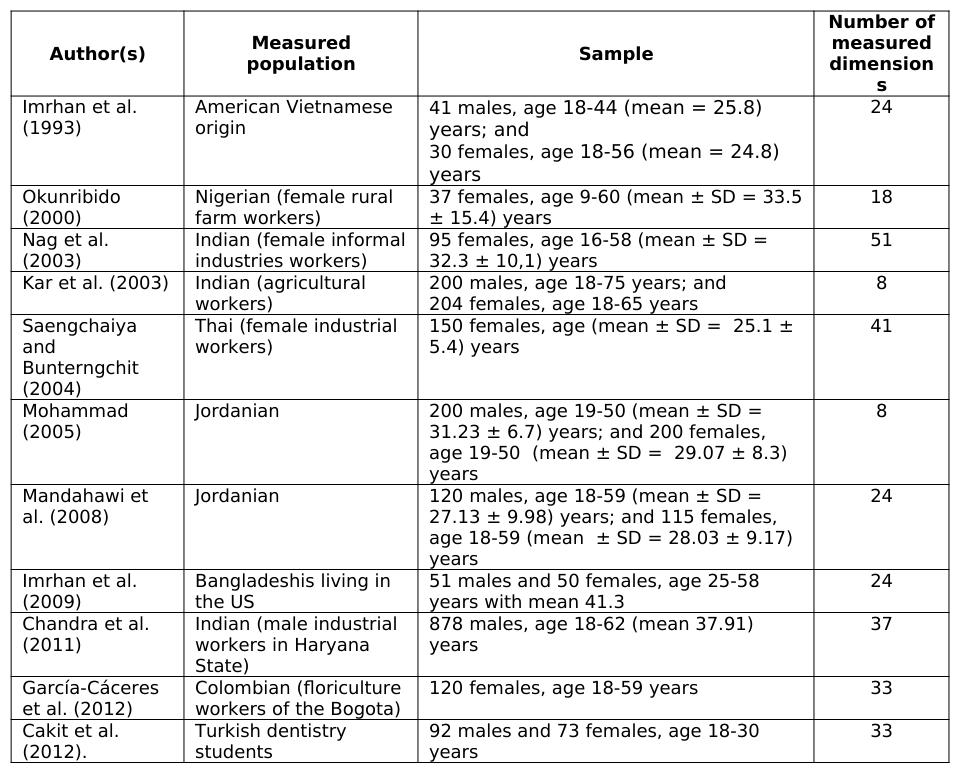
The review was performed by identifying the measurements included in each study and by comparing their aims and methods. The studies included for review are listed in Table 1.
RESULT AND DISCUSSION
Eleven studies focused on hand anthropometry were included in this literature review and studies’ comparison (Table 1). All the selected studies have used manual methods to measure the hand dimensions such as measuring tape, calliper, measuring grid, and wooden cone. The studies have involved the following populations: Colombian (floriculture workers), Jordanian, Bangladeshis living in the US, dentistry students in Turkey, female rural farm Ergonomics In Design, Usability & Special Populations I (2022) https://openaccess.cms-conferences.org/#/publications/book/978-1-4951-2106-7
workers in Western Nigeria, female industrial workers in Thailand, and Indian (female informal industries workers, agricultural workers, and male industrial workers).
Table 1: Studies included for review
Table 1 shows that there is a difference in age of subjects involved in the studies. However, in general it can be stated that the studies measured the hand dimensions of adult populations with minimum age of 18 years, except two studies performed by Okunribido (2000) and Nag et al. (2003), which also involved subjects under the age of 18 years. Okunribido (2000) included female under 18 years old in his study because they have been involved in food processing as young as 6 years in Nigeria. Meanwhile, Nag et al. (2003) included 16-year-old women because they have worked in industries in India.
From a gender perspective, six studies involved both male and female (Imrhan et al., 1993; Kar et al., 2003; Mohammad, 2005; Imrhan et al., 2009; and Cakit et al., 2012), four studies involved only females subjects (Okunribido, 2000; Nag et al., 2003; Saengchaiya and Bunterngchit, 2004; García-Cáceres et al., 2012), and the remaining studies by Chandra et al. (2011) involved only male subjects. A specific reason for gender selection was only mentioned by García-Cáceres et al. (2012) and Okunribido (2003). García-Cáceres et al. (2012) selected only female subjects because the floriculture companies prefer to hire women as their employee (García-Cáceres et al., 2012). Meanwhile, Okunribido (2000) measured only female hand because the harvesting and food processing activities were mostly done by rural women in Nigeria. Two other studies that measured female hand (Nag et al., 2003; Saengchaiya and Bunterngchit, 2004) and another study that measured male hand (Chandra et al., 2011) explained that their studies were done due to lack of data of the gender. However, it does not indicate that the hand anthropometrics data of the opposite gender have been collected previously. In general, all studies explained that Ergonomics In Design, Usability & Special Populations I (2022) https://openaccess.cms-conferences.org/#/publications/book/978-1-4951-2106-7
their works were driven by the lack of hand anthropometrics data of a population.
Table 1 also indicates that there is a wide variability of hand dimensions selected in each study. The included studies involved a range of 8 to 51 different hand dimensions. Each study had their own reasons for the selection of the hand anthropometric measures involved. However, in general, the studies indicated the relevance of the involved measures to the design of hand tools and other manual equipment as their main reason.
It is very interesting to verify that most studies compared their data with other populations. According to the authors, this was done to know the differences of hand dimensions between populations. Such differences have implications for design of hand tools and devices (Imrhan et al., 1993; Okunribido, 2000). Since the recent trend that some hand tools may be manufactured based on population of one country and exported to another country (Okunribido, 2000; Mandahawi et al., 2008), the knowledge of the differences of hand dimensions between populations becomes an important issue.
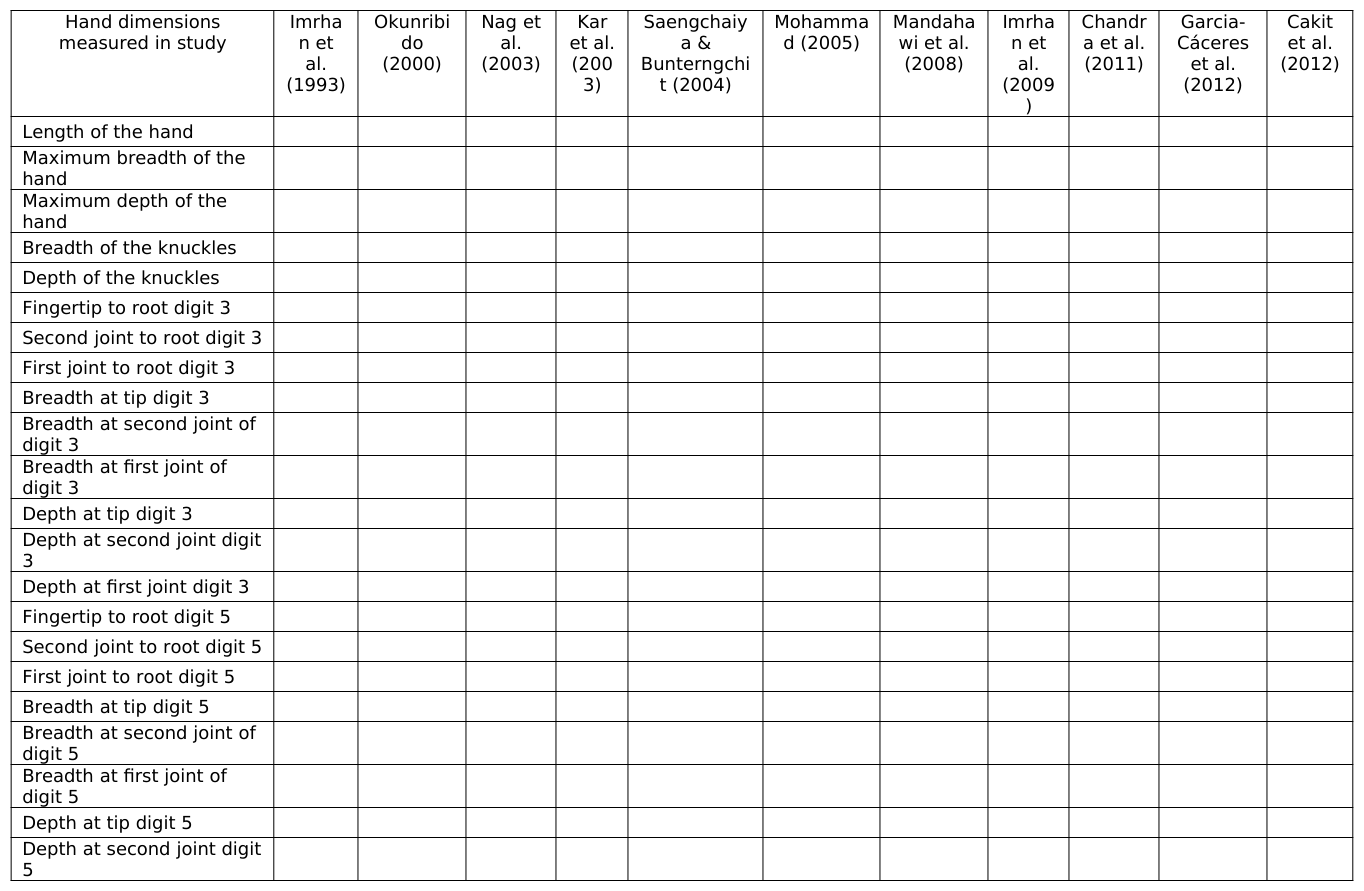
Table 2 shows the twenty-four dimensions that were considered in at least five different studies. In Table 2 a tick ([Equation or mathematical symbol available in the original paper PDF]) indicates that the hand dimension listed in the row heading was included in a study. However, this does not mean that the dimensions have the same definitions and methods in different studies. For example, some studies defined maximum breadth of the hand as the dimension that is measured horizontally at the widest section of the hand when the hand is extended and palm is facing down, fingers are together and the thumb is attached loosely the side of the palm (Imrhan et al., 2003; Mandahawi et al., 2005; Imrhan et al., 2009; Saengchaiya and Bunterngchit, 2004; Chandra et al., 2011; Cakit et al., 2012). While other studies defined the maximum hand breadth as the breadth of the palm measured at the level of maximum bulge of the palm including thumb (Kar et al., 2003; Mohammad, 2005).
It can be seen from Table 2 that twenty-three hand dimensions measured by Imrhan et al. (1993) were also selected by Saengchaiya and Bunterngchit (2004), Mandahawi et al. (2008), Imrhan et al. (2009), and Chandra et al. (2011) in their studies. Imrhan et al. (1993) selected twenty-two of their measurements identical to those measured by Davies et al. (1980) and Courtney and Ng (1984). Then Mandahawi et al. (2008) and Imrhan et al. (2009) precisely used those selected measurements for their study. Okunribido (2000) adopted sixteen measurements that were identical to those measured by Davies et al. (1980), Courtney and Ng (1984), and Imrhan et al. (1993). Chandra et al. (2011) added a few measurements in their study to accomplish the thirty-eight hand dimensions in their study. In another study, Saengchaiya and Bunterngchit (2004) also considered the definitions and techniques of measurements in ISO 7250 (1996) along with the dimensions investigated by Davies et al. (1980) with some adaptations.
Kar et al. (2003) and Mohammad (2005) adapted the definitions and techniques of measurements of hand dimensions in their studies since the measurements correspond to the guidelines in the NASA-1024 (NASA, 1978), but only eight of all fourteen dimensions defined in the guidelines were used. Table 2 shows five of eight dimensions selected by Kar et al. (2003) and Mohammad (2005) were included in the list.
In a study of hand dimensions of Turkish dentistry students, Cakit et al. (2012) adopted the definitions and techniques of measurements in the guidelines published by NASA (1978) and ISO (1996). Some other definitions and measurements methods were derived from previous studies by Davies et al. (1980), Courtney and Ng (1984), Imrhan et al. (1993) and Mandahawi et al. (2005).
A way to determine the hand dimensions selected in the study by García-Cáceres et al. (2012) seems to be very interesting. It is different from other studies in this review. They selected the hand anthropometry measured in their study based on three criteria (García-Cáceres et al., 2012): (i) measure representativeness; (ii) reliability of measurement in accordance with the available instruments; and (iii) conformity with the research objectives (considering what subjects do in their daily works). Regarding the latter purpose, they analysed the anthropometric measures in the literature and their relation to the tools used in their subjects’ daily works. Based on the criteria, they ignored some measurements that have been included in previous studies. A similar procedure was also done by Okunribido (2000) in measuring hand anthropometry of rural farm workers in Ibadan, Western Nigeria. He adopted measurements and methods from Davies et al. (1980), Courtney (1984), Courtney and Ng. (1984), and Imrhan et al. (1993). Sixteen hand dimensions measured on his study were selected from the previous studies and two other dimensions were fingertip to the knuckle of thumb and maximum circumference of hand.
Some functional dimensions of hand were also included in a few reviewed studies, such as: fist circumference (Nag et al., 2003; Chandra et al., 2011; García-Cáceres et al., 2012), grip diameter - inside (Nag et al., 2003; Chandra et al., 2011), and hand circumference while holding fingertips (Nag et al., 2003; García-Cáceres et al., 2012). Some Ergonomics In Design, Usability & Special Populations I (2022) https://openaccess.cms-conferences.org/#/publications/book/978-1-4951-2106-7
other measurements can also be found in individual study by Nag et al. (2003), Chandra et al. (2011) and García- Cáceres et al., 2012). However, all these functional dimensions were not included in selected measurements listed in Table 2. All measurements listed in Table 2 are structural dimensions of the hand.
Different from other studies, Cakit et al. (2012) also measured biomechanics of hand. Thirteen hand biomechanics measures were obtained and then compared to other populations. The obtained database can be used to evaluate and to design the dental tools for Turkish market.
Ergonomics In Design, Usability & Special Populations I (2022) https://openaccess.cms-conferences.org/#/publications/book/978-1-4951-2106-7
Proceedings of the 5th International Conference on Applied Human Factors and Ergonomics AHFE 2014, Kraków, Poland 19-23 July 2014 Edited by T. Ahram, W. Karwowski and T. Marek
Table 2: Summary of measurements included in each study Imrha Okunribi Nag et
Ergonomics In Design, Usability & Special Populations I (2022) https://openaccess.cms-conferences.org/#/publications/book/978-1-4951-2106-7
Proceedings of the 5th International Conference on Applied Human Factors and Ergonomics AHFE 2014, Kraków, Poland 19-23 July 2014 Edited by T. Ahram, W. Karwowski and T. Marek
It should be noted that although all the reviewed studies considered hand–related tools design, they used different guidelines and references in selecting measured hand dimensions. There are three main references used to determine definitions and methods of hand measurements in the studies, namely: (i) NASA Reference Publication 1024 (NASA, 1978), (ii) ISO 7250:1996 (ISO, 1996), and definitions and methods used by previous investigators. Few studies used one guideline as done by Kar et al. (2003) and Mohammad (2005), while other studies compiled two or more references as done by Saengchaiya and Bunterngchit (2004) and Cakit et al. (2012). In following the guidelines, few investigators discarded some measurements recommended in the guidelines and added other measurement in accordance to their studies objectives as done by Okunribido (2000) and García-Cáceres et al. (2012). Another consideration is the availability of measuring devices. Only some studies discarded some certain measurements because they did not have a reliable device to measure the dimensions as done by García-Cáceres et al. (2012).
CONCLUSIONS
In this investigation, the main purpose was to determine the measurements and variables that need to be included in a study of hand for Portuguese population. From the several studies reviewed it was clear that each study involved different number of hand measures and that the selection of the hand anthropometric measures involved were selected by different reasons. Some of those reasons were the relevance of the measures to the design of hand tools and other manual equipment, the inclusion of the measures in previous studies, the need of the measures to be compared with other populations, and the availability of reliable measuring devices. However, it can be generally concluded that the studies selected the measures based on three criteria: (i) from the general guideline in NASA Publication Reference 1024 (NASA, 1978) and ISO 7250:1996 (ISO, 1996), (ii) from conformity with the type of hand tools or hand-held devices, and (iii) from definitions on previous studies. In summary, it can be stated that all new measurement definitions and methods which were not found in the guidelines and previous studies should be describe in detail, since, it is very important to keep the consistency of the definitions and the methods of measurements in order that it can be compared with data from other studies.
ACKNOWLEDGEMENT
This project has been funded with support from the European Commission. This publication reflects the views only of the authors, and the Commission cannot be held responsible for any use which may be made of the information contained therein.
REFERENCES
Cakit, E., Durgun, B., Cetik, O., Yoldas, O. (2012), “A survey of hand anthropometry and biomechanical measurements of dentistry student in Turkey”, Human Factors and Ergonomics in Manufacturing and Services Industries (online), doi: 10.1002/hfm.20401. Chandra, A., Chandna, P., Deswal, S. (2011), “Analysis of hand anthropometric dimensions of male industrial workers of
Haryana State”, International Journal of Engineering (IJE), Volume 5 No. 3. Courtney, A. J. (1984), “Hand anthropometry of Hong Kong Chinese females compared to other ethnic groups”, Ergonomics, Volume 27 No. 11. Courtney, A. J., Ng, M. K. (1984), “Hong Kong female hand dimensions and machine guarding”, Ergonomics, Volume 27 No. 2. Davies, B. T., Abada, A., Benson, K., Courtney, A., Minto, I. (1980), “A comparison of hand anthropometry of females in three
ethnic groups”, Ergonomics, Volume 23 No. 2. García-Cáceres, R.G., Felknor, S., Córdoba, J.E., Caballero, J.P., Barrero, L.H. (2012), “Hand anthropometry of the Colombian floriculture workers of the Bogota plateau”, International Journal of Industrial Ergonomics, Volume 42 No. 2. Imrhan, S. N. (2003), “Two-handed static grip strengths in males: The influence of grip width”, International Journal of Industrial
Ergonomics, Volume 31 No. 5. Imrhan, S. N., Nguyen, M., Nguyen, N. (1993), “Hand anthropometry of Americans of Vietnamese origin”, International Journal of Industrial Ergonomics, Volume 12 No. 4. Imrhan, S.N., Farahmand, K. (1999), “Male torque strength in simulated oil rig tasks: the effects of grease-smeared gloves and
Ergonomics In Design, Usability & Special Populations I (2022) https://openaccess.cms-conferences.org/#/publications/book/978-1-4951-2106-7
Proceedings of the 5th International Conference on Applied Human Factors and Ergonomics AHFE 2014, Kraków, Poland 19-23 July 2014 Edited by T. Ahram, W. Karwowski and T. Marek
handle length, diameter and orientation”, Applied Ergonomics, Volume 30 No. 5. International Organisation for Standardization (ISO) (1996), “Basic Human Body Measurement for Technological Design (ISO 7250:1996). Kar, S.K., Ghosh, S., Manna, I., Banerjee, S., Dhara, P. (2003), “An investigation of hand anthropometry of agricultural
workers”, Journal of Human Ecology, Volume 14 No. 1. Kattel, B.P., Fredericks, T.K., Fernandez, J.E., Lee, D.C. (1996), “The effects of upper extremity posture on maximum grip strength”, International Journal of Industrial Ergonomics, Volume 18 No. 5-6. Mandahawi, N., Imrhan, S., Al-Shobaki, S., Sarder, B. (2008), “Hand anthropometry survey for the Jordanian population”,
International Journal of Industrial Ergonomics, Volume 38 No. 11-12. Mohammad, Y. A. A. (2005), “Anthropometric characteristics of the hand based on laterality and sex among Jordanian”, International Journal of Industrial Ergonomics, Volume 35 No. 8. Nag, A., Nag, P. K., Desai, H. (2003), “Hand anthropometry of Indian women”, Indian Journal of Medical Research, No. 117. National Aeronautics and Space Administration (NASA) (1978), “NASA Reference Publication 1024 - Anthropometric Source
Book, Vol. II: A Handbook of Anthropometric Data”. Okunribido, O. O. (2000), “A survey of hand anthropometry of female rural farm workers in Ibadan, Western Nigeria”, Ergonomics, Volume 43 No. 2. Pheasant, S., Haslegrave, C. (2006), “Body space: anthropometry, ergonomics and the design of work”, Taylor and Francis,
London. Radwin, R.G., Marras, W.S., Lavendertheor, S.A. (2001), “Biomechanical aspects of work-related musculoskeletal disorders”, Theoretical Issues in Ergonomics Science, Volume 2 No. 2. Rempel, D., Serina, E., Kleinenberg, E., Martin, B.J., Armstrong, T.J., Foulke, J.A., Natarajan, S. (1997), “The effect of keyboard
keyswitch make force on applied force and finger flexor muscle activity”, Ergonomics, Volume 40 No. 8. Saengchaiya, N., Bunterngchit, Y. (2004), “Hand anthropometry of Thai female industrial workers”, The Journal of KMITNB, Volume 14 No. 1.
Ergonomics In Design, Usability & Special Populations I (2022) https://openaccess.cms-conferences.org/#/publications/book/978-1-4951-2106-7
LISTED IN THE AHFE DIGITAL BOOKSTORE CATALOGUE
Explore the complete digital volume
Advances in Ergonomics In Design, Usability & Special Populations: Part I
Read this individual research paper free through the original publisher, or explore the full digital proceedings book.
ISBN 978-1-4951-2106-7
Explore this ISBN in the AHFE Bookstore ↗Listed in the July 2026 bookstore catalogue; search by ISBN to confirm current availability · Digital book purchase optional