Ricardo Dagge, Ernesto Filgueiras (2022). Comparative Analysis Between Two Distinct Realities Concerning the Transport of School Material. In: Advances in Ergonomics In Design, Usability & Special Populations: Part I. AHFE Open Access, vol. 18. https://doi.org/10.54941/ahfe100777
This paper presents a comparison regarding the transportation of school supplies by children and pre-adolescent in two different countries with distinct economic and social realities (Portugal and Sri Lanka). This approach focusses on the way how school supplies are transported considering the reality of a European developed country and an Asian developing country. For this, the study of Jayaratne (2012) carried out in Sri Lanka was reproduced in the public education system in Portugal. Attended by 110 students, 56% of which were female, with ages between 12 and 15 years old (M=13.1; S.D.=0.92) from 7th to 9th grade, this study consisted of a survey and an on-site observation that had the purpose of gathering two types of data (qualitative and quantitative) regarding the context of use, the typology of products used and the user himself, of products able to transport school supplies. Major findings revealed that for both realities, the scholar backpack was the elected product (82% vs. 79.6%), by the students, to carry school supplies. However, considering the user interaction with this, it was observed that only 51% of the Portuguese students, in comparison with the 97% of Sri Lanka’s, make a proper use of their backpacks (wearing the two straps of the backpack). Despite the fact that the percentages found in both studies were around 10% of total body weight (respecting the internationally recommended limit placed between 10% and 15%), it is relevant to say that in both cases, the amount of students that reported musculoskeletal discomfort or pain during and/ or after the carriage of their school supplies was around 50%.
Products responsible for carrying school supplies are not fully explored in all the aspects allowing to perform the task to which they were developed. This could be seen, in the beginning of each new school year, by the considerable amount of growth stage children that report back pain and musculoskeletal disorders due to the use of their backpacks. The lack of design and research made around this type of products is due to market demands tending to work mostly upon its aesthetical aspect.
Goodgold et al. (2002) claim that the problems reported by backpack users happen because their center of gravity is displaced to the direction of the load, and therefore to compensate, the individual tends to lean his body into the opposite direction, which can generate fatigue of the soft tissues and ultimately can lead to postural deformities.
The non-observation of human factors and ergonomic aspects, when developing a product, should be seen as a serious information gap in the early stages of product development that results in the problems mentioned above.
Ergonomics In Design, Usability & Special Populations I (2022)
Therefore designers and development teams must spend time studying the physical, cognitive and sensory aspects surrounding the context of product’s use being developed.
This paper presents the application, in a European developed country, of a study similar to the one applied by Jayaratne (2012) in Sri Lanka. Results obtained here will be compared with the ones gathered by Jayaratne (2012) for further understanding the context of use, in two distinct economic and social realities, of products responsible for the carriage of school supplies.
This paper has the intended purpose of understanding whether economic and social differences between developing and developed countries, interfere with the human factors and ergonomic problems presented before.
FIELD STUDY
Method
This field study, conducted to determine ergonomic factors surrounding the products and the task of carrying school supplies, consisted of a survey and an on-site observation strategy primarily made to gather user’s interactional and behavioral data.
This was conducted in the urban district of Oeiras, in a public educational system school in Portugal, from March to June 2013. With a total amount of 1062 middle and upper-middle class students, 491 of these attending 3 rd Basic Cycle of Education (ESQM 2013), this school tends to be present in 5th place of the National Ranking of public educational system (DN 2012).
Sample Attended by 6 classes, 2 representing each of the grade that compose the 3rd Basic Cycle of Education (7th, 8th and 9th), this field study featured a total amount of 110 students. From these, 56% were females and the age range varied from 12 to 15 years old (M=13.1; S.D.=0.92), 38.18% of these were attending 7th grade, 32.73% the 8th grade and 29.09% the 9th grade.
Study procedures For determining the ergonomic factors surrounding the products and the task of carrying school supplies this field study consisted, as mentioned above, of a survey and an on-site observation strategy.
The survey presented to the subject is composed by 12 questions having a pre-established set of possible answers. Among these, there is a question including an adaptation from the Standardized Nordic Questionnaire based upon the work made by Kaewboonchoo et al. (1998) where was asked to the subject to highlight the body area in which the amount of discomfort and pain, if applicable, occurred.
The 12 questions approached themes like: a) Product typology used to carry school supplies;
b) Features that the user would like to change in the product responsible for the carriage of his school supplies; c) The most valued aspect of the product used;
d) People mostly influencing in the decision process of which product to buy; e) The most common brands and concepts associated to these, regarding the product used;
f) Situations outside school, where the same product is used;
Ergonomics In Design, Usability & Special Populations I (2022) g) The adaptation of the Standardized Nordic Questionnaire, that included the day period where the discomfort or pain emerge; h) A brief clinical history to help the distinction between chronic and product use related pain or discomfort; i) Number and kind of elements carried inside the product responsible for the school supplies transportation; j) The life-time of the product used to carry their school supplies;
k) User point of view of his own habits and strategies to carry the product responsible for the transportation of his school supplies; l) Finally, the means of transportation used to travel to and from school.
The on-site observation strategy was carried out as a complementary method of the survey intended to verify and further understand the answers gathered.
Regarding the survey answers that needed to be verified we had the ones related with: a) Product typology used to carry school supplies;
b) The most common brands and concepts associated to these, regarding the product used; c) User point of view of his own habits and strategies to carry the product responsible for the transportation of his school supplies;
d) Finally, the number and kind of elements carried inside the product responsible for the school supplies transport.
The intended observation data that primarily lead to this strategy, approached: a) The need to register the product typology used, by dividing them into morphological classes;
b) The gathering of the most common adopted postures, by photographic registry; c) The need to compare the weight capacity against the effective weight carried by the user, in the product responsible for the transportation of his school supplies, weighing the user with and without the elected product while registering this procedure simultaneously with photographic means;
d) The gathering of the quantity and typology of the transported items inside the elected transportation product; e) Finally, the need to gather the general anthropometrical measures like the minimal, mean and maximal height of the studied population, by placing a measurement tape on the wall of the observation room.
RESULTS
Field study results were divided into two major groups, the first group composed by the results gathered with the survey applied and the second group composed by the collected data from the application of the on-site observation strategy.
Survey results Survey results are divided into three major groups according to the main theme of each question as follows:
a) Product related questions;
Ergonomics In Design, Usability & Special Populations I (2022) b) Method of use and transported content related questions; c) And finally negative effects, resulting from the use of the product responsible for carrying school supplies, related questions.
a) Product related questions The surveyed sample revealed a distribution of 82% of users that claim to carry their school supplies in backpacks, 12% use a suitcase, 5% a shoulder bag and only 1% of the surveyed sample use a trolley bag to carry their own school supplies to and from school.
Most of the surveyed subjects (65%) claimed that the capacity of the product used is the ideal to carry the amount of school supplies needed for most of the days. 33% said that the capacity of the product responsible for the carriage of their school supplies proved to be insufficient, while only 2% of the surveyed subjects claimed that the amount of space available proved to be more than sufficient to transport their school supplies needed for everyday activities.
Product related results also revealed that 39% of the surveyed subjects own a product that has been acquired in the beginning of the present school year. Also 39% of surveyed subjects claimed to have bought this product in the last 3 years, while 22% of the surveyed subjects claimed to have their product for more than 3 years.
b) Method of use and transported content related questions Major findings revealed that most of the surveyed sample (76%) tend to only use their product to carry their supplies to and from school, not using it at all outside this routine.
55% of the surveyed subjects claimed to move around only in motorized means of transportation, while 38% claimed not to use any kind of motorized transport at all. The rest of the surveyed subjects (7%) claimed to use both means of transportation mentioned before.
Within the universe of 82% of the surveyed subjects that claimed to use a backpack to carry their own school supplies, the perceived user posture in interaction with it revealed a distribution of 51% claiming to use both of the carrying handles, while 31% claimed to use only one of its two carrying handles. It was also found that 13% of this particular universe tend to carry other product than the backpack used to carry their own school supplies. Most common extra products referenced were a dossier and other bags.
Regarding the transported content inside the products intended for carrying school supplies, it was found that 63% of the surveyed subjects carry 5 or more books every day. It was also found that 15% of the surveyed subjects transport their own laptop every day.
c) Negative effects related questions Regarding the negative health effects of transportation of school supplies, 55% of the surveyed subjects showed that this task tend to generate some kind of musculoskeletal discomfort or even pain. From these, 45% classified them as a minor discomfort or slightly pain, while the remaining 10% classified it as a moderate or even acute level of pain.
From the 55% surveyed subjects that reported musculoskeletal pain or discomfort, distributed according to the time of the day in which these incidents tend to occur, 5% claimed the arise in the beginning of the school day, 31% reported episodes during this period, while the vast majority (64%) related the occurrence of this type of episode in the end of the day.
Major findings regarding the most negatively affected areas, by the transportation of products intended to carry school supplies, also revealed that: a) 20% of the surveyed subjects described some kind of pain or discomfort in the neck;
b) 55% of these also described pain or discomfort episodes in the shoulder areas; c) Finally, 48% of the surveyed subjects also pointed out the upper back area as a place where pain or Ergonomics In Design, Usability & Special Populations I (2022) discomfort was felt.
It was also found that 36% of the subjects revealed musculoskeletal problems in the previous month of this survey.
On-site observation strategy results The validation of results obtained is confirmed by the convergence between gathered results from the on-site observation strategy and the survey presented before. Therefore those results won’t be presented again.
It will only be presented the data regarding the weight capacity against the effective weight carried by the user, the quantity and typology of the transported items inside the elected transportation product and finally general anthropometrical measures of the studied population.
Comparing the weight capacity against the effective quantity of items carried by the users in their products intended for carrying school supplies, from a total amount of 110 observed students, it was found that only 3% of the transported products capacity seem to be insufficient; 25% presented a fairly capacity amount in comparison with the transported items, whilst the vast majority (72%) of the products observed seem to have an oversized capacity for its transportation requirements.
Regarding the items transported inside the product intended to carry school supplies, it was found that 39% of those were scholar and non-scholar books; 16% were notebooks, 7% dossiers, 12% school kit cases, 9% calculators, 7% rulers and the remaining 10% were considered “other products”.
Major findings regarding the weight of the product carried by the studied population revealed a mean weight of 5.06 Kg (S.D.= 1.99) with a maximum and minimum of 10 Kg and 0.2 Kg respectively.
Also gathered through the on-site observation strategy, the general anthropometrical measures of the studied population, found a mean of 163 cm height (S.D.= 9) with a maximum and minimum of 190 cm and 144 cm respectively.
CONCLUSIONS
“Inculcating the Ergonomic Culture in Developing Countries: National Healthy Schoolbag Initiative in Sri Lanka” (Jayaratne 2012) was the article used as guideline to understand Sri Lanka’s reality regarding the transportation of school supplies while the field study presented here intended for the same purpose regarding the Portuguese reality in this matter.
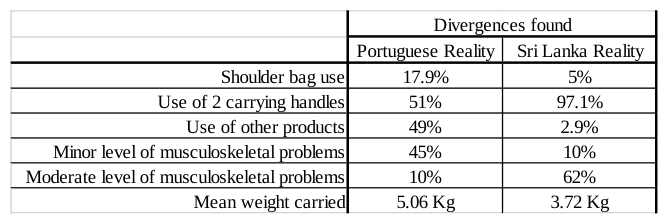
Major findings revealed that the differences between these two realities are primarily placed in 2 major aspects, one regarding the carrying method of the product used for the transportation of school supplies and the other regarding the negative effects resulting from this use.
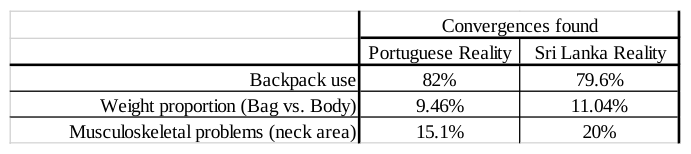
Major findings of the field study presented here converge with the ones gathered by Jayaratne (2012) in the amount of surveyed subjects that tend to use a backpack for carriage of their own school supplies. This is proved by the slightly difference between 82% of Portuguese students against 79.6% of Sri Lanka ones as seen in Table 1. The results convergence can also be found in the mean percentage relation of schoolbag weight as a proportion of body weight of 9.46% from Portuguese user’s against 11.04% of Sri Lanka ones as referenced in Table 1. A convergence between the results gathered from both studies can also be found in the user’s percentage that reported musculoskeletal problems around the neck area, as seen in Table 1 (15.1% of Portuguese students against 20% of Sri Lanka ones).
Ergonomics In Design, Usability & Special Populations I (2022)
Table 1: Convergences found between studied realities Convergences foundTable 2: Divergences between studied realities Divergences found
Acknowledgments
The authors would like to thank to Quinta do Marquês High School and in particular all the students, which volunteered to the field study developed.
REFERENCES
DN (2011). “Veja o Rankingdas escolas Secundárias e Básicas”. Diário de Notícias Website: http://www.dn.pt/DNMultimedia/DOCS+PDFS/RankingEscolas2011/Secundarias.html ESQM (2013). “PEE - Projeto Educativo da Escola”. Escola Secundária Quinta do Marquês Website: http://www.esqm.pt/index.php?pg=4&spg=32
Goodgold, S., Corcoran, M., Gamache, D., Gillis, J., Guerin, J. and Quinn C., J.. 2002. “Backpack Use in Children”, in: Pediatric Physical Therapy Vol. 14. Pp. 122 – 131.
Jayaratne, K. 2012. “Inculcating the Ergonomic Culture in Developing Countries: National Healthy Schoolbag Initiative in Sri Ergonomics In Design, Usability & Special Populations I (2022)
Lanka.”, in: Human Factors: The Journal of the Human Factors and Ergonomics Society No. 54 (6). Pp. 908-924.
Kaewboonchoo, Orawan, Hiroichi Yamamoto, Nobuyuki Miyai, Seyed Mohamad Mirbod, Ikuharu Morioka e Kazuhisa Miyashita. 1998. “The Standardized Nordic Questionnaire Applied to Workers Exposed to Hand-Arm Vibration”, in: Journal of Occupational Health No. 40:5. Pp. 218–222.
Ergonomics In Design, Usability & Special Populations I (2022)
LISTED IN THE AHFE DIGITAL BOOKSTORE CATALOGUE
Explore the complete digital volume
Advances in Ergonomics In Design, Usability & Special Populations: Part I
Read this individual research paper free through the original publisher, or explore the full digital proceedings book.
ISBN 978-1-4951-2106-7
Explore this ISBN in the AHFE Bookstore ↗Listed in the July 2026 bookstore catalogue; search by ISBN to confirm current availability · Digital book purchase optional