Hannu Karvonen, Tuomo Kujala (2022). Designing and Evaluating Ubicomp Characteristics of Intelligent In-Car Systems. In: Advances in Ergonomics In Design, Usability & Special Populations: Part I. AHFE Open Access, vol. 18. https://doi.org/10.54941/ahfe100765
In this paper, we present a preliminary taxonomy for designing and evaluating intelligent systems from the viewpoint of ubiquitous computing (ubicomp). As an example of intelligent systems, we examine a few novel in-car systems, which are already commercially available. We also discuss some ergonomics issues related to the design of in-car systems and argue that rationale for solving these issues can be found from the ideal qualities of ubicomp systems. The five characteristics we define to be ideal for genuine ubicomp systems are context-awareness, natural interaction methods, invisibility, support for everyday tasks, and interconnectivity. Based on these characteristics, we create a framework to analyse the differences between the ubicomp characteristics of the examined novel in-car systems. To assess the utility of the framework in the development of entirely new systems, we use it to evaluate two intelligent prototype in-car systems. The results suggest that the framework suits well for guiding the design and evaluation of in-car computing systems from the ubicomp point of view. Future work needs to be conducted to improve the applicability of the framework in evaluating also other intelligent systems than only in-car systems.
Ubiquitous computing (or ubicomp, for short) is a vision of a future where computing has woven itself into the fabric of our everyday life and is practically an indistinguishable part of it (Weiser, 1991). An ideal ubicomp system ‘disappears’ into the background of people’s lives and does not require their active attention. However, the system can still support people’s everyday activities as naturally as possible for them and offers its computing power in situations where they need it (Weiser, 1993). A classic example from Weiser (1991) of this support is the dozens of different systems inside a typical car, which for example start the engine, clean the windshield, and lock and unlock the car doors. Although most drivers are not aware of the functioning principles of these systems, they can still utilize them as a natural part of everyday life: the systems support their daily driving without them even noticing it.
In this paper, instead of going into specifics of the above-kinds of primitive systems, we focus on intelligent systems available for passenger cars today. To be exact, we concentrate on intelligent in-car systems (also referred to as e.g., ADAS, advanced driver assistance systems). Therefore, for example intelligent transport systems embedded into the road infrastructure are excluded from the scope of this paper. First, we make a brief review of some of today’s intelligent in-car systems that can be utilized while driving, such as navigation, adaptive cruise control, and x-by- wire systems. We see that cars offer a great opportunity for ubicomp, as cars can today be considered an everyday technology that is used naturally by many people. Furthermore, cars are large enough for placing new systems in them and they can feed stable power for the different devices. Second, we discuss some of the ergonomics issues, Ergonomics In Design, Usability & Special Populations I (2022) which should be taken into account in the design of these systems. Third, we present a framework for evaluating these kinds of intelligent systems. The framework is based on the original ubicomp visions by Mark Weiser and also others’ work that builds on his ideas; we argue that rationale for ergonomics research and design can be found from the ideal qualities of ubicomp systems. Fourth, we use the framework to analyze the already existing in-car systems reviewed in the paper. Finally, we present two new prototype in-car systems, and evaluate them with the framework. By conducting this kind of an analysis for the new systems, we aim to gain feedback for their future development.
SOME EXISTING INTELLIGENT IN-CAR SYSTEMS Today, commercially available intelligent in-car computing systems that can be utilized during driving include navigation, night vision, adaptive cruise control (ACC), electronic stability control (ESC), driver vigilance monitoring, collision avoidance and warning, x-by-wire, and lane departure warning and keeping systems. Some of these systems – like ESC – have become a standard in every new car and most of them can be bought as an accessory to many of today’s vehicles. Next, we discuss briefly each of these systems on a general level, arranged by first commercial introduction to the market (based on the time of release, mostly according to Regan et al., 2001).
Navigation Systems (early 1980s) Navigation systems are well known nowadays and have become a common part of driving. Their basic function is to guide the driver from one point to another as smoothly as possible. Today, navigation systems have increasingly versatile features; they can for example suggest alternative routes in case a traffic jam is detected to be on the route.
Night Vision Systems (early 1990s) In dark conditions (or poor weather), a night vision system offers an enhanced view to the environment that is beyond the reach of the vehicle’s headlights. Typically, this kind of a system includes an in-car LCD display fixed in the dashboard of the car, which shows a camera view where the natural light in the environment is amplified. Solutions that are more elegant use a head-up display (HUD) to highlight heat-emitting objects from the drive view. This enables the driver to enjoy an enhanced driving view without taking one’s eyes off the road (Rohr et al., 2000).
Adaptive Cruise Control (mid 1990s) An ACC system uses radars or lasers in the front part of the car to monitor the distance of the traffic ahead. The driver can set a certain time interval, which the ACC will keep in relation to the vehicle in front. Therefore, a static safety distance to the car ahead can be held without driver intervention. If the road ahead is empty, the system acts just like a normal cruise control system (i.e., keeping a specified speed for the vehicle). The driver can take over the control of the vehicle from the ACC anytime necessary. Manual control may be required in surprising situations, for example, if another vehicle suddenly cuts out in front of the car. Therefore, although ACC usually takes care of speed control, the driver must also constantly keep an eye on the road environment. Some studies (e.g., Kovordányi, 2005) suggest that ACC users drive steadier and keep longer safety distances compared to drivers without ACC.
Electronic Stability Control (mid 1990s) An electronic stability control (ESC) system applies the vehicle’s brakes to keep the vehicle stable during safety- critical situations. An example of this technology is ESP (electronic stability program), which can prevent vehicle skid by using for example the car’s ABS (anti-lock braking system). Some ESC systems can also reduce the incoming power from the engine in these situations. The main goal of ESC is to compensate for the driver’s driving mistakes (e.g., too much speed, under- or oversteering, and swerving of the car) in sudden situations.
Driver Vigilance Monitoring Systems (late 1990s) A driver vigilance monitoring system can detect if the driver is temporarily incapable of driving the car. This kind of a situation can occur, for example, if the driver falls asleep or has a stroke while driving the vehicle. If a situation of this kind happens, the system first warns the driver about the matter for example with an auditory alert. If the driver does not react to the alert, some systems can even take over the control of the vehicle and stop the car, if necessary.
Ergonomics In Design, Usability & Special Populations I (2022)
Collision Warning and Avoidance Systems (late 1990s) A collision warning system uses radars (or lasers) to detect the movements of the surrounding vehicles. The system uses this information to evaluate threatening situations from the surrounding traffic. If this kind of a situation occurs, the system gives a warning to the driver about a possible threat. In addition to these functionalities, a collision avoidance system can also do collision avoidance maneuvers by intervening in the car’s brakes (Walker et al., 2001).
X-By-Wire Systems (late 1990s) In x-by-wire systems, the mechanical connection between the vehicle’s basic functions is replaced with an electronic one. The letter X in this context is the feature that is controlled electronically (e.g., throttle, steer, or brake). For instance, in steer-by-wire, the steering wheel becomes merely an electronic input device, which sends signals to the car’s road wheels. In this way, steering input can be integrated into the electronic architecture of the vehicle and also to other computing systems in the vehicle (Walker et al., 2001). Therefore, the benefit with x-by-wire systems is that for example the car’s other safety systems (e.g., ESC) can usually react to driver’s inputs (by taking into account factors that the driver cannot notice by him- or herself) in a more accurate way than with mechanical actuators.
Lane Departure Warning and Keeping Systems (early 2000s) A lane departure warning system uses for example machine vision to detect the road’s lane markers. The system monitors that the car stays inside its own lane always when it is also supposed to stay there. If the car passes a lane marker from either side of the lane (without the correct turn signal on), an auditory or tactile warning is given. This kind of a situation can occur, for example, if the driver is concentrating too much on a secondary task at the cost of the primary task. A lane keeping system can also do corrective maneuvers to make the car return to its own lane.
Other intelligent in-car systems, which can be used while driving, include for example parking assistance systems, traffic-sign detection systems, reversing assistance systems, and even autopilot systems. However, for the purposes of this paper ̶ and in order to keep the length of this paper within the defined limits ̶ we do not review them here.
DESIGN ISSUES FROM THE ERGONOMICS POINT OF VIEW Although the systems reviewed in the previous chapter are designed to improve driving safety, efficiency, and enjoyment (Walker et al., 2001), it is not self-evident that they will always have a positive effect on these factors. In addition to technical issues, the ergonomics (or human factors) problems of these systems can have a significant negative impact, for example, on safety. In this chapter, we discuss seven examples of these problems. First, some of these systems (e.g., navigators) often require a proportion of the driver’s attention and have therefore the potential to deteriorate performance in the primary task of driving. Therefore, for example when designing the interfaces of these systems, one of the key issues is to present information in a simple and understandable way, so that it distracts the primary task as little as possible (Ekholm, 2002). The challenge is that for example desktop human-computer interaction design principles do not apply as such to the design of in-car systems, as the interaction with these systems happens concurrently with the (sometimes fast-paced) main task. Consequently, it is crucial that this interaction does not cause for example too much workload, because it can lead even to fatal accidents. However, minimizing this additional workload in the development of these devices and systems can be very challenging.
Second, we see that in-car system designers should make the feedback of the system as natural as possible. For example, when designing x-by-wire systems, it is essential that the driver feels that the vehicle’s basic controls act correctly according to the outside road conditions (by taking into account e.g., the road’s slipperiness). Some studies (e.g., Walker et al., 2006) have shown that if the feedback of the x-by-wire system is not accurate, the driver may lose the ‘feel of driving’ from the controls. Third, the interaction between the user and the system has been indicated to change radically in ubicomp environments (Abowd and Mynatt, 2000). Therefore, the use of other modalities than just visual output and manual hand input (like with desktop computers) has to be considered. This has been well understood by navigation system developers, as today’s navigators provide for example voice output of the driving instructions. To give an example from the data input side, speech technology is already used in some systems and can be considered as a natural interaction method when one’s hands are occupied and manual input with hands (e.g., with a touch screen keyboard) and looking at a separate in-car screen would distract the driving considerably. Ergonomics In Design, Usability & Special Populations I (2022)
However, due to speech technology’s current unreliability and inefficiency compared to manual controls in sudden situations, it is obvious that it should not be used for safety-critical functions, such as braking.
Fourth, we want to discuss a phenomenon, which has been found to be true especially with navigation systems: drivers who drive a route without a navigation system seem to remember the route better than the ones who drive it with the assistance of a navigation system (Jackson, 1998). Navigators can therefore work as a memory prosthesis and in this way have a negative effect on memorizing and learning new environments: the driver does not then know how to navigate without the system, even in frequently visited places. On a more general level, this phenomenon can be a problem also with other in-car systems: once the drivers get used to them, they may no longer have the skills to drive without them. The question is how they will be able to drive if one of the systems suddenly stops working.
Fifth, one side effect of the increase of in-car computing systems is that the nature of the driving task itself is changing as computers take automatically care of more and more of the driving-related tasks. Therefore, it needs to be considered how to allocate the tasks between the automatic system and the driver so that the driver does not lose situation awareness. An important concept related to this issue is ‘locus of control’. According to Stanton and Young (1998), drivers with an internal locus of control experience themselves to be responsible for the behavior of the vehicle while drivers with an external locus of control experience that the behavior of the vehicle is controlled by the automated system. In the latter case, the drivers usually trust the system too much and can therefore jeopardize safety. This can lead to the misuse of automation in situations it was never designed to cope with in the first place.
Sixth, drivers tend to change their behavior according to the seemingly increased safety margins created by the system. This change of behavior can be anything from driving at higher speeds to focusing less attention on driving. In the previous literature, this phenomenon is called ‘negative behavioral adaptation’ (e.g., Kovordányi, 2005). When designing intelligent in-car systems, it is crucial that the designers can find a way to make the drivers take full advantage of the vehicle’s systems, but in such a way that their behavior does not simultaneously negatively adapt. Related to this issue is also the finding that new in-car systems can paradoxically either increase or reduce the level of mental workload, depending on the situation (Walker et al, 2006). Low mental workload on normal driving situations can suddenly rise to a very high mental workload when a hazardous situation occurs. This kind of a situation can happen for example, when a driver uses an ACC and mistakenly believes that the system makes the driving safe and does not pay enough attention to the events happening in the road environment (Kovordányi, 2005).
Finally, a false assumption with some of the visions related to future usage of these systems is to expect people to look kindly upon technology. In reality, a substantial number of people are against new technology, for example because they are afraid of it. This phenomenon, called technophobia (Brosnan, 2002), should be regarded as one of the key issues to consider when designing new intelligent systems for everyday environments. For example, some people might find it a frightening idea (at least at first) if their cars could talk to them while they are driving.
In-car system designers must be aware of these kinds of ergonomics issues, which affect the usage and acceptance of intelligent systems in vehicles. Making a complex system interact with the complex human being can always create an unexpected series of events, which can ultimately have catastrophic consequences. Furthermore, the long-term effects of these systems on the driving behavior can be completely different from the ones originally envisioned. If all the relevant human factors issues are not taken into account on a sufficient level in the design of new intelligent in-car systems, the expected positive effects of these systems can eventually turn out to be quite the opposite.
SOLUTIONS FROM THE IDEOLOGY OF UBIQUITOUS COMPUTING We argue that solutions to some of the above-mentioned problems can be found from the ideal qualities of ubiquitous computing systems. After a literature review on the topic, the key characteristics we define to be common for genuine ubicomp systems are context-awareness, natural interaction methods, invisibility, support for everyday tasks, and interconnectivity. In our view, these five factors are also the ideal characteristics that enable a truly valuable intelligent in-car system. Therefore, these characteristics can also be considered as evaluation heuristics or criteria for different systems during their development. Next, we define these characteristics on a general level:
Ergonomics In Design, Usability & Special Populations I (2022)
1. Context-awareness: Abowd and Mynatt (2000) argue that the ‘five W’s’ (Who, What, Where, When, Why) are a minimal set to be included in the definition of context. They also state that ‘ubicomp applications need to be context-aware, adapting their behavior based on information sensed from the physical and computational environment’. According to Dey (2001), ‘a system is context-aware if it uses context to provide relevant information and/or services to the user, where relevancy depends on the user’s task’. In our view, context-awareness could be a solution e.g., to the aforementioned negative behavioral adaptation problem; a crucial aspect of these systems should be to understand for example the state, behavior, workload, and even the mental models of the user. Based on these factors, and on the prevailing driving situation, the system should adapt its behavior in an appropriate manner. In long-term usage, the system should therefore also be able to adapt to mitigate the effects of negative behavioral adaptation of the user. 2. Natural interaction methods mean ‘off the desktop’ interaction methods that are natural forms of communication to humans (Abowd et al., 2002). Examples of these methods while driving are auditory or tactile feedback for output and speaking or physical actions for input. Natural interaction methods are needed with ubicomp, because of the interaction paradigm change caused by the proliferation of intelligent computing systems everywhere into our living environments (Abowd and Mynatt, 2000). In cars, these methods are required for ‘hands-on’ and distraction-free driving as the driver’s eyes and hands can be busy. 3. Invisibility, which does not necessarily mean that the computing devices are physically hidden, but rather, that the system is invisible from the usage point of view. Therefore, the technology should ‘disappear’ (Weiser, 1991) and its use should be non-disturbing. In cars, this type of technology can ease the previously mentioned problems of driver distraction, technophobia, and losing situation awareness while driving. 4. Support for everyday tasks, which means that computing is used as part of everyday life to accomplish and ease routine daily tasks (Weiser, 1991). Supporting everyday tasks in the driving context can mean, for example, that the basic functions of driving are not changed considerably, but rather supported with computing to be for example safer. This can help to reduce the problems of distraction and technophobia. 5. Interconnectivity, which means that the computing system is connected also to other intelligent systems and data from and to the system is transmitted through non-distracting (for the user) wireless network technologies (Weiser, 1993), such as GPS, 3G, Wi-Fi, and Bluetooth. The systems should therefore be able to communicate seamlessly with each other through wireless connections and in this way adapt to the prevailing circumstances without human intervention. Interconnectivity can be seen as a technical solution for some of the previously mentioned factors, but in the car context, it may also have some additional ergonomics benefits: for instance, if the user needs to transfer address information from a mobile phone to a navigation device, a wireless connection between these devices can minimize the effort in this operation.
Some researchers (e.g. Abowd et al., 2002) define also ‘automated capture and access’ to be an important characteristic of ubicomp systems. In cars, automated capture could be used for example for black box type of capturing of accident situations to see later on, what actually happened. This information could be useful for instance for lawyers who want to determine who was guilty of an accident. However, nowadays there are for example cheap dashboard cameras available for proving one’s innocence in accidents. Automated capture could also be used for educational purposes if the driver (or an instructor) wants to see a recording of a driving performance. Yet, this kind of an in-car recording can also be produced easily with modern digital video cameras that can be installed inside the car. Furthermore, in our view, educational feedback is more efficient if advice for a better driving style can be given directly during the driving situation itself. For these reasons ̶ and as in this paper we are looking at systems used while on the move ̶ we do not include automated capture and access as part of our taxonomy here.
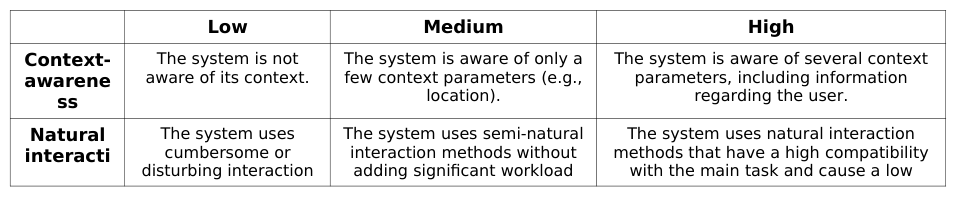
In our proposed preliminary framework, the above-mentioned five characteristics can rank different qualitative fulfillment levels with different systems. A detailed description of the meanings of these levels is shown in Table 1.
Table 1: The meaning of the fulfillment levels (low, medium, and high) of different characteristics in the proposed framework
Ergonomics In Design, Usability & Special Populations I (2022) for the driver or disturbing the
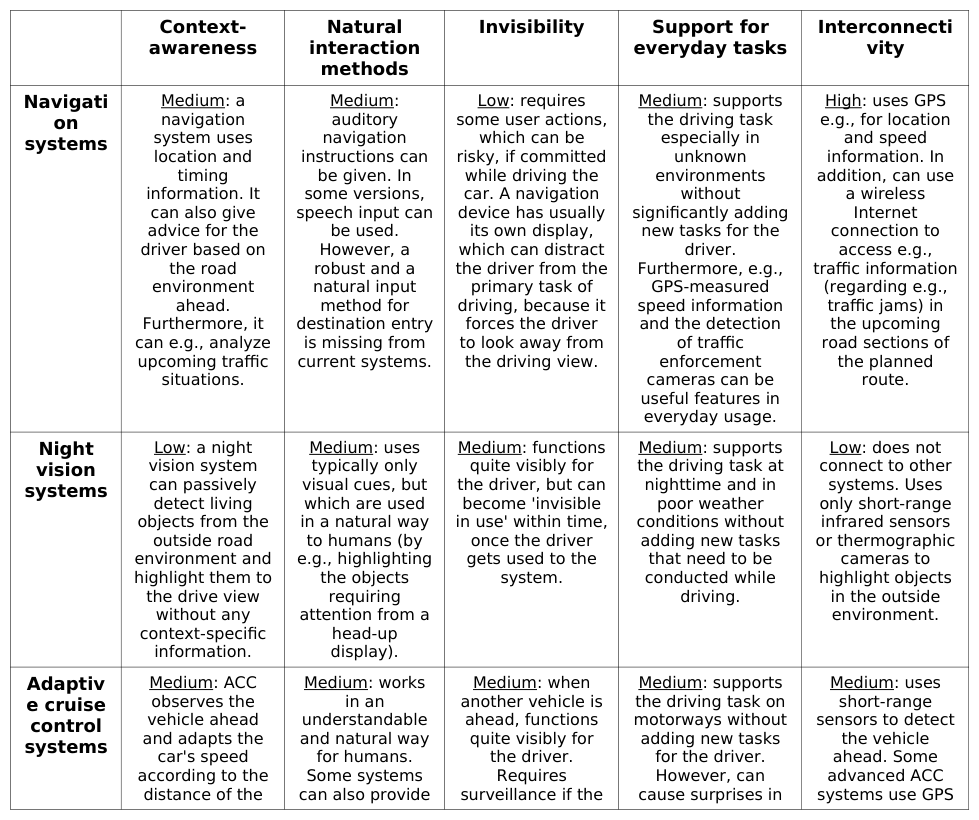
An ideal (in-car) ubicomp system would receive the ‘high’ rating in all of the above-mentioned characteristics. In Table 2, the defined framework is used to evaluate the level of each characteristic in the intelligent in-car systems we have discussed previously in this paper. A short explanation is provided to support each assessment in the table.
Table 2: Some of nowadays' intelligent in-car systems (that can be utilized while driving) evaluated with the proposed framework
Ergonomics In Design, Usability & Special Populations I (2022) other vehicle. e.g., auditory surrounding traffic
TWO NEW INTELLIGENT IN-CAR SYSTEMS To evaluate the applicability of the proposed framework in the development of entirely new intelligent in-car systems, we organized two driving simulator experiments with 24 participants. For these experiments, we developed prototype versions of two new in-car systems, which we call the Driver Tutoring System (DTS) and the co-driver system (C-DS). The details of these systems and the conducted experiments are reported in Karvonen et al. (2006) and Karvonen et al. (2008). Briefly explained, the systems were studied with a Wizard-of-Oz method (e.g., Dahlbäck, 1993), which means that the participants believed that they were interacting with a fully automated and intelligent system (either the DTS or C-DS) although the operations of the systems were carried out by an experimenter behind the scenes. Several methods were used to gather data from the experiment. Qualitative methods Ergonomics In Design, Usability & Special Populations I (2022) included thinking-aloud (Bainbridge and Sanderson, 1995) while driving in the simulator and a semi-structured interview after the experiment. Quantitative data was captured with a modified NASA Task load index (NASA- TLX, Hart and Staveland, 1988) questionnaire and by counting the number of driving errors a participant committed from the collected video material afterwards. Suitable parameters, such as means and standard deviations, were counted from the quantitative data. The quantitative results were also put through statistical significance tests.
Next, we provide detailed descriptions of these systems by utilizing the characteristics proposed earlier in this paper. The framework also guided us in deciding to what aspects should be paid attention to in the further development of these systems and what ergonomics issues should be taken into account in the possible implementation to a real car.
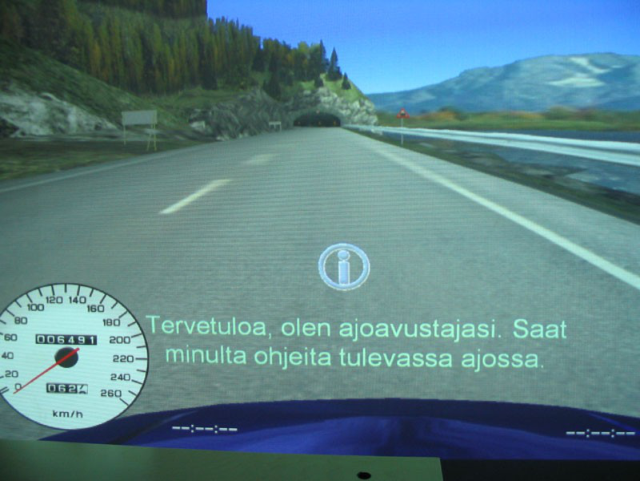
Driver Tutoring System The DTS (see Figure 1) interpreted the surrounding road environment, the upcoming road situations, and the driving style of the driver, and gave advice based on this information into a HUD for safer and more economical driving. The HUD guidance messages were related to navigation (e.g., an ’i’ symbol and the text ‘Take the first turn on the left’), driving style (e.g., ‘Try to avoid sudden movements of the steering wheel’), speeding (e.g., ‘You are speeding, please slow down’), and upcoming demanding situations (e.g., a warning sign and the text ‘Approaching a roundabout, please slow down’). As can be noticed, some of this information is already available in real traffic from road signs. However, our system could have a beneficial impact on driving if the driver does not notice a sign.
Figure 1. The driver tutoring system with an exemplary tutoring message in Finnish presented in the head-up display.
One aim of the DTS was to reduce the passiveness of the driver, which can be caused for example by routine everyday driving. By activating the driver in different situations, the system tried to support the driver in orientating to the upcoming situations in the road. In this way, the aim was to move the driver’s external locus of control into an internal locus of control (e.g., Stanton and Young, 1998). Furthermore, the DTS could help to avoid the emergence of negative behavioral adaptation (e.g., Kovordányi, 2005) related to the seemingly increased safety margins with new intelligent in-car systems by making the drivers more conscious about the risks related to the development of their driving style with other in-car systems. Next, we go over the DTS experiment results in a condensed format through the characteristics of our framework.
Context-awareness The DTS had context-aware textual and traffic sign information presented on a HUD: the system observed the
Ergonomics In Design, Usability & Special Populations I (2022) driver’s driving style and the surrounding and upcoming road environment and adapted its behavior based on this information. The results of our experiment with the DTS show that presenting this kind of context-aware information decreased significantly the number of driving errors (i.e., lane marker exceedings in this case) of the participants compared to driving performance without the system.
Natural interaction methods It has been shown (by e.g., Wittmann et al., 2006) that the nearer the information presented on an onboard display is to the windshield, the fewer glances off the road it requires, the less effect it has to the driving performance, and the less subjectively experienced workload it causes. The DTS presented information on a HUD, so the driver could see the information directly from the drive view. Therefore, it can be argued that this was a more natural way of presenting information to the driver compared to an onboard display located for example in the dashboard of the car.
However, the DTS gave its messages only in textual format without voice guidance, because one purpose of our experiments was to examine the benefits of voice guidance with the C-DS compared to non-voice guidance with the DTS. The results of our experiments suggest that to increase the naturalness of these tutoring messages, the system should also give them as voice messages in addition to the textual presentation. Our results related to voice messages also indicate that to avoid the irritation of the driver, the messages should not be given in a too slow reading speed or too densely in relation to the other given messages.
Invisibility As a one measurement of invisibility, NASA-Task Load Index was utilized after the experiments. According to our results, the mental workload of the participants was not reported to be significantly higher with the DTS compared to the trial without the system. This suggests that the DTS did not disturb the driver, but rather was a somewhat invisible part of the driving task. This ‘disappearing into the background’ phenomenon would probably become even more obvious in the long-term usage of the system.
Support for everyday tasks The idea of the DTS was rather to support the task of everyday driving than to disturb it. According to the results of our experiment, the real implementation of the DTS would require it to progressively decrease the amount of provided messages as the driver learns to drive in a better way, suggested by the system. In addition, the results show that there should be a possibility to filter only desired (e.g., speeding related) tutoring messages for the driver.
The general acceptance of the DTS among the experiment participants was mostly positive. Although the experienced drivers of the experiment thought that some of the guidance messages the DTS gave were frustrating, the driving error results of our experiment showed that the experienced drivers’ driving errors were paradoxically more significantly decreased compared to the novice drivers. In real life, the DTS could be useful for experienced drivers in refreshing their memory about possibly forgotten traffic laws and even to learn out of the bad driving habits they have developed over the years. For novice drivers, the DTS would be useful for example when an uncertain driver is introduced to a new vehicle or environment, in which the driving requires learning. In these kinds of situations, the DTS could have a calming effect, with its helpful guidance messages.
Interconnectivity The real implementation of the DTS would require a robust internal network between the different systems of the car in order to transfer the information about the driver’s driving style. In addition, receiving information about the surrounding environment would require at least short-range wireless technologies, such as machine vision, radars, and lasers. Finally, to receive information about the upcoming dynamic road environment would require at least a GPS and an Internet connection.
In an implementation to a real car, the DTS could present also other information than what was shown in the experiments by connecting to the other present-day intelligent in-car systems, which were discussed earlier in this paper, such as navigation, traffic jam warning, collision warning, and parking assistance systems. In addition to speeding warnings, the DTS could give messages about the prevailing traffic regulations on the road, such as information about one-way streets and possibly other, even more dynamic information such as temporary road Ergonomics In Design, Usability & Special Populations I (2022) arrangements. Furthermore, when a new driver enters a vehicle, advice could be given about how to operate the physical devices of the car. Receiving these kinds of pieces of information would require a wireless network connection between the different systems in order to guide the driver for a safer and better driving style.
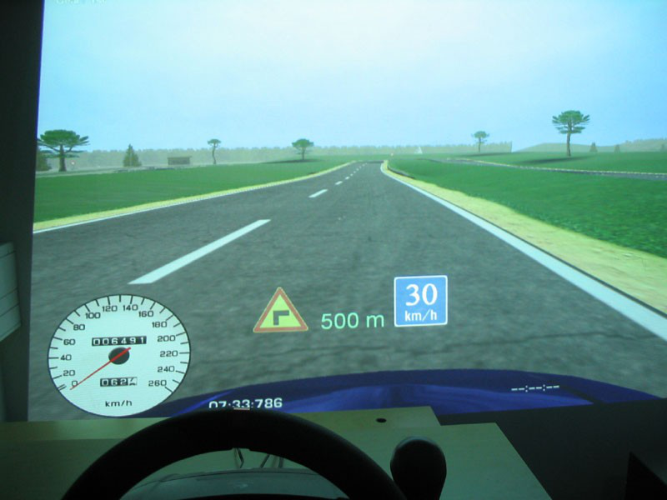
Co-Driver System The C-DS (see Figure 2) gave information to the HUD about the properties of the upcoming curve (direction, distance and recommended speed), just like a real co-driver (the navigator in a rally car) reading a map would do. In addition to this traffic sign and textual information, a pre-recorded female voice was used to give the messages verbally. In the C-DS experiment, the messages were always given on a predefined location on the road, depending on the distance to the upcoming curve. The main aim of this experiment was to study the effects of false messages to driving behavior, but in this paper, we consider only the received results regarding the correct messages. Next, we present in a condensed format the results of the C-DS experiment through to the characteristics of our framework.
Figure 2. The co-driver system with an exemplary visual message presented in the HUD: in this case, the message indicates that there is a sharp curve to the right in 500 meters and the recommendation speed for the curve is 30 km/h.
Context-awareness The C-DS presented context-aware turn-by-turn information (with for example traffic signs) regarding the upcoming curve on the road: the direction of the curve, the sharpness of the curve, the distance to the curve, and the recommended speed for the curve. Our experiment results regarding the correct messages suggest that presenting this kind of context-aware information would also be useful in a real automobile. If the system would be implemented to a real vehicle, the C-DS should use location and other context information to adapt its behavior.
Natural interaction methods As was noted with the DTS, information presented on a HUD requires fewer glances off the road than a separate in- car display and can therefore be considered to be a natural interaction method while driving. To increase the level of natural interaction between the C-DS and the driver, the HUD information was complemented with female voice guidance, which gave the provided messages verbally aloud. When comparing the results of the DTS and the C-DS, the voice guidance of the C-DS was valued (compared to situation without it) and regarded as a natural and non- disturbing interaction method.
Ergonomics In Design, Usability & Special Populations I (2022)
The C-DS could be improved with high-resolution real-time maps, which can be found in nowadays’ navigation systems. In this way, the driver could estimate the sharpness of the upcoming curve by him- or herself. However, the recommendation speed and the distance to the curve would still be essential information that should be provided for the driver. Also, a few of the participants also commented that the long-term use of the C-DS would require a filtering feature in order to present the wanted information according to the driver’s preferences.
Invisibility Although it can be argued that the C-DS was quite visible for the driver with its traffic sign information presented in the HUD, it was not actually reported to be disturbing the driving task among the participants (as long as it gave correct messages). For example, most of the participants reported its information to be useful if the recommendation speed was actually in line with what the upcoming curve required. Furthermore, the invisibility aspect of the C-DS would probably evolve in long-term usage after the driver would get used to the system and would feel its information to be helpful in certain driving situations.
Support for everyday tasks The C-DS would have a beneficial impact – just like well-designed navigation systems have – on driving in unfamiliar and difficult driving environments. Properties, which the C-DS had and are typical for navigators, were turn-by-turn guidance, voice directions, and the direction and distance information of the upcoming curve.
The system’s benefits would become obvious especially in hairpin bends of certain mountainous environments (e.g., Norway or Switzerland). Furthermore, the co-driver system could have a beneficial impact in unfamiliar and difficult driving conditions such as in dark or in foggy weather.
To support everyday use, the C-DS should also have a possibility to filter only certain kind of information about the upcoming curves, such as recommendation speeds. Furthermore, according to some participants, there should also be an option to shut the system down when wanted, as the system might not benefit the driving in familiar environments and good weather conditions.
Interconnectivity The real implementation of the C-DS would require GPS and other information through wireless external networks to present the required information about the upcoming curves. In addition, a network connection for the dynamic information, such as recommendation speeds in environments with varying weather conditions would be required.
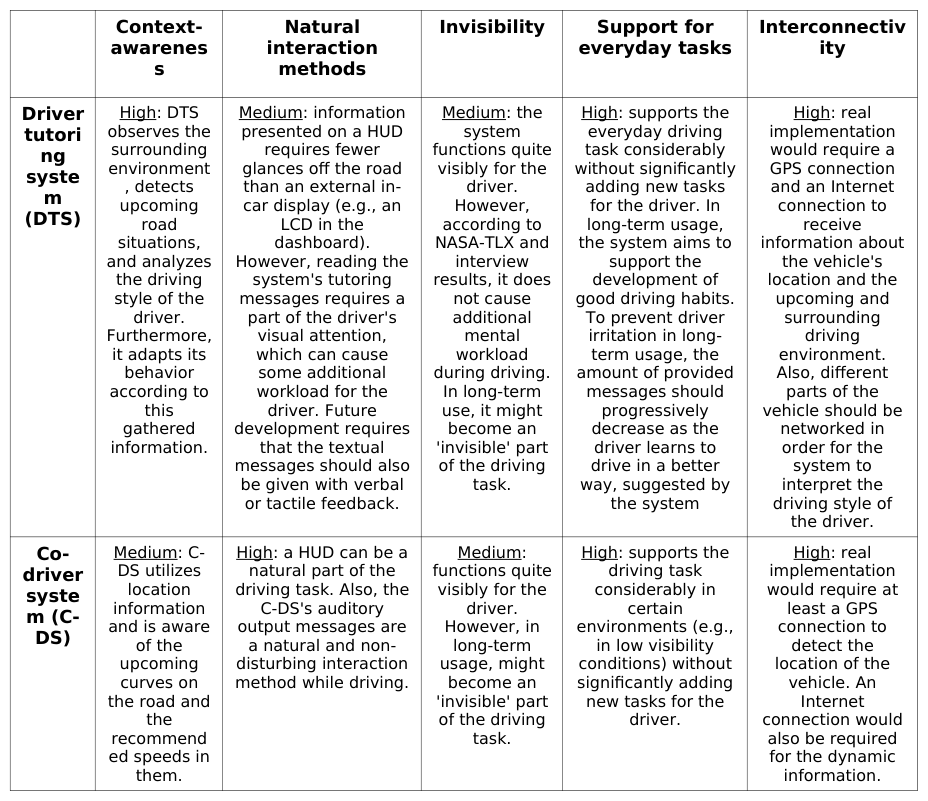
EVALUATION OF THE TWO NEW INTELLIGENT IN-CAR SYSTEMS In Table 3, we utilize our preliminary framework to evaluate the DTS and the C-DS systems against the ideology of ubiquitous computing. As can be noticed from the level of different characteristics in Table 3, the prototype systems seem to fit quite well in to the taxonomy of ideal characteristics of ubicomp systems. According to the results, future development work needs to focus especially on 1) improving the ‘invisibility’ of both of the systems (with e.g., more subtle types of messages), 2) utilizing more natural interaction methods with the DTS (e.g., also verbal and tactile feedback), and 3) considering how receiving and utilizing more context-aware information could benefit the C-DS (e.g., by using also other information in addition to location, with what the system could adapt its behavior to match the driver’s current state and the upcoming situation better). Our results with the C-DS (see Karvonen et al., 2008) also emphasize the importance of the system’s transparency and understandability. However, achieving transparency (e.g., by offering the user to see what the system is doing ‘behind the scenes’ and if there are possible indications of failures) with ubicomp systems in general may be rather difficult, as in our view the original ubicomp goal of invisibility contradicts with the transparency requirement: according to the ‘invisibility’ ideal, the user should not be bothered with details of the system’s functioning and the system should not disturb the user unnecessarily. A compromise solution to this problem could be that if the user wants, she could examine additional information in limited situations. Nevertheless, this information should be presented in such a way that it does not disturb the normal usage of the system (or the primary task of driving) and cause additional workload for the user.
Ergonomics In Design, Usability & Special Populations I (2022)
Table 3: The driver tutoring system and the co-driver system evaluated with the proposed framework Interconnectiv Context- awarenes
DISCUSSION AND CONCLUSIONS Our suggested framework is a tool for evaluating and designing new in-car computing systems from the viewpoint of ubicomp. We have empirically found the tool to be useful in evaluating existing in-car systems and also in supporting the design of two new in-car systems. As one of the main themes of the original ubicomp visions is that the user should be put at the center of everything, our framework’s characteristics answer also to some of the ergonomics issues, which need to be taken into account for intelligent systems to be usable and acceptable. If these issues are not taken into account in the design of in-car systems, significant problems can arise. The consequences of these problems may vary from minor nuisances for the driver to fatal accidents. Therefore, effort must be devoted in preventing these problems. Our framework, once developed further from the preliminary version presented in this paper, could work as a one of the tools for this kind of research and design in the future.
In the future development of the framework, we see that for example the meaning of the ‘interconnectivity’ characteristic needs to be examined on a more profound level. This is due to fact that although it is a more technical characteristic than the other ones in our taxonomy, in the original ubicomp wireless connectivity between different systems was seen as an enabler for smooth and ‘invisible’ interaction with these systems (e.g., Weiser, 1993). In addition, in future work it has to be emphasized that although the provided taxonomy includes three superficially similar characteristics (i.e., natural interaction methods, invisibility, and support for everyday tasks), they can still be considered rather different when examined deeper from the ubicomp’s point of view: natural interaction methods Ergonomics In Design, Usability & Special Populations I (2022) emphasizes the modalities of natural forms of communication to modern human beings, invisibility signifies that the system does not require our active attention and works in the background without us even noticing it, and support for everyday tasks means that computing is used as part of everyday life to accomplish and ease routine daily tasks.
From the evaluated in-car systems, especially electronic stability control, driver vigilance monitoring and x-by-wire systems seem to suit the defined ubicomp characteristics particularly well. For example, these systems scored ‘high’ in both natural interaction methods and support for everyday tasks. In the further development of the DTS and C-DS systems, our initial experience indicates that the proposed framework seems to suit well for guiding the design in important issues of these kinds of systems in order for them to be safer, more efficient and enjoyable (Walker et al., 2001). Contrary to some seemingly similar frameworks, such as the one by Scholtz and Consolvo (2004) that defines usability criteria for the evaluation of ubiquitous computing environments, the aim of our framework is to find evaluation and design criteria for any kind of (in-car) system from the ideal characteristics of ubicomp systems.
Future work is needed to validate the framework with other in-car systems than the ones reviewed in this paper. In addition, in order for the framework to be applicable in evaluating every kinds of intelligent systems (i.e., not only in-car systems), the taxonomy should be expanded to consider all the other potentially important ubicomp characteristics, such as automated capture and access (Abowd and Mynatt, 2000), which was also briefly discussed earlier in this paper. Other possible new characteristics for the taxonomy that were not directly examined in this paper could be for example ‘calmness’ (Weiser and Brown, 1997), ‘localized scalability’ (Satyanarayanan, 2001), ‘masking uneven conditioning’ (Satyanarayanan, 2001), or ‘user engagement’ (Rogers, 2006).
The current development trend of intelligent in-car systems leads to a future where the driver will be gradually relieved from the manual task of driving. Consequently, in the future, the driver will be merely a supervisor of the different systems, as has happened in other environments where highly automated systems have been introduced. It can therefore be said that a technological revolution in cars is happening, which will considerably change the nature of driving. If designed correctly, these technological systems can ultimately make using our cars safer, easier, more efficient and fun. To keep up with this revolution, research and design should focus more on the human interaction with these systems from the ubicomp point of view. Our framework can serve as a one tool for supporting this work during the currently on-going transition phase from manually controlled cars to entirely automated driving.
REFERENCES
Abowd, G. D., Mynatt, E. D. (2000), “Charting past, present, and future research in ubiquitous computing”. ACM Transactions on Computer-Human Interaction (TOCHI), 7(1), 29-58. Abowd, G. D., Mynatt, E. D., Rodden, T. (2002), “The human experience”. IEEE Pervasive Computing, 1(1), 48-57. Bainbridge, L., Sanderson P.: (1995), “Verbal Protocol Analysis”, in: Evaluation of human work: A practical ergonomics
methodology, J. Wilson, E.N. Corlett (Eds.). pp. 159-184 Brosnan, M. J. (2002), “Technophobia: The psychological impact of information technology”, Routledge. Dahlbäck, N., Jönsson, A., Ahrenberg, L. (1993), “Wizard of Oz studies—why and how”. Knowledge-based Systems, 6(4), 258-
266. Dey, A. K. (2001), “Understanding and using context”. Personal and ubiquitous computing, 5(1), 4-7. Ekholm, A. (2002), “The design of in-car communication and information applications”. Personal and Ubiquitous Computing, 6(3), 153-154. Hart, S. G., Staveland, L. E. (1988). “Development of NASA-TLX (Task Load Index): Results of empirical and theoretical
research”. Advances in Psychology, 52, 139-183. Jackson, P. G. (1998), “In search of better route guidance instructions”. Ergonomics, 41(7), 1000-1013. Karvonen, H., Kujala, T., Saariluoma, P. (2006), “In-car ubiquitous computing: driver tutoring messages presented on a head-up display”, in: Intelligent Transportation Systems Conference (pp. 560-565). Karvonen, H., Kujala, T., Saariluoma, P. (2008), “Ubiquitous co-driver system and its effects on the situation awareness of the
driver”, in: Intelligent Vehicles Symposium (pp. 337-342). Kovordányi, R. (2005), “When Will Advanced Driver Support Systems be User-Adaptive? The Case of Adaptive Cruise Control”, in: AAAI Spring Symposium: Challenges to Decision Support in a Changing World (pp. 54-59). Regan, M. A., Oxley, J. A., Godley, S. T., Tingvall, C. (2001). Intelligent transport systems: Safety and human factors issues
Royal Automobile Club of Victoria (RACV), Report No. 01/01. Rohr, S. N., Lind, R. C., Myers, R. J., Bauson, W. A., Kosiak, W. K., Yen, H. (2000), “An integrated approach to automotive safety systems”. SAE Transactions, 109(6), 453-459. Rogers, Y. (2006). “Moving on from weiser’s vision of calm computing: Engaging ubicomp experiences”, in: UbiComp 2006:
Ubiquitous Computing (pp. 404-421).
Ergonomics In Design, Usability & Special Populations I (2022)
Satyanarayanan, M. (2001). “Pervasive computing: Vision and challenges”. Personal Communications, IEEE, 8(4), 10-17. Scholtz, J., Consolvo, S. (2004). “Toward a framework for evaluating ubiquitous computing applications”. IEEE Pervasive Computing, 3(2), 82-88. Stanton, N. A., Young, M. S. (1998), “Vehicle automation and driving performance”. Ergonomics, 41(7), 1014-1028. Walker, G. H., Stanton, N. A., Young, M. S. (2001), “Where is computing driving cars?”. International Journal of Human-
Computer Interaction, 13(2), 203-229. Walker, G. H., Stanton, N. A., Young, M. S. (2006), “The ironies of vehicle feedback in car design”. Ergonomics, 49(2), 161-
179. Wittmann, M., Kiss, M., Gugg, P., Steffen, A., Fink, M., Pöppel, E., Kamiya, H. (2006), “Effects of display position of a visual in-vehicle task on simulated driving”, Applied Ergonomics, 37(2), 187-199. Weiser, M. (1991), “The computer for the 21st century”. Scientific American, 265(3), 94-104. Weiser, M. (1993). “Some computer science issues in ubiquitous computing”. Communications of the ACM, 36(7), 75-84. Weiser, M., Brown, J. S. (1997), “The coming age of calm technology”, Beyond Calculation: The Next Fifty Years of
Computing, J. Denning, R.M. Metcalfe (Eds.). pp. 75-85
Ergonomics In Design, Usability & Special Populations I (2022)
LISTED IN THE AHFE DIGITAL BOOKSTORE CATALOGUE
Explore the complete digital volume
Advances in Ergonomics In Design, Usability & Special Populations: Part I
Read this individual research paper free through the original publisher, or explore the full digital proceedings book.
ISBN 978-1-4951-2106-7
Explore this ISBN in the AHFE Bookstore ↗Listed in the July 2026 bookstore catalogue; search by ISBN to confirm current availability · Digital book purchase optional