Ana M. Sousaa, Álvaro M. Sampaioa, Paulo Simõesabc (2022). Ecodesign and Usability in the Redesign of Everyday Products. In: Advances in Ergonomics In Design, Usability & Special Populations: Part I. AHFE Open Access, vol. 18. https://doi.org/10.54941/ahfe100764
The design activity involves achieving design solutions that preserve as much as possible, natural resources, while improving the physical and social contexts of its users. Currently the market is saturated, with products that offer little advantage over its predecessors, or do not effectively respond to what users long for, thereby contributing to an excessive increase of resources. Therefore, in this study, the intention is to respond to the users’ needs, but considering also the environmental aspects. This study seeks to adapt these concepts for the redesign of a domestic product – a vacuum cleaner. For this purpose, the study was divided into two main phases of research: (1) recognition of the real needs of users as well as problems associated to the product, through surveys and usability tests (N=120), and (2) quantification of the environmental impact of the product (via eco-indicator 99 method). The overall data allowed to define the product requirements and outlined the criteria to be incorporated into the redesign product and also the measures to improve product usability that are consistent with ecodesign solutions.
Currently, design reaches a value that exceeds the concept of creativity, aesthetics and originality. It is a strategic activity in solving problems, creating opportunities, materializing ideas into useful and liable physical products, contributing to improve the society quality of life.
This article presents an overview of the practices and guidelines that can be used to generate products that meet the real needs of their users, while respecting the ecosystem. Thus achieving a sustainable balance with quality functional products. To be able to study user requirements, usability testes are performed since they give real results on the behavior and expectations between the user and the product under study. Additionally, the eco-indicator 99 method provides the environmental analysis of the product that aids in decision making with regards to the implementation of suitable measures. This method is executed in order to reduce the environmental impact of the product, towards meeting ecodesign principles.
Ergonomics In Design, Usability & Special Populations I (2022) https://openaccess.cms-conferences.org/#/publications/book/978-1-4951-2106-7
Concepts contextualization Victor Papanek (1995) addresses an awareness of the power that design has to improve everyday life, by creating viable solutions that respect the development of future generations. Over time, we have witnessed an improvement at that level. Product innovation has undergone an evolution, from product enhancements through its redesign to more radical interventions such as the design of new environmentally compatible products (Vezzoli, 2007a).
To Papanek (1985), design should result in the sum of social responsibility and ethics, and should be aware of its impact, socially, environmentally and economically. This premise assumes an “effort of the design activity to propose systems of production and consumption which are at the same time economically competitive and socially equitable and cohesive” (Vezzoli, 2007b, p.141). Tischner and Charter (2001) reinforce this idea arguing that the design for sustainability integrates economic, environmental and social aspects in creating products and services. The discussions that have emerged about this subject point to different postures that promote adaptation measures aimed at sustainability and the consequent rationalization of resources. These measures support the principles of ecodesign. Karlsson and Luttropp (2006) claim that ecodesign is defined as “a multifaceted concept, which integrates aspects of the project and environmental considerations” (p.1291), to product development, with the aim of “creating sustainable solutions to meet human needs and desires” (p.1298), Furthermore, “ecodesign considers environmental aspects at all stages of the product development process, designing products that have minimal environmental impact throughout their life cycle” (Brezet and Van Hemel, 2009, p. 243).
The factors that motivate the adoption of products or processes with ecodesign principles are not limited to environmental benefits. Companies that implement eco-design practices benefit from a likely cost saving, gain competitive advantage, improve their corporate image, promote the quality of their products, and may even get to reduce the legal requirements they are subject to (Vercalsteren, 2001).
Product features that cause environmental impacts are the focus of ecodesign, Ecodesign should have their focus in the phases which are more relevant when assessing the product in question. For this, there are various tools, methodologies and therefore strategies developed specifically to guide projects with sustainable considerations. These practices are aimed to environmental considerations, and are part of the recent orientations of the design area, which seeks to respond to international guidelines (eg, Brundtland Report - Our Common Future) that have been imposed by international organizations (eg, United Nations Program for the Environment), that end up, on one hand by guiding government policies to adopt attitudes that promote the principles of sustainability, and on the other, increasingly aware the population to acquire a positive ethical behavior regarding the impact they have has on the ecosystem.
It is pertinent to note that this activity should not be carried out in isolation, because the relevant aspects in product development such as ergonomics, functionality, cost, and quality should not be discarded. Ergonomics has the principle of adapting the object to the user and not the contrary, is based on various scientific areas with the objective of ensuring that individuals perform their tasks comfortably, correctly, effectively and in the shortest possible time, promoting, consequently, user satisfaction. Soares (2012) states that product ergonomics can be considered as a tool in the quest for quality in product design, and essentially seeks to ensure usability and to improve products performance. Issues such as safety, comfort, efficiency of use, or operation of the objects are particularly studied to facilitate activities and human tasks. Ergonomic studies can help to solve problems, especially those related to the comfort and efficiency (Dul and Weerdmeester, 2004).
Thus ergonomics is related with usability, in which the main principle is the easiness in which people interact with products. Santos (2000) says that usability can be understood as the ability, in functional terms, in which a system, can be used, easily and effectively by its user. Cybis (2003) emphasizes that usability is the quality of use that may be assessed or measured within a specific context. Nielsen (1993) points out that for a system to have good usability, it must be easy to learn, be efficient, favoring spontaneity, reduce the possibility of errors and to satisfy physically and psychologically. Moraes (2002) adds effectiveness, attitude and flexibility within a specified context. Therefore, it can be concluded that these two areas, ergonomics and ecodesign, are complementary to design, promoting the development of innovative, environmentally and socially compatible projects.
Ergonomics In Design, Usability & Special Populations I (2022) https://openaccess.cms-conferences.org/#/publications/book/978-1-4951-2106-7
PROBLEM – ECODESIGN AND USABILITY The main focus of design is to understand Humans and to promote their quality of life. "For designers, the possibility of action lies in its ability to give strategic guidance to their activities (...) which implies a considerable design ability: the ability to generate visions of a sustainable socio-technical system, and to be able to organize them into a coherent system of regenerative products and services, (…) and to communicate such visions and systems, properly, in order to be recognized and evaluated by a sufficiently broad audience” (Manzini, 2008, p. 28). Through this area it is possible to conceive products with great social, economic or even ecological differential.
However, currently, product development happens at a great speed, everyday are introduced to the market new products with the objective of responding to a competition that often generates products with little advantage in relation to the already existent on the market (Gerst, 2001; Clarkson et al., 2004). Changes are made not only to meet the existing needs, desires or latent expectations of consumers (Lauglaug, 1993) but, as well as to improve the performance of the products or to correct defects (Eckert et al., 2004). This response speed is incompatible with the creation of products with actual value added. In this way, products are born with defects affecting the quality and availability of the product causing losses for both the manufacturer and the user. Besides the damage to businesses, defective products lead to a higher environmental impact, because even if they have been designed to last, must will need to be repaired or replaced (Vezzoli and Manzini, 2008). Moraes (2004) notes that the concern with usability often appears only at the end of the project, when any important modification in the semi-finished product may be financially unviable. Therefore, considering the user, throughout the design process is a basic condition for ensuring an effective ergonomic quality.
On the other hand, ecology is adopted in the design process, either as a competitive advantage, or as a philosophy of preserving the ecosystem. However, address it separately has the opposite effect, because there is no point to transport to market an Eco-friendly product, if the product doesn't respond to what users’ want (i.e., their needs and expectations). The correct use of products not only increases their longevity but also improves aspects of the user (i.e., safety, comfort, satisfaction) and the environment (Karwowski, Soares & Stanton, 2011).
The challenge that professionals faced, however, is to predict the greatest amount of potential flaws in the early stages of the product development process. To this end, it is necessary to take into account the entire life cycle of the product, from production, to use and up to its recycling/reuse stage.
OBJECTIVE Users should be in the center of the design process, since they will by responsible for the success of the product (Simon and Benedyk, 2000). It is at the consumer level that the effects of ergonomic concepts, good and bad, are intensely felt, given that, it is at the concept design stage that the success or rejection of a given product should be evaluated (Stern and Galer, 1990). Therefore it becomes pertinent to elaborate a design methodology that can adapt the users’ needs to the needs of the ecosystem. To this end, the use stage, where the Human-Product interaction occurs, reveals the crucial points to identify the product acceptance criteria: 1- usability validates what the user needs; 2- ergonomics translates how these needs should be resolved; 3 – and the Ecodesign, where the damage to the ecosystem is minimize.
METHODOLOGY
The methodological procedure is divided into two phases: (i) the analysis phase – focused on the user and (ii) the project – that investigates the environmental impact of the product under study.
Ergonomics In Design, Usability & Special Populations I (2022) https://openaccess.cms-conferences.org/#/publications/book/978-1-4951-2106-7
Figure 1: Diagram of the adopted methodology
Figure available in the original PDF paper.
Figure 1 illustrates the methodological process adopted. As it is possible to see, this methodology is a circular system. In the first task, after selecting the product, it is necessary to analyze the product by means of the real needs and expectations of the user. Here, usability emerges as a discipline that connects these two issues – the analysis of an existing product and a user-centered process.
The usability tests can be conducted in various forms, however for this particular analysis, it becomes appropriate to support the method with a survey before performing the tasks requested. This survey seeks, above all, to verify users’ behavior, their opinion and preferences about similar products. The next task is where the requirements are understood by implementing the usability tests.
The implementation and analysis of the usability tests supported with surveys and photographic records, seeks to identify the evident problems both from similar products as well as from the actual product studied. This analysis allows tracing the specific targets of intervention for the redesign of the product, in terms of ergonomics, safety, ecology, among others issues that are relevant.
These tests are carried out to a sample of individuals, which allows organizing the data by the accumulated sum of errors in a hierarchical system that represents the problems with more incidents. With this hierarchical organization system (problems in the Human-Product interaction) it is possible to organize the requirements and parameters of the redesign project that are the input to the next task, where ergonomics tries to give a first answer and solution to the identified problems.
After evaluating users’ behavior it is necessary to assess the ecological impact of the product.
In this task Ecodesign is implemented, since it is oriented towards the minimization of resources that allows, through the eco-indicator 99 method to evaluate the 'ecological load' of the product. In this case, this assessment is centered on the materials and their manufacturing processes, leaving aside all electrical components.
The eco-indicator 99 method details the system or subsystems of a product according to their environmental impact, in this way it is possible to identify the parts where is possible to intervene in order to develop the redesign into a more environmentally friendly product. After evaluating the user in a first phase, and the product in a second, there is reliable data to organize the requirements and parameters of the project. If in one hand there were recognized the needs and expectations of the user (what to do), on the other there were verified where to intervene (where to act), in an attempt to generate a product that meets the needs of its user while respecting environmental resources. The next task of generating concepts is where solutions are materialized through the requirements formulated - Redesign. In this task, alternatives should be detailed and finally analyzed with the aim of trying to understand the one that is the suitable solution to the intended concept. The chosen concept should be prototyped for validation, with new usability testing with the user. The two main phases of this methodology, are described with more detail in the following sections.
Ergonomics In Design, Usability & Special Populations I (2022) https://openaccess.cms-conferences.org/#/publications/book/978-1-4951-2106-7
USABILITY TESTS Usability
Mozota (2003) states that "Good Design" criteria are shared globally and possesses four main types of criteria: (i) functionality, efficiency, (ii) aesthetic, attractiveness, (iii) ease of use, user friendliness, (iv) definition of a new thinking model. As such, it is clear that two of these four criteria are directly related to usability - measure by which a product can be used by specific individuals to achieve specific goals with effectiveness, efficiency and satisfaction in a given context (ISO 9241 -11, 1997).
According to Eason (1995), an existing approach to ergonomics is to act on behalf of users. As such, many theories and general broad principles are designed so they can be applied on behalf of the people. However, this approach, apparently worried about users, is constantly criticized for not taking into account various aspects of the real end user, because it fails to involve the user in the process. Is not enough to make for the user, it must be done with the user. People are not just elements of task performance, are creatures with purposes, with ambitions, beliefs, emotions, values, satisfactions (Eason, 1995).
Objectives The need to understand this relationship between the user and the product, leads to a field of investigation based on usability tests that, through surveys and observation provides the data necessary to distinguish the needs and specifications to the project. The sample testing (N = 120) is characterized by adults, divided into 6 groups by age and gender. At this stage surveys with 26 closed questions were performed to acquire data on the experience and feedback of users interacting with similar products. Usability tests are performed, involving 7 general tasks, subdivided into a total of 23 activities.
The main purpose of these usability tests is to assess the overall condition of the product in order to identify the flaws inherent to their use and thereby to be able to formulate the relevant requirements for the development of its redesign. The life cycle phase that this test responds, correspond to the step in which the end user interacts directly with the product (use phase). Thus should highlight the following factors: Ease of use; Maintenance (simple); Quality of materials; Efficiency, Performance, Comfort (Ergonomics, load, etc.), Safety, Resistance (use, impact), Environmental impact (user perception).
Method
To verify the product usability, it is used a vacuum cleaner as a case study, because it is an essential product that is used in most households on a daily basis. This is an appliance that has not been undergoing significant improvements about its impact on the environment, but on the other hand, corresponds to an invention of the last century that allows to perform household chores with less effort, improving living conditions and comfort of those who perform them.
A vacuum cleaner is a device that uses an air pump to create a partial vacuum to 'suck' the dust and dirt from the floor and surfaces of homes, industries, automobiles, etc. This appliance has evolved from brooms, the first manual models emerged in the 1960s, and the electric models appeared only at the beginning of the twentieth century. The model was chosen according to data from DECO Proteste, which characterizes it as the best choice. DECO – Associação Portuguesa para a Defesa do Consumidor (Portuguese Association for Consumer Protection) is an organization whose mission is to defend the legitimate rights and interests of consumers.
Usability tests attempt to measure users' performance (number of errors, and duration of the task) during the experience of using the system, with a quantitative approach (Souza et al., 1999). Other authors, such as Preece et al. (2005), Pressman and Lowe (2009), Cybis et al. (2010), Silva and Barbosa (2010) and Nielsen and Loranger (2007) argue that the results of the usability tests also have a qualitative approach, it is necessary to judge and interpret the results with the purpose of identify problems and the recommend solutions.
Ergonomics In Design, Usability & Special Populations I (2022) https://openaccess.cms-conferences.org/#/publications/book/978-1-4951-2106-7
Procedure Initially, each participant was properly guided by the evaluator: it was explained the context and relevance of the test. Where it was intended that the participant understood that it was the object that was being evaluated, not the participant performance when interacting with the product. At this stage a form was filled out identifying the user profile (e.g., age, gender, level of experience).
The second stage corresponded to the registration of the pre-test questionnaire, cited above, with the purpose of collecting information about user preferences and experience with similar products.
Once given the guidelines related to the testing activities and tasks, the participant was allowed to use the product freely for five minutes. After, the participant was asked to execute the tasks that make up the test in question. The evaluator asked the participant to verbalize their doubts, as this helps to identify the occurrence and the reason of the problems. During the test, the events observed by the assessor were recorded on a form, as well as abnormal changes in time spent on each task.
After the completion of all tasks, the participant filled out a questionnaire assessing the product, whose purpose was to collect preferred participant information regarding the particular product. Finally the participant was asked verbally by the evaluator in an attempt to create a more informal dialogue. Subjective perceptions of usability about the product by the participant were discussed, and also comments were made on the participant overall performance and problems encountered. The participant was able to review the test openly, allowing the collection of additional information.
Once all tests and questionnaires were collected, the data was moved into a statistical table, in order to present the results on a comparative basis among the various participants, this had enable the possible to correlate the information and thus find the product aspects that could be intervened in the redesign of the equipment.
Results
In this section, the most relevant data is described. Vacuum cleaners are mostly used once a week (26,67%) or twice a week (25%), whether it is at home (50,79%), whether it is in the car (41,36%). This last one is more common in male users, with ages ranging between 20 and 30 years old. The age and gender especially delimit the context of use, experience and concerns about product performance. There is a greater use among the female population, but men are who have an approach more conscious about the characteristics and performance of this type of products. This awareness is most noticeable depending of the individuals’ maturity.
This analysis also finds that there are functions in the product that in some way become unnecessary, eg, it was found that there are many accessories, many of them rarely used, 63,33% of the respondents stated they did not use any accessories; only one of the two suction power regulators is used, so the one located in the handle is normally overlooked by 87.18% of subjects. Regarding the product disposal, it is noticed that a significant majority of users do not disassemble the vacuum to store it, only 22.5% of the individuals said to disassemble it, this is due to the fact that it is kept in a storeroom (53.54%) or in the garage (19.69%). The characteristics that deserve more attention, in the act of purchasing a new product are, in order of importance, power (19.34%), price (16.87%), ease of use (10.49%) and weight (7.82%), however it became visible a confusion between power and suction power, because users associate that the greater the power of the device (78.99%) the product has more suction power, which does not match to reality. On other hand, they have reported to have ecological concerns, namely, energy consumption (63.39%), taking into account the previous data we can conclude that there is a contradiction because they seek products with higher power therefore with higher energy expenditure. As for the frustrations experienced during the use of this kind of products, stands out, for degree of incidence, noise (15.22%), the wire size (14.73%), the clash with furniture (13.29%), accessibility to difficult areas (12.56%), insufficient sucking power (12.32%) and weight (7%).
After the survey, tests provided validation to some of the given answers. An important finding was that the majority of the respondents said that they changed the vacuum filters (72,27%), mostly after a few uses (45,45%) or when they noticed a product performance decrease (30,68%), however during the tests they only identified the air filter, and that it was unknown to these users (89%) the existence of the engine filter. Users, in general, also stated that most of the malfunctions in their vacuum cleaners were due to overheating (25.60%) or unknown failure (30.40%), so it can be conclude that this failure could have been the result of poor product maintenance, namely poor filter Ergonomics In Design, Usability & Special Populations I (2022) https://openaccess.cms-conferences.org/#/publications/book/978-1-4951-2106-7 maintenance (i.e., when one of them was forgotten).
Regarding the tasks success and failure, most of them were intuitive. The errors found indicate that, there is a need to check, the motor filter, adjust the suction power, change the nozzle according to the surface to be treated, adjust the size of the wire and last but the most common one, to use the slots of storage, which rarely happened (only 6 subjects performed this task).
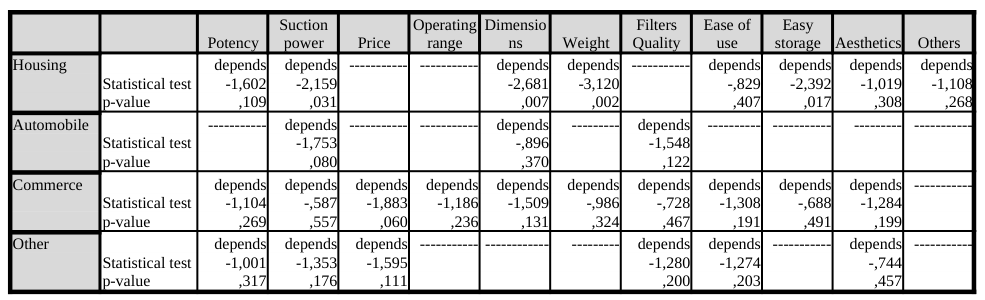
Some statistical tests, Mann-Whitney and Kruskal-Wallis were applied aiming to identify possible relationships between the available variables. In particular the Mann-Whitney tests results indicate that the relationship between the aspects to consider at the moment of purchase and context of use is shown in table 1.
Table 1: Relationship between context of use and relevant criteria’s that influence on the time of purchaseTable 2: Relationship between users’ choice of bag vs deposit by motive choice Ease of use Experience More Economical Environmentally Friendly More Hygienic Others Preference: bag or deposit depends depends depends depends depends ---------------
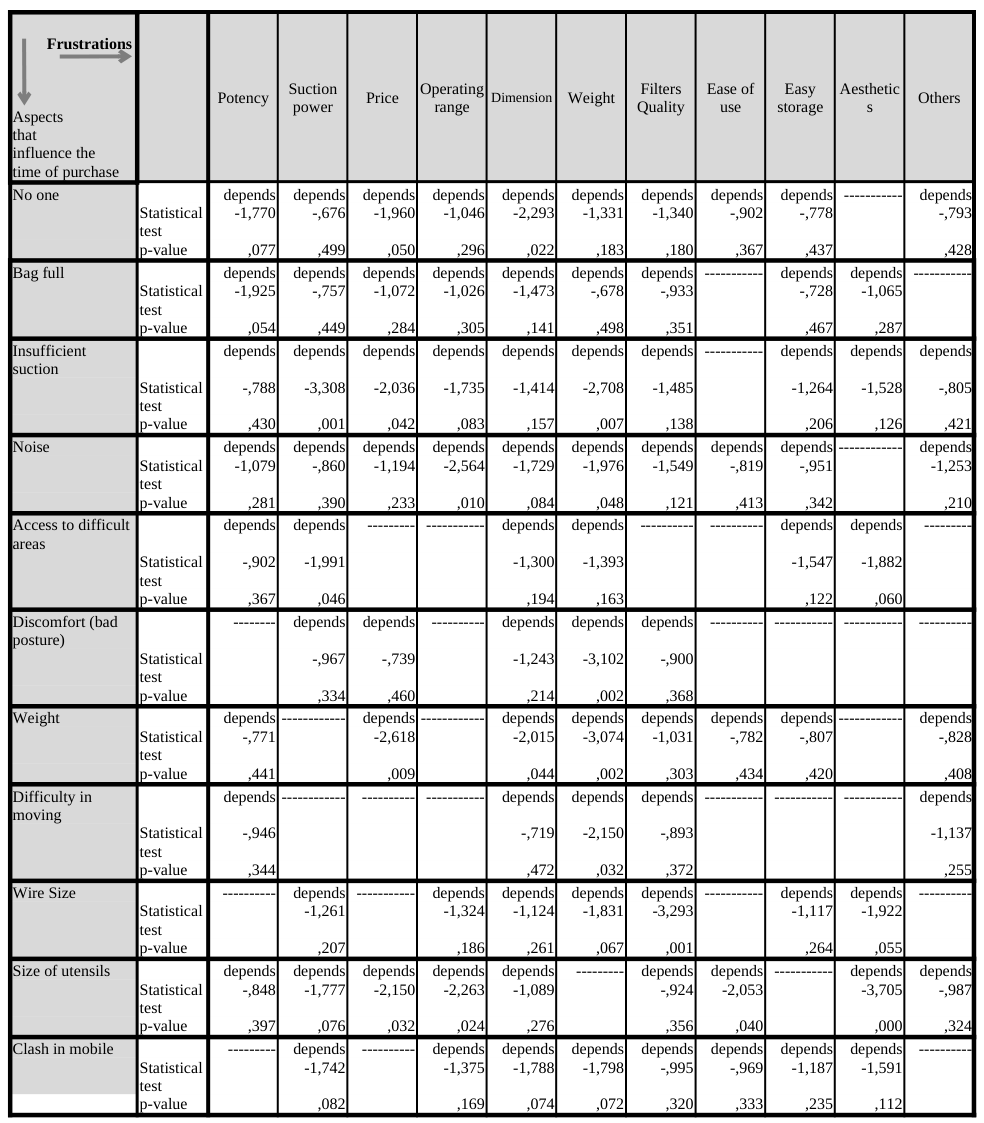
In order to determine whether exists a relationship between the frustrations felt in the use of the vacuum cleaner and the aspects considered important at the time of purchase, were also made Mann-Whitney tests, with the results presented in table 3.
Additionally, the Kruskal-Wallis tests show that only the pantry does not depend on the vacuum cleaner disassembling habit (statistical test = 0.141, p-value = 0.932). The relationship between the regularity with which the filters are cleaned or the reason to exchange the vacuum cleaner is shown in table 4.
Ergonomics In Design, Usability & Special Populations I (2022) https://openaccess.cms-conferences.org/#/publications/book/978-1-4951-2106-7
Table 3: Correlation between frustration and relevant criteria’s that influence on the time of purchase
https://openaccess.cms-conferences.org/#/publications/book/978-1-4951-2106-7 Ergonomics In Design, Usability & Special Populations I (2022)
Table 4: Correlation between frequency of filters change and motive of malfunction
All these results have served to gain a better understanding about how vacuum cleaners are used and conditioned, we also managed to check what users want from a device of this type, which are the usage requirements and the frustrations and concerns associated with the use of this kind of equipment. However the results suggest that there should be a more detailed and thorough analysis of the vacuum cleaners characteristics. It appears, however, that these results are sufficient to conclude that we must consider to design a device with characteristics, at a formal level and at a functional level, more consistent with what users want.
LIFE CYCLE ANALYSIS Life Cycle Analysis
Thrane and Schmidt (2006) define the Life Cycle’s Analysis (LCA) as a tool that is used to evaluate a product, or service, environmental impact during all of its life cycle, being also used as an Ecodesign tool. The LCA studies cannot measure the product’s real impact in the ecosystem, but only their potential impact, because the real ones depend on several valuables that cannot be represented by trustworthy or concrete data, and are difficult to access (Haes et al., 2002). The LCA promotes the conception of environmentally-low impact products, so the product development is directed to Ecodesign. The products characteristics as well as its environmental impact are defined during the conception phase. That said, the focus must be on the production process, establishing mass and/or energy balances, evaluate the inputs so that the outputs can be minimized, thus adding more value to the product, to its global quality, then optimizing its life cycle.
Objectives Evaluating the life cycle allows the evaluation of the products environmental impact, with the environmental safeguard related to the optimized material and energy source choices, approaching it so the society, economy and environment have equal priority. This analysis seeks to verify the ecological burden of a domestic vacuum cleaner, by analyzing its LCA. The vacuum cleaner – Electrolux Classic Silence xzs2100 – is the selected model for the redesign, which can justify the adaptation of this methodology in similar products. With the products LCA it is possible to verify the action points that relate to a possible vacuum cleaners improvement, mainly in the ecological aspect, and should be used as a value adding component, and helps in the decision-making process, in addition to other indispensable tools in the development of a new product.
So, this analysis is the approach for the development of the new product. In this case, the task is to identify flaws and improve the product, such as materials replacement, and subsequently the appliance of different technologies in the production process, and the reduction of residue when the products life ends. So, the limit of this analysis is the whole sets material, the products main body, not considering the components that are the vacuum cleaners “subproducts”, i.e: filter, bag and engine, such as the rest of the electronic components. The engine, the bag and the filters are considered “subproducts”, used in other products of the same series/family, so they are separately produced, in such a scale that does not justify its inclusion in a study centered on a specific product redesign.
Method
In order to obtain the products ecological footprint, the eco-indicator 99 was used, because it is a method that allows the calculation to be done objectively and accurately with the limited data available (i.e., mass, material, processes).
Ergonomics In Design, Usability & Special Populations I (2022) https://openaccess.cms-conferences.org/#/publications/book/978-1-4951-2106-7
This process allows to set different damage categories, which eases the manipulation of LCA results, transforms the inventory tables data in numbers that can be used as a comparison method between similar products, or represented into environmental impact graphics.
The eco-indicator 99, reconstructed version of the Eco-indicator 95, is a LCA method which translates the products ecological burden, and is today a classic example of the “endpoint” approach – method based on the damage, tries to model the environmental impact in its final effect, in the damage or “endpoint”. The calculations result is represented on a unique eco-indicator scoring, in “mili-points”. Each “point” can be interpreted as a thousandth of the average Europeans environmental burden (Eco-indicator 99, 2000). The obtained value allows to guide the interventions choices, in order to redesign the studied product. As previously stated, in this case the objective is to change the products body, which is mainly polymeric-based, where the material-related data that do not regard the vacuum cleaners electric component were excluded. So, the calculations result do not represent the vacuum cleaners ecological burden, but the target components, in this case, the materials that make up its body.
Procedure In the first stage, it was necessary to disassemble the vacuum cleaner. At first, the visible screws were taken off, and then the dissemblance continued, making usable to verify that the assembly had been done by fit. All the process was photographically recorded. Then the electronic components were separated from the rest. All the components were identified and catalogued, and each piece was given a number, in order to easily identify each component, so it was not necessary to visualize them in each step of the process. The cataloging presents each component data (e.g., mass, material). Initially the components were weighted using a decigram scale. Following the identification of the material. The majority of the polymeric-based components had an identification code. However, there were used auxiliary identification techniques in order to identify some smaller components. The identification test used was the flame test, in which a small part of the component is burnt, and its behavior is observed. Each material type has a different behavior (flame color, smell or material reaction). There is the possibility that the combustion is hard or even inexistent, or a fast combustion, continuing even outside the flames source. The material fluidity also varies in different polymer types. The above shown data were cataloged in a table, the content was divided in several categories: (i) number of each piece; (ii) components photo; (iii) mass, in kilograms; (iv) type of material; and (v) manufacturing process. These data were transferred to a table, in order for the eco-indicator method to be applied.
Results
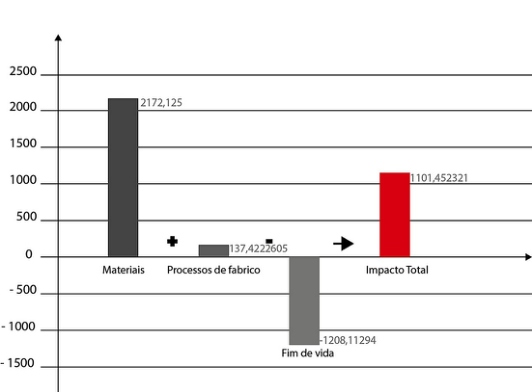
Figure 1: Eco-indicator 99
By looking at the above-presented graph, the final calculation result obtained by the eco-indicator 99, for the studied processes, is approximately 1101,45 milipoints, which represents a superior ecologic burden, compared to the one of an average European, in a year. However, in order to be able to compare the burden in these terms, the products burden had to be divided by the number of the total years of the products life, and that information cannot be obtained. On the other hand, a comparative analysis was made with another product of the same family; it was a vacuum cleaner that was launched over a decade ago, a Moulinex model, the 1000 S Compact, having a slightly Ergonomics In Design, Usability & Special Populations I (2022) https://openaccess.cms-conferences.org/#/publications/book/978-1-4951-2106-7 superior mass, about 1kg of material. By comparing the results, it was possible to conclude that the second vacuum cleaners burden is slightly superior (Electrolux: 2172,125 mPts Vs Moulinex: 2238,256 mPts), however, when taking the manufacturing process into account, the result almost triples. Whereas the Electrolux has a 137,442 mPts burden, its predecessor has a 365,28 mPts. This can be the reflection of an evident evolution on the manufacturing processes. The data that refer to the end of life, and by that, to the materials recycling, shows that the Electrolux materials are slightly more compatible with the environment, whereas this one reduces its burden with a value of 1208,11294 mPts, the Moulinex only achieves 814,77 mPts. It is to be noted that the fact that the Electrolux, with this value, can reduce its ecological burden to almost, half, so it is possible to conclude that it has already materials which can be recycled. These results will be afterwards compared to the product inherent to its design, and the objective is for this last product to have an inferior result, by replacing materials to more environmentally- compatible ones.
OVERALL RESULTS Through the data collected from the two analyses described above it is possible to predict and define the requirements and parameters that are essential to the product redesign. The requirements are the result of the usability tests - they respond to what users need and want, consciously or unconsciously, to see resolved in the product studied. The parameters indicate the action that needs to be performed, namely, how is it possible to respond to the requirements. Therefore, through a comparative analysis between the results of the usability tests and the result of the calculation of the eco-indicator 99, is possible to concluded that the main purpose of the latter is the optimization of material, so it became apparent that this a basic parameter that enables to define in more detail the parameters of the project. For example, if it is stated that there is an exaggeration of utensils (requirement 1), it is also possible to state that it becomes relevant to reduce them to those that are used most frequently. This reduction enables a reduction of utensil material (parameter 1), which enables the inclusion of ecodesign principles. Other requirements go through the reduction of weight, which is achieved by reducing the thickness of the material or replacement by other lighter materials (parameter 2), provided that the latter are more sustainable.
As a first analysis, it is possible to verify that problems of interaction between user and product, such as noise, crash into furniture, comfort (touch), can be minimized by replacing/reduction/optimization of materials. Materials have characteristics which by themselves already give response to some of the problems that need to be solved, whether of usability, as is the case of ductility, thermal and acoustic insulation, ecodesign, provided they are recyclable, recycled and/or renewable. It turns out, that there is a relationship between the two methods discussed, and which complement each other throughout this process.
CONCLUSIONS
The preservation of the environment has been the big discussion in the last decades, international organizations have presented studies and reports about the environmental issues inherent with the high economic growth of the last few centuries, and advocate a proactive approach to combat the erosion of the environment, so that it becomes possible to ensure good living conditions to future generations. With this, the development of sustainable products acquires more and more responsibility as regards the environment and the product value. The ecodesign thinking, encourage the adoption of sustainable products through the study of its life cycle, analyzing how can the impact be minimized for each case. The guidelines for sustainable product development advocate the reduction of emission of waste, minimizing the use of resources, using resources of lower impact, extend the life of the product and of the materials and, enabling product disassembly. However, the creation of sustainable products is only synonymous of products targeted at reducing the environmental impact, it is necessary that the products will be also useful products, in other words, that products respond effectively to the purpose for which they were developed. Therefore one must take into account the criteria of usability applied to the product, which minimize the risk of placing in the market a product that is not well accepted by end-users. This article reviews the theme of sustainability and relates it with usability, justifying a project-oriented methodology to address and correlate these two themes in an attempt to develop more environmentally compatible products. It is an approach where the use of materials falls, as much as possible, in a closed circle, promoting its reuse or recycling.
Ergonomics In Design, Usability & Special Populations I (2022) https://openaccess.cms-conferences.org/#/publications/book/978-1-4951-2106-7
REFERENCES
Brezet, J. C., Van Hemel, C. G. (1997), “Ecodesign, a promising approach to sustainable production and consumptions”, UNEP. Charter, M. (2001), “Sustainable solutions: developing products and services for the future”, in: Charter, M., Tischner U., Sheffield: Greenleaf Publishing, Managing ecodesign, pp. 220-242. Cybis, W. de A. (2003), “Engenharia de usabilidade: uma abordagem ergonómica”, Florianópilis, Labiutil – Laboratório de
utilizadilidade de informática. Dul, J., Weerdmeester, B. ( 2004), “Ergonomia Prática”, Edgard Blücher. Eason, K. (1995), “User-centred design: for users or by users? Ergonomics”, Volume 38, No.1. Eckert, C.; Clarkson, P.J.; Zanker, W. (2004), “Change and customisation in complex engineering domains,” Research in Engineering Design, Volume 15, No.1. Gerst, M., Eckert, C., Clarkson, J., Lindemann, U. (2001), “Innovation in the Tension of Change and Reuse”, in: International
Conference On Engineering Design, ICED 01, Glasgow, UK. Professional Engineering Publishing, pp.371-378. Goedkoop, M., Effting, S., Collignon, M. (2000), “The Eco-indicator 99 A damage oriented method for Life Cycle Impact Assessment”, Manual for Designers, 2nd edn, PRé Consultants. Crilly, N., Moultrie, J., Clarkson, P.J. (2004), “Seeing things: consumer response to the visual domain in product design”, Design
Studies, Volume 25, No.6. International Organisation for Standardisation (ISO) (1997), “ISO 9241-11: Ergonomic requirements for office work with visual display terminals (VDTs). Part 11 — Guidelines for specifying and measuring usability.” Karlsson, R., Luttropp, C. (2006), “EcoDesign: what's happening? An overview of the subject area of EcoDesign and of the
papers in this special issue”, Journal of Cleaner Production, Volume 14, No. 15/16. Karwowski, W., Soares, M., Stanton, N. A. (2011), “Human Factors and Ergonomics in Consumer Product Design. Methods and Techniques”, CRS Press, Taylor & Francis Group. Lauglaug, A.S. (1993), “Technical-market research: Get customers to collaborate in developing products”, Long Range
Planning, Volume 26, No.2. Manzini, E. (2008), “Design para a inovação social e sustentabilidade”, Comunidades criativas, organizações colaborativas e novas redes projetuais, Editora E-papers. Maroco, J. (2007), “Análise Estatística – Com utilização do SPSS”, Editora Sílabo. Moraes, A. (2002), “Prefácio”, Revista de Ergodesign e Usabilidade, ano 1, No. 1. Mozota, B. (2003), “Design Management”, Allworth Press. Nielsen, J., Landauer, T. (1993), “A mathematical model of the finding of usability problems”, ACM Proceedings, Interchi 93. Papanek, V. (1985), “Design for a Real World: Human Ecology and Social Change”, Academy Chicago. Pereira, A. (2008), “SPSS – Guia Prático de Utilização”, Editora Sílabo. Pestana, M. H., Gageiro, J. N. (2008), “Análise de Dados para Ciências Sociais - Complementaridade do SPSS”, Editora Sílabo. Santos, R. L. G. (2000), “Abordagem heurística para avaliação da usabilidade de interfaces”, in: Dissertação (Mestrado em
Design) – Programa de Pós Graduação em Design, Pontifícia Universidade Católica do Rio de Janeiro. Simon, J., Benedyk, R. (2000), “Addressing pleasure in consumer products through ergonomics”, in: McCabe, P.T., Hanson, M.A., and Robertson, S.A., Contemporary Ergonomics, Taylor & Francis, London, pp.390-394. Soares, M. S. (2012), “Translating user needs into product design for the disabled: an ergonomic approach”, Theoretical Issues,
Ergonomics Science, Volume 13, No.1. Stearn, M. C., Galer, I. A. R. (1990), “Increasing consumer awareness: an ergonomics marketing strategy for the future”, Ergonomics, Volume 33, No.3. Thrane, M., Schmidt, J. (2006), “Life Cycle Assessment, LCA”, Department of Development and Planning, Aalborg University. Tischer, U., Charter, M. (2001), “Sustainable Product Design”, in: M. Charter e U. Tischner (eds.), “Sustainable Solutions –
Developing Products and Services for the Future”, Greenleaf Publishing Ltd. Udo De Haes, H.A., Finnveden G., Goedkoop M., Hauschild M., Hertwich E., Hofstetter P., Jolliet O., Klöpffer W., Krewitt W., Lindeijer E., Mueller-Wenk R., Mueller-Wenk I., Pennington D., Potting J., Steen B. (2002), “Life-Cycle Impact Assessment – Striving towards best practice”, Press. Vercalsteren, A. (2001), “Integrating the ecodesign concept in small and medium-size enterprises: experiences in the Flemish
region of Belgium”, Environmental Management and Health, Volume 12, No.4. Vezzoli, C., Manzini, E. (2008), “Design for Environmental Sustainability”, Springer. Vezzoli, C. (2007a), “Design per la sostenibilità: una disciplina (sempre più) articolata”, in: Vezzoli C. Tamborrini P. (Eds.), Design per la sostenibilità. Strumenti e strategie per la decade - “Educazione per lo sviluppo sostenibile”, Nazioni Unite (2005-2014), LlibreriaClup editore, pp. 31-45. Vezzoli, C. (2007b), “System Design for Sustainability: Theory, methods and tools for a sustainable “satisfaction-
system”design”, Maggioli Editore.
Ergonomics In Design, Usability & Special Populations I (2022) https://openaccess.cms-conferences.org/#/publications/book/978-1-4951-2106-7
LISTED IN THE AHFE DIGITAL BOOKSTORE CATALOGUE
Explore the complete digital volume
Advances in Ergonomics In Design, Usability & Special Populations: Part I
Read this individual research paper free through the original publisher, or explore the full digital proceedings book.
ISBN 978-1-4951-2106-7
Explore this ISBN in the AHFE Bookstore ↗Listed in the July 2026 bookstore catalogue; search by ISBN to confirm current availability · Digital book purchase optional