Jiong-Yu Tu, Jen-Loong Yong, Sheue-Ling Hwang (2020). A Latent Human Error Model in Aviation Maintenance Tasks. In: Advances in The Ergonomics in Manufacturing: Managing the Enterprise of the Future. AHFE Open Access, vol. 12. https://doi.org/10.54941/ahfe100451
In this study, an analysis model has been developed by taking Root Cause Analysis (RCA) method as the basic logic, Human Factor Analysis and Classification System (HFACS) as the factor source to find out the most important latent human error factor in aviation maintenance tasks. The research team dismantled the maintenance process and classified the error factors to design questionnaire, surveyed experienced staffs to rate factors according to their working experience, and finally established the model. Here are some conclusions of this study: First, the combination of RCA and HFACS is an easy use mode to investigate the causal inference and build the factor connection of collected data. Second, the developed model can successfully find some relative important / unimportant factors and provide a direction to design improvement plans. Third, the weighted average scores from the analysis outcome can be regarded as a weight to use in continuous research. And finally, this model may be modified to fit other similar maintenance tasks such as vehicles or precision electronic equipment maintenance, and may be changed to explore other types of human operating works, such as monitoring tasks.
For the past few years, human error has been a huge advancement since the classification of operational errors (Swain & Guttman, 1983), human information processing error type (Reason, 1997), analysis and classification human error (Rouse &Rouse, 1983), human error prediction and even human errors books (Dhillon, 2009; Modarre, 2009) are all important discussion topics. However, the human errors lead to work safety accidents or medical negligence has continued occur. In considering the human contribution to systems disasters, it is important to distinguish two kinds of error: Active errors, whose effects are felt almost immediately, and Latent errors whose adverse consequences may lie dormant within the system for a long time, only becoming evident when they combine with other factors to breach the system’s defenses. In general, Active errors are associated with the performance of the ‘front-line’ operators of a complex system and common being direct causes which recorded in the general report of accident and defined as “obviously”. Latent errors, slumbering within the system, constitute the greatest threat to safety in a complex system. There are many root causes in the system long before the operator's active error takes place, which is expressed in terms of the operator inheriting systems within which prior weaknesses have been created—through bad design, and so on (Marianne, Tomas & Carin, 2004). According to this theory, in order to identify the causes of a damaging or harmful event, it is important to observe not only the direct responsibility of individuals, but above all the conditions in which the personnel work and the organizational context in which the accident occurred (Chiara & Federica, 2010). Therefore, the Latent errors is worthy of further exploration and it cannot be ignored.
BACKGROUND
Latent Human Error As described by Reason (1990), Active failures are the actions or inactions of operators that are apparent to cause the accident. In contrast, Latent errors or conditions are errors that exist within the organization or elsewhere in the supervisory chain of command and affect the tragic sequence of events characteristic of an accident. The problem is that these Latent failures or conditions may lie dormant or undetected for some period of time prior to their manifestation as an accident (Shappell and Wiegmann, 2002).
Human error identification method (HEI) are used to identify latent human and operation errors that may arise as a result of human-machine interactions in complex and dynamic system, the causal factors, consequences and recovery strategies associated with the errors (Stanton et al., 2005). And the conception of HEI methods (SHERPA, HET, TRACEr, CREAM, HEART and HERA) emphasize to analyze and predict the latent operation errors in human-machine interactions via the understanding of task characteristics and action details. The output of HEI methods usually describes potential (Latent) errors, their consequences, recovery potential, probability, critically and offers associated design remedies or error reduction strategies.
Human Factors Analysis and Classification System and Root Cause Analysis The Human Factors Analysis and Classification System (HFACS) is a taxonomic incident coding system developed for the US Marine Corps aviation sector, classifies four levels about Active and Latent human errors to analyze the role of human factors in accidents and incidents and for application by practitioners to aid in investigating. The question for incident investigators and analysts alike is how to identify and mitigate these active and latent failures or conditions. The structure of the HFACS shows the different categories mapped onto Reason’s model. Working backward from the immediate causal factors, analysts classify the errors and associated causal factors involved using the taxonomies presented (Paul, Miranda and Margaret, 2012). HFACS’s development has been consistently documented in publications, including the publication of error trends from aviation incident reports using the HFACS coding methodology and a wide ranging number of reliability studies. As a basic analytic hierarchy process of Reason’s model, HFACS descripts the major tiers with associated categories and sub-categories of the active and latent failures/conditions.
The analysis routine of the Reason’s model which is similar to Root Cause Analysis (RCA) method that aims at determining the causes and factors accompanying a specific failure event. RCA is a process designed for use in investigating and categorizing the root causes of events in many different fields, and it helps to identify what, how and why something happened to prevent recurrence. RCA can also find out the most basic causal relations of the operating deviations to identify the risk and defect on the tasks to prevent the accident (Roony and Heuvel, 2004; Cheng, 2013) .For investigating human errors, RCA is a useful method to establish the mode. But if we would like to find out which one is the most useful technic, it should has a standard to make sure that these RCA tools and methods can be properly evaluated. Gano (1999) has compared these RCA technics with following six criteria and only Apollo Root Cause Analysis developed can fit all the criteria. There are six criteria for assessing RCA tools and methods: (i) Define the problem and its significance to the problem owners. (ii) Delineate the known causal relationships that combined to cause the problem. (iii) Establish causal relationships between the root cause(s) and the defined problem. (iv) Present the evidence used to support the existence of identified causes. (v) Explain how the solutions will prevent recurrence of the defined problem. (vi) Document criteria 1 through 5 so others can easily understand the logic of the analysis.
METHOD
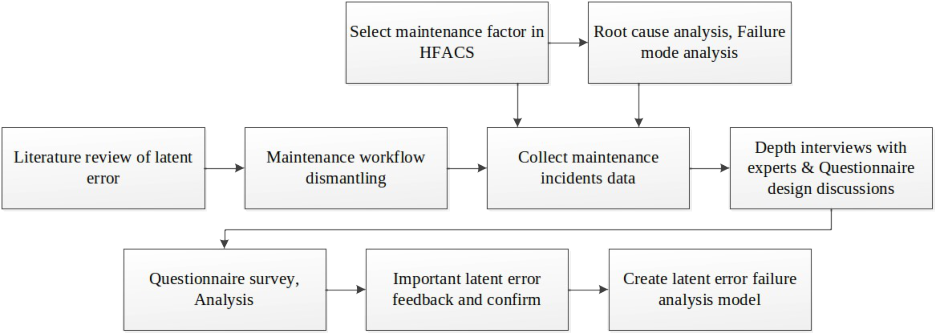
Research Framework The project aims at constructing a latent human error analysis model based on historical data of aviation maintenance program, and apply HFACS as the factor database and RCA as the methods to define the hierarchical process (see Figure 1).
Figure 1. Research Framework Preliminary Assessment of the Maintenance Error Factors
The initially selected maintenance error factors from HFACS have been classified into two types - Latent errors and Active errors by team discussion, and then use a 1-0 matrix to check if there is any relationship between these two kinds of errors one by one. However, during this process, the team found that except Latent-Active interaction, Latent-Latent and Active-Active also have some important interactions that may influence the final event. After asked the expert for advice, the team change to check all the relationships between each factor to get the most appropriate correlation results for drawing the Reality Chart by RCA method.
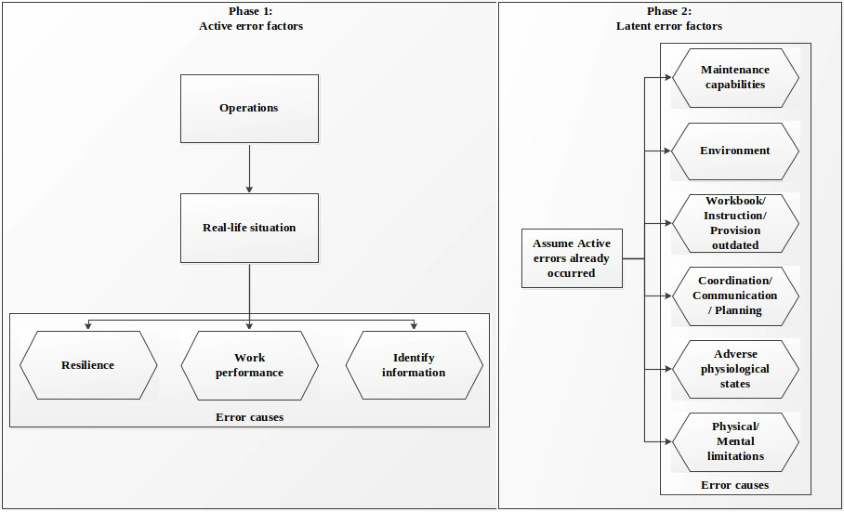
Questionnaires Design and Survey Process The survey accomplished by the eight execution procedures in AMP (Aviation Maintenance Professional), and then let each procedure corresponding to the operations and error proportion which provided by the historical maintenance data of Taiwan’s airline. The theoretical background of the real-life situation is addressed by RCA which helps identify what, how and why the error happened, therefore, the description of Active errors link to Latent errors can be more logically consistent. The questionnaire is responded in a ten-point rating scale so that the operators may fill in and assess quickly and easily. A total of 115 operators from Taiwan Airline`s maintenance staff (seniority 1-31 years, M = 15, avg = 15.05) participated in this study. On being informed of the aims of the research, all operators were trained for 5 minutes, which served to familiarize them with the logical of RCA and how to set the descriptive Active errors set into real-life situations in operations. The questionnaire was divided into two phases (see Figure 2); in phase 1, each operation had three questions which described real-life situation of Active errors; and in phase 2, operators had to take six Latent error scores, which consisted in each Active error. During the entire questionnaire survey process, subjects were allowed to ask questions and given feedback for the score accurately.
RESULTS
Reality Chart After the classification, the research team followed the reasoning process, considering Active error factors as the events and the Latent error factors as the causes to merge, link and change statement and then develop the Reality Chart (see Figure 2).
Figure 2. Integration of Reality Chart
Results of Qquestionnaire This questionnaire surveyed 115 and collected 109 back because some of the participants are working oversea, and after removing invalid samples for missing tick or only choosing extreme value, it finally got actual valid samples 100 in part A and 87 in part B. Active Error Factors
In questionnaire, each maintenance procedure contains three error-related events, and each event is corresponding to an Active error factor. By multipling the score with the weight from the historical maintenance data of Taiwan’s airline to get the weighted score as analysis data, the statistical tests was conducted using one-way ANOVA with alpha level setted to .05, and the result is shown that some of the Active error factors have significant differences between each other, p < .05. (See Table 1)
Table 1: ANOVA on active error factor score DF SS MS F P
Latent Error Factors Latent error factors can be independently analyzed corresponding to the three active factors, but there is no weight to multiply here because the collected data can’t tell the incidence of each latent factor. All the ANOVA results revealed that there were significant differences among some of the Latent error factors, p < .001. And Table 2 is the outcome of the most influencial active error factor.
Table 2: ANOVA on latent error factor score DF SS MS F P
Importance Ranking and Weighted Score of Factors Since Table 1 and 2 reveals that there is significant difference between Active error factors and the same result between Latent error factors, the Tukey test is used to determine the order of the importance degree. And the integration of the results outline is as follows: (i) The most important Active error factor is “Task execution error”; (ii) The most important Latent error factor is “Maintenance capability”; (iii) The Latent error factors “Adverse Physiological States” and “Environment” are not that urgent to be improved. These results will be reported back to the airline for improving programs design, and the weighted score will be used to check the improve performance and validate the reliability of the model after the programs implemented for a while.
Study Limitations Although this Latent Human Error Model was designed for widely applying in various domains, it still had some limitations in this study: First, the interaction between factors should be ignored. When drawing the Reality Chart, some interaction between the factors had been discovered, but it would be difficult to do the following steps of this model with keeping those interactions, so the low influential factor’s link should be ignored to make the research carried out smoothly. Second, this model is weak to apply in fewer sample-sized events. For fewer sample-sized events, there is no source of the weight to revise the influence of each divided procedures, this may reduce the persuasiveness of the model or can’t get the influential factors.
CONCLUSIONS
This section summarizes the feasibility and application results of the latent human error factors investigation model, and provides some improvement suggestions to make this model more complete and can fit to other type of human machine interaction works. The main conclusions for this study are listed as follows: (i) HFACS is a well factor source.
In the developed latent human error factors investigation model, using HFACS as the factor source and changing the descriptive contents to real situations makes the cause of the events/accidents be clearly understood and link the related factors effectively.
(ii) RCA gives a more detailed thinking logic to investigate.
Using RCA as the reasoning logic to investigate the error situations shows more specific operating scenarios retrospect than just simple brainstorming, can further probe the latent error factors.
(iii) Error factors can be ranked to show the degree of importance.
The questionnaire’s analysis results shows the importance ranking of both active/latent error factors. And the final result can correspond to the error situation in the questionnaire to provide hierarchical considerations when designing the improvement plans.
ACKNOWLEDGEMENTS
This research was supported by National Science Council under the project # NSC 101-2221-E-007-013-MY2.
REFERENCES
Cheng, C.M. (2013), “Integration and Application of Human Error Identification Techniques on the Chemical Cylinder Change Task”, Retrieved from National Tsing Hua University Library website: http://www.lib.nthu.edu.tw/ Chiara, V., Federica, T. (2010), “A human factors and reliability approach to clinical risk management: Evidence from Italian
cases”, Safety Science Volume 48 No. 5 Dhillon, B.S. (2009), “Human reliability, error, and human factors in engineering maintenance”. New York: CRC Press. Gano, D.L. (1999), “Apollo Root Cause Analysis – A New Way Of Thinking (3rd ed.)”. Washinton: Apollonian Publications. Marianne, D., Tomas, B., Carin, S.F. (2004), “Human actions and errors in risk handling—an empirically grounded discussion of cognitive action-regulation levels”, Safety Science Volume 42 No. 3. Modarre, S.M. (2009), “Reliability Engineering and Risk Analysis”. New York: CRC Press. Paul, M.S., Miranda, C., Margaret, J.T. (2012), “Systems-based accident analysis methods: A comparison of Accimap, HFACS,
and STAMP”, Safety Science Volume 50 No. 4 Reason, J. (1990), “Human Error”. New York: Cambridge University Press. Brookfield,VT: Ashgate Publishing. Reason, J. (1997), “Managing the human and organizational response to accidents”. Aldershot: Ashgate. Rooney, J., Heuvel, L.N.V. (2004), “Root Cause Analysis For Beginners”, in: QUALITY BASICS, www.asq.org. pp.45-53 Rouse, W.B., Rouse, S.H. (1983), “Analysis and classification of human error”, IEEE Trans. On Systems, Man and Cybernetics, MC-13(4). pp. 539-549 Shappell, S., Wiegmann, D. (2002), “The Human Factors Analysis and Classification System–HFACS”. Ashgate Publishing, Ltd Stanton et al. (2005), “Human Factors Methods: A Practical Guide for Engineering and Design”, Neville Stanton: Ashgate. Swain, A., Guttmann, H. (1983), “Handbook of Human Reliability Analysis with Emphasis on Nuclear Power Plant
Applications: Final report(NUREG/CR-1278)”. Washington, DC: Nuclear Regulatory Commission.
LISTED IN THE AHFE DIGITAL BOOKSTORE CATALOGUE
Explore the complete digital volume
Advances in The Ergonomics in Manufacturing: Managing the Enterprise of the Future
Read this individual research paper free through the original publisher, or explore the full digital proceedings book.
ISBN 978-1-4951-2103-6
Explore this ISBN in the AHFE Bookstore ↗Listed in the July 2026 bookstore catalogue; search by ISBN to confirm current availability · Digital book purchase optional