Petr Zámečník, Matúš Šucha, Pavel Řezáč, Kateřina Bohmová (2021). Attitude Towards Electric Vehicles in the Czech Republic. In: Advances in Human Aspects of Transportation: Part II. AHFE Open Access, vol. 16. https://doi.org/10.54941/ahfe100694
Present study deals with the attitudes of people in the Czech Republic towards electric vehicles. Research was carried out in the form of a questionnaire, which was filled by 245 persons aged 17-81 years from all over the Czech Republic. The results show that for most respondents is the acquisition of electric vehicle few conceivable. The most common reason is the cost. Other reasons are a small number of charging stations, small trunk and limited commuting travel. The results also show that between men and women is not a statistically significant difference in attitudes to electric vehicles in general. The exception is the attitude to the fact that electric vehicles are environmentally friendly and the area of the purchase price. Women, compared to men, perceive less the cost of electric vehicles as excessive. At the same time women (unlike men) consider electric vehicles as much more environmentally friendly.
The European Union in the frame of the Europe 2020 Strategy undertook by 2020 to promote greener and more competitive economy which will be less resource demanding. Concrete expression of the priority of sustainable growth in the field of climate and energy is commitment "20-20-20", which aims by 2020 to reduce greenhouse gas emissions by 20% compared to 1990 level, to increase the share of renewable energy in total energy consumption in the EU on 20% and increase energy efficiency in Europe by 20%. Furthermore Transport White Paper aims to eliminate by 2050 conventionally powered vehicles in the cities and urban areas, along with other measures, plans to reduce emissions in transport by 60%. White Paper - Roadmap to a united European space aims to reduce greenhouse gas emissions by approximately 20% below 2008 level by 2030 and to reduce greenhouse gas emissions by at least 70% below 2008 level by 2050 (Žák et al., 2012).
Several surveys have been vehicleried out recently in EU to collect feedback from potential consumers on electric vehicles such as testing the familiarity of vehicle drivers with electric vehicles, investigating their interest to purchase an electric vehicle as well as inquiring about their priorities for improving the features of current electric vehicles (e.g. Ernst & Young, 2010; Bunzeck et al., 2011; EurotaxGlass, 2011; McMullan, 2012; Thiel et al., 2012). In the Czech Republic was held a survey on attitudes to electric vehicles for small, medium and large enterprises in the project “Elektromobil Prague“. The results indicate that up to 70% of all respondents (Prague companies of different sizes) considering in next five years (till 2016) purchase of an electric vehicle, and up to 30% of them that count with that. More than half of the companies included in the survey had own fleet of over 10 vehicles and a quarter with more than 500 vehicles (Žák et al., 2012).
METHOD
We used quantitative processing of electronic form questionnaires. Statistical data processing was vehicleried out using SPSS.
RESEARCH SAMPLE Our research is focused not on the company, but the individual residents of the Czech Republic. As part of the telephone survey was piloting the questionnaire, which showed that 9 out of 10 respondents refused to answer or continue to communicate when asked on household income. The questionnaire was subsequently distributed in electronic form so as to obtain a demographically and geographically balanced sample.
Total participants were 271 people. 26 participants were excluded from the analysis because of incompleteness (gender age etc.). Finaly we were working with 245 persons surveyed (134 women and 111 men). All persons surveyed were aged 17 - 81 years. The research sample was 128 persons employed 40 persons on parental leave, 29 entrepreneurs, 28 students, 13 pensioners and the unemployed 6. Three respondents did not specify their economic activity. The sample came from the entire country - from all 13 regions. Representation of individual regions, however, has been uneven. Most people (84) lived in the Southmoravian Region, the city of Prague was represented by 36 persons.
DATA GATHERING The questionnaire was distributed via the link on social networks and presentation of links to websites dealing with the transport issues. Due to ensure acquiring subjects older than 50 years, a questionnaire was distributed among these people personally. Filling out an anonymous questionnaire took an average of 20 minutes.
DATA ANALYSIS Data were analyzed using SPSS program. Before beginning the analysis, some questionnaires were excluded. Firstly were excluded incompletely filled questionnaires and secondly those, in which respondents indicate that they know nothing about electric vehicles (as their opinion in this case is rather hypothetical). In the analysis, we worked with gross scores, according to how respondents identified their testimony on the scale. The research sample was unevenly represented relative to the population except gender representation. First, we conducted a simple analysis of the frequency-response range of the testimony. Because of the uneven distribution of the examined sample, we also work with non-parametric test. To determine the difference in the variables between the groups, we used the nonparametric test Mann - Whitney U for independent samples, due to the failure to achieve the above normal distribution of the variables in the research files. For more detailed findings of the size differences between the variances, we also investigated the Cohen's d effect size - r (effect size). We additionally computed using the online calculator.
RESULTS
Driving license owned 90 % of the survey respondents. When asked what respondents know about electric vehicles, answers correspond mostly with three topics: environment friendly, run on electricity and that are expensive. There have been also answers that electric vehicles need long time to charge for a relatively short trip. Respondents were asked specific questions with the option to tick the answers to range "Definitely yes, rather yes, rather not, definitely not, I do not know." The conclusions of these issues could be summarized as follows. Except for two respondents are electric vehicles considered as expensive. Topic about the costs of electric vehicles is also related to the fact that only 12 % of respondents think that they would be able to buy an electric vehicle. 70 % of people surveyed think that they will not be able to buy an electric vehicle. The rest of those surveyed currently do not know if they could buy an electric vehicle.
Whether the sale of electric vehicles will in the next five years increase significantly, most respondents answered (40 %) probably not, but another 28 % think that more so, because this question is very unclear. On the question of whether electric vehicles are safe, most respondents replied that "Definitely yes and Rather yes" (61 %). Respondents in 13 % cases believe that electric vehicles can travel on great distances. 37 % of respondents believe that their friends consider them as a fools if they buy an electric vehicle. A total of 73 % of the respondents think that electric vehicles are environmentally friendly mode of transport. The research sample is considering to purchase some vehicle in next five years (not solely electric) in 55 %. When asked whether they would choose an electric vehicle when buying a vehicle, 96 (42%) out of a total of 226 respondents answered “Rather not”. 73 more persons (32%) said that they would definitely not buy an electric vehicle. Only 27 respondents would be willing to purchase an electric vehicle, 21 (9%) out of which chose “Rather yes” and merely 6 (2%) of them would definitely buy this type of a vehicle. The remaining 30 respondents did not know whether they would buy an electric vehicle or not. Reasons for not buying an electric vehicle are as follows: the most frequent was high purchase price of the vehicle (95 % of respondents), 91 % of respondents resent a small number of charging stations for electric vehicles, 85 % of respondents did not want electric vehicle because of the small vehicle go area (it is a “city car”), 77 % percent of respondents resent the total size of the vehicle, 76 % of respondents discouraged from buying limited battery life, 68 % of respondents matters little driving distance of the vehicle, 30% were discouraged from buying by low top speed.
A combination of several reasons was most often given by the respondents who said that they would not buy an electric vehicle. Multiple reasons for not buying an electric vehicle were stated by 60 respondents. A sole reason for not buying an electric vehicle was given by 57 respondents. The most common reason why respondents would not buy this type of a vehicle was its high purchase price. This was also the only reason stated by a total of 32 respondents (13 %). 44 respondents (18%) mentioned the purchase price along with another reason. The second most common reason for not buying an electric vehicle was its short driving distance mentioned in a total of 48 cases (20 %). According to the respondents, the third most common problem is the limited number of charging stations, as stated by 23 respondents (9 %). In sum, the reasons why the respondents thought about buying an electric vehicle are 87% of respondents low operating costs, 69% of respondents environmentally friendly, 74 % of respondents would be encouraged to buy an electric vehicle if they can recharge your batteries at home, with 72 % of respondents low noise, 66 % of respondents would purchase an electric when stimulated by state support. Some respondents would also appreciate enhanced performance of electric vehicles, simple charging facilities in the vicinity of their home, a possibility of having the vehicle repaired in a standard vehicle repair shop, availability of spare parts or the possibility to use an alternative unit in the case of a flat battery. Several respondents stated that they would buy an electric vehicle if it was largely subsidized.
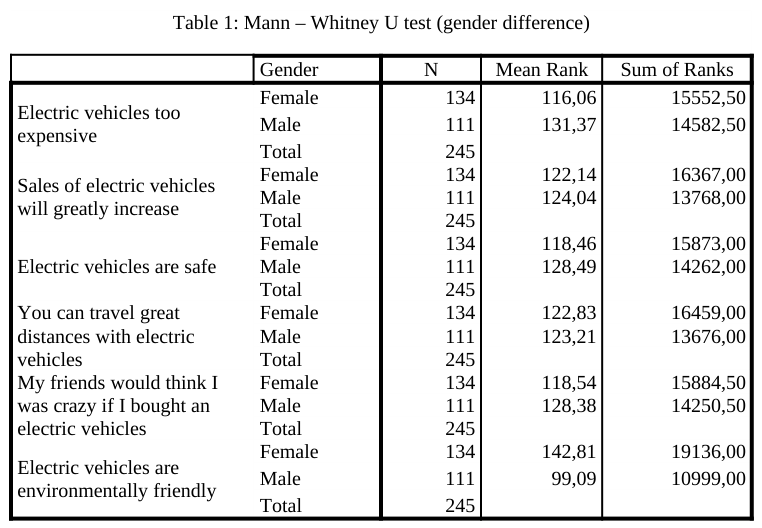
An analysis of the Mann-Whitney U resulted in differences between the testimonies of men and women (see Table 1). It is evident that the majority of responses to the scale-response differences exist between men and women.
Table 1: Mann – Whitney U test (gender difference) Gender N Mean Rank Sum of Ranks
The biggest difference is the attitude of men and women to the fact that electric vehicles are environmentally friendly. Women compared to men believe that electric vehicles are significantly more environmentally friendly. With the entire research group reached women in the analysis Mann-Whitney U rank average 142.81, compared to men who have achieved an average 99.09 respectively. These differences were demonstrated at the 1% level of significance. Statistically significant gender differences were also evident in the attitudes of people surveyed for the price of electric vehicles. Men against women, solves significantly more cost electric vehicles. Consider electric for very expensive. Men in analysis Man - Whitney U achieve average ranking 131.37. The average ranking of women reached 116.06.
DISCUSSION
Other results show that 83% of the examined group believes that the price of fuel will increase in future years. We nonetheless considered only 11% of respondents would purchase an electric vehicle. As the reason it can be seen the often quoted fact of the high purchasing price. Respondents probably consider the application of electric vehicles rather for cities where the annual mileage raid is relatively low and higher initial purchase price will be compensated by low operating costs. The most commonly reported information about electric vehicles were statements about their environmental friendliness, low operating costs and low commuting travel. The reason why respondents rather not think about buying an electric vehicle may also be that interested in protecting the environment is not such a significant factor that can outweigh the higher costs. These findings are consistent with the view Thiel et al. (2012). The aspect of the high price appears as the primary interest of the respondents in this study. In the context of the question, what would have to happen that respondents thought about buying an electric vehicle, the most of answer has the form “that they had to reduce the purchase price of the vehicle”. It is interesting that there was not revealed more significant differences in the investigated areas between groups of men and women. At the same time was also not significantly higher propensity to buy electric vehicles with increasing household income. Economic status of the household does not play a role in thinking about buying an electric vehicle. Unlike in research of Thiel et al. (2012), where was presented strong agreement with the statement that electric vehicles are significantly safer, this was not mentioned by respondents in our study.
CONCLUSION
When thinking about future market of electric vehicles in the Czech Republic, one should see the company in Prague (capital) as a target group rather than individuals or household. Generally the electric vehicles are perceived as costly and that they provide less comfort. As the environmental issues do not play an important role in the Czech Republic, this view will be not changed in near future. As a surprise it can be seen more friendly attitudes towards electric vehicles by women than by men. As the buyers are usually men, women can consider wider context than just selling price as they see it in a bit more hypothetical way. Low willingness for buying is supported by the facts that there are no subsidies in the Czech Republic and that purchasing cost can be compensated by low operating cost only when using such a vehicle as company car (e.g. taxi). As this sample was representative only according to gender and people from big cities with higher education were overrepresented, there is need for further research to uncover more aspect and valid data from the Czech Republic. But above mentioned groups of citizens (high educated people in big cities) should be those who will buy electric vehicles due to their higher salaries and environmental awareness. So their low interest portend grim times for the electric vehicles sales without further campaigns and state subsidies.
REFERENCES
Bunzeck, I.; Feenstra, C.F.J.; Paukovic, M., (2011), Evaluation of potential users of electric vehicles related to charging – A survey in eight EU countries. Ernst & Young, (2010), Gauging interest for plug-in hybrid and electric vehicles in selected markets. European Commission, (2011), Communication – Whitepaper: Roadmap to a Single European Transport Area – Towards a
competitive and resource efficient transport system. COM (2011) 144. European Commission, (2012a). Communication - VEHICLES 2020, Action Plan for a competitive and sustainable automotive industry in Europe. COM(2012) 636. European Commission, (2012b). Driving and parking patterns of European vehicle drivers –mobility survey. European Environment Agency, (2012). Monitoring CO2 emissions from new passenger vehicles in the EU: summary of data for
2011. EurotaxGlass, (2011), Electrification of the Automotive Industry – The European Consumer’s View. McMullan, G. (2012), Public Awareness of and Attitudes towards Electric Vehicles. Report of the Department for Regional Development (DRD), Belfast. Thiel, C., Alemanno, A., Svehiclecella, G., Zubaryeva, A., Pasaoglu, G. (2012), Attitude of European vehicle drivers towards
electric vehicles: a survey. Reference Report of the Joint Research Centre of the European Commission. Žák, Z., Zadina, V., Votruba, Z. (2012), Manifest elektromobility v České republice. Národní spolekt pro elektromobilitu a podporu moderních technologií. Praha. Dostupné z http://www.narodni-spolek.cz/manifest-elektromobility
LISTED IN THE AHFE DIGITAL BOOKSTORE CATALOGUE
Explore the complete digital volume
Advances in Human Aspects of Transportation: Part II
Read this individual research paper free through the original publisher, or explore the full digital proceedings book.
ISBN 978-1-4951-2098-5
Explore this ISBN in the AHFE Bookstore ↗Listed in the July 2026 bookstore catalogue; search by ISBN to confirm current availability · Digital book purchase optional