Stephanie Cynka, Toni Flintb, John McMorrowb (2021). How Well Do People Understand the Signs and Signals at User Worked Level Crossings?. In: Advances in Human Aspects of Transportation: Part I. AHFE Open Access, vol. 15. https://doi.org/10.54941/ahfe100652
In 2012, RSSB commissioned TRL to carry out a review of the signs and signals at user-worked level crossings (UWCs) to identify whether improvements can be made. This paper describes a comprehension survey of these signs and signals and presents the findings for three signs: a ‘Stop Look Listen Sign for Pedestrians’, a ‘Stop Look Listen Sign for Drivers’, a ‘Stop and Telephone Sign for Drivers’; and one signal: a miniature stop light (MSL). An online questionnaire was administered to 224 road users to determine the extent to which the information provided at these types of crossings is well understood. The results show that respondents’ understanding of the road user types at which each of the three signs is aimed is poor regardless of experience or context. In addition, the results show that there is a lack of understanding about the appropriate procedure to follow for two of the signs and the MSL signal. The implications of these findings are that the design of information at user-worked level crossings needs to be improved. These methods for improvement will be identified and evaluated during the next phase of the work.
According to the Road-Rail Interface Special Topic Report (RSSB, 2010) there are over 2600 user-worked level crossings (UWCs) in Great Britain. This is approximately 40% of all level crossings and 60% of vehicular crossings, making them a relatively common category of crossing.
UWCs are typically found on private land (e.g. farms) but can be on public access roads and road users are required to decide when it is safe to cross. There are three types of UWCs:
1. UWC – These crossings only have gates and signs present. All road users are required to stop, look, and listen for trains and decide for themselves whether it is safe to cross. Drivers of unusually long, wide, low, heavy or slow-moving vehicles are required to telephone before crossing.
2. UWCT – These crossings have gates, signs and a telephone present. Non-motorists are required to stop, look and listen to decide whether it is safe to cross. All motorists must telephone for permission before crossing.
3. UWCMSL – These crossings have gates or barriers and miniature stop lights (MSLs) showing a red or green light signal depending on whether a train is approaching. All road users must obey the MSLs. Some UWCMSLs have a telephone if drivers of long or low vehicles are required to call before crossing.
It is difficult to compare risk at different types of level crossing as usage rates by different types of road user would need to be taken into account in addition to rail vehicles using the crossing and the number of each type of crossing. Table 4 of the Special Topic Report shows that from 2000 to 2009 (inclusive), 34% of all collisions at level crossings took place at private road crossings and in the same time period 41% of fatalities at level crossings took place at this category of crossing. While one would expect a large proportion of the collisions and fatalities to have occurred at this relatively common category of level crossing, it is important to consider that usage rates at these crossings are relatively low. Therefore it is likely that risk at private road level crossings per traverse is relatively high when compared with other types of level crossing.
Chart 29 of the same report shows that just under half of the reported level crossing misuse incidents take place at private road level crossings. Various reports have highlighted specific areas of concern in relation to private road level crossings, including issues with current signs. An investigation of a crossing incident between a tanker and passenger train at Sudbury (RAIB, 2011) concluded that the wording of the signs at the level crossing may have been confusing.
This indicates an opportunity to reduce risk by tackling road user errors and violations at private road level crossings. One method of addressing road user behaviour is to ensure that they are provided with appropriate and well-designed information, instructions or warnings as they approach crossings. Information and signs currently used at UWCs may not necessarily conform to current human factors good practice and may not represent an optimum solution.
This paper focuses on road users’ understanding of three signs and a MSL at UWCs:
Stop Look Listen Sign for Pedestrians, which is a warning sign for a non-vehicular UWC. Non-vehicular traffic, such as pedestrians and cyclists, are expected to check for trains and decide for themselves whether it is safe to cross the tracks.
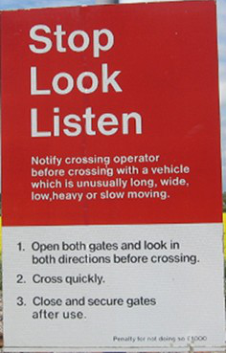
Stop Look Listen Sign for Drivers, which provides instructions for use at a vehicular UWC without a telephone. Drivers of “unusually long, wide, low, heavy or slow moving” vehicles must notify the crossing operator before using the UWC, but all other drivers are expected to check for trains themselves and decide whether it is safe to cross.
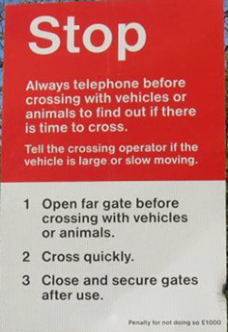
Stop & Telephone Sign for Drivers, which provides instructions for use at a vehicular crossing with a telephone. All drivers, along with people who are crossing with a herd of animals, must use the telephone to call the crossing operator before using the crossing.
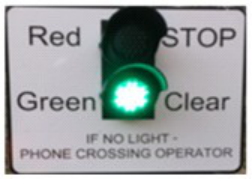
MSLs, which show either a red light or green light, depending on whether a train is approaching. The red light signifies that a train is approaching and that the road user must stop, and the green light signifies that the line is clear. All road users are expected to obey the light signals.
METHOD
Design
An online questionnaire was created using ‘SmartSurvey’, a web-based program designed specifically for the purposes of gathering questionnaire data, to evaluate road users’ comprehension of three signs and a MSL used at UWCs. Participants received an email with a link to the questionnaire and completed it at home. The tool collects responses and these were downloaded to Microsoft Excel for analysis.
Participants were asked to supply some background information which included their gender, age, driving experience, road user type and their use of private road level crossings.
Since many participants were unlikely to be familiar with user-worked crossings, a short explanation was provided at the beginning of the study. Supplementary information was also provided for particular signs and signals at the beginning of certain sections if participants required the information to be able to answer questions about the signs or signals.
For each sign, participants were asked to mark all of the types of road users from a list to which they thought the sign applied to. Subsequent questions, which may have indicated which road users the sign applies to, were not visible at this point.
Participants were then asked what they should do in order to use the level crossing safely as a pedestrian, car driver/van driver/motorcyclist, or driver of farm vehicles or large vehicles. Questions were divided into high-level categories, such as use of gates or barriers, monitoring the crossing, and use of telephone, and participants were required to select at least one multiple-choice response for each category.
Two versions of the survey were developed to determine how much information is contained inherently within each sign in isolation, and how much the meaning of the sign might be interpreted differently when seen in a relevant context. In summary:
Half of the participants received the version with signs and signals presented out of context
Half of the participants received a version that included images of the signs and signals in the context of the level crossing environment. For these images, a close up photograph of the sign of interest was presented alongside the photograph of the level crossing scene in order for participants to be able to read the information
A photograph of the following types of user-worked crossings were included in the in-context version: o A typical user-worked crossing without telephones (UWC)
o A typical user-worked crossing with telephones (UWCT) o A typical user-worked crossing with miniature stop lights (UWCMSL)
Participants The study aimed to include 200 participants in the comprehension survey and in total, 224 responses were received. Participants from TRL’s database of approximately 2,000 local road users were emailed and asked to complete the survey, as well private road level crossings users that we engaged with during the initial stages of the study. The sample included:
Non-users of private road level crossings
Private road level crossings users, including: o Users who navigate the crossing in different types of vehicles
o Users of each type of private road level crossing o Some users from different regions of the country
To ensure that similar numbers of participants completed the in context and out of context surveys, interested participants were asked to reply to the initial email so that a researcher could send them the appropriate link. This also allowed a suitable spread of male and female, and younger and older participants across each survey.
The participants were of mixed age and gender with various degrees of driving experience. In addition, different types of road users were included in the sample, such as car/van drivers, pedestrians, cyclists, horse riders and drivers of farm vehicles.
To encourage participation, participants who completed the survey were given the opportunity to enter themselves into a prize draw to win one of four £60 cash prizes (around €70). They were informed that their personal information would only be used if they won the prize draw and their personal information would not linked to the survey they completed.
Materials
Road users comprehension was assessed for three signs and a MSL used at UWCs. The signs and MSL that were included in the survey are presented in Figure 1 to Figure 4.
The Stop Look Listen sign for pedestrians is shown in Figure 1. Non-vehicular traffic, such as pedestrians and cyclists, are expected to check for trains and decide for themselves whether it is safe to cross the tracks.
Figure 1. Stop Look Listen sign for non-vehicular traffic
Figure available in the original PDF paper.
The Stop Look Listen sign for drivers is presented in Figure 2 and provides instructions for use at a vehicular UWC without a telephone. Drivers of “unusually long, wide, low, heavy or slow moving” vehicles must notify the crossing operator before using the UWC, but all other drivers are expected to check for trains themselves and decide whether it is safe to cross.
Figure 2. Stop Look Listen sign for vehicular traffic
The Stop and Telephone sign for drivers, shown in Figure 3, provides instructions for use at a vehicular crossing with a telephone. All drivers, along with people who are crossing with a herd of animals, must use the telephone to call the crossing operator before using the crossing.
Figure 3. Stop and Telephone sign for vehicular traffic
MSLs presented in Figure 4 show either a red light or green light, depending on whether a train is approaching. The red light signifies that a train is approaching and that the road user must not cross the level crossing, and the green light signifies that the line is clear. All road users should obey the light signals
Figure 4. Miniature stop light showing the green light aspect
RESULTS
Initially, responses were divided and analysed based on familiarity and context. However, very few differences in the responses provided were found between these groups, so all of the responses were combined and analysed together.
Stop Look Listen Sign for Pedestrians The Stop Look Listen sign shown in Figure 1 is aimed at non-vehicular level crossing users. This would generally be the only sign present at the level crossing to warn of the hazard and instruct road users who are crossing on foot on how to cross.
Respondents were asked to mark all of the road user types to which they thought the Stop Look Listen sign applied. As Figure 5 shows, a high percentage of participants thought the sign applied to all road user groups despite it being intended for non-vehicular traffic only. Although the number of responses for the vehicular categories was slightly lower, the results indicate that participants were generally not aware of which road users the sign applies to.
Percentage of responses
Figure 5. Percentage of respondents who thought the Stop Look Listen sign for Pedestrians applied to each type of road user
Figure available in the original PDF paper.
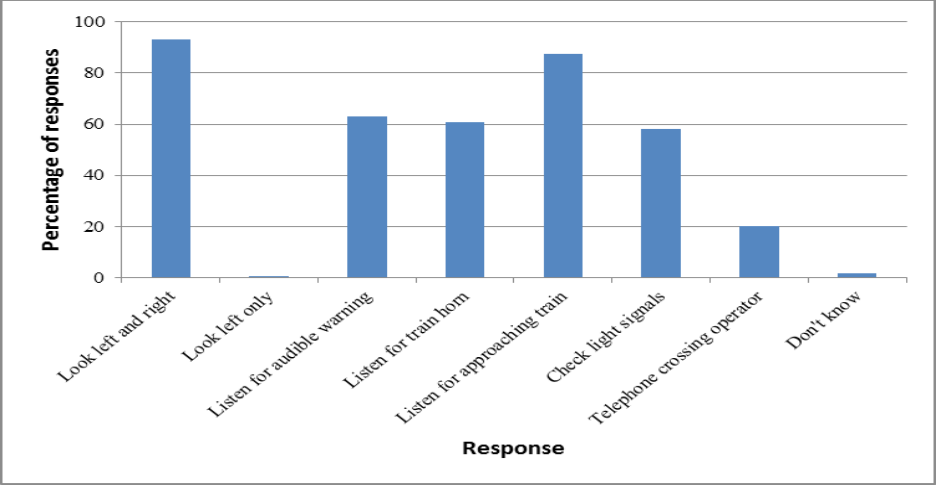
Respondents were also asked what they should do in order to cross the level crossing safely. Although a large number of respondents (93%) correctly said that they should look to the left and right to check for trains before crossing, 7% indicated that they would not look in both directions (see Figure 6). Some of the respondents instead indicated that they would rely on their hearing, telephone the crossing operator or check light signals. However, telephones are not always present at crossings with this sign in place and light signals are never present. Participants’ responses suggest that information is required at UWCs to provide clear instructions for pedestrians about the procedure to follow in order to cross safely.
Figure 6. Percentage of respondents who selected each procedure for crossing the tracks Stop Look Listen Sign for Drivers
The Stop Look Listen Sign for Drivers is used at UWCs without telephones to provide instructions to vehicular traffic on the safe crossing procedure. The sign instructs drivers of long, wide, low, heavy or slow moving vehicles to call the crossing operator before crossing.
As found for the Stop Look Listen Sign for Pedestrians, respondents were generally not aware of which road user types the sign applied to. Again, the majority of participants thought that the Stop Look Listen Sign for Drivers applied to all types of road users, and the ‘Farm vehicle drivers’, ‘Horse riders’, and ‘LGV drivers’ categories were most frequently selected.
Figure 7. Percentage of respondents who thought the Stop Look Listen sign for Drivers applied to each type of road user
Figure available in the original PDF paper.
Although a high number of respondents (83%) said that drivers of LGVs or farm vehicles are required to telephone before crossing, this leaves 17% who did not believe that these types of road users are required to call the crossing operator. However, most participants who identified the need for drivers of LGVs and farm vehicles to call recognized that they should do so prior to opening the first gate.
Furthermore, there appeared to be some confusion over when it is appropriate to telephone the crossing operator. Only 35% of respondents correctly identified that car drivers are not required to telephone before crossing and nearly half the sample thought car drivers should check for trains but call the crossing operator if they are unsure. 13% of respondents stated there is not enough information to know whether a car driver should call the crossing operator and 6% also selected this category for drivers of LGVs or farm vehicles.
These findings show that the message about telephoning the crossing operator on the current Stop Look Listen Sign for Drivers is not clearly conveyed.
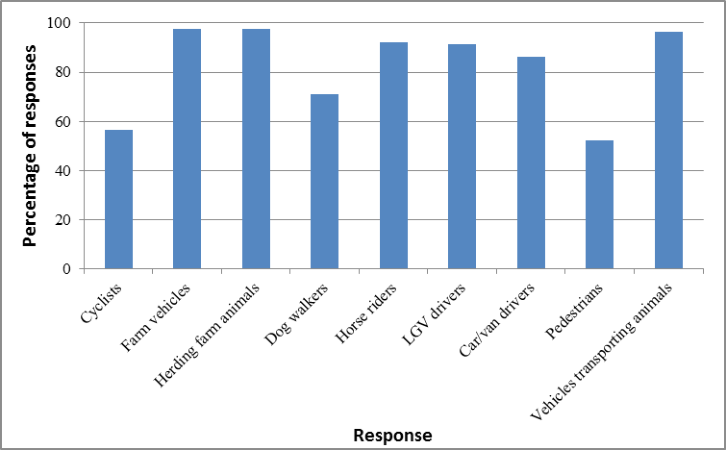
Stop and Telephone Sign for Drivers The Stop and Telephone Sign for Drivers is used at UWCTs to provide vehicular traffic with instructions. All road users who are crossing in a vehicle or who are moving a herd of animals over the crossing are required to obtain permission from the crossing operator using the telephone provided.
When asked which types of road users the Stop and Telephone Sign applies to, respondents were more likely to select the vehicular options. However, a large number of respondents still selected the ‘cyclist’ and ‘pedestrian’ categories, suggesting that there is some confusion over who the sign is for. Furthermore, 70% of respondents incorrectly thought the sign applied to dog walkers despite the message being intended for people driving or shepherding herds of animals. This finding shows that what constitutes as ‘crossing with animals’ is not well understood.
Figure 8. Percentage of respondents who thought the Stop and Telephone Sign for Drivers applied to each type of road user
Respondents were asked what a motorist should do at the crossing and although all vehicle drivers should use the telephone to find out if there is enough time to cross before crossing, only 70% of the sample selected this option. Human Aspects of Transportation I (2021)
The 30% of respondents who did not choose this option tended to say that drivers should look to the left and right for approaching trains. The instruction about telephoning before crossing with vehicles or animals does not therefore appear to be as clearly conveyed as it should be.
Miniature Stop Light MSLs are present at some UWCs to indicate whether a train is approaching or not. Road users must not cross when the red light is on, and if the red light stays on after a train has passed, another train is approaching and road users must still not cross. Road users should only use the crossing when the green light is showing.
Most participants recognized that the light signals applied to all types of road users and all respondents indicated that they should not cross a level crossing if the MSL is showing red. However, 85% and 87% of participants correctly stated that pedestrians and motorists respectively should decide when it is safe to use the level crossing when MSLs are present by checking the light signals, leaving a substantial number of respondents who thought different procedures were more appropriate. Of the participants who did not select this option for motorists, 79% stated that motorists should check in both directions for approaching trains, one participant (7%) selected the ‘Don’t know’ option, and the remaining respondents (14%) thought a motorist should call the crossing operator. Of the participants who did not select the check light signals option for pedestrians, 70% stated that pedestrians should check in both directions for approaching trains, 21% stated that pedestrians should telephone the crossing operator and one participant selected each of the ‘Look right only’, ‘Check far side of crossing is clear’ and ‘Don’t know’ categories.
Additionally, 83% of respondents in total said car drivers should check to the left and right for trains and 84% of participants said that pedestrians should look in both directions before using the level crossing. Although many participants would do this in addition to checking the MSLs, this may indicate a lack of trust in the signals.
DISCUSSION
Stop Look Listen Sign for Pedestrians Overall the majority of respondents (regardless of experience or context) stated that the sign applied to all road users, despite the sign being intended only for pedestrians. This is perhaps unsurprising, given that the instructions may well be deemed by many users to be standard precautions when using a level crossing. However, drivers may be instructed to telephone for permission to cross at some crossings and the presence of the Stop Look Listen Sign for Pedestrians could therefore provide users with conflicting information.
Results from the survey also suggested that the Stop Look Listen Sign for Pedestrians does not provide clear information about how non-vehicular traffic should safely use the level crossing. 7% of the sample did not select the correct response, ‘look to the left and right for trains’, and instead indicated that they should determine when it is safe to cross by listening for trains, telephoning the signalman or checking MSLs. Furthermore, over 30% of the respondents said that they did not know or that there was not enough information available in relation to operating the gates.
Stop Look Listen Sign for Drivers The Stop Look Listen Sign for Drivers was deemed to be less universally relevant than the Stop Look Listen Sign for Pedestrians, although the majority of respondents still felt it applied to all road user types. Drivers of farm vehicles stood out as the user group believed by most people to be amongst the intended targets of this sign.
A high percentage of respondents identified correctly that that drivers should open both gates on foot, cross in their vehicle, then close both gates on foot. However, 17% of the sample failed to recognize that drivers of LGVs or farm vehicles must telephone the crossing operator first and only 35% of respondents correctly stated that car drivers are not required to telephone before crossing.
Respondents answered the questionnaire in their chosen location in their own time. A high number of correct responses were expected since respondents could spend as much time as they liked reading the signs, but the findings of the survey instead suggest that the signs currently used at UWCs are confusing and do not clearly convey the correct messages.
Stop and Telephone Sign for Drivers Despite only being intended for vehicle drivers, around 50% of respondents felt the sign also applied to pedestrians and cyclists, around 70% felt it applied to dog walkers, and over 90% felt it also applied to horse riders. This implies that respondents did not have a clear understanding of exactly what constitutes crossing with animals.
As found with the previous sign, most respondents identified correctly that drivers should open both gates on foot, cross in their vehicle, then close both gates on foot but around 30% of participants indicated that they would cross without contacting the crossing operator first. Once again this suggests that respondents did not all have a clear understanding of the different users groups to which the sign applied and the correct procedure, despite having no time constraints when viewing the signs.
Miniature Stop Lights The MSL was generally found to be well understood, but a small number of participants indicated that they should check left and right for approaching trains rather than checking the light signals to determine whether a train is coming. It is unclear whether these participants misunderstood what the MSLs were for or whether they did not trust the light signals and instead felt it is safer to determine whether a train was coming by visually checking the railway line themselves.
Furthermore, a large number of participants stated that they would check to the left and right as well as checking the MSL. Although this is not an unsafe behavior to engage in if the MSL is showing green, it may suggest that participants did not fully trust the technology.
CONCLUSIONS
This experiment evaluated the comprehension of 224 participants for three signs and a light signal which are present at some UWCs. Road user comprehension of the signs was found to be poor, regardless of whether the signs were shown in context or out of context and regardless of whether participants were familiar with these types of crossings or not. In general, respondents were unable to differentiate between the signs which are aimed at different road user groups and this could lead to some road users following incorrect, and potentially unsafe, procedures.
Reported behavior in response to the MSLs that are present at some UWCs was somewhat surprising. Although the majority of respondents recognized the need to check the aspect of the light signal before deciding whether to cross, a significant proportion of road users also stated that they would look left and right to check for trains before crossing. This indicates that there is either a lack of trust in the light signals, or that respondents do not fully understand the procedure that they are required to follow.
Alternative signs which are clearly aimed at particular road user types and provide clear instructions for use of the crossing should be designed and tested with participants. The designs that are shown to be beneficial in terms of road user understanding and behaviour should be considered for implementation at UWCs.
REFERENCES
RAIB (2011). Rail Accident Report. Collision between an articulated tanker and a passenger train at Sewage Works Lane user worked crossing near Sudbury, Suffolk. 17 August 2010. Rail Accident Investigation Branch, Department for Transport. RSSB (2010). Road-Rail Interface Special Topic Report.
LISTED IN THE AHFE DIGITAL BOOKSTORE CATALOGUE
Explore the complete digital volume
Advances in Human Aspects of Transportation: Part I
Read this individual research paper free through the original publisher, or explore the full digital proceedings book.
ISBN 978-1-4951-2097-8
Explore this ISBN in the AHFE Bookstore ↗Listed in the July 2026 bookstore catalogue; search by ISBN to confirm current availability · Digital book purchase optional