Teresa Cotrim, Carlos Fernandes da Silva, Vânia Amaral, Pedro Bem-Haja, Anabela Pereira (2021). Work Ability and Psychosocial Factors in Healthcare Settings: Results from a National Study. In: Advances in Human Aspects of Healthcare. AHFE Open Access, vol. 13. https://doi.org/10.54941/ahfe100477
Interactions between the ageing process, heath status, lifestyle and work strongly influence the work ability. In this paper, the healthcare workers were the selected professional group and their Work Ability was analysed in order to develop Portuguese reference values and to determine the influence of socio-demographic and psychosocial factors in the WAI. The methodology encompassed the work ability analysis using the Portuguese Version of the Work Ability Index and the characterization of the psychosocial factors using the Portuguese Version of Copenhagen Psychosocial Questionnaire. The sample included 1016 individuals from Portuguese hospitals with different professional categories. In average our sample had good work ability. WAI did not correlate with age. Among those with better WAI, physicians and nursing aides were the seniors, pointing to a probable healthy worker effect. The COPSOQ showed critical values in the scales’ cognitive and emotional demands. The scales quantitative demands, role conflicts, sleep troubles, burnout, stress, depressive symptoms and offensive behaviors correlated negatively with WAI meaning that when these risk factors are lower the work ability is better. The scales role clarity, recognition, social community at work, quality of leadership, justice, self-efficacy, meaning of work, job satisfaction and development opportunities correlated positively with WAI probably acting as work ability protecting factors.
Interactions between the ageing process, heath status, lifestyle and work strongly influence the work ability (Ilmarinen et al, 2005). Work ability is also significantly related with the psychosocial factors, such as job satisfaction, social support and others (Estryn-Behar et al, 2005). Work ability has a determinant role in employability and employment, which is getting more important nowadays to prevent the discrimination of older workers in healthcare settings. Different studies in healthcare settings indicate that work ability of nurses decreases with age (Capelo et al, 2012; Cotrim et al, 2011) but this trend is not always verified among physicians, technicians, and clerks (Costa and Sartori, 2007). Nevertheless, studies conducted with several groups of healthcare workers suggest an increased prevalence of poor and moderate WAI scores as the population ages (Estryn-Behar et al, 2005; Fisher et al, 2006). While exposure to physical hazards, for instance, frequent patient lifting, are well-known contributors to hospital workers’ poor health and poor work ability (Trinkoff et al, 2002; Cotrim et al, 2011), other studies indicate that psychosocial work-related characteristics are also of importance (Camerino et al, 2008; Francisco et al, 2012; Rongen et al, 2013). Among nurses, in order to improve and maintain work capabilities, certain measures are recommended such as: increasing the capacity of dealing with the mental work demands in young nurses and improving working conditions in order to reduce the physical workload in senior nurses (Chiu et al, 2007).
The objective of the national study was to characterize the Work Ability of Portuguese Workers aiming at creating a national databank. In this paper, the healthcare workers were the selected professional group and their Work Ability was analysed in order to develop Portuguese reference values. Another objective was to determine the influence of socio-demographic and psychosocial factors in the work ability index.
METHODOLOGY
Procedures The methodology encompassed the work ability analysis using the Portuguese Version of the Work Ability Index (Silva et al, 2011) and the characterization of the psychosocial factors using the Portuguese Version of Copenhagen Psychosocial Questionnaire (Silva et al, 2012). The WAI and COPSOQ questionnaires were self-administered during 2011 and 2012 to healthcare workers of Portuguese private and public hospitals. The workers were asked to give their written informed consent for the survey and participation was voluntary.
The total number of participants comprised 1074 healthcare workers. The inclusion criterion was to have a valid WAI, so 58 questionnaires were excluded.
Methods
The Work Ability Index (WAI) describes the worker’s assessment regarding his own work ability. This instrument should be used in the area of Occupational Health, simultaneously with the assessment of work places, and is intended to be used as an aid for maintaining work ability (Ilmarinen, 1999; Ilmarinen et al, 2005). WAI is made up of 7 items, based on the actual work ability, the physical and mental work demands, health conditions, absenteeism, work ability prognosis and psychological resources. Scoring, that varies between 7 and 49, is distributed from a poor to excellent work ability. Depending on the work ability level, certain intervention measures are recommended (Ilmarinen, 1999).
The medium version of the Copenhagen Psychosocial Questionnaire (COPSOQ-II) was used to measure the psychosocial work environment. This instrument includes 28 sub-scales that cover the main areas of the psychosocial work environment: demands at work, work organization, interpersonal relations at work and mental health symptoms (Pejtersen et al, 2010; Silva et al, 2012).
RESULTS AND DISCUSSION
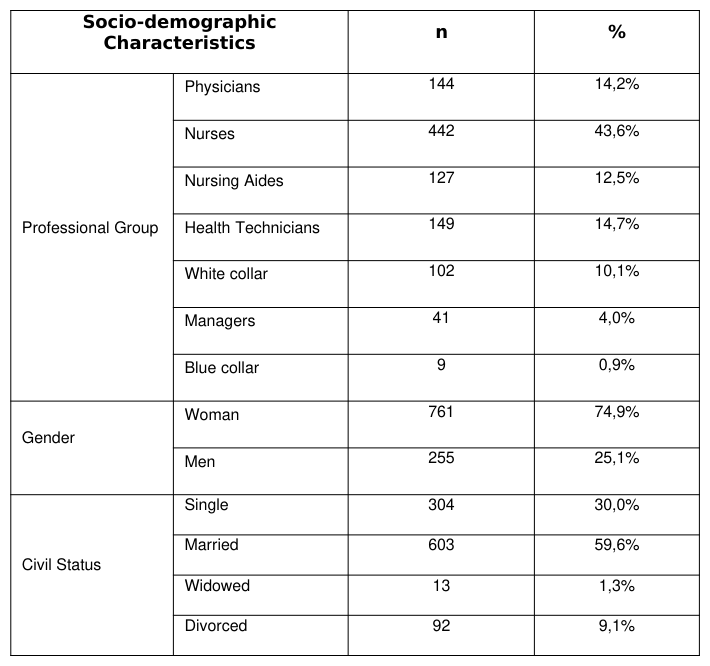
Participants The sample included 1016 individuals, 43,6% nurses, 14,2% physicians, 12,5% nursing aides and 14,7% health technicians, 74,9% were women and 59,6% were married (table 1). Participants had a mean age of 39,57 years (sd=9,99), from 20 to 68 years old, and a mean seniority of 15,87 years (sd=10,18), with a minimum of one and a maximum of 49 years of work. By age group, 52,7% belonged to the 20-39, 45,1% to the 40-59 and 1,7% to the 60- 69 age group.
Table 1: Socio-demographic characteristics Socio-demographic Characteristics n %
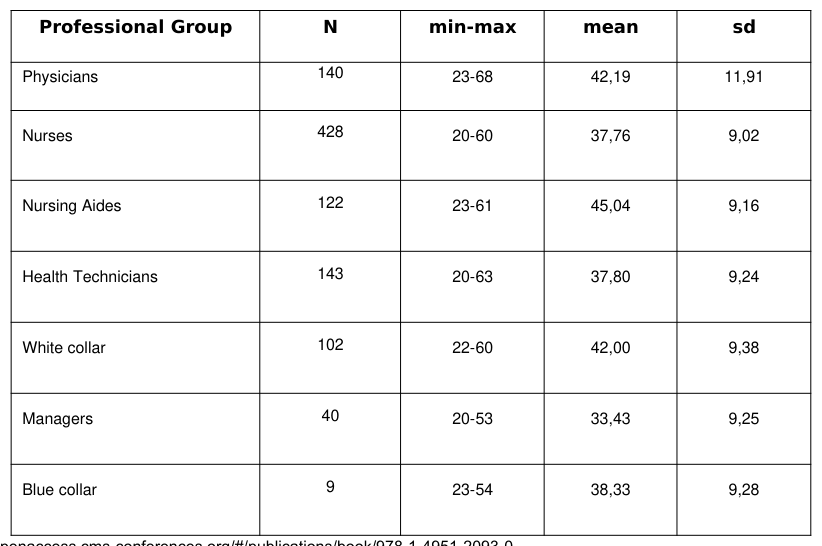
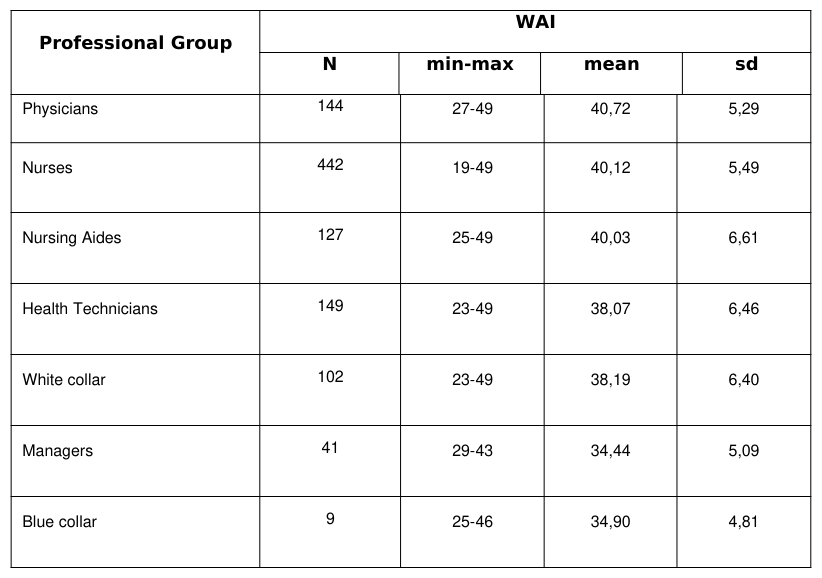
By professional group, when looking at the mean age, the nursing aides [45,04±9,16], the physicians [42,19±11,91] and the white-collar workers [42,00±9,38] were the oldest groups (table 2).
Table 2: Age by professional group.
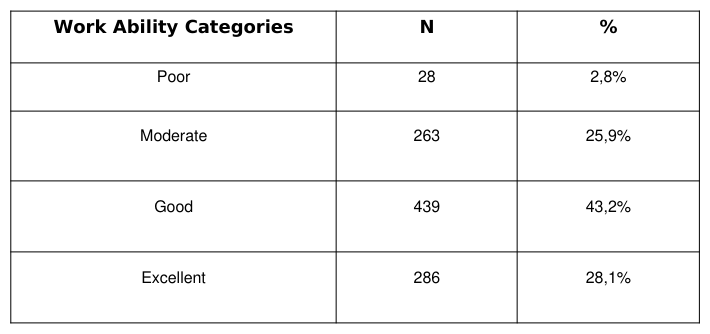
Work Ability In average our sample had good work ability [39,45 ± 5,85], with 43,2% perceiving their work ability as good and 28,1% as excellent (table 3), corresponding to 71,3% of satisfactory and 28,7% of unsatisfactory WAI. Similar prevalence of unsatisfactory WAI in healthcare workers was also found in the study of Bethge et al (2009) (32%) and Fisher et al (2006) (22,8%).
Only 2,8% of the healthcare workers had poor work ability, but by professional group there were identified 2,3% within the nurses, 4,1% within the healthcare technicians, 4,0% within the white collars and 4,0% within nursing aides with poor work ability. The workers with poor work ability were the senior ones [44,86±8,60 yrs] compared with those with moderate [39,18±10,39 yrs], good [39,87±9,91 yrs] and excellent [39,04±9,75 yrs) work ability. Age is one of the demographic factors most studied and several works reported a decreased WAI with age (van den Berg et al, 2008).
Table 3: Work Ability categories.
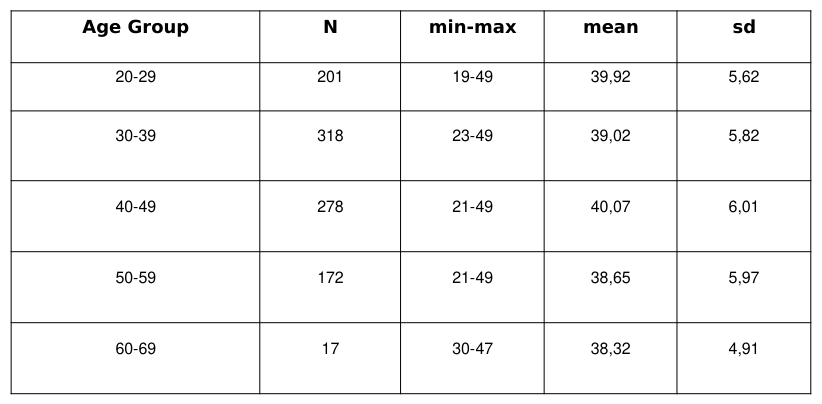
In our study, WAI did not correlate with age (r=-0,04; p=0,213). This can be due to a high percentage of satisfactory WAI in our sample (71, 3%) (table 3), a low decrease of WAI with age, but also to a higher mean WAI among the 40-49 years old [40,07±6,01) (table 4), pointing to a probable healthy worker effect. Nevertheless, other studies also showed no association between age and WAI (van den Berg et al, 2008; Capelo et al, 2012).
Table 4: Work Ability Index by age group.
Men had a higher mean WAI [40,19±5,60] compared with women [39,20±5,92], but when controlling for age the differences were not statistically significant (F=2,140; p=0,144). The gender differences are commonly studied and the results are not consensual, some studies with nurses point to a better WAI among men (Cotrim et al, 2011) but others don´t show any association between gender and WAI (van den Berg et al, 2009).
With respect to the perception of the main work demands, 74,7% perceived their work determinants as both, physical and mental, 21,6% as mental and 3,7% as physical demands. There were differences between the groups (X2
kw=22,072; p<0,001), with those reporting both physical and mental demands showing a higher WAI [39,92±5,65] and differing from the group reporting mental demands (p<0,001). Both, physical and mental, demands are mostly perceived by nurses (93,2%), physicians (68,1%), nursing assistants (85,0%) and health technicians (57,4%). Quite the reverse, managers (85,4%) and white-collar workers (53,9%) perceived mental demands in a higher percentage. Our findings reveal how important the influence of the psychosocial factors is in WAI perception. For instance, Costa and Sartori’ (2007) study showed that in jobs with higher mental involvement and autonomy but lower physical constraint the WAI remains high over the years while it decreases in nurses with the higher physical work load and the lower job control. However, some authors refer that nurses might report the very high work demands as being lower than people in other occupations (Nubling et al, 2010).
Estryn-Behar et al (2005) stated that the more skilled the occupation, the higher the WAI, taking into consideration that the task demands play a major role. However, in our sample, by professional group, physicians [40,72±5,29], nurses [40,12±5,49] and nursing aides [40,03±5,61] had higher WAI mean scores, when compared with healthcare technicians [38,07±6,46], white-collar workers [38,19±6,40], managers [34,90±4,81] and blue-collar workers [34,44±5,09] (table 5). Nonetheless, among the groups with better WAI, physicians and nursing aides are the older groups. This fact can be understood in the sense of what was referred by Estryn-Behar et al (2005) because, on the one hand, the meaning of the caring profession is a value for nursing aides and, on the other hand, the task demands of physicians can play an important role in their WAI perception.
Table 5: Work Ability Index by professional group.
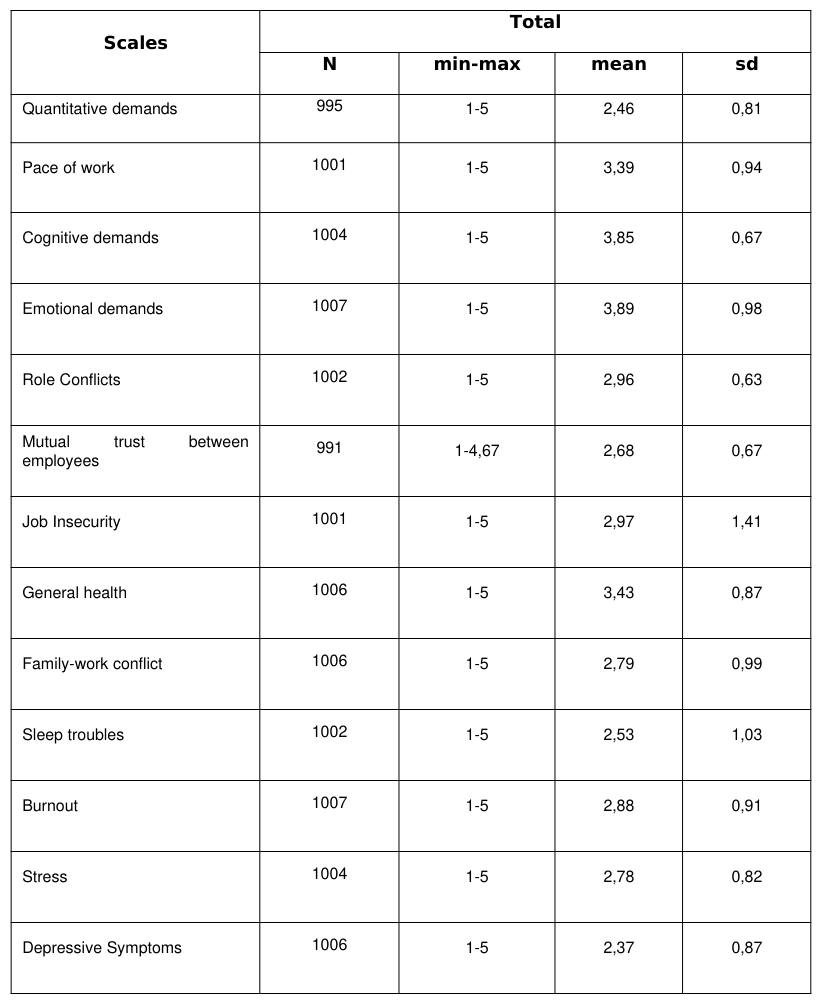
Psychosocial Factors The perception of psychosocial risk factors showed critical values in the scales cognitive [3,85±0,67] and emotional [3,89±0,98] demands (table 6). The mean results of these scales in this sample of healthcare workers were slightly worse than the ones found in the national study with a sample of 4162 workers from different activity sectors, respectively 3,97 (sd=0,71) and 3,42 (sd=1,15) (Silva et al, 2012).
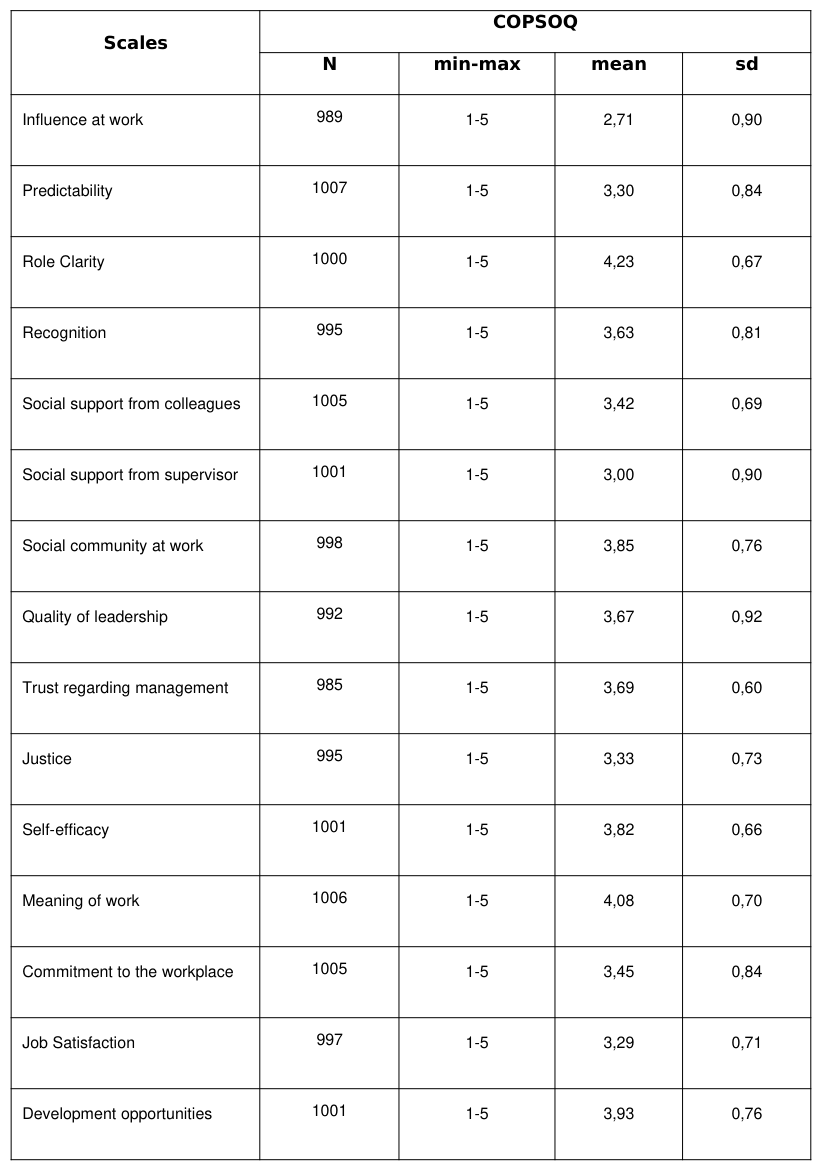
On the contrary, the scales role clarity [4,23±0,70], social community at work [3,85±0,76], self-efficacy [3,82±0,66], meaning of work [4,08±0,70] and development opportunities [3,93±0,76] presented very good results (table 7). On average, the results of these scales in this sample of healthcare workers were also slightly worse than the ones found in the national study, exception made for the scale role clarity (Silva et al, 2012).
Table 6: COPSOQ subscales distribution (the critical value is the higher).Table 7: COPSOQ subscales distribution (the critical value is the lowest).
Work ability and psychosocial factors
The scales quantitative demands (r=-0,27; p<0,001), role conflicts (r=-0,209; p<0,001), sleep troubles (r=-0,26; p<0,001), burnout (r=-0,31; p<0,001), stress (r=-0,37; p<0,001), depressive symptoms (r=-0,39; p<0,001) and offensive behaviors (r=-0,21; p<0,001) correlated negatively with WAI meaning that when these risk factors are lower the work ability is better. In several studies, a large variety of psychosocial factors at work have been addressed and some of them reported positive associations between high mental work demands and poor WAI (van den Berg et al, 2008).
The scales role clarity (r=0,18; p<0,001), recognition (r=0,20; p<0,001), social community at work (r=0,22; p<0,001), quality of leadership (r=0,23; p<0,001), justice (r=0,22; p<0,001), self-efficacy (r=0,21; p<0,001), meaning of work (r=0,31; p<0,001), job satisfaction (r=0,285; p<0,001) and development opportunities (r=0,22; p<0,001) correlated positively with WAI meaning that they act as work ability protecting factors. Similar results were found in the healthcare sector (Camerino et al, 2008) and in other professional sectors (Cotrim et al, 2013).
Poor psychosocial work environment decreases self-worth, gives less opportunity to experience self-efficacy and therefore affects mental health (Bethge et al, 2009), and poor mental health is negatively related to work ability (van de Vijfeijke et al, 2013).
CONCLUSIONS
In summary, the results of this study highlight the need to balance the work demands of healthcare workers with its work ability in order to maintain welfare professionals throughout working life and productivity in the healthcare sector.
In order to increase work participation and to prolong the working life among older workers the determinants of their work ability must be identified (van den Berg et al, 2009). Considering the ageing trends, the work ability index is an important tool for bringing together the working capabilities of senior healthcare workers and the demands of workplaces in order to establish appropriate strategies for promoting work ability. Maintaining good work ability and improving poor work ability becomes increasingly important to retain healthcare workers.
Several studies point out the relevance of improving working environment and organization in order to reduce physical and mental demands to better fit the work to senior nurses (Chiu et al, 2007; Cotrim et al, 2011; Estryn- Behar, 2005).
AKNOWLEDGMENTS This work was supported by a grant from FCT: PTDC/SAU-ESA/661613/2006.
REFERENCES
van den Berg, T., Elders, L., Zwart, B., Burdorf, A. (2008), “The effects of work-related and individual factors on the work ability index: a systematic review”, Occup. Environ. Med., 66, 211-220. Betheg, M, Radoschewski, F., Muller-Fahrnow, W. (2009), “Work stress and work ability: cross-sectional findings from the
German socio-medical panel of employees”, Disability and Rehabilitation, 31(20), 1692-1699. Camerino, D., Conway, P., Sartori, S., Campani, P., Estryn-Behar, M., van der Heijden, B., Costa, G. (2008), “Factors affecting work ability in day and shift-work nurses”, Chronobiology International, 25:2, 425-442. Capelo, C; Cotrim, T; Fernandes da Silva, C. (2012), “Work Ability, Individual and Occupational Factors among Nurses and
Nursing Assistants in a Private Hospital”, in Proceedings Book of the International Symposium on Occupational Safety and Hygiene, SHO 2012, pp99-103, Arezes, P. et al (Ed), February 9th and 10th, Guimarães, Portugal, ISBN 978-972-
99504-9-0. Chiu, M., Wang, M., Lu, C., Pan, S., Kumashiro, M., Ilmarinen, J. (2007), “Evaluating work ability and quality of life for clinical nurses in Taiwan”, Nursing Outlook, 55 (6), 318-326. Costa, G., Sartori, S. (2007), “Ageing, working hours and work ability”, Ergonomics, 50:11, 1914-1930. Cotrim TP., Cardoso C., Rebelo F., Silva, CF. (2013), “Comparing Work Ability and Psychosocial Factors among Workers from
Municipal Services and a Control Center”, Conference Abstract presented at Work, Well-being and Wealth. Active ageing at work. Scand J Work Environ Health. Helsinki (Finland) August 2013. Available from: wwww.sjweh.fi/www2013.php. Cotrim, T., Simões, A., & Silva, C. (2011), “Age and Work Ability among Portuguese Nurses”, Age Management during the Life Course, Eds C.-H. Nygard, M. Savinainen, T. Kirsi & K. Lumme-Sandt. Tampere. Estryn-Behar M, Kreutz G, Le Nezet O, Mouchot L, Camerino D, Salles R, Ben-Brik E, Meyer J, Caillard J, Hasselhorn H,
(2005), “Promotion of work ability among French health care workers – value of the work ability index”, Assessment and Promotion of work ability, health and well-being of ageing workers. Costa, Goedhard e Ilmarinen (Eds). Verona: Elsevier. Fisher, F., Borges, F., Rotenberg, L., Latorre, MR., Soares, N., Rosa, P., Teixeira, L., Nagai, R., Steluti, J., Landsbergis, P., (2006), Work ability of healthcare shift workers: what matters?, Chronobiology International, 23:6, 1165-1179. Francisco, C., Cotrim, T., Correia, L., Silva, CF., (2012), “Work ability and patient handling occupational risk perception among
nurses”, in Proceedings Book of the International Symposium on Occupational Safety and Hygiene, SHO 2012, pp201- 203, Arezes, P. et al (Ed), February 9th and 10th, Guimarães, Portugal, ISBN 978-972-99504-9-0. Ilmarinen, J. (1999), “Ageing workers in the European Union - Status and promotion of work ability, employability and employment” (G. Oja, J. Savisaari & K. Savisaari, Trans.). Helsinki: Finnish Institute of Occupational Health. Ilmarinen, J., Tuomi, K., Seitsamo, J. (2005), “New dimensions of work ability”, International Congress Series 1280, 3-7. Nubling, M., Vomstein, M., Schmidt, S., Gregersen, S., Dulon, M., Nienhaus, A., (2010), Psychosocial work load and stress in
the geriatric care, BMC Public Health, 10:428. Available from: www.biomedcentral.com/1471-2458/10/428. Pejtersen, J.H., Kristensen, T., Borg, V. and Bjorner, J. (2010), “The second version of the Copenhagen Psychosocial Questionnaire”, Scand J Public Health, 38 (suppl 3), 8-24. Rongen, A., Robroek, S., van der Heijden, B., Schouteten, R., Hasselhorn, HM., Burdof, A., (2013), “Influence of work-related
characteristics and work ability on changing employer or leaving the profession among nursing staff”, Journal of Nursing Management, DOI: 10.1111/jonm.12066. Silva, C.F., Amaral, V., Pereira, A., Bem-Haja, P., Pereira, A., Rodrigues, V., Cotrim, T., Silvério, J., Nossa., P., (2012), “Copenhagen Psychosocial Questionnaire, COPSOQ. Portugal e países africanos de língua oficial portuguesa”, 1st ed., Portugal, FCT: PTDC/SAU-ESA/661613/2006. Silva, C.F., Rodrigues, V., Sousa, C., Cotrim, T., Rodrigues, P., Pereira, A. et al (2011), Índice de Capacidade para o Trabalho -
Portugal e Países de Língua Oficial Portuguesa, 2nd Ed., Portugal, FCT: PTDC/SAU-ESA/661613/2006. Trinkoff, A., Lipscomb, J., Geiger-Brown, J., & Brady, B. (2002), “Musculoskeletal Problems of the Neck, Shoulder and Back and Functional Consequences in Nurses”, American Journal of Industrial Medicine, 41, 170-178. van den Vijfeijke, H., Leijten, F., Ybema, J., van den Heuvel, S., Robroek, S., van der Beek, A., Burdof, A., (2013), Differential
effects of mental and physical health and coping style on work ability, JOEM, 55:10, 1238-1243.
LISTED IN THE AHFE DIGITAL BOOKSTORE CATALOGUE
Explore the complete digital volume
Advances in Human Aspects of Healthcare
Read this individual research paper free through the original publisher, or explore the full digital proceedings book.
ISBN 978-1-4951-2093-0
Explore this ISBN in the AHFE Bookstore ↗Listed in the July 2026 bookstore catalogue; search by ISBN to confirm current availability · Digital book purchase optional