G. Andreonic, F. Costaa, S. Muschiatoa, L. Spreaficob, D. Tinèa (2021). Visual and Spatial Rehabilitation for Elderly in a Sensorial Path. In: Advances in Human Aspects of Healthcare. AHFE Open Access, vol. 13. https://doi.org/10.54941/ahfe100498
The elderly population affected by Alzheimer’s disease presents many dysfunctions related to the course of the degenerative disease. Some of these disorders are treated with physical and cognitive rehabilitative the-rapies. In order to help and develop the therapies, the article explains the project of a new modular rehabilitative platform and the test made on it using Alzheimer’s patients. The test conclusions show that the patients interact with the sensorial, visual and tactile stirrings provided by the platform; the repetition of these stirrings through exercises can lead to a longer maintenance of the perceptual functions. The article describes the first step to a neurological rehabilitation for Alzheimer’s and a walk rehabilitation for elderly people with balance problems.
The aim of this paper is to present the development and testing of a sensorial path for the visual-spatial and motor rehabilitation for the elderly (65 +) with specific reference to its ergonomic issues to achieve a best patient compliance and motivation to the task.
The development of the project is based on the theories of the User Centered Design applied to the detailed study of the psychological needs of elderly people who have to follow a path of functional rehabilitation of the lower limbs. The hypothesis of the research work is based on the concept of coordination between visual stimuli and cognitive performance of movement rehabilitation. Thus both physical and cognitive ergonomics requirements should be considered in prototype development. The study and the tests were performed in collaboration with a residential and rehabilitation facility.
The project development of visuo-spatial path involved different experts who allowed us to address the different issues through a multidisciplinary approach. The user’s study started with target identification, users’ needs requirements and contextual analysis and also involved medical and physiotherapists opinions to improve users test and product development.
Spatial Rehabilitation for Elderly: The Users
The monitoring of the target was conducted in the nursing near Milano, Italy. The Alzheimer’s patients perform physiotherapy and restraining therapies for the neurological degeneration, using also pins, balls, hoops and mats for the creation of various paths (Antonini R., Fastame M. C.,2005). The therapies are often in group as they help to face more efficiently the negative effects of the disease (loss of memory, false identifications, progressive inability to perform voluntary movements etc.). The most used are ROT therapy (Reality Rehabilitation Therapy) and the Occupational Therapy. There are also the Music therapy and the Pet Therapy, not still applied at the structure.
For Alzheimer’s patients most of the perceptual functions are hypo-stimulated, for example because they live in poor-stirring environments or because they suffer by cognitive deficit caused by the disease. It’s possible to maintain active as long as possible these functions, trying to involve the patient in activities that give him repeated solicitations. So, for Alzheimer’s people are even used sensorial stimulations (Sensorial Therapies) including visual, tactile, olfactory types in order to stimulate the senses and slow down the degeneration. These activities with motivation and repetition can become habit and so they can be carried out without “resistance”. The elderly patient without Alzheimer’s disease, run rehabilitation therapies often individually with the aid of the equipment described and the physiotherapist. This type of patient do physiotherapy because of deambulation problems, for example of visuo-spatial coordination, due to the age, operations, long periods of bed rest or prolonged periods sitting on a wheelchair.
Discussing with the experts of this sector, it resulted that different walking surfaces, for example with diffe-rent conformations, would have been useful for a more effective and complete rehabilitation. The motor reeducation (chinesitherapy) aims to return to a normal function of muscles, joints, movement coordination and posture. It is performed before an operation or for rehabilitation and it’s important to treat neuromotor diseases. In particular the proprioceptive rehabilitation is a “neuromotor reprogram obtained through specific stimulations of the neuromotor system”, fundamental for the balance and movement. A non-use or alteration of the sensory receptors (Ataxia), which we have anywhere on the body and most of all in the sole of the feet, alters proprioceptive mechanisms which have the function to transmit the information to the central nervous system.
The Proprioceptive Gymnastics consists of “a continuous stimulation of the peripheral receptors (through which proprioceptive nerve circuits are activated) with specific destabilizing joint stresses which enable the patient to optimize muscle responses”. Also, if we run a movement imaging to do something (ex. Doing a movement with the hand imaging to draw something), the proprioception is more stimulated and developed compared with an act performed without imagination or motivation. The upright posture allows the connection of the receptors of the brain to those of the foot, forming a “proprioceptive chain”; this permits to have “a precise and constant central coding of the temporal and spatial information (...) as well as the actualization of spinal reflexes” useful to do lots of motor gestures. So, it is too important the using of different soils and ergonomic plantars for the improvement of the proprioception. From this assumption, it can be deduced that a rehabilitation that includes chinesitherapy and proprioceptive gymnastic for the stimulation of the sensory receptors, is beneficial to improve the balance and the deambulation of the elderly, but especially for Alzheimer’s people.
The Method and the Project The study and the tests were performed in collaboration with a residential and rehabilitation facility. The project development of visuo-spatial path involved different experts who allowed us to address the different issues through a multidisciplinary approach. The user’s study started with target identification, users’ needs requirements and contextual analysis and also involved medical and physiotherapists opinions to improve users test and product development.
Elderly users affected by Alzheimer disease were involved with the aim to compare the possibility of activation of cognitive stimulation in patients with impairments of memory functions (Boccardi M. ,2000). The new platform for the rehabilitation tries to go beyond the concept of the simple platform with the parallel bars only for supporting the patient and still used today in rehabilitation. It was designed for integrating into a single object a "tactile" stimuli of the foot (useful in a sensorial and balance rehabilitation), and visual inputs that allow for the rehabilitation of the sensori-motor coordination.
The new footboard is composed by two parts: a sensorial path (on the right side) and a set of with walkable monitors to provide visual stimuli to the users (on the left side). The aim of the project was to obtain a compact and useful object, with high modularity for quick assembly and redistribution of the modules to allow for different and multimodal rehabilitation exercises. The targets of the product are second level Alzheimer’s elderly (65 + years) and elderly people with motor deficits, with sufficient motor capacity to walk and sufficient attentive capacity.
The platform completes an unique object in the proprioceptive and motor rehabilitation, allowing the patient to walk, safely, on types of paths different in structure and softness to permit a better recover and sensorial stimulation. The object is secure and intuitive, easily used by elderly often with dementia; also has a logic path which gives a motivation for Alzheimer’s people to better develop the proprioception, and last but not least play and finish the exercise.
The platform is modular, formed by two parts: sensory and video. To develop the project was used the User Centred Design method, which starts from the identification of the target and goes on to analyze his needs and context of use, using the tool of Anthropometry.
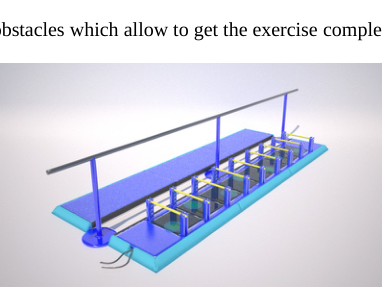
The platform for the motor and visuo-spatial rehabilitation tries to go beyond the concept of the platform with parallel, still used today in physiotherapy gyms, integrating into a single object the tactile zones, useful in a sensory and balance rehabilitation, and visual areas with related obstacles that allow a rehabilitation of the view-action coordination.
The compactness of the object and its modularity enables quick assembly and a rapid redistribution of the modules for the change of the exercise, as well as a wider range of exercises than using today. The platform consists of two parts: the right side is given to the housing of the monitor LED that, suitably connected between them, allow the projection of any type of color image, operated through a PC with corresponding software. These images can compose pathways that stimulate the visuo-spatial coordination of the patient.
At the beginning and end of the path there are two areas without monitor (in blue) where the patient can turn of 180 ° to repeat the exercise.
Fig.1 Platform without obstacles
This part may be accompanied by obstacles which allow to get the exercise complete of lifting the lower limbs.
Fig 2. Platform complete with obstacles
The left part is constituted by three modules each of which has a different floor surface, simulating a walk on the sand, stones, water to stimulate proprioception. The three modules are detachable and can be repo-sitioned to form more combinations of path and there is a soft perimeter (in blue) in the event of leakage from the path.
In the center is placed a bar of aluminum for the support of the patient, which if necessary can support himself with the physical therapist who follows him during all exercises. Below the pieces that assembles the customer:
Fig. 3 Parts to assembly
The anthropometric measures used were the 99th percentile American male of age 65 and UNI-ISO distances for the handrail
Usability and Acceptabilty Test: Preparation A set of experiments was carried out to verify product requirements and functionalities with users with different levels of physical and cognitive capabilities. The aims of tests were to assess the physical ergonomics requirements (fitting to human dimension), acceptability about integrated technologies, comprehensibility and the usability also for medical users. The methodology for data collection included: questionnaires, checklists, direct observation though video recording and photo, open questions with audio recording. The test duration for each patient was about 10 min.
Selected users: 1. 2nd stage Alzheimer’s disease (dementia), able to talk and walk holding on to a bar or someone 2. Patients with advanced dementia, able to respond but not compose sentences, able to walk holding on to a bar or someone 3. Patients with mobility and / or visuo-spatial problems, able to speak and even walk holding on to a bar or someone Each type of user has tried both sides of the object.
Objectives: 1. Verify the acceptability of the subject on the 1st approach 2. Checklist of features by direct observation: list of actions / claims that you can see during the test score on paper and then checking the box yes / no 3. Open-ended questions with audio recording (in case of losing the passages in the conversation): simple questions made by the physical therapist and / or Doctor (who has a closer connection and sympathy with the patient) directly to the user such as “it was difficult to walk on the platform?” to understand his point of view. In case of people with dementia, they are not always able to respond to open-ended questions; 4. A questionnaire given to the physiotherapist and the Doctor to assess the impact on patients, complexity of use, usefulness, etc. 5. Video recording and photo The test were developed in a physiotherapy room.
Fig. 4 One moments of the test
The patient has responded well to the proprioceptive part; perpetuating the exercise the answers would improve. The patients n^ 2-5 were confused when, once rotated by 180 ° on the LEDs part, they had to start again because they saw under their feet the light already on and so they set off on the wrong foot. The numbers 1-3-6 turned around after getting off the platform and went in the correct sequence. Varying from time to time the sensory parties we can make the exercise specific to the patient and make it varied in order to stimulate more research of equilibrium. Patient n^ 5 has an irregular left/right size step, due to the operation on the hip; using the platform with lights, he regularized the pace by putting his feet up on each light. This exercise, if repeated over time, could lead to an improvement in performance observed in the Tinetti’s Scale.
Same thing for the patient n^ 2 that had an irregular pace, but bringing attention to the lights he has regularized it, albeit the short duration of the exercise.
The following cards are a series of open-ended questions made on patients singularly after the test:
2. Which one of the 3 sensorial parts did you find more enjoyable? Why?
Patient n^ 3: the stones hurt a bit Patient n^ 6: ( observation: on the softer part he started laughing looked like he was enjoying )
3. Which one of the two parts (light and sensory) did you find more enjoyable? Were you able to see the lights?
Patient n^ 1: like more the lights Patient n^ 2: that of lights Patient n^ 3: the part with lights All patients had evidently followed the lights; patients that at the first lap didn’t follow them, we told to put their feet on the lights and immediately altered the way and centered the lights with their feet. The following card summarizes the comments made by the Doctor and physiotherapist; in the test were given a card to head.
1. The whole object is applicable?
Yes, certainly applicable; no problems were found. It allows you to stimulate the attention using the view by performing the exercises in the correct way
2. For how many people in the structure would you use it?
Difficult to quantify, but for those people who have problems in general postural and gait; better for psycho- neuro-rehabilitation
3. Have noticed some difficulties in patients using it? If yes, which one?
No particular physical difficulties; Maybe difficulties of first impact caused by the lack of knowledge of the object related to the approach that can be overcome if seen and used several times.
The fact that there is only one bar is much better than two because the patient is more supportable and more driveable and you can prevent him, not having the clutter of two bars, from falling backwards.
Perhaps the difficulty of the patient to become accustomed to the various sensory modules is that he can only do 3-4 steps on each side; if it were longer, perhaps they would be more stable on the road and less confusing
4. Using which parts do you think patients responded well?
Both, but also were attracted by the lights
5. There is something that you would like to change? If yes which one? How?
Not change, but integrate; something on the principle of the bar to allow those who have to get up from the wheelchair to be able to support and stick to rise better; have all modules of the same sensory part to make them interchangeable, because can be different needs and impacts depending on the succession.
Obstacles can be integrated to the path of LED lights, in this way over the laterality you can have also the height: you can recover to a specific pattern of the specific step for the patient.
Have an area without LED lights at the ends of the path to be able to turn 180 degrees, without the patient is confused by the lights under his feet while he turns and without going down every time to turn
For the medical aims of rehabilitation and with Alzheimer’s patient is very important develop a light way to make exercises trought devices and product They don’t express and communicate the medical aspects. The accettability of the terapies is very connected with the emotional response of the patients. Also the physical terapist work are related with the emotional response of the patients, the affective response is a value judgment which seems to function as a survival reaction, essentially "safe or not safe," and we have become very adept at this initial classification. Nature does visceral (emotional) design and we are very well tuned to utilize strong emotional signals; they occur automatically and have unavoidable consequences (Normann, 2004).
Test and Data Collection From observations and comments of the Doctor and physical therapist, it can be concluded that the shape, size and design choices regarding the use of light sources and the resulting sensory interaction are confirmed for the target chosen in a kind of neuropsychological rehabilitation, and the acceptability of the object is also guaranteed by the repetitive use.
As in the tables, were not observed particular problems and the statements of the Doctor and the physiotherapist have been taken into consideration as design improvements, that have been incorporated into the project described in the preceding pages.
CONCLUSIONS
With the use of the rehabilitative platform different types of exercises can be played to improve proprioception, balance, deambulation and neuropsychological faculties of people suffering from Alzheimer’s disease and elderly with mobility and coordination problems. This new platform integrates into itself the classical sensory rehabilitation in a single compact object with handy modules, and a visuo-spatial rehabilitation performed with innovative tools from other business areas that can improve the effectiveness of therapy. In fact, the LED tiles can be, like a walkable PC monitor, play pictures, moving images or timed colored at will. Of course, all this increases the chances of the composition of the path and the range of exercises, as well as the variety and difficulty. As a future project developments it would be useful to include sensors that measure the pressure of the step, the step length and the time between each step and the other; in addition, it would be useful that these data were displayed on a monitor which is attached to the platform, in order to correct the pitch in a more specific and faster way.
REFERENCES
Accolla, A. (2009), “Design for all. Il progetto per l’individuo reale”, Franco Angeli Antonini R., Fastame M. C.(2005), “Recupero in...abilità visuo –spaziali”, Percorsi e attività per la scuola primaria e secondaria di primo grado, Collana diretta da Dario Ianes e Carlo Scataglini Boccardi M. (2000), “La riabilitazione nella demenza grave, estratto: la riabilitazione cognitiva ecomportamentale nella
demenza: un approccio pratico per le r.s.a.”, Edizioni Erickson Norman, D. (2004). Emotional Design: Why we love (or hate) everyday things. New York, Basic Books. Norman, D. (1990), “The design of everyday things”, New York: Doubleday Otmar Bock, “Dual-task costs while walking increase in old age for some, but not for other tasks: an experimental study of healthy young and elderly persons”,in: Journal of NeuroEngineering and Rehabilitation, Institute of Physiology and Anatomy, German Sport University, Köln, Germany Muschiato, S. (2010), “Ergonomia e sensorialità nel design di produttori industriali”, Aracne. Tilley, A.R. (2001), The measure of man and woman, Wiley & Son Tosi, F. (2006) Ergonomia e progetto, Franco Angeli.
LISTED IN THE AHFE DIGITAL BOOKSTORE CATALOGUE
Explore the complete digital volume
Advances in Human Aspects of Healthcare
Read this individual research paper free through the original publisher, or explore the full digital proceedings book.
ISBN 978-1-4951-2093-0
Explore this ISBN in the AHFE Bookstore ↗Listed in the July 2026 bookstore catalogue; search by ISBN to confirm current availability · Digital book purchase optional