Chuliporn Sopajareeya (2021). Assessment of Risk Factors of Low Back Pain Among Hospital Nurses. In: Advances in Human Aspects of Healthcare. AHFE Open Access, vol. 13. https://doi.org/10.54941/ahfe100473
Nursing is an occupation with high prevalence of low back pain (LBP). This pain is multifactorial and assessing its risk factors is essential. The study aim was to determine the prevalence and risk factors of LBP among 225 hospital nurses in Thailand in a cross-sectional study. A self-reported questionnaire divided into six parts including personal factors, working factors, job stress modified from the Nursing Stress Scale, low back pain modified from the Standardized Nordic Questionnaire, health behaviors, and work environment was used for collecting the data. Data were analyzed by descriptive statistics and logistic regression. Study results revealed that the prevalence of LBP in the past seven days was 34.2%. Logistic regression analysis indicated that lifting overweight patients without assistance (OR=1.8; 95%CI=0.95-3.77) and having previous diseases related to LBP (OR=6.3; 95%CI=1.65-24.32) were important risk factors of LBP. Study findings are useful for developing LBP preventive strategies including training on lifting and transferring overweight patients by using a lift team method and lifting devices, developing a manual or guidelines for safe patient handling, and treatment of LBP.
Nursing is an occupation with high prevalence of low back pain (LBP) and many nurses globally experience LBP while they work. Its prevalence during a one month-period in countries ranged from 19.0% to 54.1.0% (Branney & Newell, 2009; Sopajareeya, 2013; Sopajareeya, Kalampakorn, Lapwongwatana, Viwatwongkasem, & Hong, 2013; Violante et al., 2004). Most LBP studies among hospital nurses reported chronic LBP in the past 12 month-period. A few studies regarding acute LBP in nurses were conducted in Thailand. The prevalence of low back pain in the past seven days among nurses in a secondary care hospital (310 beds) was 36.6% (Sopajareeya, Kalampakorn, Lapwongwatana, Viwatwongkasem, & Hong, 2013), whereas it was 43.7% (Sopajareeya, 2013) in a tertiary care hospital (653 beds). This evidence indicates that the prevalence of LBP among nurses working in various types of hospitals was different.
LBP has impacts on both nurses and their organizations, and include illness and work disability (Ghaffari, Alipour, Farshad, Jensen, Josephson, & Vingard, 2008). The impacts of LBP on nurses’ organizations are increased health care costs, compensation for injured nurses, sick leave, turnover, shortages of nurses, and decreased quality of care (Byrns, Reeder, Jin, & Pachis, 2004; Daraiseh et al., 2003).
The origin of LBP is from many factors, including age, female gender, obesity, smoking cigarettes, pregnancy, years of service, lifting or moving patient without assistance, lifting overweight patients without using lifting devices, lifting heavy objects, awkward positions, prolonged standing or sitting, lack of back muscle exercise, job stress, and workplace environment (Feng, Chen, & Mao, 2007; Jellad, Lajili, Boudokhane, Migaou, Maatallah, & Frih, 2013; Karahan, Kav, Abbasoglu, Dogan, 2009; Kerr et al., 2001; Landy, Raman, Sulway, Golightly, & Hamdan, 2008; Smith, Mihashi, Adachi, Koga, & Ishitake, 2006; Sopajareeya, Viwatwongkasem, Lapvongwatana, Hong, & Kalampakorn, 2009; Sopajareeya, 2013; Thomas et al., 2006). There has been a little research regarding the risk factors of acute LBP among Thai nurses. Therefore, assessing its risk factors is very essential to reduce preventable risk factors.
In this study, the steps of epidemiological, and behavioral and environmental assessment in the PRECEDE- PROCEED model (Green & Kreuter, 1999) was applied as a study framework to assess the prevalence and risk factors of LBP among hospital nurses.
OBJECTIVE The aim of this study was to determine the prevalence and risk factors of low back pain among hospital nurses.
ETHICAL CONSIDERATION This study was approved by the Ethics Committee on Human Research of Chiangrai Prachanukroh Hospital (Reference No. 02/2011). Informed written consent was given by the participants. Participation in the study was voluntary.
MATERIAL AND METHODS A cross-sectional study was conducted among nurses at Chiangrai Prachanukroh Hospital in Thailand. This 756 bed tertiary care hospital was purposely selected because it had a target population of 704 nurses. Questionnaires were administered to the sample, 280 nurses working in the nursing department for at least one year, during the August and September 2011. Of these 280, a total of 225 nurses completed the survey, a response rate of 80.3 %.
Data were collected using a self-reported questionnaire in Thai. The questionnaire was divided into six parts: personal factors (17 items), working factors (15 items), job stress (30 items) modified from the Nursing Stress Scale (NSS) (Gray-Toft & Anderson, 1981), health behaviors (16 items), work environment (12 items), and low back pain (14 items) modified from the Standardized Nordic Questionnaire (SNQ) (Kuorinka et al., 1987). LBP reported by nurses was classified by a dichotomous outcome variable indicating both the presence or absence of LBP in the past seven days. A 4-point Likert scale was used to indicate the frequency of job stress from never (1), to occasionally (2), to frequently (3), and to very frequently (4). Health behaviors consist of unsafe manual handling, unsafe object lifting, awkward postures, lack of back muscle exercise, and wearing shoes with high heels. Three categories were used to indicate the frequency of health behaviors including never (1), sometimes (2), and usually (3). The perception of nurses toward the number of work environment arrangement provided by administrators of the hospital in order to prevent low back pain such as the number of lifting devices, lifting staff, and workspace was classified by a dichotomous variable indicating adequate or inadequate/none.
The validity of the questionnaire was examined by five experts with having at least one specialty in research, occupational health nursing, ergonomics, or low back pain. The reliability of the questionnaire on job stress and health behaviors when tested by Cronbach’s alpha were found to be 0.91 and 0.89, respectively. Moreover, the reliability of the questionnaire on work environment when tested by Kuder-Richardson (KR-20) was 0.72.
Descriptive statistics were used to describe characteristics of the study participants and the study variables. Cross- tabulation procedures were conducted among bivariate variables to determine odds ratios (ORs) along with a 95% confidence interval (CIs). Logistic regression analysis using the stepwise method was then applied to identify associations between LBP and possible associated risk factors, including personal factors, working factors, health behaviors, job stress, and work environment. The level of statistical significance was set at 0.05.
RESULTS
Characteristics of Participants The majority of the participants were registered nurses (92.4%) and female (96.0%). Participants’ ages ranged from 22 to 59, with a mean age of 36.2. The BMI of the nurses ranged from 14.9 kg/m 2 to 38.0 kg/m2, with a mean BMI of 21.9 kg/m2. Almost all the participants (99.1%) had never smoked. More than half (56.0%) reported that they had never been pregnant. The majority of the participants (85.8%) had never experienced an accident or back trauma from work and also the majority (93.3%) had never experienced an operation by epidural or spinal block. More than half (59.6%) had worked both day and night shifts. Almost all (96.0%) had no previous diseases related to LBP.
The most popular strategies for relieving the pain symptom among the nurses were taking medicine (37.0%) and using topical medicine and massage (31.7%). Some nurses utilized stopping work immediately (26.9%), lying down immediately (24.3%), and sick leave (2.5%) as methods for relieving the pain (see Table 1).
Table 1: Methods for Relieving the Low Back Pain Symptom Methods % Taking medicine 37.0 Using topical medicine and massage 31.7 Stopping work immediately 26.9 Lying down immediately 24.3 Sick leave 2.5
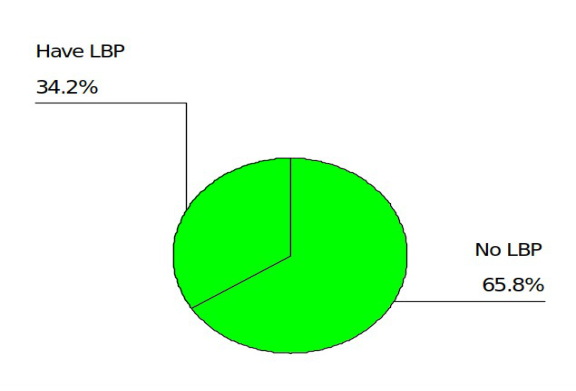
Prevalence of LBP in The Past Seven Days The prevalence of LBP in the past seven days was 34.2 % (see Figure 1). Of the 225 nurses, 77 reported having LBP and 148 reported not having LBP in the past seven days.
Figure 1. The Prevalence of Low Back Pain in the Past Seven Days
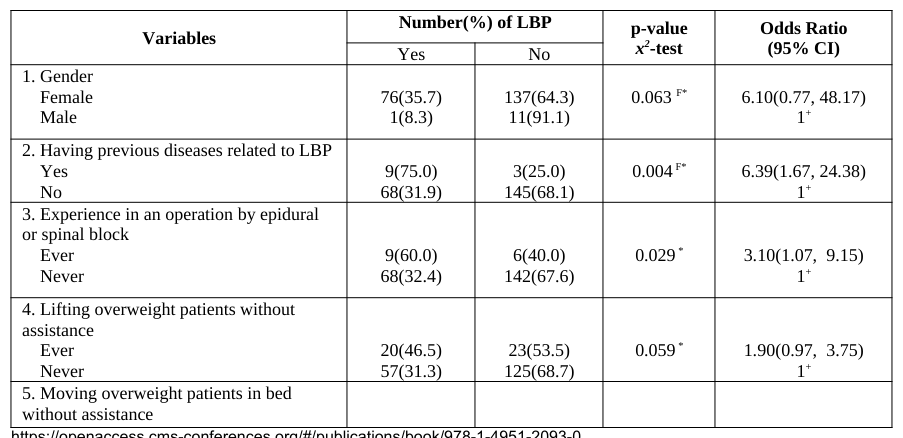
Risk Factors of LBP in The Past Seven Days In order to examine associations between LBP and possible associated risk factors, including personal factors, working factors, health behaviors, job stress, and work environment, bivariate analysis was used. In this study, any predictor variable whose bivariate test has a p- value of less than 0.10 should be considered as a candidate in a multiple logistic regression model. Ten covariates including a) gender (OR= 6.10; 95%CI=0.77-48.17), b) having previous diseases related to LBP (OR= 6.39; 95%CI=1.67-24.38), c) experience in an operation by epidural or spinal block (OR= 3.10; 95%CI=1.07-9.15), d) lifting overweight patients without assistance (OR= 1.90; 95%CI=0.97-3.75), e) moving overweight patients in bed without assistance (OR= 2.32; 95%CI=1.08-5.00), f) lifting heavy objects 1-5 kilograms (OR= 1.82; 95%CI=1.02-3.26), g) lifting heavy objects 6-12 kilograms (OR= 2.17; 95%CI=1.23-3.81), h) prolonged standing more than 6 hours (OR= 1.91; 95%CI=1.06-3.45), i) the number of stretcher trolleys (OR= 0.43; 95%CI=0.20-0.90), and j) the number of wheel chairs (OR= 0.53; 95%CI=0.30-0.95) were chosen in the initial logistic regression model. Table 2 shows the association between the ten associated risk factors and LBP in the past seven days using bivariate analysis.
Table 2: The Association between the Ten Associated Risk Factors and Low Back Pain in the Past Seven Days using Bivariate Analysis
+ Reference category F Fisher’s Exact Test * Significance with p-value <0.10 (to be in a multiple logistic regression model)
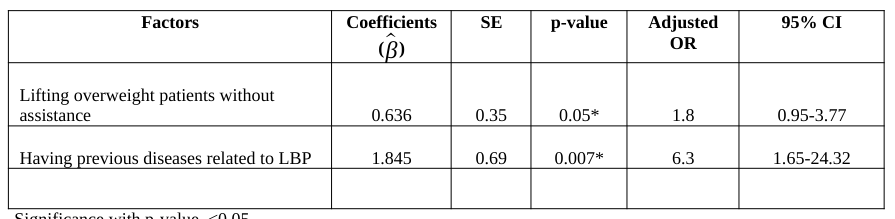
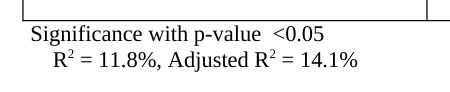
In the performance of the logistic regression analysis, all variables were substituted with a dummy coding method. To find the best model, a backward stepwise method was used to determine the set of variables that best predicted the occurrence of LBP in the past seven days. Two of the ten variables were retained in the last additive model without interactive effects. An interactive effect model was determined and no interaction among independent variables was found. Table 3 presents the final model in the logistic regression analysis. The most appropriate model includes factors of lifting overweight patients without assistance and having previous diseases related to LBP. The overall accuracy of the logistic regression model was 68.4%. It was found that nurses who had lifted overweight patients without assistance were 1.8 times as likely to get LBP in the past seven days than those who had never lifted overweight patients without assistance. The findings also indicated that the nurses who had previous diseases related to LBP were 6.3 times more likely to get acute LBP than those who did not have previous diseases related to LBP.
Table 3: Logistic Regression Analysis –The Final Model
*
Equation reproduced from the original PDF.
DISCUSSION
Prevalence of LBP in The Past Seven Days The finding from the present study demonstrated that the prevalence of LBP in the past seven days was 34.2%. Nursing work is associated with LBP and the origin of LBP is multifactorial including manual frequent and heavy lifting, transferring, moving, turning patients, and pushing or pulling heavy objects. In addition, nursing work with awkward positions are the risk physical activities (Landy, Raman, Sulway, Golightly, & Hamdan, 2008). These factors may affect the occurrence of LBP among hospital nurses.
Compared with the research findings from similar studies previously undertaken in Sawan Pracharax Hospital, a tertiary care hospital in Thailand which revealed a 43.7% (Sopajareeya, 2013), the prevalence of LBP in this study is lower than that of the previous prevalence in Sawan Pracharax Hospital. This study was done in Chiangrai Prachanukroh Hospital, a tertiary care hospital. Although, the two hospitals are the same type, the prevalence of LBP among nurses was different. Compared with the findings from the previous studies in Singburi Hospital, a secondary care hospital, the prevalence of LBP in this study is lower than that of Singburi Hospital (36.6%) (Sopajareeya, Kalampakorn, Lapwongwatana, Viwatwongkasem, & Hong, 2013). The difference may be due to the differences in the nature of nursing work, the ratio between nurses and patients, and the supporting system for LBP prevention in each hospital.
Compared with other countries, the prevalence of LBP in this study is higher than levels measured during the same seven day-period in Italy (19.0%) (Violante et al., 2004). However, compared with the research findings from the previous studies during one month-period, the prevalence of LBP in this study is lower than that of the prevalence of LBP in England (54.1%) (Branney & Newell, 2009). All prevalence data found in other countries tended to be both higher and lower than the finding in this study. This could be due to the different various definitions of LBP and many kinds of questions for collecting the data (Engels et al., 1996).
Risk Factors of LBP in The Past Seven Days
As the results indicated, lifting overweight patients without assistance was an important risk factor of LBP among hospital nurses. This could be due to the fact that when a nurse is burdened with the excess weight of a patient, her spine is forced into non-neutral postures and movements (Morewitz, 2006). The finding of this study validates the finding of the earlier study by Landy, Raman, Sulway, Golightly, and Hamdan (2008) that lifting, transferring, or turning patients was an important factor associated with acute LBP. The study by Sopajareeya (2013) also found that turning overweight patients without assistance was a significant risk factor of LBP among hospital nurses.
The results of this study also indicated that having previous diseases related to LBP was a risk factor of LBP. In the present study, previous diseases related to LBP included chronic cough, skeletal defects, spine defects, scoliosis, and osteoporosis. The study results indicated these previous diseases were risk factors of LBP. This could be explained that these symptoms and defects lead to physical impairment and may also be antecedents to LBP (Landy, Raman, Sulway, Golightly, & Hamdan, 2008). The skeletal defects of an abnormal back make the back more susceptible to LBP, even under normal stress conditions (Edlich, Winters, Hudson, Britt, & Long, 2004). This finding is consistent with the finding from Violante and colleagues (2004) that acute LBP was affected by the presence of scoliosis. Also, the result of this study was supported by the result of Sopajareeya, Kalampakorn, Lapwongwatana, Viwatwongkasem, and Hong (2013) which found that having history of previous diseases related to LBP was a risk factor of LBP in the past seven days.
STUDY LIMITATION This study is a cross-sectional design, therefore causal associations between risk factors and LBP cannot be examined. The study results are limited to participants of one tertiary care hospital in Chiangrai province, hence, wide ranging generalization cannot be done.
CONCLUSION
Although the prevalence of LBP in this study was not high, it was the important occupational health problem among nurses. This study confirmed that nursing work factor is one of the significant risk factors of LBP among hospital nurses.
IMPLICATIONS/ RECOMMENDATION The findings of the study are useful for developing primary and secondary prevention strategies. Primary prevention strategies should include regular education sessions for nurses on safe patient lifting techniques, training on lifting and transferring overweight patients by using a lift team method and lifting devices, and developing a manual or guidelines for safe patient handling. A secondary prevention strategy should include treatment of LBP. Further research is certainly needed to evaluate the effects of the LBP preventive strategies.
ACKNOWLEDGEMENTS
The author would like to thank all the nurses, the director of the hospital, and the head of nurses at Chiangrai Prachanukroh Hospital, Chiangrai province for their cooperation during the data collection. Also, the author is very grateful to Praboromarajchanok Institute for Health Workforce Development, Thai Ministry of Public Health for financial support on this conference presentation.
REFERENCES
Branney, J., & Newell, D. (2009). Back pain and associated healthcare seeking behaviour in nurses: a survey. Clinical Chiropractic, 12(4), 130-143. Byrns, G., Reeder, G., Jin, G., & Pachis, K. (2004). Risk factors for work-related low back pain in registered nurses and
potential obstacles in using mechanical lifting devices. Journal of Occupational and Environmental Hygiene, 1, 11-21. Daraiseh, N., Genaidy, A.M., Karwowski, W., Davis, L.S., Stambough, J., & Huston, R.L. (2003). Musculoskeletal outcomes in multiple body regions and work effects among nurses: the effects of stressful and stimulating working conditions. Ergonomics, 46(12), 1178-1199. Edlich, R., Winters, K.L., Hudson, M.A., Britt, L.D., & Long, W.B. (2004). Prevention of disabling back
injuries in nurses by the use of mechanical patient lift systems. Journal of Long-Term Effects of Medical Implants, 14(6), 521-533. Engels, J.A., van der Gulden, Senden, T.F., & van’t Hof, B. (1996). Work related risk factors for musculoskeletal complaints in the nursing profession: results of a questionnaire survey. Occupational and Environmental Medicine, 53, 636-641. Feng, Chao-Kang, Chen Mei-Lien, and Mao I-Fang. (2007). Prevalence of and risk factors for different measures of
low back pain among female nursing aides in Taiwanese nursing homes. BMC Musculoskeletal Disorders, 8, 52-60. Ghaffari, M., Alipour, a., Farshad, A.A., Jensen, I., Josephson, M., & Vingard, E. (2008). Effect of psychosocial factors on low back pain in industrial workers. Occupational Medicine, 58, 341-347. Gray-Toft, P., & Anderson, J.G. (1981). The Nursing Stress Scale: Development of an instrument. Journal of
Behavioral Assessment, 3, 11-23. Green, L.W. & Kreuter, M.W. (1999). Health promotion planning: An educational and ecological approach (3rd ed.). California: Mayfield. Jellad, A., Lajili, H., Boudokhane, S., Migaou, H., Maatallah, S., & Frih, Z. (2013). Musculoskeletal disorders among
Tunisian hospital staff: prevalence and risk factors. The Egyptian Rheumatologist, 35, 59-63. Karahan, A., Kav, S., Abbasoglu, A., Dogan, N. (2009). Low back pain: prevalence and associated risk factors among hospital staff. Journal of Advanced Nursing, 65, 516-524. Kerr, M.S., Frank, J.W., Shannon, H.S., Norman, R.W., Well, R.P., Neumann, W.P., Bombardier, C., & the
Ontario Universities Back Pain Study Group. (2001). Biomechanical and psychosocial risk factors for low back pain at work. American Journal of Public Health, 91(7)1069-1075. Kuorinka, I., Jonsson, B., Kilbom, A., Vinterberg, H., Biering-Sorensen, F., Andersson, G. & Jorgensen, K. (1987). Standardized Nordic Questionnaires for the analysis of musculoskeletal symptoms. Applied Ergonomics, 18, 233-237. Landy, M.D., Raman, S.R., Sulway, C., Golightly, Y., & Hamdan, E. (2008). Prevalence and risk factors associated with low
back pain among health care providers in a Kuwait. Health Services Research, 33(5), 539-545.
Morewitz, S.J. (2006). Chronic diseases and health care: new trends in diabetes, arthritis, osteoporosis, fibromyalgia, low back pain, cardiovascular disease and cancer. The United States of America: Springer. Smith, D.R., Mihashi, M., Adachi, Y., Koga, H., & Ishitake, T. (2006). A detailed analysis of musculoskeletal disorder risk
factors among Japanese nurses. Journal of Safety Research, 37(2), 195-200. Sopajareeya, C., Viwatwongkasem, C., Lapwongwatana, P., Hong, O., & Kalampakorn, S. (2009). Prevalence and risk factors of low back pain among nurses in a Thai public hospital. Journal of The Medical Association of Thailand, 92 (Suppl 7), s93-99. Sopajareeya, C., Kalampakorn, S., Lapwongwatana, P., Viwatwongkasem, C., & Hong, O. (2013). Prevalence and risk factors of
acute low back pain among nurses in Singburi Hospital. Journal of Public Health Nursing (Thai), 27 (2), 1-14. Sopajareeya, C. (2013). Low back pain among hospital nurses in Thailand. pp. 38-43. In: Proceedings of the XXVth Annual International Occupational Ergonomics and Safety Conference. June 6-7, 2013. Atlanta, Georgia, USA. Thomas N.I., Brown, N.D., Hodges, L.C., Gandy, J., Lawson, L., Lord, E.L., & Williams, K. (2006). Factors associated with
work-related injuries among hospital employees. American Association of Occupational Health Nurse Journal, 54(1), 24-31. Violante, F.S., Fiori, M., Fiorentini, C., Risi, A., Garagnani, G., Bonfiglioli, R., & Mattioli, S. (2004). Associations of psychosocial and individual factors with three different categories of back disorder among nursing staff. Journal of Occupational Health, 46, 100-108.
LISTED IN THE AHFE DIGITAL BOOKSTORE CATALOGUE
Explore the complete digital volume
Advances in Human Aspects of Healthcare
Read this individual research paper free through the original publisher, or explore the full digital proceedings book.
ISBN 978-1-4951-2093-0
Explore this ISBN in the AHFE Bookstore ↗Listed in the July 2026 bookstore catalogue; search by ISBN to confirm current availability · Digital book purchase optional