Susana Vi Costa, Rodolfo AG Vilela, Marco Antonio Pereira Querol (2021). Formative Intervention to Change the School Health Center Activity. In: Advances in Human Aspects of Healthcare. AHFE Open Access, vol. 13. https://doi.org/10.54941/ahfe100490
The aim of this paper is to propose an interventionist approach for transforming a School Health Center (CSE) in São Paulo, Brazil. The Center is in a situation of crisis, providing precarious health services due to limited human and material resources. In the article we argue that the solution for the crisis depends on how it is interpreted. We present an ethnographic narrative constructed collectively by researcher and practitioners through data from interviews and a mini-intervention. The aim of this narrative was to provide a better understanding about the development of the activity of health care and education/research conducted at the CSE. As it will be argued this hypothesis is the first step towards a broader on-going intervention using a method called Change Laboratory, which is based on an Activity Theoretical approach. The narrative shows that the School Health Center’s object (primary and secondary health care) and the object of the Faculty of Public Health (research and education) have changed towards different developmental directions. The integration between these two objects is narrower than when the Center was first created, and this can be a key source of conflicts between CSE by the Faculty. The results suggest that a more effective solution to the crisis would involve the reconstruction of the object motivation (product service) produced in the activity.
The Brazilian sanitary reform was born in the struggle against the dictatorship with the theme Health and Democracy, and was structured in universities, the trade unions movement, in regional experiences of organizing services. This social movement was consolidated in the 8th National Health Conference in 1986, which resulted in the creation of the National Health System - SUS, consolidated in the Federal Constitution of 1988. After 25 years of its creation, we find that there is still the need for changes at the management level, as well as on the health system funding and in its quality of service. In June 2013, Brazilian citizens took the streets to claim the social rights guaranteed by the Constitution and to express their outrage at the poor conditions of health, transport and education services. Based on data from the Integrated Financial Management System, the Federal Council of Medicine revealed in detail the results of the lack of quality of financial management in health. This study is empirically based on a case of a School Health Center located in the city of São Paulo, Brazil, administered by the Faculty of Public Health (FSP) of the University of São Paulo. The CSE in the last century operated as model unit in São Paulo and Brazil; it was responsible for deploying pioneering services and programs that guided the actions of the Ministry of Health, State and Municipal Health Departments. Until the early 1980s, the CSE had great importance as a place of research and teaching-care, considering that free health care was a privilege of people with formal employment, while most of the population was forced to pay for private care or settle for charitable services of charitable institutions and university welfare services. By integration between teaching and care we mean the collective work, agreed and integrated, of students and teachers from the training courses with workers belonging to the healthcare teams, including managers, aiming at the quality of care to individual and collective health, the quality of training and the development/satisfaction of employees (Albuquerque, 2008). Since the link between professional training, work and social practices should be the goal of higher education, the National Curriculum Guidelines and SUS guidelines are the landmark for the proposal of trainees’ professional profile, opportunities and mechanisms of exposure to learning. They also stand as a referencefor the political-pedagogical project, the organization and orientation of the curriculum and teaching practices, the production of knowledge and the relationships established by the school with the local health system (Ceccim and Feuerwerker, 2004).The interdisciplinary and multidisciplinary training of health professionals aims at promoting an integral vision of the individual, breaking the compartmentalized model and medical model existing before the reform of the health sector. The CSE under study now lives a moment of crisis and, in spite of difficulties, continues to provide assistance to the community. However, this is done precariously due to lack of human and material resources. Projects, teaching and research programs with the presence of teachers and students are rare. The care, although considered of good quality by the population served, has had complaints and conflicts due to the difficulty of scheduling; it is difficult to add new users, and these, when inserted, face delays for the care. How can this situation be understood in order to produce more effective solutions for these conflicts and disturbances? Which type of analysis could help researchers/interventionists to understand and change this situation? Within this context, FSP researchers contacted the faculty board in search of a situation considered by managers as a problematic activity that could have a demand for organizational change for intervention research. The Faculty direction at once indicated the CSE as an important site for study and intervention, due to the great dissatisfaction and isolation that was felt by the professionals of that service. This study presents the preliminary results of a particular stage of the intervention in progress at the CSE. It brings data from a historical analysis of the activities of health care, research and teaching conducted at the CSE services. As a theoretical basis for understanding the analysis intended here, the Activity Theory (AT) was elected - theory of Russian origin, that was first developed by authors from the fields of Education and Psychology, such as Vygotsky, Leontiev and Davydov for the theoretical debate. Since the 1970s, this theory has been rediscovered in the West, and came to be used in research on work environments.
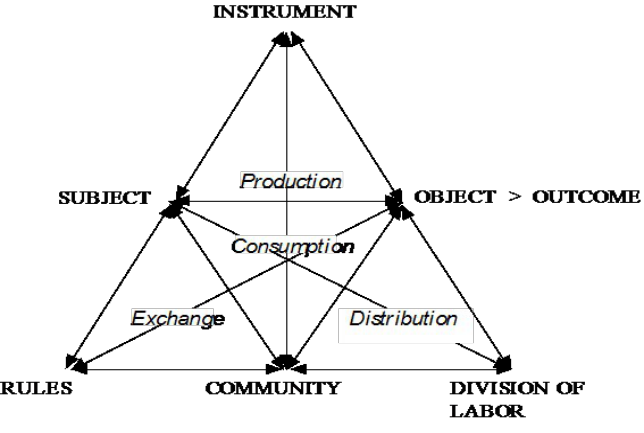
ACTIVITY THEORY AND THE CHANGE LABORATORY According to Engeström (1999), on Activity Theory it is understood that humans are involved in various activities which are distinguished from each other by the objects to which they are oriented. Unlike the objective or goals that are anchored to a particular place and time, the object of an activity is more sustained and open, and is related to a human need. An object is at the same time a raw material or initial situation that has to be transformed into a result. Engeström (1999) expanded the previous understanding of Activity Theory by the creation of a triangular graphic representation demonstrating the basic relationships in the mediation of human activity systems; thus, he proposed the Activity System as the basic unit of analysis: it incorporates the unit for the understanding of human actions. Besides the understanding that the subject makes use of cultural artifacts in the transformation of the object, mediators that were not previously foreseen, such as social elements, rules, division of labor and community are also included (Figure 1).
Figure 1. Activity System (Adapted from Engestrom, 1987).
When one has an activity system as an element of analysis, any change that can be imagined to a situation or a work context must be understood as unique, specific and exclusive to each activity; any intentions of standardization or generalization must be discarded for learning contexts such as the CSE and FSP. Therefore, such a change can be facilitated if practitioners understand their activity as a system of historical development of values production, in addition to being co-responsible in the creation of new forms of activity. This kind of expansive learning is centered on collaboration and in theoretically grounded empirical research, enabling experimentation in order to transform the activity. This innovative and developmental learning requires cooperation between strategic managers and among those involved in the implementation of the activity (Engeström, 2004).
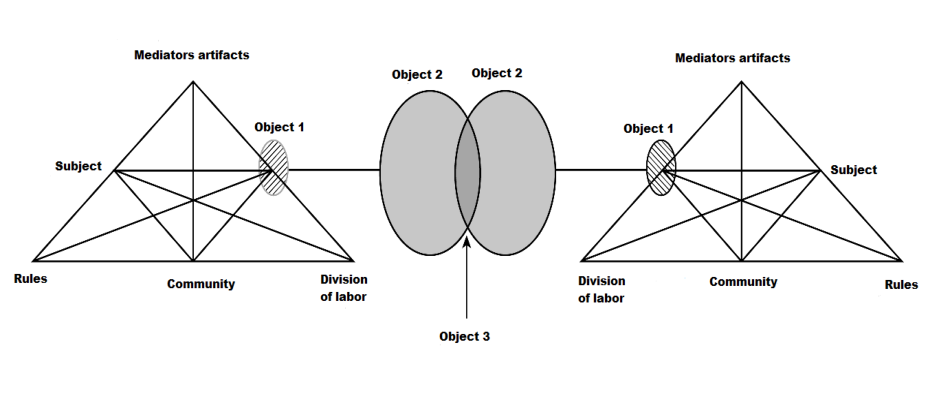
Figure 2. Two activity systems with partially shared object (adapted from Engeström, 2001).
Engeström (2001) goes a step further by presenting what he calls the third generation of Activity Theory, in which Human Aspects of Healthcare (2021) he presents a new model that represents the collaboration / cooperation between two activity systems. This model aims at explaining the motivation behind the activities with a partially shared object. In this model, shown in Figure 2, the object moves from a non-reflected initial state of a 'raw material' and given by the situation (object 1, for example, a specific patient entering a in a medical area) for a collectively significant object constructed by the system of activity (object 2, for example, the patient constructed as a biomedical disease category and therefore, as a general object of health / disease) and a potentially common or jointly constructed object (object 3, for example, a collaboratively constructed understanding of the life situation of the patient and the care plan).
The object of the activity is a moving target, non-reducible to conscious short-term goals. To constitute the theoretical-methodological assumption of the final intended research it was elected the method of Change Laboratory (CL), as an interventionist methodology to reach the teaching and care activities of the institutions under review. According to Engeström (1999), the Change Laboratory ® is an example of application of the training methodology, composed of a set of concepts and methodological principles that can be used in collaboration between researchers and professionals to profound changes or superficial incremental changes in work (Engeström et al., 1996).
The method uses a series of concepts based on a theoretical and methodological approach based on the Activity Theory based on Russian researchers, especially Vygotsky; among them, i) the Theory of Cultural Mediation of human actions; ii) the Method of Double Stimulation; iii) the Model of Activity System and iv) the Theory of Expansive Learning (Engeström, 1987, 1999, 2011). In this approach, disturbances in the production process (ruptures, conflicts, employees’ diseases, accidents) that affect productivity and quality of production are seen as manifestations of contradictions that need to be analyzed by the participants in the search for their understanding and creation of collective responses.
The fundamental principles of the methodology are: analysis of a system of collective activity, the multi vocality, the historicity, the building of a collective explanation for the contradictions that explain the disturbances and expansive transformations in activity systems. The main stages of CL are: questioning, analysis, solution design, testing of the new model, the new model’s implementation; reflection on the process and consolidation of the new actions.
The subjects involved in the activity are the main actors in the construction of change. The researcher and participants engage in seeking changes for a collective problem.
The production of knowledge is directly related to its social utility. The CL enables the modeling of an activity system, in this case the CSE. In the expansive learning, its contents are created gradually. Participants and interventionists create and develop together the solution to the problem. Participants are assisted to formulate hypotheses about the contradictions and potential solutions to resolve them.
The research here explained is part of the preparation of an intervention process using CL. The results presented here may be regarded as preliminary results of the mapping process and analysis. The steps and data collected so far allow us to point out some anomalies, contradictions and problems of care activity in its relation to the activity of teaching, research and extension, the object of the FSP system.
SPREADING AND CONSOLIDATING:
- Teaching others what we learned - Codifying the new practices
CHARTING THE SITUATION: - Recognizing the need for change - Committing to development
ANALYZING THE SITUATION: - How did we work in the past (history)? - What are our present troubles and contradictions?
CONCRETISING AND TESTING THE NEW MODEL: - What changes do we want to try next month?
CREATING A NEW MODEL: - How do we want to work five years from now?
Figure 3. Stages of expansive development during the Change Laboratory. (Adapted from Engeström, 2009, p 25.)
Figure available in the original PDF paper.
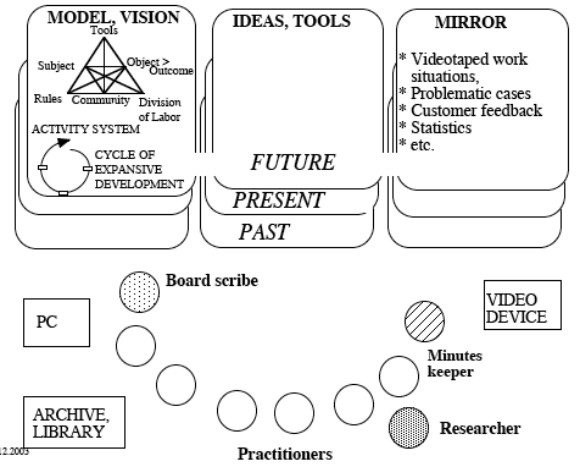
The proposed intervention in CL is performed through the constitution, at the workplace, of a space in which representation tools for analyzing disturbances and for building new models of activity are available (Engström et al, 1996). Such interventions are composed by a limited number of participants, between 15 and 20. Interventions begin with the collection of data about: 1) the status of the activity, such as historical data about important events, 2) current practices (how the activity is conducted), 3) the major problems faced, and 4) the main concepts and tools used in the activity. The function of these data is twofold, that is, they serve as data to be used during the sessions and as a mirror of the activity, helping the interventionists to understand the activity and guide the learning process. The sessions begin with an analysis of data on the problems faced in everyday life, identifying the systemic causes of the observed problems, which are, as previously emphasized, expressions of inherent contradictions or contradictions between activity systems. After the participants analyzed the problem, the interventionist helps them to shape new solutions. Again, the interventionist provides tools to assist in this process. As the new models are implemented and tested, the sessions are organized in order to evaluate and reflect on new solutions and potential problems that arise during the implementation of the solutions. Adjustments and changes in the model are common so that it is adapted to local conditions. The central tool of CL is a set of 3x3 screens or frames for representing the work activity. The participants of the CL face these screens, aided by a rapporteur chosen among them, as well as video equipment and other tools available, such as a meaningful database and reference library (Figure 3). The horizontal dimension of the screens represents different levels of abstraction and theoretical generalization. In the first one (located on the right), the mirror screen is used to represent and examine experiences of working practices, particularly problem situations and disturbances, but also innovative solutions. On the other hand, the model / view screen (located on the left) is reserved for theoretical tools and conceptual analysis of the interconnections and systemic quality of the work activity. In this screen the subject, tools, objects (products, results), the division of labor and the community rules are depicted. Systemic roots of specific problems and disorders are explored and conceptualized as internal contradictions of the activity system. (Engeström, 1987; Sannino, 2008). According to Engeström (1987), the third screen (located in the middle) is reserved for ideas and tools. In the analysis of problem situations and design of new models for work activity, intermediate cognitive tools are often needed, for examples ketches and processes’ flow diagrams, figures of layout and diagrams of organizational structures, categorizations of responses from interviews, formulas for costs’ calculations, or techniques for generating ideas and solving problems, which includes simulations, models, and played roles. Whilst the participants move between the mirror experiments and the model / theoretical view, they also produce intermediate ideas and partial solutions to be tested and tried. This process is also shown in the middle screen. The vertical dimension of the surfaces represents the movement in time, between the past, present and future. The work in CL begins with the mirror of the current problems, which moves to trace the roots of these present problems in past experiences and modeling the past activity system. The work continues towards modeling the current activity and its inner contradictions, which allow participants to focus their efforts in the transformation of the essence of the origins of the problems (Engeström, 1987).
Source: http://www.helsinki.fi/cradle/Change% 20laboratory.html (accessed on Dec.2011)
Figure 4. Layout of the Change Laboratory
The next step is to face the future activity model, including its implementation, through the identification of the next steps in terms of tools and partial solution. The planning and monitoring of the implementation of up coming steps from the new vision follows. The CL does not seek to impose ready-made solutions to problems faced by organizations, but to provide meta-tools in which practitioners, along with researchers, are able to analyze the problems faced in the development of activities and pursue their own paths and more appropriate solutions. From the practical point of view, the methodology can be used to help practitioners to assess the content of their work and expand the object of their activity (what and how is produced) in order to understand the problems faced in relation to historical changes in activity. In this article we focus specifically on the first stage of the CL, the mapping of the situation. The following are the preliminary results of a historical ethnography, whose objective was to provide greater knowledge about the development of the activity. This step is important to help the interventionist to formulate an initial hypothesis of contradictions and thus guide the practitioners’ learning during the intervention. Ethnographic data used in the analysis were obtained through observations, semi-structured and open interviews, used along with analysis of documents. Teachers, students, trainees, graduate students, service users, health professionals, employees, the CSE manager, the FSP manager, Department Directors and coordinators of undergraduate courses were interviewed. These interviews were useful to develop the hypothesis advocated in this study; it was presented during a mini-intervention, which gathered together seven health professionals from the service, the coordinator of the course of Nutrition and representatives of the users. The intervention covered the stage of mapping and partially the phase of questioning, since one of the results of the intervention was the recognition that there is a need of involving students of the Faculty to achieve a more effective solution.
ETNOGRAPHIC RESULTS Multi-Vocality
The opinions about the problems faced by the CSE differ between actors. Some are convinced that if it is to survive as a Primary Care Unit or a Specialty Unit, a great effort from the FSP and service management to obtain resources, hiring more employees is necessary, as well as a greater effort from teachers and departments to use the CSE as a Human Aspects of Healthcare (2021) training field for students, enhancing the currently existing activity. Others insist that it is not worth it for the University to continue funding and collaborating with the provision of health services: this is responsibility of the SUS, its users could be transferred, without loss, to another health equipment, since the removal of the objects is already done, and it is a waste that the university offers space and human resources for such a small return as a field of teaching and research. They argue that currently the CSE has become a "burden" for the FSP because it uses human resources that are accounted for as if they were in the service of the college, making it difficult to release new and necessary professionals for the institution. Teachers emphasize that, over time, the didactics of teaching has changed, and so the presence of teachers and students in CSE for in-service training has ceased to exist, partly because there was a split, a natural distinction between the doctor-teacher who consulted people and at the same time taught the student, and the professional-doctor who was serving at the Health Center. In order to effectively become a teaching reference, a service needs the presence of teachers, supervisors and tutors of students, in addition to having human and material resources and relying on a minimally adequate physical structure to exist and sustain itself as a field of learning . In 1996, there was a change in the statute of the university: the extension activity of teaching-healthcare offer changed its configuration. It was named community service, losing teaching space as a field of teaching and learning. On the other hand, the teachers began to be demanded to and valued for conducting research and for achieving goals of published scientific articles. The hyper valuation of published articles at the expenses of education and extension activities seems to explain the low adherence to other aspects of the academic life, leaving the social integration of the university in the background. With the implementation of SUS, other health care facilities opened up to the population, and these have also become a new field of learning for undergraduate and graduate students of the university. Some public health courses have privileged SUS units for field visits and fulfillment of curricular and extracurricular school stages. They consider that the increase in numbers and the change in the demographic profile of users (for instance population aging) in the region covered by the CSE signals that more primary healthcare clinics, such as family health program units, would be required; however, these are not offered by the national health system, a fact that favors the overload of patients and precarious work at the CSE. Users constantly complain about the difficulty of access to the service and the delay for getting an appointment to be seen by the general practitioner, which is the gateway to other specialties such as the Hospital das Clínicas, located nearby. However, when seen by the doctor, they value the quality of service received. The graduate and undergraduate students that are attending Nutrition training courses at the CSE conceive it as a primary care unit, but disagree about the importance of family health program network in the region: this prevents the practice of home visits and other preventive and health promotion actions, so important in the territory. This lack of a care network turns out to reduce the activity to the actions of assistance, and there are few spaces and means for education and health promotion. These students also complain about the lack of food for the preparation of workshops and educational activities about healthy eating behaviors. They understand that the CSE should do what it is expected from a School Health Center: health promotion, prevention, education and assistance.
Similar complaints are made by professors and undergraduate students in Public Health. The course started in 2012, and is oriented towards the training of professionals focused on the care and prevention of diseases of populations; therefore, it is closely related to the disciplines that study health as a collective phenomenon, consisting of historical, demographic, epidemiological, social, political and environmental aspects. Its performance is geared towards preventive actions and health promotion practices that have limited space on the CSE agenda. Despite a convergence with the concept of operation of the CSE, the service managers, on the other hand, complain about the lack of teachers and undergraduate students using it as a learning field on issues like health management, expertise and experience in public health, etc.
The Emergence and Development of the CSE-FSP The Geraldo de Paula Souza Health Center (CSEGPS) was the first health center in Latin America to be officially established by Decree n º. 3874 of 19/07/1925 on the premises of the former Institute of Hygiene, current School of Public Health USP. It became a reference center for leprosy and from there grew and became a School Health Center. The CSE was born from the idea of creating a model service, and has been since the beginning a place for in-service teaching and research for graduate Specialization, Master and PhD courses. Until the 1980s, the CSE was an experimental laboratory inside the FSP. In 1983 it left its premises and occupied the former house of the painter Tarsila do Amaral, where it still is. It was the place for training practices of the courses offered at FSP - such as the course of Nursing Primary Care Practice, for USP's undergraduate nursing students or Public Health Nursing Specialization Course; the latest was regarded as a specialization, because it lasted one year, 40 hours per week, with the first half devoted to theory and the second half dedicated exclusively to practice at the CSE. Due to curriculum changes in the nursing program, which now includes Public Health, these courses no longer exist today: specialization in Nursing and Public Health is performed at the Faculty of Nursing. In 1988 USP's statute was reformed; the university was encouraged to focus in and foster research activities. Thereafter its teachers started to be required by their faculties to put emphasis on scientific papers and publications. In the early 1990s an agreement was signed between USP, the state of São Paulo and the city of São Paulo for the completion of the "Large Scale Project", which aimed to train nurses who would by their turn train Nursing helpers to become Nursing assistants. The CSE was a training and learning field for those students and at the same time still provided care for the population of the western part of the city, along with the lines of the old regiment of FSP that holds up until today: a therapeutic service related to medical specialties, without any connection with health promotion and prevention activities and with little connection with the processes of learning of the undergraduate degree in Nutrition, the only undergraduate course of USP by then. Due the initiative of local management and service professionals, CSE currently receives undergraduate interns from various universities and health services in São Paulo, such as the Faculty of Pharmacy, São Camilo University, Emilio Ribas Hospital, CEFACS-INCOR, USP, Psychology from PUC and UNIP, and graduate students of Nutrition and Psychology with a FUNDAP scholarship, residents from Geriatrics from the Faculty of Medicine (USP), pediatrician residents from the Cândido Fontoura Hospital and Obstetrics / Gynecology, Urology and other residents, but they are not incorporated and developed as a field of research and teaching. Sanitary Dermatology (Sexually Transmitted Diseases-STDs and Hanseniasis) was the only specialty that has established, since its inception, as a reference to the whole country. Besides it - a medical specialty linked to the Faculty of Medicine of USP, only undergraduate students taking a degree in Nutrition at FSP develop regular activities in its premises. In 2009 the CRnutri - Reference Center for Nutrition was created, with the objective of becoming a reference in nutrition and leveraging the development and integration of the CSE with FSP, but it did not succeed. Since 1986, the Specialization Course in Psychopathology and Public Health Courses of FSP and graduate studies in Nutrition of FUNDAP use the CSE as a training field for practice. As it was already mentioned, the main activity of CSE is to provide assistance; it offers a training field to students of nutrition and requires that students attend to the population.
Hypothesis: Differentiation of the Shared Object Over the years, several directors were at the helm of the CSE, all of them university professors who conciliate their teaching assignments with the management activity of CSE. Today it lives a moment of crisis, because it lacks human, material and financial resources, leading to a precarious care offer.
The CSE covers an area with a population of 118 000 inhabitants, 10 000 of which are using the service. Most users are aged between 20-50 years. In site of belonging to USP, but an agreement was signed with the Municipal Health Secretary of São Paulo for care coverage to the population. Through this agreement, funding is transferred from SUS regarding secondary care services (specialties level), which corresponds to 33% of cases; the other 67% of the cases correspond to primary care services, but these are not funded. The Municipal Health Secretariat, through this agreement, transfers to the CSE R$ 18,900.00 and R$ 5,300.00 to FSP. Besides the financial aspect, the problems listed by the actors are: illnesses of its employees related to emotional causes; the change of the socioeconomic profile of the covered area population and the increasing number of users, the aging of this population, the increasing numbers of psychiatric cases; the appearance and growing numbers of homeless and users of psychoactive drugs. The fact that the scheduling of return appointments are still performed manually by the doctors themselves also aggravates the existing conflicts and hinders the optimization of the work done by the reception area. It is in here, at the reception, where most conflicts with the population happen.
There are irregular work contracts of employees, which were signed to replace part of retired professionals. The lack of other healthcare services in the region is another explanation given as a cause of work overload at the CSE, in addition to the fact that 3,500 extra patients do not want to leave the CSE and continue to use its services through legal actions in spite of residing in other regions of the city. The professionals and the managers of the CSE also complain about the lack of integration with other departments of the Faculty. The waiting time for an appointment with the general practitioner is appointed by professionals as the main factor of public discontentment and of conflict with the employees. This has led users, conscious of their rights, to make complaints to USP's ombudsman and to the Municipal Health Department, and also to seek support through the intervention of the Public Ministry to guarantee their appointments; this wears the image of the service and the employees.
To speed up appointments and reduce the waiting list, triage task forces were made in order to solve easier or more urgent cases: these are now seen by a multidisciplinary team to reduce waiting time for appointments. Two pharmacists were hired and 11 computers were purchased to introduce electronic health records of patients. A Staff Committee was founded; after studying the work processes, it presented a proposal for Quality and Excellence in Services, creating protocols and standardization of services and developing teaching actions, such as a Symposium on Science, Spirituality and Health. In 2011, an Association of Members of the CSE was created with the goal of giving voice to its users and, through meetings with their representatives, to inform how the unit worked and what its role is. In addition, the staff sought a dialogue with the Faculty, calling students to get to know it and encouraging departments and teachers to participate and use it as a field of study and research. Despite these efforts, the CSE remains isolated and without a defined role regarding the FSP, facing difficulties with users and society; it sees its employees getting sick and retiring, and the service deteriorating for lack of investments in material and human resources. During the first mini intervention that took place with the participation of CSE professionals and Nutrition Degree teachers, it was requested that participants identified the main problems and the initiatives that were being developed at the service to face them. During the discussions it could be seen that one of the reasons why teachers are no longer present in the CSE day-to-day care practices, as they did before, is related to their evaluation and strong pressure for researching and publishing articles, in addition to their work as teachers. Analyzing the situation allows us to formulate hypotheses that the current problems are manifestations of contradictions in the two systems of activity that have been moving away historically. On the one hand, the research activity of the Public Health Faculty, which seeks to align to the guidelines of USP as a worldwide center of excellence, has left little room for teaching and student assistance activities during practical activities.
In this regard, professors are charged and assessed by the number of publications and not for the quality and assistance to students, whether undergraduate or graduate. This contradiction between the object of FSP (student education) and the rules imposed by the national university system seem to be a plausible explanation to poor adherence, for instance, to the project CRnutri of the teachers of the faculty of Nutrition, a task that would require leadership, coordinated action and collective leadership, without an immediate return in terms of scoring to the eyes of the university system evaluators. On the service side, its lack of definition (primary or secondary care) and the consequent tension within SUS system, of which insufficient funding seems to be a consequence, increase the distance and makes integration more difficult. The actors (health and support professionals, unit and Faculty managers, teachers, etc.) do not seem to be clear about what are the origins of systemic problems, which sometimes generates complaints of lack of teachers or departments' interest. Local efforts become palliative to fix the situation without an organizational and sustainable solution. As the previous object of the CSE - that is, the practice of care teaching and research - was decreasing, there was an increase of the function of health care. Given the pressures for adequate care to the population, the group chooses to keep professionals with employment contracts, without considering that this faculty has also failing to give its human resources to serve the CSE. The staff feels rejected by the university and by the teachers, and fears the municipalization of service, because it would result in compulsory transferring to other units of the university. Besides the concrete loss, a change in the workplace, there is a subjective loss of identity as service provider to population's health. We note that there is a contradiction between the movement to seek and to increase the transfer of financial resources of Municipal Health Secretariat to provide the best in health care and between going towards CRnutri, for example, and strengthen its activities in research and teaching through hiring more nutritionists, increasing the presence of teachers and students, interns and graduate students acting in teaching and service practice, providing advice and expertise to the community, as recommended by the extension activity. The CSE management and part of its employees seek to focus and enhance the school function, whist the community of users demands the health care function. The efforts of management and staff who seek to find solutions, however, are still done in an isolated fashion, since the means to it are partial, and the changes seem to require major initiatives, which are expected to surpass this group's power of action.
Developmental Possibilities The discussion between researchers and practitioners during the mini-intervention enabled us to identify the development trend of the activity that shows the previous situation, the current and possible future activity. Two dimensions of the object's development were identified. One dimension reflects a highly individualized and specialized service moving towards more holistic and collaborative services, shared between different actors (e.g. nutritionist, cardiologist). The other dimension reflects the temporal dimension that indicates a movement from care actions towards preventive actions. These two dimensions were combined generating a two-dimensional model that represents the development of services at the CSE (Figure 5). The initiatives and resolutions discussed at the mini- intervention were classified using the different solutions that were being tested at the CSE. The discussions show that there is a general development towards the quadrant 3 of Figure 4. The quadrant 1, bottom left, represents the current activity which is centered on care actions at the level of individual performance (specialized and isolated) that may develop into future activity marked by communication/cooperation and prevention, as is shown in the right upper quadrant. This model helped researchers and practitioners to reflect upon which solutions could solve the problems faced by the CSE in the long-term, and which solutions were superficial and momentary.
Collaborative actions
3
4
Cooperation with medicine and
Creation of common objects in between FSP and
other USP units
CSE (e.g CRnutri)
screening
Involvement of FSP
(Group Reception)
Association (Members of CSE )
Volunteerism Prevention Assistance
1
Care by a specialist
Specialized / individualized care
Figure 5: Possibilities of development of teaching and research activities at the CSE
Figure available in the original PDF paper.
CONCLUSIONS
The ethnographic analysis conducted in this study helped the researchers and some practitioners to expand the way they understood CSE's problems and possible solutions for the case. The analysis shows multivocality - that is, the different interpretations of CSE activity's object and how it should be produced. This diversity of perspectives can be understood as a manifestation of the division of labor and different stories and experiences of the actors. It also presents a historical narrative of the activity of teaching / research and care offered at the CSE. This analysis helps to formulate the hypothesis that the conflicts and the problems faced in there are manifestations of the distance between the CSE and the faculty's objects, leading to a situation of reduced sharing between their objects.
Based on these assumptions, a model of potential development of CSE's activities was formulated. One could say that the ethnographic analysis conducted in this study, which is part of a larger intervention using the Change Laboratory, is helping researchers and practitioners to expand the way they understand the problems and possible solutions. Moreover, the study favors the questioning of why the CSE does not arouse interest of the faculty to use it as a field of expertise and experience in its various fields. What happened that led it to this situation? This study is ongoing, and the next step will be the beginning of the CL sessions; in them, other hypotheses and discoveries shall come. To this end, we believe that the CSE's fate is in the hands of the academic community, its main actors. In this context, the initial results offered by ethnographic analysis helped researchers to achieve more in-depth nuances of the activity system.
REFERENCES
Albuquerque, V. S. (2008). A Integração Ensino-Serviço No Contexto Dos. RevistaBrasileira De EducaçãoMédica , Pp. 32 (3) : 356–362; 2008. Engeström Y. (1996) The working health center project: Materializing zones of proximal development in a network of
Lifelong Learning In Europe, 1(2), 10-17. Engeström Y. Activity Theory And Individual And Social Transformation. In: Engeström Y, Miettinen R. &Punamäki RL.
(Orgs.) Perspectives On Activity Theory. Cambridge: University Press, 1999. Engeström Y. From Design Experiments To Formative Interventions. Theory & Psychology, V. 21, N. 5, P. 598-628, 2011. Engeström Y. Learning By Expanding: An Activity-Theoretical Approach To Developmental Research. Orienta-KonsultitOy,
1987. Engeström Y. From Learning Environments And Implementation To Activity Systems And Expansive Learning. Actio: An International Journal Of Human Activity Theory. V. 2, P. 27-32, 2009. Pereira-Querol MA, Jackson Filho JM, Cassandre MP. Change Laboratory: Uma Proposta Metodológica Para Pesquisa E
Desenvolvimento Da Aprendizagem Organizacional. Administração: Ensino E Pesquisa, V. 12, N. 4, P. 609 - 640, 2011. R. B. Ceccim, Feuerwerker.Laura C. Macruz (2004) Mudança Na Graduação Das Profissões De Saúde Sob O Eixo Da Integralidade Cad. SaúdePública, Rio De Janeiro, 20(5):1400-1410, Set-Out, 2004 Sannino, A. (2008) From talk to action: experiencing interlocution in developmental interventions. Mind, Culture, and Activity,
London-UK, v. 15, n. 3, p. 234–257. Vygotsky LS. Mind In Society: The Development Of Higher Psycholgical Processes. Cambridge, Ma: Havard University Press,1978.
LISTED IN THE AHFE DIGITAL BOOKSTORE CATALOGUE
Explore the complete digital volume
Advances in Human Aspects of Healthcare
Read this individual research paper free through the original publisher, or explore the full digital proceedings book.
ISBN 978-1-4951-2093-0
Explore this ISBN in the AHFE Bookstore ↗Listed in the July 2026 bookstore catalogue; search by ISBN to confirm current availability · Digital book purchase optional