Zhaojing Lan, Xiaoping Hu (2021). A Study of Medical Garment Design for Puerpera Based on Ergonomic Theory. In: Advances in Human Aspects of Healthcare. AHFE Open Access, vol. 13. https://doi.org/10.54941/ahfe100486
Clean and comfortable medical garment for puerpera could make them feel relax and cheerful. This study aims to identify puerpera’s needs and their concerns, in order to design the puerperal medical garment in the light of ergonomic theory. A questionnaire was prepared and given to these people, which have investigated 125 puerperas aging from 20 to 40 who are in treatment in central city hospital, as the data shows that most of the participants need functional garment, which should be in compliance with design rationales according to analysis data and in conformity with ergonomic theory. It was established that the functional medical garment for puerpera in conformity with ergonomic theory could not only promote puerpera’s entire recovery, prevent cross infection by pathogenic bacteria, but also benefit the breastfeeding and contact between mother and baby in the early stage, and make puerpera more cheerful.
Pregnancy and childbirth is common in life reproduction by women. As social development, women take more important roles in political and economic status, and modern women pursue the health model by balancing physiological, psychological and social adaption. However, according to World Health Organization statistic shows, about 800 women die of pregnancy- or childbirth-related complications everyday all over the world. In 2010, 287 thousand women died in and after pregnancy and childbirth process, and most of the complications could be prevented. Pregnant women are not patient, and they are a respectable mother who is performing a life reproduction process (Wang & Jiang, 2008). As a basic physiological need, clothes does not only show one’s social status, but also plays an important role in a specific group, and provides a comfortable feeling and a protection from external injury. Clothing gives a richness to a person’s appearance from both the physical and emotional (Chowdhary, 1991). It would take about one week in hospital for a normal pregnant woman to conduct her childbirth process, in the meantime, medical garment could protect their privacy as a key medium and plays an important part in preventing cross infection by pathogenic bacteria. Clean and comfortable medical garment for puerpera could make them feel relax and cheerful, promote their entire recovery in the early stage and benefit the breastfeeding and contact between mother and baby.
Most of detailed literature reviews indicate that, there is more and more demand for functional medical garment (Yip & Yu 2006). Research for medical clothing relating to patients’ compliance and satisfaction focuses mainly in the following areas: pressure garments for burns patients (Macintyre & Baird 2006), varicose veins (O`Hare 1997) and hip fractures (Myers et al. 1995). Williams et al. (1998) found that comfort, color, ease of movement were the key factor influencing the orthopedic patients’ satisfaction to pressure garments. Myers et al. (1995) found that elderly patient would take more consideration on function, fitness, comfort, aesthetics, restrained manner, washing and cost when they are using hip protective garments. Wu (2011) report that most of the wheel chair patients are not convenient in their defecation, shower and other daily life and activities, they would attach more importance to dressing convenience, then the comfort, water absorbance, ventilation character, keeping warm and other factors. However, there is little research about puerperal medical garment on ergonomic theory. Tang (2007) has investigated the influence of different factors for puerpera selecting their clothing by questionnaire, which involved 9 precedent factors. By further research on puerpera’s demand and their concerns, it helps to get design rationales, promote satisfaction for puerpera and design the suitable puerperal medical garment in conformity with ergonomic theory.
METHODS
Study sample This study is chosen sample of 125 puerperas, who are in treatment from the frontline city central hospital in China. The inclusion criteria would be established in the women from the ages of 20 to 40 in the third trimester of pregnancy and childbirth.
Data collection procedure The participants are in volunteer basis, and written informed consents were obtained after explanation of the purpose and procedure of the study. Participants’ personal background information by collecting the questionnaire covers the clinical data.
Prior to the study, literature reviews and materials for assessment were prepared. A preliminary observation was carried out with 13 puerperas to determine the questions for the questionnaire. A pilot investigation was taken to check clarify of wordings and logical flow of the questions by these 13 women. This form has two pars. The first part focuses on general information regarding the puerpera, the second part aims to determine changes of the body after pregnancy, their preference for medical garment, and the demands and needs.
In this study all of the investigation was arranged in the maternity ward. In addition, considering that the maternal needed a lot of time to rest, the whole process of questionnaire lasted about 30 to 40 minutes.
RESULTS AND DISCUSSION
Age and Delivery mode There are 125 questionnaires in this study, of which 120 effective questionnaires were taken back. The effective rate is 95.8%. For all of these participants, (75) 62.5% age from 20 to 30, (45) 37.5% age from 30 to 40, most of them are puerpera in the right age. 96 cases are natural childbirth, accounting for 80%, the rest chose cesarean or other delivery mode, which accounted for 20%.
Alterations in the body From the placenta to maternal body each organ back to normal unfertilized state in addition to the mammary gland requires a period, called the puerperium (Xie & Gou 2013). Early body alterations of respondents could refer to Table 1, most of them could feel the alteration of many organs in the body. Among them, whether it is a natural childbirth, or other forms of childbirth, lochia or lactation is one of the more obvious physiological changes. Sequela of episiotomy is reflected on the body of natural childbirth puerpera, and the cut due to childbirth needs treatment and nursing everyday. Therefore, a series of questions after childbirth would directly influence the design of puerperal medical garments.
Table 1. Body features of puepera Categories f %
Physical alterations Lactation 115 30 Sequel of episiotomy 86 24
Lochia 92 24 Size changes 62 16
Needs and problems relating to medical garments Through the comparison and analysis of the percentage of cognitive problems in obstetric patients to medical garment function, aesthetics, comfort, convenience, the psychological state of five major themes, Table 2 shows the puerperas` demand and attention about the patient clothes.
Function 90% of participants believe puerperal medical garments should protect puerpera’s privacy, especially when they are breastfeeding the newborn infant. Most of them have experienced the embarrassed situation when they have to unveil most of the medical garments to breastfeed in the maternity ward. This does not protect well of puerpera’s privacy, but also makes them adaptable to catch a chill. 80% participants pay attention to protection matters of medical garments and 50% participants believe medical garments should play a role of identification. In addition, as the increase of hygiene awareness and hygiene standard, all participants pay attention to the cleanliness of medical garments. As most of medical garments are washed and kept uniformly, used in recycle, some participants taboo recycling gown is not clean and not willing to wear, and even some people wear their own clothes in the puerperium in hospital.
Aesthetics Most of participants desired for aesthetic appearance when wearing medical garments whereas a little part had less concern about aesthetics factor since they cover outerwear out of medical garments. Sixty per cent of the participants prefer the simple style rather than exaggerated ones. Eighty per cent prefer looks good, more people believe popular color and patten could increase fashion to medical garments. Adjustable feature were preferred for convenience and fitting. As previous research indicates, the style that “look good” could give psychological comfort and help to release puerpera’s anxiety in childbirth period.
Comfort A large percentage (80%) of respondents worry that wearing medical garments could lead to their allergy even bacteria infection. Within one week after childbirth, puerpera’s physical signs is changing and easy to heat and sweat with mattress in the maternity ward (Xie & Gou 2013). Thereafter, all respondent prefer natural fabric in proper thickness, especially with hygroscopic good heat dissipation in the summer, good cold and warm performance in the winter. While synthetic fabric is bad in ventilation which could lead to skin rash. In the process of complex heat exchange among human body, clothing and environment, clothing may be regarded as extension of body, take effect on heat resistance between skin and environment and preventing the heat (Huang, JH. 2005). Soft and smooth fabric is also favored by most of the respondents.
Easy to put on and take off In daily life, especially in the treatment of postpartum nursing, all participants wish to wear a simple, convenient and ergonomic medical garments. E.g. within 5 days after childbirth, compared to prenatal, the maternal toilet rates increased significantly. The wound of natural childbirth and episiotomy needs regular cleaning and care (Xie & Gou 2013), and breastfeeding babies, traditional unitary medical garments style is easy to expose puerpera’s privacy, it could not meet the needs of puerperas.
Psychology 20%-30% participants would have anxiety and fear, 10% puerpera would have loneliness. The emotion is one of the manifestations of postpartum depression, usually within two weeks of delivery (Xie & Gou 2013). Many reasons for the postpartum depression, in which, environment is most important factor influencing one’s psychology. Childbirth room and ward often disposed to white for looking clean, this could arise fears, loneliness and helplessness for puerpera particularly who have childbirth first time. Reasonable layout, cheerful environment, combining with comfort clothing, could help to reduce puerpera’s negative emotions and increase their confidence in childbirth. According to ergonomic theory, human, clothing and environment is an interactive system, by mutual influences, clothing and environment could be more adaptable to human (Zhang, JX. 2010).
Table 2. Percentage of puerperas expressed their needs and problems relating to medical garments
Table available in the original PDF paper.
Themes Needs/concerns/problems % Function Protectiveness 80
Privacy 90 Cleanliness 100
Identification 50
Aesthetics Simple style 60 Looks good 80
Fashionable 70 Adjustable feature 40
Fits body well (nice shape, not bulky) 50 Accessories 30
Color 90 Patten 80
Comfort Keep warm 70
Itchiness, skin rash or infection 80 Breathable fabric 80
Easy to put on and take off For treatment 100 In daily life 90
Psychology Anxiety 30 Fear 20
Lonely 10
Design rationales The factors influencing the obstetric clothing should be comprehensively considered. But due to some limitations in the design and production process, the participants’ need could not be fully met. Figure 1 shows that the comparison of scores on factor’s importance to puerperal medical garment, 5 is full. As can be seen from the figure that function is 4.8, which is the most concerned matters to puerpera, then the comfort and privacy, which are 4.6, and aesthetics, easy to put on and take off, cleanliness and material is important as well, the last one is keeping warm and water absorbance.
Medical garments characteristics
Cleanliness
Keep warm
Figure 1. Puerperas` responses the order of precedencer for the medical garments
Figure available in the original PDF paper.
Through the data analysis, combining the physiological and psychological demands on the characteristics, design rationales for puerperal medical garment could be summarized as follows: on the basis of functional demand, it should be in conformity with puerpera’s aesthetics demand and be humanized. As to each factor in the design, easy to use and no exposure in function, convenience and privacy should be in good combination; conforms to the Human Aspects of Healthcare (2021) conception of detail and artistic view by ergonomic theory, and meet the aesthetics demand; the material should be environmental, natural and safe, to protect health maximally and prevent allergy; combining the layout of childbirth room and maternity ward, it represents a sweet and comfort home style as a whole to release the pressure of childbirth; establish a sound management system for medical garment, washing and sanitizing uniformly, packaged in vacuum and replaced timely in cleanliness.
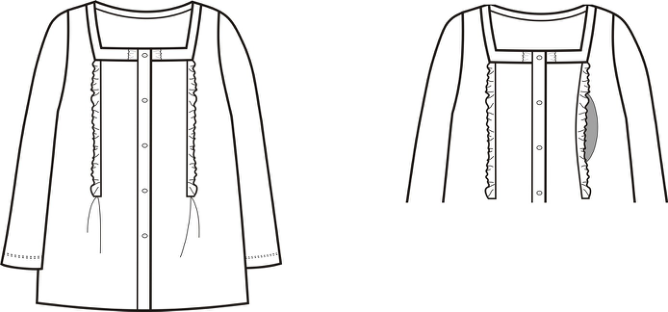
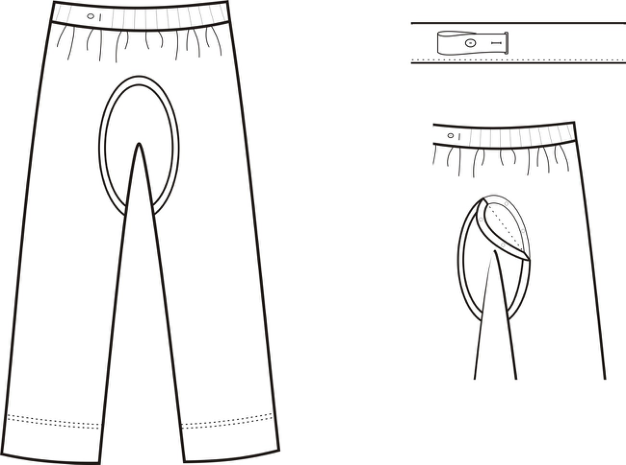
Medical garment design features According to the above result analysis and design rationales, the puerperal medical garment could be conducted to design in conformity with ergonomic theory. Puerperal medical garment is designed as two-part model by clothing function as the precedent factor. Due to puerpera often sweat after childbirth, which could damp the bedding, shower should be limited instead by washing by towel. For the top part, cardigan is designed for easy to put on and take off, and the square-cut collar is convenient for puerpera to wash. Two hidden lactating holes on both sides designed by structure lines and are covered by button. The hidden lactating hole protect the puerpera’s privacy and keep warm preferably (Figure 2). The adjustable belt could be adjusted by the waist difference and be fixed by the button, which increase the flexibility and fitness of the lower part. Crotch part is in a half open form, covered by button, which is convenient for daily activity and therapy after childbirth (Figure 3). The garment is pink matched by white wave point, and decorated by small flouncing in the collar and lactating holes, to enhance fashion style and make puerpera feel relax and cheerful. Clothing uses natural pure cotton fabrics, moisture-retentive, ventilated and easy to clean.
Figure 2. The upper part and details of the medical garment for puerperaFigure 3. The lower part and details of the medical garment for puerpera
CONCLUSIONS
This study identified puerperas` needs and their concerns towards puerperal medical garments, and five main themes of specific ergonomic needs were found. They include function, aesthetics, comfort, easy to put on and take off and psychology. In the process of investigation, a better understanding in desirable the defect in ordinary puerperal medical garments and characteristic of special medical garments. Therefore, according to the design rationales to make puerperal medical garments conformed to ergonomic theory. These results proposed will contribute to further understanding the puerpera needs of experience and provide a valuable reference for improving satisfactory to the puerpera.
REFERENCES
Chowdhary, U (1991), “Clothing and self-esteem of the institutionalized elderly female: two experiments”. Educ. Gerontol. 17, 527–541. Huang, JH (2008), “Thermal comfort of garment”. Beijing, ON: Science Press Macintyre L & Baird M (2006), “Pressure garments for use in thetreatment of hypertrophic scars: a review of the problems
associatedwith their use”. Burns 32, 10–15. Myers AH, Michelson JD, Van NM, Cox Q & Jinnah R (1995), “Prevention of hip fractures in the elderly: receptivity to protective garments”. Archives of Gerontology and Geriatrics 21, 179–189. O’Hare L (1997), “Scholl compression hosiery in the management of venous disorders”. British Journal of Nursing 6, 391–394. Tang HY (2007), “The research of maternity dress design”. Dong Hua University, Shanghai, China. Wang LX & Jiang M (2008), “Practicality of obstetric care and technology”. Beijing, ON: Science Press. Williams F, Knapp D & Wallen M (1998), “ Comparison of the characteristicsand features of pressure garments used in the
management of burn scars”. Burns 24, 329–335. Wu DW (2011), “Development and evaluation of functional daily wear for wheelchair users”. Dong Hua University, Shanghai, China. Xie X & Gou WL (2013), “Obstetrics and Gynecology”. Beijing, ON: People's Medical Publishing House Yip J & Yu W (2006), “Intimate apparel with special functions”. “In Innovation and Technology of Women’s Intimate Apparel
”(Yu W, Fan J, Harlock SC & Ng SP eds). Woodhead Publishing Limited,Cambridge, pp. 171–192.
Zhang JX (2010), “Costume designing ergonomics”. Beijing, ON: China Light Industry Press
LISTED IN THE AHFE DIGITAL BOOKSTORE CATALOGUE
Explore the complete digital volume
Advances in Human Aspects of Healthcare
Read this individual research paper free through the original publisher, or explore the full digital proceedings book.
ISBN 978-1-4951-2093-0
Explore this ISBN in the AHFE Bookstore ↗Listed in the July 2026 bookstore catalogue; search by ISBN to confirm current availability · Digital book purchase optional