Akihiko Obata, Noriyuki Kobayashi (2019). Learning Driven Collaboration Management for Unstructured Service Processes. In: Advances in The Human Side of Service Engineering. AHFE Open Access, vol. 8. https://doi.org/10.54941/ahfe100270
We conducted ethnographic studies of several service works, such as social welfare case work in a city and, customer support desk work for a computer maintenance company, etc. We found the unstructured nature of service to be one of the major problems in improving service performance and quality. We propose a collaboration management model for structuring and improving unstructured service processes. We conducted an experiment in social welfare work in a city. An expert and two teams of case workers participated. The case workers successfully elaborated the initial work template created by the expert by two learning cycles of the proposed collaboration management model.
The development of scientific management methods for improving the performance and quality of service has been expected. We conducted ethnographic studies of several service works and found the unstructured nature of service processes is one of the major problems in improving service performance and quality. In this paper, we discuss the issue of service processes obtained from our field work, and propose a collaboration management model for structuring and improving unstructured service processes. We will also demonstrate the results of our experiment conducted in social welfare case work in a city.
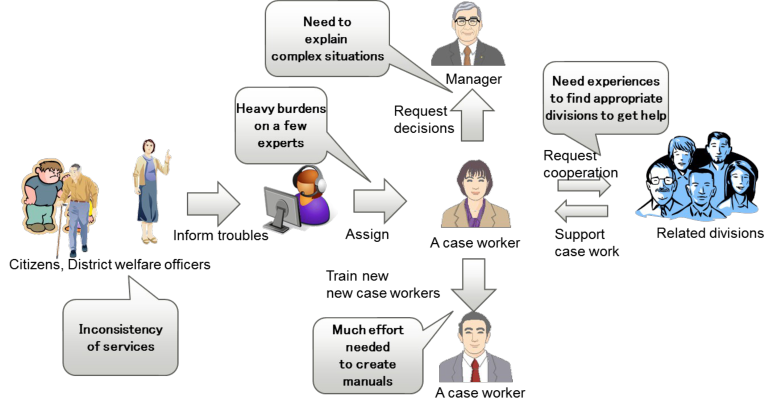
UNSTUCTURED SERVICE PROCESSES Ethnographic studies were conducted for several service works, such as social welfare case work of a city [Obata et al. 2012], as well as, customer support desk work for a computer maintenance company [Ohori et al. 2012], etc. We found common problematic situations [Obata et al. 2013]. Workers had to handle irregular requests despite the fact that processes for handling irregular requests had not been predetermined. Thus, workers had to address irregular requests through collaboration with experts in multiple departments in an ad hoc manner. Due to this cycle of ad hoc work being repeated, business processes were complicated and tacit. As a result, only a few experienced workers accumulated sufficient knowledge of business activities, creating a heavy burden on a few experts. Those few experts could be a bottle neck for improving performance. Moreover, in order to complete irregular requests, many implicit decisions were made that were not always perfect nor consistent. Making implicit decisions explicit is also an important factor for improving the quality of services. Continuous improvement of processes and decisions are needed to improve the quality of services, however, intensive task analysis is needed to clarify such unstructured work processes.
Figure 1. Problem situation of social welfare work in a city LEARNING DRIVEN COLLABORATION MANAGEMENT
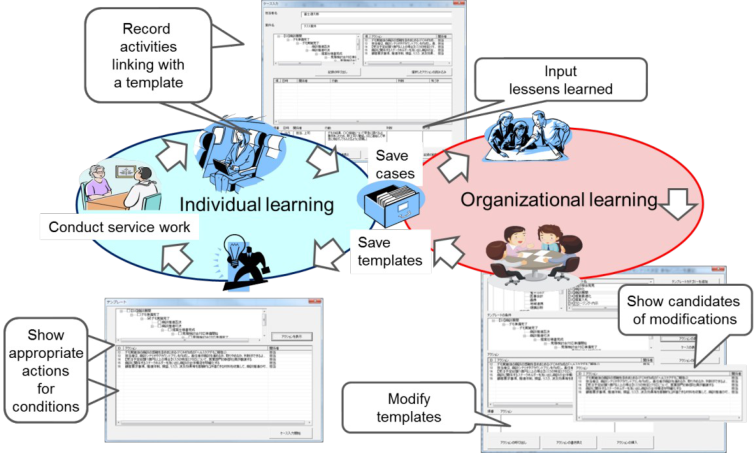
We propose a management model called LdCM (Learning driven Collaboration Management). It allows for each worker and manager to collaborate in forming work templates from unstructured service processes without the heavy burden of task analysis. The collaboration process consists of two types of learning cycles: individual learning cycles, and organizational learning cycles. In the individual learning cycles, workers complete their work guided by recommended actions and decision points with specific conditions described in templates. The templates consist of conditions and recommended actions and decision points in a tree structure. Workers conduct their actions based on a template, and record their activities and decisions through linkage with a template. After they complete their task, they compare the actions they took with the recommended actions in the template, and record the lessons they learned. On the other hand, templates are elaborated and improved in organizational learning cycles. When managers refer to the lessons learned in difference cases, they can easily find what actions should be added, or modified under specific conditions, by comparing templates with the actions they took.
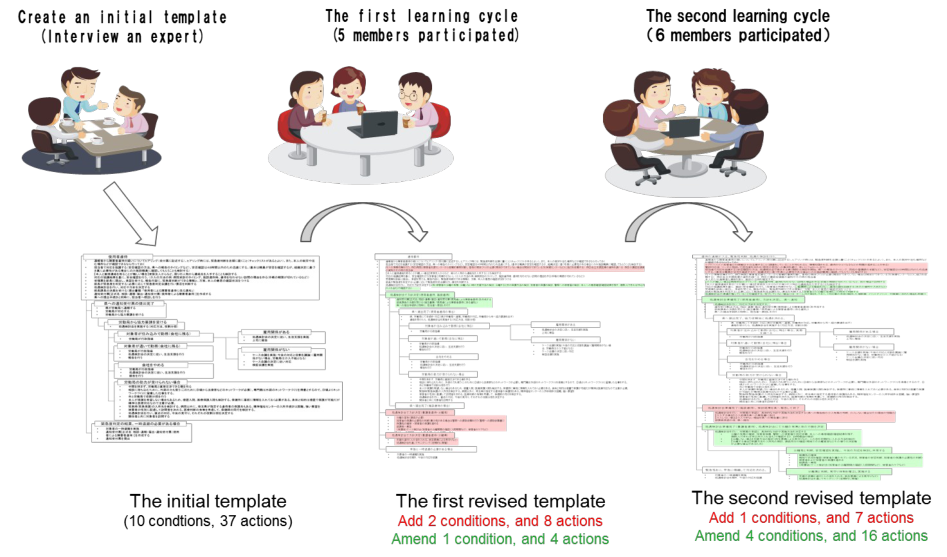
EXPERIMENT We conducted an experiment in social welfare works in a city. An expert and two teams of case workers (a mix of experts and novices with five, and six members) participated. The expert created the first version of the template for mistreatment cases that consisted of 10 conditions and 37 actions. From there, two learning cycles were conducted using the template. After the two learning cycles, the initial templates were elaborated into 14 conditions and 56 actions. Participants in the experiment commented that the template and the management model were very helpful in clarifying and improving their unstructured work processes efficiently. Expert case workers commented that they could express their tacit knowledge efficiently using the template. On the other hand, novice case workers commented they could learn implicit decisions and the know-how of experts.
Figure 3: Elaboration of the template for mistreatment cases
CONCLUSIONS
We found the unstructured nature of processes to be one of the major problems in improving service performance and quality. Our proposed work model functioned well in a small scale experiment concerning social welfare case work. Further research will be needed regarding large scale and longitudinal experiments in different types of service works.
REFERENCES
Obata, A. Ohori, K., Kobayashi, N., Hochreuter, H., and Kensing, F., “Challenges of participatory design for social innovation a case study in aging society”, (2012) Proc. 12th Participatory Design Conference: Exploratory Papers, Workshop Descriptions, Industry Cases – Vol.2 , Pages 9-12 Obata, A., Ohori, K., and Takahashi, S. (2013), “Service process modeling based on ethnographic study” (in Japanese), Proc. of
the 1st Conference of Society of Serviceology, OP4-13 Ohori, K., Kobayashi, N., Obata, A., Takahashi, A. and Takahashi, S. (2012) “Decision Support for Management of Agents’ Knowledge and Skills with Job Rotation in Service-oriented Organization”, 45th Hawaii International Conference on System Sciences, pp1492-1501
LISTED IN THE AHFE DIGITAL BOOKSTORE CATALOGUE
Explore the complete digital volume
Advances in The Human Side of Service Engineering
Read this individual research paper free through the original publisher, or explore the full digital proceedings book.
ISBN 978-1-4951-2091-6
Explore this ISBN in the AHFE Bookstore ↗Listed in the July 2026 bookstore catalogue; search by ISBN to confirm current availability · Digital book purchase optional