Juan Carlos Dall’Asta, Paola Scala, Bruna di Palma (2026). Iteration as Epistemic Dialogue: Rethinking Human-Centered Design in AI-Augmented Architectural Practice. In: Human Interaction and Emerging Technologies (IHIET 2026). AHFE Open Access, vol. 236, pp. 644–652. https://doi.org/10.54941/ahfe1008167
Iteration is widely regarded as a fundamental mechanism in architectural design, yet it is often reduced to cyclical refinement and optimisation. This paper reconsiders iteration as an epistemic dialogue in which knowledge is produced through reciprocal interactions among human designers, artificial intelligence, and representations. Drawing on Gordon Pask’s Conversation Theory and seven years of studio-based pedagogical investigation, the study frames design as a conversational process grounded in reciprocity rather than control. Drawings, models, prompts, and AI-generated outputs are treated not as passive records but as active sites of interpretation and transformation. Analysis of recurring studio practices identifies conversational operations including translation across media, amplification of intentions, divergence through unexpected outputs, conceptual reframing, and recursive feedback. These operations unfold across manual, digital–computational, and generative spheres, forming a non-linear field in which outputs repeatedly become inputs. Artificial intelligence is positioned neither as a neutral tool nor as an autonomous author, but as a dialogical participant that expands possibilities while requiring human interpretation and critical commitment. The paper contributes a theoretical reframing of iteration as knowledge production and an operational account of conversational design practices relevant to architectural pedagogy and professional workflows.
The growing presence of Artificial Intelligence in architectural design has led to a proliferation of tools and workflows aimed at enhancing efficiency and creativity. Yet much of the current discourse continues to frame AI as an external instrument applied to an otherwise stable design process (Shneiderman, 2022; Oxman, 2017), reducing iteration to a technical loop of optimisation or variation while leaving its epistemic implications largely unexamined. This paper argues that such an instrumental view is insufficient to account for contemporary transformations in design thinking. Although architectural design has always been iterative, iteration has rarely been theorised as a mode of knowledge production. Foundational studies describe design as a reflective practice in which understanding emerges through action rather than linear problem-solving (Cross, 2007; Lawson, 2017; Dorst, 2011). From this perspective, iteration operates as a dialogical process of conjecture and reframing. With the introduction of AI, iteration is intensified rather than
645
accelerated, unfolding through recursive exchanges across representational modes. The focus thus shifts from integrating AI into existing methodologies to understanding how iteration itself is reconfigured when design becomes a conversation between human and non-human agents. Rather than proposing a new framework or protocol, this paper articulates an iterative conversational method emerging from studio-based investigation, in which continuous exchanges between sketches, physical models, digital environments, and generative AI systems function as epistemic laboratories for design thinking (Pask, 1976). Building on prior research on Human–AI collaboration in architectural education (Cheung and Dall’Asta, 2023; Cheung and Dall’Asta, 2024), the study shifts attention from what AI does to how designers operate iteratively when AI participates in the design dialogue. Design is shown to unfold across interrelated manual, computational, and generative spheres, forming a non-linear field in which representation shifts from depiction to dialogue and iteration is reframed as an epistemic dialogue through which architectural knowledge is progressively constructed and stabilised.
RESEARCH CONTEXT AND APPROACH The study adopts a longitudinal, practice-based research approach developed through seven years of architectural design-studio teaching and experimentation. The empirical basis consists of sustained observation of students’ iterative work across hand drawing, physical modelling, digital modelling, immersive environments, and generative AI. Rather than evaluating a single software tool or comparing fixed workflows, the inquiry follows how representational artefacts move between media, acquire new meanings, and redirect design decisions over successive cycles. Recurring operations were identified through interpretive comparison of these studio processes and consolidated into three interdependent conversational spheres. The resulting account is analytical rather than prescriptive: it describes repeatable patterns of translation, amplification, divergence, reframing, and feedback without imposing a universal sequence. This scope supports theoretical transfer to pedagogy and practice, while the absence of a controlled baseline means that the paper does not claim quantified gains in speed or design quality.
Within the iterative conversational method articulated in this paper, design advances not through predefined stages but through recurring conversational operations operating within a non-linear field of action. These operations do not form a workflow or protocol; rather, outputs continually become inputs for further exchanges, allowing movement across representational modes while refining intention and meaning. This understanding aligns with established interpretations of design as a reflective and conversational practice in which knowledge emerges through action and feedback rather than linear problem-solving (Schön, 1983; Cross et al., 1992; Lawson and Dorst, 2009). Iteration thus functions as an epistemic condition,
Iteration as Epistemic Dialogue 646
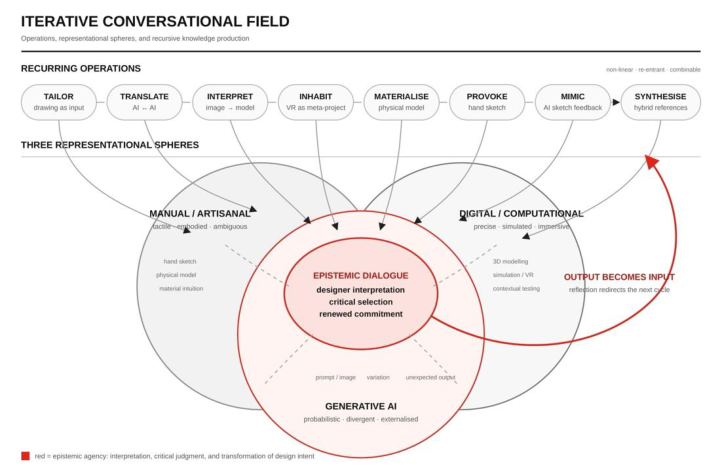
unfolding through cycles of conjecture, interpretation, and transformation, intensified by the participation of generative AI as a dialogical agent. The conversational design operations presented here are not steps to be followed but recurring modes of translation that may occur in varying sequences or simultaneously, depending on the evolving design inquiry (see Fig. 1). Tailored Drawings and Sketches as Conversational Inputs. The process often begins with drawings and sketches produced either manually or digitally to engage AI systems. Hand-drawn inputs retain the immediacy, ambiguity, and openness of exploratory sketching, while digital drawings operate as purposefully constructed syntheses, selectively combining spatial, formal, and contextual information to orient the ensuing dialogue. In both cases, these representations do not depict resolved ideas; rather, they function as conversational artefacts designed to provoke interpretation, variation, and transformation. Drawing thus becomes a dialogical act, shaped by an awareness of how an image may be read, reinterpreted, and extended by AI. This shift from representation to communication positions drawings and sketches as active prompts within an ongoing design conversation (Oxman, 2017; Negroponte, 1975). Recursive AI–AI Image Translation. Rather than treating AI-generated images as final outputs, designers frequently reintroduce them into AI systems to enable recursive transformations. Through this cyclical process, latent spatial, formal, and atmospheric qualities are progressively amplified. Such exchanges position AI within an iterative reasoning process in which meaning emerges through successive reinterpretations rather than singular acts of generation. Iteration thus functions as exploratory dialogue rather than optimisation, aligning with conversational models of learning and knowledge construction (Pask, 1976; Cross, 2007). Conceptual Digital Modelling from AI Image Interpretation. AI-generated images are subsequently interpreted through the construction of digital conceptual models. These models do not aim to reproduce the images faithfully; instead, they operate as interpretative translations that extract spatial logic, organisational principles, or tectonic cues. The act of modelling becomes a form of critical reading, transforming visual ambiguity into spatial hypotheses. This resonates with designerly ways of knowing, where making is inseparable from thinking and interpretation (Pask, 1976; Cross, 2007). Immersive Evaluation through VR as Meta-Project. Digital conceptual models are explored through immersive virtual reality environments not to simulate a final design, but to construct a meta-project: an interpretative space in which the designer can critically examine, compare, and redirect emerging possibilities. This role becomes particularly important in AI-augmented processes, where the rapid production of alternatives can weaken the designer’s understanding of how intentions, decisions, and transformations develop over time. VR restores processual awareness by allowing provisional spatial constructs to be inhabited before they are stabilised as solutions. Paradoxically, its value lies less in simulating reality than in simulating opportunities that remain open to interpretation. Through embodied immersion, latent spatial relationships, experiential qualities, inconsistencies, and previously unrecognised potentials become available for critical assessment. The resulting understanding may confirm, reject, or reframe an emerging direction, generating new intentions that
647
re-enter the conversational process through drawings, models, or further AI exchanges. VR therefore operates as a meta-projective and conversational device: it does not validate a predetermined outcome, but strengthens the designer’s epistemic agency and capacity to maintain critical command of an increasingly distributed design process. Physical Model Production and AI Reinterpretation. Physical model-making sustains material, tactile, and reflective reasoning within the conversational field. The constraints of materials, techniques, scale, and manual production require the designer to select, synthesise, and give provisional form to relationships still open to development. Models thus operate not as resolved representations, but as productively “forced” syntheses for further dialogue with AI. Once photographed and reintroduced into generative systems, they mediate between material intuition and digital abstraction, enabling new interpretations and transformations. Their constraints deepen understanding, incompleteness allows them to function as conversational inputs rather than conclusions (Dall’Asta and Di Marco, 2024). Hand Sketches as Critical Synthesis and Reinterpretation. At later moments in the conversational process, hand sketches operate as selective syntheses or reinterpretations of spatial possibilities emerging from AI exchanges, digital models, VR exploration, or physical artefacts. Through manual redrawing, the designer filters complexity, establishes hierarchies, and reasserts design intention. The resulting sketch is neither a record nor a final representation, but a critically reformulated input that can initiate further dialogue with AI (Dall’Asta and Di Marco, 2024). AI-Generated Sketches and Mimetic Feedback. In some instances, hand sketches are shared with AI to generate images that resemble hand-drawn outputs. This mimetic operation produces a reflective feedback loop in which the designer confronts an externalised version of their own graphic language. Such exchanges prompt critical distance and reinterpretation, reinforcing the idea of AI as a dialogical partner rather than a substitute for manual expression (Dall’Asta and Di Marco, 2024). Hybrid Conceptual Drawings through Artistic References. Manual sketches, AI-generated sketches, and references derived from artistic works are frequently combined to generate hybrid conceptual drawings. These images do not seek stylistic coherence; instead, they operate as dense fields of reference that stimulate conceptual synthesis. Artistic precedents function as interpretative lenses rather than formal templates, expanding the conversational space and enriching the design dialogue (Dall’Asta and Di Marco, 2024).
Contextual Expansion and Situated Reinterpretation Representations produced through previous operations are expanded into contextualised images, often depicting AI-generated interpretations of physical models situated within specific environments. These images function not as final visualisations but as speculative probes that test relationships between concept, context, and material presence. Contextualisation reintroduces constraints into the conversational field, frequently triggering new cycles of iteration across representational spheres.
Iteration as Epistemic Dialogue 648
Across these operations, iteration operates as a conversational infrastructure rather than a procedural mechanism. Manual, digital, and AI-driven practices form interdependent spheres whose boundaries are continuously renegotiated. Each representational act, whether a drawing, model, or AI-generated image, is produced to sustain an ongoing dialogue rather than conclude a decision. Design thus emerges as an epistemic practice constructed through iterative conversation, with AI participating in shaping how architects think, make, and decide (Dall’Asta, 2025).
THE THREE CONVERSATIONAL SPHERES The iterative conversational method described in this paper operates across three interdependent representational spheres: manual production, digital– computational environments, and generative artificial intelligence (see Fig. 1). These spheres should not be understood as tools, phases, or technical domains, but as distinct regimes of design production whose epistemic roles have been fundamentally altered through their mutual interaction. Contemporary design practice unfolds not within any single sphere, but within the continuous movement between them, where each act of making is intentionally oriented towards dialogue with the others (Cross, 2007; Lawson, 2017; Glanville, 1999).
Manual and Artisanal Sphere The manual sphere includes hand sketches, drawings, and physical models traditionally associated with tactile and embodied design thinking. Historically, these practices have been understood as reflective acts through which designers externalise ideas and stabilise form (Schön, 1983; Dorst, 2009). Within an iterative conversational context, however, manual production no longer functions primarily as representation. Hand-drawn marks and physical models are increasingly produced as conversational artefacts designed to provoke interpretation and response from digital and generative systems. This shift redefines the epistemic status of manual making. Drawing by hand becomes a strategic gesture within a broader dialogical field rather than a self- contained cognitive act. Ambiguity and incompleteness thus operate as productive qualities, enabling sketches and models to sustain exchanges across representational spheres. The artisanal retains relevance not by resisting technology, but by adapting its expressive logic to a conversational condition.
Digital and Computational Sphere The digital–computational sphere includes three-dimensional modelling, parametric systems, simulations, and immersive environments such as virtual reality. Traditionally associated with precision and optimisation, these tools have often been used for formal refinement or technical validation. Within iterative conversational design, however, their epistemic role shifts from resolution to interpretation. Digital models and immersive environments function as provisional constructs rather than definitive representations, enabling designers to test spatial hypotheses and inhabit speculative conditions. These constructs are not endpoints but are intentionally designed to generate further questions and re-enter the conversational
649
loop through translation into manual or AI-mediated forms. This aligns with computational perspectives that position digital systems as interactive partners in design reasoning rather than neutral instruments (Oxman, 2017; Negroponte, 1975).
Generative AI Sphere The generative AI sphere introduces a distinct form of agency into design, participating in the dialogue by producing interpretations and transformations beyond the designer’s immediate intentions. AI outputs are not treated as solutions but as epistemic provocations requiring interpretation and response. Operating relationally with manual and digital practices, AI acquires meaning only through the designer’s interpretative engagement and subsequent acts of making. This preserves human agency while expanding design reasoning, positioning AI as a participant in knowledge production rather than an instrument of automation (Pask, 1976; Cheung and Dall’Asta, 2024). Together, the three conversational spheres form a non-hierarchical field in which design knowledge emerges through iterative translation rather than linear progression. Representation becomes dialogue, and iteration the medium through which architectural knowledge is continuously reconfigured.
Figure 1: The iterative conversational field connects manual, computational, and generative AI operations. Their intersections enable epistemic dialogue through interpretation and critical selection. Red indicates epistemic agency and the recursive transformation of outputs into new inputs.
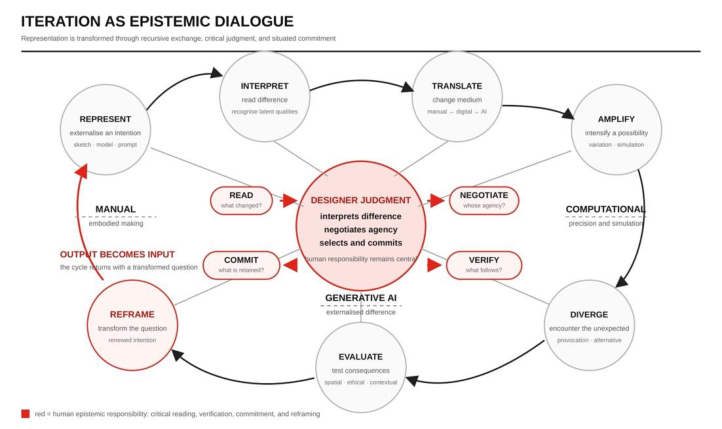
EPISTEMOLOGICAL IMPLICATIONS OF ITERATIVE CONVERSATIONAL DESIGN The conversational design operations outlined above reconfigure the epistemic structure of architectural design. As Figure 2 shows, when iteration is understood
Iteration as Epistemic Dialogue 650
as a conversational method rather than a procedural loop, design knowledge emerges through sustained dialogical engagement across heterogeneous modes of making rather than linear problem-solving or progressive refinement. Iteration thus functions as an epistemic condition through which understanding is continuously constructed and revised (Pask, 1976; Schön, 1983; Glanville, 1999; Dorst, 2006). Within this paradigm, iteration no longer operates as a mechanism of convergence but through divergence and translation. Representational acts are produced not to stabilise meaning, but to expose it to reinterpretation across representational spheres, reinforcing views of design as a reflective and exploratory practice in which making and thinking remain inseparable (Cross, 2007; Hekkert and van Dijk, 2011). As a consequence, representation itself is transformed. Drawings, models, and images cease to function as static carriers of information and instead act as epistemic agents that actively participate in the design dialogue by provoking interpretation and reformulation. This shift from depiction to conversation aligns with cybernetic perspectives that frame design as an interactive exchange between human intention and responsive systems (Pask, 1976; Negroponte, 1975). The introduction of generative AI intensifies this condition without displacing human agency. AI operates neither as an autonomous author nor as a neutral tool, but as a dialogical participant whose outputs reshape the designer’s interpretative horizon through externalised reasoning that must be read and negotiated (Oxman, 2017; Cheung and Dall’Asta, 2024).
Figure 2: Iteration as epistemic dialogue and knowledge production. Representations are interpreted, translated, amplified, opened to divergence, evaluated, and reframed through recursive exchanges across manual, computational, and generative AI practices. Red identifies human epistemic responsibility: critical reading, negotiation of agency, verification, commitment, and transformation of the design question.
Across this dialogical field, manual, digital, and AI-mediated practices are epistemically reshaped through their relations to one another, producing a
651
distributed condition of knowledge. By framing iteration as epistemic dialogue, architectural design is positioned as a mode of knowledge production grounded in reflexivity and productive indeterminacy, where commitment emerges from dialogue rather than optimisation or closure.
CONCLUSION
This paper has argued that architectural design engaging generative AI cannot be adequately understood through linear process models or instrumental notions of iteration. Instead, iteration is reframed as a conversational epistemic practice through which design knowledge emerges from sustained dialogue across manual, digital, and AI-mediated representations. Drawing and modelling thus operate as dialogical gestures that redirect and intensify design thinking rather than resolve it. Within this condition, generative AI functions not as an autonomous creator or neutral tool, but as a participant in an expanded conversational field shaping how architects interpret and commit to design decisions (Oxman, 2017; Cross, 2007; Pask, 1976). Based on seven years of studio-based investigation, the study demonstrates that design advances through iterative conversational exchanges unfolding across three interdependent spheres—manual, digital, and generative—whose boundaries are continuously renegotiated. These spheres form a dynamic epistemic field in which outputs repeatedly become inputs, enabling movement across media while progressively refining intention and meaning. Generative AI introduces externalised reasoning that intensifies, rather than replaces, human agency. AI-generated transformations operate as epistemic provocations requiring interpretation and critical reworking, positioning Human– AI collaboration as shared participation in an iterative conversational process rather than delegation or automation (Cheung and Dall’Asta, 2024; Schön, 1983). A central contribution of this work lies in its redefinition of representation. Drawings, models, and images are repositioned as epistemic agents capable of provoking, resisting, and transforming intention. Even hand drawing is reconfigured as a conversational act that initiates exchanges across representational spheres, reinforcing design as a reflective, knowledge-generating practice grounded in action (Lawson and Dorst, 2009). By framing iteration as an open-ended epistemic dialogue, the paper resists closure through optimisation or automation and preserves uncertainty as a productive force. In doing so, it offers a conceptual foundation for understanding Human–AI co-design as a transformation in how architectural knowledge is generated, negotiated, and stabilised through practice.
REFERENCES
Cheung, L.H. and Dall’Asta, J.C. (2023) “Exploring a collaborative and intuitive framework for combined application of AI art generation tools in architectural design process”, in Muller, B. (ed.), Proceedings of the AISB Convention 2023, pp. 122–130. Cheung, L.H. and Dall’Asta, J.C. (2024) “Human–computer interaction (HCI) approach to
artificial intelligence in education (AIEd) in architectural design”, EIDOS, 17(23), pp. 109–131. Cross, N. (2007) Designerly Ways of Knowing. London: Springer.
Iteration as Epistemic Dialogue 652
Cross, N., Dorst, K. and Roozenburg, N. (eds.) (1992) Research in Design Thinking. Delft: Delft University Press. Dall’Asta, J.C. and Di Marco, G. (2024) “AI machine learning in creative design”, in
Creativity in the Age of Digital Reproduction, Lecture Notes in Civil Engineering 343, pp. 190–200. Cham: Springer. Dall’Asta, J. C. (2025). “Integrating Artificial Intelligence into the Human-Centered Design Process: Enhancing Creativity and User-Centricity in Architectural Education”, Human Interaction and Emerging Technologies (IHIET-AI 2025): Artificial Intelligence and Future Applications, 161, pp. 173–182. https://doi.org/10.54941/ahfe1005908 Dorst, K. (2006) “Design problems and design paradoxes”, Design Issues, 22(3), pp. 4–17.
https://doi.org/10.1162/desi.2006.22.3.4. Dorst, K. (2009) “Layers of design: Understanding design practice”. Available at: https://opus.lib.uts.edu.au/handle/10453/11246. Dorst, K. (2011) “The core of ‘design thinking’ and its application”, Design Studies, 32(6),
pp. 521–532. https://doi.org/10.1016/j.destud.2011.07.006. Glanville, R. (1999) “Researching design and designing research”, Design Issues, 15(2), pp. 80–91. https://doi.org/10.2307/1511844. Hekkert, P. and van Dijk, M.B. (2011) Vision in Design: A Guidebook for Innovators.
Amsterdam: BIS Publishers. Lawson, B. (2017) How Designers Think: The Design Process Demystified. 4th edn.
London: Routledge. Lawson, B. and Dorst, K. (2009) Design Expertise. Oxford: Architectural Press. Negroponte, N. (1975) Soft Architecture Machines. Cambridge, MA: MIT Press. Oxman, R. (2017) “Thinking difference: Theories and models of parametric design thinking”, Design Studies, 52, pp. 4–39. https://doi.org/10.1016/j.destud.2017.06.001. Pask, G. (1976) Conversation Theory: Applications in Education and Epistemology.
Amsterdam: Elsevier. Schön, D.A. (1983) The Reflective Practitioner: How Professionals Think in Action. New York: Basic Books. Shneiderman, B. (2022) Human-Centered AI. New York: Oxford University Press.
SEARCH THE AHFE DIGITAL BOOKSTORE BY ISBN
Explore the complete digital volume
Human Interaction and Emerging Technologies (IHIET 2026)
Read this individual research paper free through the original publisher, or explore the full digital proceedings book.