Progress Kamonere, Faith Dowelani (2026). An Examination of Challenges for Property Owners and Occupants in Decaying Urban Cores - A Case Study of Harare, Zimbabwe. In: Human Factors in Architecture, Sustainable Urban Planning and Infrastructure. AHFE Open Access, vol. 229, pp. 91–100. https://doi.org/10.54941/ahfe1007957
Urban decay is a significant problem in major cities worldwide, and Harare, Zimbabwe, is no exception. The central business district (CBD) of Harare has experienced a significant decline in building quality, functionality, and visual attractiveness due to poor economic management, inadequate maintenance, and urban planning failures. This study examines the challenges faced by property owners and occupants in the decaying urban core of Harare. A mixed-method design was employed, involving a survey of 131 respondents and in-depth interviews with key stakeholders. The findings reveal that the top challenges identified by respondents include poor service delivery (mean = 4.40), lack of coordinated planning for building rehabilitation (mean = 4.34), lack of infrastructure development funding (mean = 4.11), overcrowding (mean = 4.04), and unemployment (mean = 4.02). Interview respondents confirmed these findings, emphasising broken infrastructure, poor planning, and insufficient political will. The study aligns with previous research on inner-city challenges, highlighting issues such as poor housing, unemployment, financing infrastructure development, and a lack of coordinated building rehabilitation. The results demonstrate the need for local government to prioritise improvements in service delivery, particularly in waste management, sanitation, and public safety. Additionally, access to financial and technical expertise is crucial for successfully implementing regeneration strategies. The study concludes that addressing the challenges in Harare's CBD requires a holistic, stakeholder-driven approach that reconciles short-term concerns with long-term sustainability targets.
The Central Business District (CBD) remains the commercial hub of the City of Harare, with old high-rise buildings that originally housed thriving corporations, with a handful of modern buildings in the uptown area surrounding Africa Unity Square (Muchoza, 2018). Several businesses are moving out of the city and setting up offices in the periphery of the CBD, particularly in the Avenues area. Previously used commercial office buildings have been either partly abandoned or converted to low-yielding properties. Due to the closure of major corporations and the broader Received February 6, 2026; Revised April 11, 2026; Accepted April 28, 2026; Available online July 20, 2026
92 Kamonere and Dowelani economic failure, the CBD is characterised by old, dilapidated, cost- ineffective buildings, overcrowding, traffic congestion, pollution, and other urban vices (Beatrice et al., 2020). This erodes economic productivity and undermines the city’s global competitiveness (Tibaijuka, 2015). Indicators of decay include abandoned structures, poor waste management, and declining property values (Chigumira, Muchadenyika, & Chitaka, 2021). Harare’s CBD has experienced a decline in building quality, functionality, and visual attractiveness. These have been attributed to poor economic management, inadequate maintenance, and failures in urban planning (Matamanda et al., 2020). Road traffic has increased significantly more than expected at the city’s discovery in the 1830s; little to no improvement has been made to the road network to accommodate this increase (Surahio, Gu, Mahesar, & Soomro, 2022). The circumstances have given rise to various social and economic challenges in inner cities, including, but not limited to, crime, poverty, unemployment, and illegal occupation. Urban decay in inner-city areas poses various challenges for property stakeholders, particularly in developing countries, where financial constraints, weak institutions, and population pressures exacerbate the problem.
This study aimed to assess the challenges faced by both property owners and building occupants in Harare CBD.
LITERATURE REVIEW
Inner-city dwellers are sometimes characterised as a persistent underclass due to their entrapment inside an ongoing cycle of economic and social challenges (MacDonald et al., 2020). The underclass experiences comparatively elevated levels of unemployment, alcoholism, substance dependency, low literacy rates, juvenile delinquency, and criminal behaviour. Educational institutions in their localities are experiencing a decline in quality, while affordable housing is becoming increasingly scarce (Govender, 2019). Local communities face deficiencies in law enforcement and emergency response services, as well as a scarcity of commercial establishments, medical facilities, and healthcare resources (Alam & Porras, 2018).
Harare’s CBD exemplifies these issues, as the area has seen a progressive decline in infrastructure quality, public services, and economic activity. Years of underinvestment have resulted in ageing buildings, pothole-riddled roads, malfunctioning traffic systems, and unreliable water and energy supply networks (Matamanda et al., 2020). Moreover, informal trading has proliferated due to high unemployment and urban poverty, often taking over sidewalks and building fronts, diminishing the formal sector’s competitiveness and limiting building occupants’ access to their premises (Nyamukapa et al., 2022). Property owners and investors face stagnant property values and lack capital incentives to initiate refurbishment projects. These dynamics foster a climate of disinvestment, where maintaining existing infrastructure is deprioritised, further accelerating decay.
Understanding these complex and interconnected challenges is essential for creating effective and sustainable revitalisation strategies. Such strategies must be holistic and context-sensitive, targeting not only the physical infrastructure but also addressing institutional capacity, regulatory reform, community engagement, and inclusive economic development.
An Examination of Challenges for Property Owners and Occupants 93 Urban Infrastructure and Maintenance Shortfall
Economically deprived populations now cluster in urban environments as inner-city dwellers, driven by their circumstances. They depend on public sector services, but their contribution to the taxes that fund them is limited (Shawly, 2022). Inner cities face an increasing gap between the financial needs of key services and the resources to finance them. The city is at a crossroads, having to choose between two options to mitigate the gap between service costs and insufficient funds to cover them (Govender, 2019). One possible course of action involves service and staff cuts, including shutting down libraries, cutting some of the few remaining public transit lines, reducing how often trash is collected and deferring the replacement of outdated educational supplies (Dean, 2018). In Harare, experiences such as regular water and electricity shortages, poor sanitation services, and non-collection of waste affect property usability and tenant satisfaction (Chikozho & Mlambo, 2021). ZIMSTAT (2022) reports that more than 65% of buildings in the CBD experience one or more service disruptions per week, with water cuts lasting 24 to 72 hours in some cases. These problems can cause unsanitary conditions and directly affect the habitability and marketability of residential and commercial properties. The Harare City Council urban audit of 2021 also found that 70% of the CBD’s sewer infrastructure was over 30 years old, leading to frequent blockages and leaks that endangered tenants’ health and made long-term leases unattractive (Harare City Council, 2021). Moreover, daily ten-hour power cuts disrupt not only business but also the buildings themselves – lifts and ventilation systems (Zimbabwe Economic Review, 2021). Without adequate municipal backing or the financial means to secure private infrastructure solutions, property owners are unable to compete for tenants, resulting in high vacancy rates and low returns. Furthermore, a significant percentage of the buildings in Harare’s CBD are over 40 years old and have not been refurbished or renovated (Matamanda et al., 2020). Deteriorating structure and non-adherence to current safety codes depress property values and impede the possibility of rehabilitation.
Legal Regulatory Barriers Building-induced problems, bureaucratic delays, and uncertain property rights are common hurdles. Area/Zoning laws are applied haphazardly, and planning approvals are delayed by bureaucratic red tape (Chigumira et al., 2021). A survey by the Zimbabwe Institute of Regional and Urban Planners (ZIRUP, 2021) revealed that 60% of developers identified unclear land tenure and long planning processes as the primary investment disincentives in the CBD of Harare. These guidelines discourage investment and prevent vacant buildings from being rehabilitated to attract tenants. Moreover, the lack of policy coherence causes domestic and foreign investors to become even more uncertain. Sometimes overlapping and contradictory regulations issued by various government institutions delay approvals or lead to double compliance requirements, which increase costs and timeframes (ZIRUP, 2021). Chipungu (2020) indicated that these inefficiencies, characteristic of most municipalities, delay the revamping of city projects and undermine investor confidence while accelerating stagnation in the CBD property market. Tenants in commercial and residential premises, and building users
94 Kamonere and Dowelani generally, are negatively affected by the poor enforcement of tenancy laws and consumer protection. The rental market operates largely on the basis of informal agreements, and rent increases, evictions, and conflicts can occur unpredictably (Nyamukapa et al., 2022).
Socio-Economic Pressures The country has suffered from hyperinflation and ongoing economic instability in recent years, leading to less money in people’s pockets and high unemployment. National unemployment is estimated to be over 20%, whilst urban youth unemployment is more than 30% (ZIMSTAT, 2022). Formal commercial and residential property demand in Harare’s CBD has since significantly reduced. Many businesses are shuttered or scaled back, and residential tenants are frequently moving to informal or peri-urban areas where living costs are lower. To address it, the informal sector and subletting have flourished. More than 40% of shops in the Harare CBD have been partially or fully sublet, and that process is not always regulated (UN-Habitat, 2020). The practice results in crowded premises, increased wear and tear on facilities, and additional pressure on already-struggling utilities such as water pipes, electrical wiring, and sanitation systems. When overburdened, systems often collapse, leaving both formal and informal tenants at risk of health problems due to poor sanitation (Nyamukapa et al., 2022). Landlords suffer as low rental yields and long vacancy periods reduce returns on investment. Some of the buildings stand empty or are underused, contributing to urban decay. Meanwhile, tenants live and work in increasingly decrepit conditions, often with no solutions in sight.
Safety and Security Issue Petty crime, vandalism, and building invasions are constant security challenges in downtown Harare. Private security is often paid for by property owners, and unsafe conditions affect tenants’ quality of life and operations (Gore & Muwanga, 2021). Poorly lit walkways, broken elevators, and inadequate fire safety measures contribute to unsafe conditions. This factor is not conducive to long-term tenancy and scares away investors (Gore & Muwanga, 2021).
Financial and Investment Limitations Access to credit and capital is a significant constraint on property development and rejuvenation. Once, the poor economic conditions of hyperinflation and an unstable currency in Zimbabwe had deterred long-term investment and made total lending from the bank prohibitive (Boamah & Gyimah, 2020). Property owners have few affordable ways to finance the buildings they need to repair or renovate, or to make them more energy-efficient. The result is that buildings continue to deteriorate, leaving both landlords and tenants in a downward spiral. In Harare, investor reluctance is currently slowing down the real estate sector due to poor performance by old, unsustainable structures. However, properly targeted sustainable intervention could transform Harare’s Central Business District into a prosperous one. Green building principles, combined with infrastructure improvements, are likely
An Examination of Challenges for Property Owners and Occupants 95 to yield significant increases in rents and property values. For instance, a pilot program in the CBD that combined energy-saving technologies and refurbished shared areas recorded a 15% increase in tenant satisfaction and a consequent 10% increase in yield within a year (Chikozho & Mlambo, 2021). The high initial costs of sustainable upgrades, combined with limited financial support, remain major hurdles for property owners in Harare. Policymaking initiatives offering tax rebates, low-interest financing, or grants for sustainable retrofitting could be crucial to overcoming these hurdles (UN-Habitat, 2020). Joint structures involving public-private partnerships are also crucial for sharing the financial liabilities associated with large-scale sustainable redevelopment efforts (Boamah & Gyimah, 2020).
Effect of Growing Informal Sector The expansion of the informal sector has significantly transformed Harare’s CBD. Indeed, “informalisation” of work not only provides a source of livelihood for many but also poses challenges such as overcrowding on sidewalks, untaxed vending, and poor garbage disposal (Nyamukapa et al., 2022). Storefronts are often damaged, and access to buildings is limited for property owners. Tenants, particularly formal business tenants, do not get much client pull due to street vendors occupying prime street frontage. This grey area between informality and formality will require policy reconciliation for inclusive regeneration (Nyamukapa et al., 2022).
Detachment/Disengagement of Stakeholders One of the biggest problems is that stakeholders are not coordinated. Government institutions, private investors, and community groups frequently operate in silos, with little to no cooperation or joint planning (UN-Habitat, 2020). The outcome is piecemeal initiatives that do not achieve significant or lasting progress. The review has demonstrated that the challenges in Harare’s CBD are multifaceted, including infrastructural, socioeconomic, and regulatory deficiencies. These issues contribute to reduced investment attractiveness for property owners and building tenants, as well as diminished urban liveability. Dealing with these challenges requires a holistic, stakeholder-driven approach that reconciles short-term concerns with long-term sustainability targets.
METHODOLOGY
A mixed-method design was employed, involving a survey of 131 respondents and interviews with 12 stakeholders to examine challenges faced by property owners and occupants in Harare’s CBD. The approach captured measurable outcomes and stakeholder perceptions in the inner city. Stratified random sampling was used to contact stakeholders in inner-city property development. Data were analysed using descriptive statistics to identify trends regarding the challenges. Participation was voluntary, with informed consent obtained. Confidentiality was assured through anonymised responses. Ethical clearance was obtained from the University of Pretoria.
FINDINGS
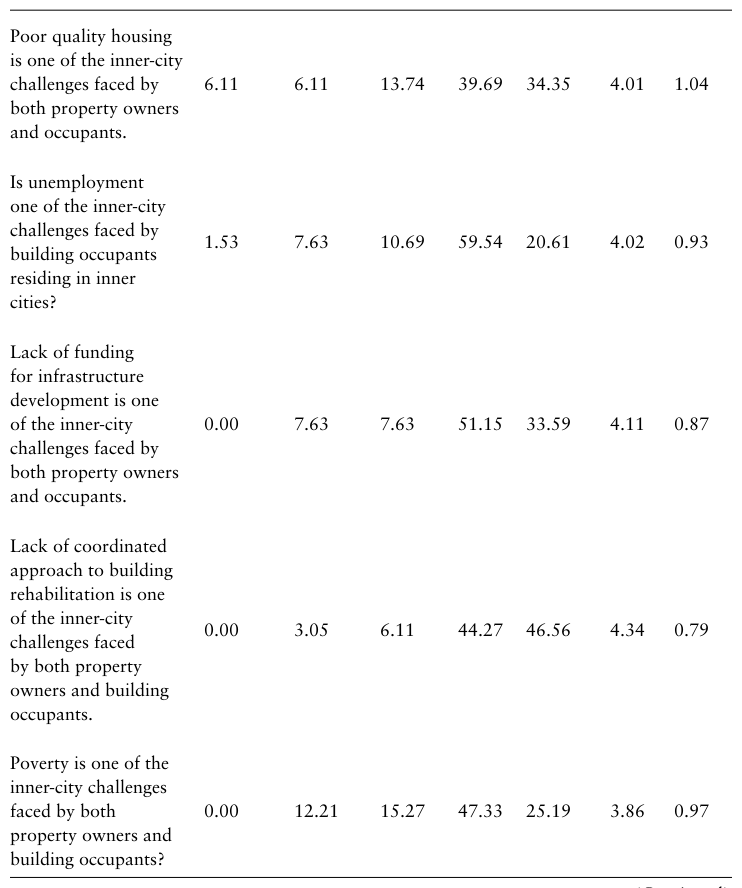
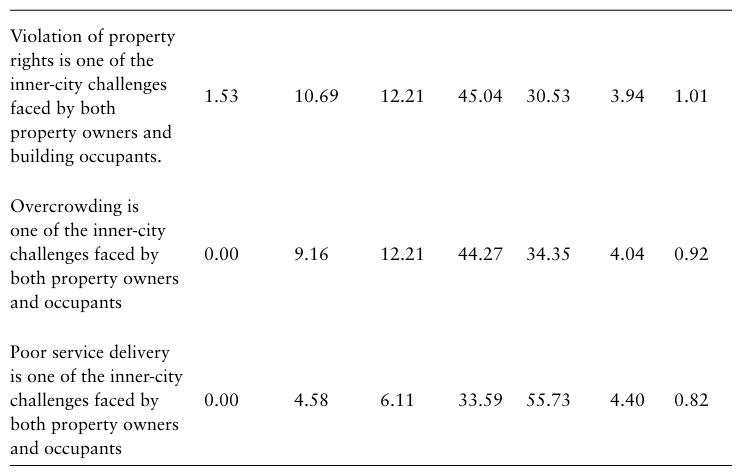
Table 4. 1 summarises responses on the challenges faced by property owners and occupants in Harare’s CBD.Table 4. 1: Challenges faced by property owners and occupants.
Table available in the original PDF paper.
Statement
Disagree (%)
Neutral (%)
Agree (%)
Mean Std. Dev.
Strongly Disagree (%)
Strongly Agree (%)
(Continued)
Table 4. 1: Continued.
Statement
Disagree (%)
Neutral (%)
Agree (%)
Mean Std. Dev.
Strongly Disagree (%)
Strongly Agree (%)
Summary of Findings The findings indicate strong agreement on several key issues, with poor service delivery as the most significant challenge, evidenced by the highest mean score of 4.40. This underscores the widespread dissatisfaction with municipal services such as waste management, sanitation, and public safety, which are fundamental to maintaining a functional and attractive urban environment. The following is a lack of a coordinated approach to building rehabilitation, with a mean score of 4.34, indicating that fragmented planning and implementation efforts hinder effective revitalisation. Insufficient funding for infrastructure development, ranked third with a mean of 4.11, further exacerbates the deterioration of urban facilities and limits the capacity for meaningful improvements. Additional challenges identified include overcrowding (mean = 4.04) and unemployment (mean = 4.02), both of which place increased pressure on already strained infrastructure and contribute to socio-economic instability within the CBD. Other notable
98 Kamonere and Dowelani concerns, such as violation of property rights, poverty, and poor-quality housing, reflect the multifaceted nature of urban decay, affecting not only the physical environment but also the well-being and security of residents and investors. The high percentage of agreement and strong agreement across these categories highlight the pervasive and interconnected difficulties confronting stakeholders in the CBD. Collectively, these findings emphasise the urgent need for enhanced service provision, strategic coordination among stakeholders, and increased financial investment to support sustainable urban revitalisation initiatives. Addressing these challenges holistically is essential to reversing the decline of Harare’s CBD and fostering an environment conducive to economic growth, improved living conditions, and long-term property value appreciation. These results align with earlier research on inner-city challenges. Gambe (2019) observed a significant challenge: poor housing (52% agree, 45% strongly agree), unemployment (78% agree, 27% strongly agree), financing infrastructure development (67% agree, 44% strongly agree), and coordinated building rehabilitation (58% agree, 61% strongly agree). Lucka (2018) noted that 58% agreed and 61% strongly agreed that a coordinated approach is lacking. Matamanda et al. (2021) found that 62% agreed and 33% strongly agreed that Political polarisation and economic crisis hinder upgrading and revitalisation efforts. Chigudu (2021) indicated that poverty (62% agree, 33% strongly agree), property rights violations (59% agree, 40% strongly agree), overcrowding (78.6% agree), and poor service delivery (84.7% agree) are significant challenges in the CBD of Harare. Matamanda et al. (2020) and Sirmayi (2016) also noted infrastructural decay and institutional inefficiencies as challenges to revitalising inner cities. Studies by Kareyeka (2020) and Chigudu (2021) identified infrastructural deterioration and institutional inadequacies as challenges afflicting inner-city revitalisation in Zimbabwean cities. The challenges facing property owners and occupants in Harare’s CBD are multidimensional and deeply interconnected. Without coordinated action and long-term commitment from government, the private sector, and local communities, urban decay will continue to erode property values and urban liveability.
CONCLUSION
This study investigated the challenges faced by property owners and occupants in decaying urban cores, using Harare’s Central Business District (CBD) as a case study. The findings indicate that poor service delivery and the lack of coordinated planning for building rehabilitation remain significant challenges in inner-city areas, adversely affecting both property owners and occupants. Unfortunately, these challenges jointly negatively affect the property’s performance, undermine the long-term investment viability of the CBD, and diminish tenant satisfaction. Addressing these issues is essential to improving living conditions and fostering sustainable urban development. Effective strategies must prioritise enhancing service quality, ensuring equitable access, and engaging stakeholders to mitigate the negative impacts on these communities. Strengthening service delivery frameworks will help revitalise inner-city neighbourhoods and promote social and economic well-being.
REFERENCES
Alam, M. and Porras, A. (2018) ‘Urban poverty and access to public services in developing cities’, Urban Studies, 55(7), pp. 1453–1470. Boamah, N.A. and Gyimah, C. (2020) ‘Sustainable real estate investment as a
risk mitigation strategy in emerging economies’, Property Management, 38(3), pp. 401–418. Chigudu, A. (2021) ‘Urban regeneration and climate resilience in Zimbabwean cities’, Journal of African Urban Studies, 6(2), pp. 89–105. Chigumira, G., Muchadenyika, D. and Chitaka, T. (2021) Urban infrastructure and
service delivery challenges in Zimbabwe. Harare: ZEPARU. Chikozho, C. and Mlambo, A. (2021) ‘Sustainable urban regeneration and tenant satisfaction in Harare CBD’, Journal of Sustainable Cities in Africa, 4(1), pp. 22–39. Chipungu, L. (2020) ‘Institutional inefficiencies and urban governance in
Zimbabwean cities’, African Journal of Public Administration, 12(1), pp. 33–49. Douglous, J., Smith, R. and Patel, K. (2019) ‘Urban renewal and the aesthetics of inner-city transformation’, Journal of Urban Design, 24(4), pp. 512–529. Gambe, T. (2019) ‘Urban revitalisation and land-use transformation in inner-city
environments’, Journal of Urban Management, 8(3), pp. 345–356. Govender, K. (2019) ‘Socio-economic inequality and urban decline in developing cities’, Development Southern Africa, 36(5), pp. 623–638. Gore, T. and Muwanga, J. (2021) ‘Urban safety, property investment and security
provision in African CBDs’, Journal of Property Investment & Finance, 39(6), pp. 585–601. Harare City Council (2021) Urban infrastructure audit report. Harare: City of Harare. Kareyeka, M. (2020) ‘Urban decay and planning challenges in Zimbabwe’, Zimbabwe
Journal of Social Sciences, 8(2), pp. 44–59. Lucka, M. (2018) ‘Property-led regeneration and the limits of urban sustainability’, Planning Perspectives, 33(4), pp. 567–585. MacDonald, R., Shildrick, T. and Furlong, A. (2020) Poverty, social exclusion and
urban marginality. Bristol: Policy Press. Matamanda, A.R. and Chirisa, I. (2021) ‘Inner-city regeneration and urban governance in Zimbabwe’, Urban Forum, 32(2), pp. 185–201. Matamanda, A.R., Chirisa, I. and Mabhena, C. (2020) ‘Infrastructure decay and
property market performance in Harare’, Journal of Property Investment & Finance, 38(5), pp. 463–479. Matamanda, A.R., Nel, V. and Chirisa, I. (2021) ‘Political economy and the failure of inner-city renewal in Zimbabwe’, Urban Geography, 42(6), pp. 889–908. Muchoza, T. (2018) ‘Urban form and spatial change in Harare’s CBD’, Journal of
Southern African Studies, 44(3), pp. 421–437. Nyamukapa, C., Dube, T. and Chitsike, I. (2022) ‘Informality and property market dynamics in Harare CBD’, African Real Estate Review, 7(1), pp. 14–29. Shawly, M. (2022) ‘Fiscal stress and service delivery in inner cities’, Public Finance
and Management, 22(1), pp. 67–84. Sirmayi, D. (2016) ‘Institutional capacity and urban regeneration in Africa’, Cities, 58, pp. 46–55. Tibaijuka, A.K. (2015) Africa’s urbanisation challenge. Nairobi: UN-Habitat. UN-Habitat (2020) World cities report: The value of sustainable urbanisation.
Nairobi: UN-Habitat.
National Statistics Agency. Zimbabwe Economic Review (2021) Energy supply and economic performance in Zimbabwe. Harare: ZER. Zimbabwe Institute of Regional and Urban Planners (ZIRUP) (2021) Planning
approval processes and urban development constraints in Zimbabwe. Harare: ZIRUP.
LISTED IN THE AHFE DIGITAL BOOKSTORE CATALOGUE
Explore the complete digital volume
Human Factors in Architecture, Sustainable Urban Planning and Infrastructure
Read this individual research paper free through the original publisher, or explore the full digital proceedings book.
ISBN 979-8-950676-05-5
Explore this ISBN in the AHFE Bookstore ↗Listed in the July 2026 bookstore catalogue; search by ISBN to confirm current availability · Digital book purchase optional