Shu-hsien Liao, Jian-ming Huang (2025). Delivery Service and Online-and-Offline Purchasing for Collaborative Recommendations on Retail Cross-Channels. In: Human Interaction and Emerging Technologies (IHIET 2025). AHFE Open Access, vol. 197, pp. 489–500. https://doi.org/10.54941/ahfe1006742
From the perspective of e-commerce, delivery and retail operators can join in discovering valuable data on the platform through interactive data on consumer preferences for delivery service and online-and-offline purchasing. These operators can then summarize the information to make collaborative recommendations more accurately, thus increasing consumer purchasing. The delivery service business model is the final link in logistics for both online-and-offline business. An omni-channel, the online-and-offline business model, provides a complete and uninterrupted consumption experience by combining data and marketing content, acting as an offline physical channel and online with consistent services and information. Online-and-offline business models combine e-commerce and physical commerce. A recommendation system filters information to recommend information, services, or products that users may need based on their preferences, interests, behaviors or needs. Recommendation systems include collaborative filtering, content-oriented recommendation, and knowledge-oriented recommendation. Regarding retail collaborative recommendation, that is, a recommendation mechanism involves two or more parties, such as logistics, retail firms and e-commerce operators, working together to obtain necessary consumer information and knowledge, such as profiles and preferences, as the basis for personalized product recommendations. For example, when consumer A purchases mountaineering equipment on a website, the shipping fee is included after discounts, and A then chooses the transaction method of electronic payment and home delivery service. This transaction record involves three-party operators of products, logistics, and cash flows. Through this transaction, the multi-party platform not only understands consumers' purchasing behavior, but also specifically understands consumers' intentions, including outdoor sports, mountain climbing, online discount preference, electronic payments, home delivery, etc. Through collaborative recommendation, multi-party operators can analyze the specific profile of consumer A and further promote information that may interest the customer. This information is not just about specific products, but also includes information related to backpacks, such as weather, map routes, sports news, blog articles, etc. Thus, collaborative recommendation is an approach that seeks to understand consumers' lives and context. In these regards, this study investigates Vietnamese consumer behaviors with delivery services and omni-channel online-and-offline (n=2,354). Data mining analytics, including clustering analysis and association rules, reveal knowledge clusters/patterns/rules for investigating delivery service and omni-channel online-and-offline for retail collaborative recommendations. Finally, with information technologies and business applications developments, such as artificial intelligence, data computation, business intelligence and machine learning, the theoretical and practical applications of retail collaborative recommendations can be more completely developed for human interaction and emerging technologies.
A recommendation system filters information to recommend information, services, or products that users may need based on their preferences, interests, behaviours or needs. Recommendation systems include collaborative filtering, content-oriented recommendation, and knowledge-oriented recommendation. In collaborative recommendation, a recommendation mechanism involves two or more parties, such as logistics, retail and e-commerce operators, working together to obtaining necessary information and knowledge, such as profiles and preferences, as the basis for personalized recommendations (Lin et al., 2023a). For example, when consumer A purchases mountaineering equipment on a website, the shipping fee is included after discounts, and A then chooses the transaction method of electronic payment and home delivery service. This transaction record involves three-party operators of products, logistics, and cash flows. Through this transaction, the multi-party platform not only understands consumers’
purchasing behaviour, but also specifically understands consumers’ intentions, including outdoor sports, mountain climbing, online discount preference, electronic payments, home delivery, etc. Through collaborative recommendation, multi-party operators can analyse the specific profile of consumer A and further promote information that may interest the customer. This information is not just about specific products, but also includes information related to backpacks, such as weather, map routes, sports news, blog articles, etc. Therefore, through the collaboration of information platforms among multi-party operators, collaborative recommendation is a mechanism that seeks to understand consumers’ lives and context, rather than just what consumers buy. This is done through continuous collection and analysis of online and offline consumer behaviour information, showing event scenarios and information that relates to consumers’ lives and contexts, leading consumers to gradually explore what they need and what products and services businesses can provide.
Cross-channel refers to an enterprise’s cross-selling via multiple channels. For example, when a consumer purchases in a company’s physical store, and the salesperson also introduces him to purchase products from the company’s online store (Singh et al., 2020). Cross-channels give customers more choices since customers can interact with brands and product through the channels they prefer (Guler, 2023). Cross-channels allow retailers to maintain consistency across-channels and media, thereby strengthening brand and reputation and reducing confusion for customers (Reimer, 2023). However, there is increasing integration with cross-channel databases, and the value of data science is in also obtaining more customer insights (Liao and Yang, 2020). This study considers that cross-channels are a business model of channel integration that can integrate different retail channels to increase the cooperative development between channels.
Online-and-offline business models combine e-commerce and physical commerce, using online marketing techniques to drive consumption in physical channels, and then extending to create online buzz (Liu et al., 2024). In addition to integrating consumers’ shopping experience across various channels, the online-and-offline model is key to integrating member information, consumption trajectories and shopping behaviours via all channels. For this, consumer data between channels must be updated in real time, allowing consumers to move between channels. The data can be converted freely, allowing businesses to better understand consumer behaviour and further implement precise marketing (Lu et al., 2023). This study considers that online-and-offline purchasing is a cross-channel integrated business model. For the retail industry, the physical and online business models are integrated through online-to-offline and offline-to- online.
In the rapidly developing sharing economy, online platform operators have begun to use crowd outsourcing to handle freight delivery operations. In this delivery service business model, last-mile delivery is the final link in logistics. The efficiency of delivery, the convenience of picking up goods, and the quality of goods all affect consumers’ continued purchase intention (Li et al., 2020). Delivery service refers to outsourcing logistics services with private
Delivery Service and Online-and-Offline Purchasing for Collaborative Recommendations 491
individuals who use their free time for delivery and receive rewards through this voluntary participation. Delivery service providers use platforms and mobile applications as media to coordinate the demand and supply of delivery services and payment services (Pachayappan and Sundarakani, 2023). This study considers that delivery service should not only provide cooperation between logistics operators and retailers but also provide consumers with last-mile transactions and services, both online-to-offline and offline-to- online.
Delivery service and online-and-offline purchasing for collaborative recommendations on retail cross-channels are complex and cross-disciplinary problems of enterprise integration. This study considers that through data mining analytics, businesses can understand consumers’ delivery service and online and offline purchasing behaviour, use this knowledge to provide both logistics and retail operators with service and sales information, and combine information platforms to make accurate collaborative recommendations to consumers.
Thus, this study implements data mining analytics, including clustering analysis and association rules, to investigate Taiwanese users (n = 2,102) to investigate delivery service, online-and-offline purchasing, and cross-channel behaviours and preferences to find meaningful profiles/patterns/rules for retail ross-channels collaborative recommendations.
LITERATURE REVIEW
Delivery Service Recommendations Liu et al. (2023) presented a sustainability-conscious collaborative service combination and service recommendation (SCSR) model that improved the quality of customer service as well as the constructive collaborative effects and eco-efficiency of the combined services. Considering the inherent interdependence of service attributes, DEMATEL (Decision Making Experimentation and Evaluation Laboratory) is proposed to obtain the impact weights of aggregating multiple service attributes into service decisions.
Online-and-Offline Purchasing Recommendations Pan et al. (2023) presented a new approach aimed at utilizing a two-tier knowledge network to enhance online-to-offline (O2O) service recommendations. That study showed that service knowledge network and consumer knowledge network play equally important roles in O2O service recommendation, and the location of O2O services is an important factor in consumers’ service selection. Notably, this study also identifies optimal parameter settings for the proposed recommendation method.
Cross-Channels Recommendations Rong et al. (2023) found that cross-platform cross-channel shopping lengthens, deepens, and broadens the online customer-firm relationship. Cross-platform cross-channel shopping has a stronger positive impact on
492 Liao and Huang
the length and depth of online customer-company relationships as the duration before cross-channel shopping increases. After cross-platform cross- channel shopping, customers who revert to the original channel have weaker relationships with the company than customers who continue to use both channels and move to another channel. These research results provided evidence on customer relationship management by targeting cross-platform cross-channel shoppers.
Data Mining for Delivery Service, Online-and-Offline Purchasing, and Cross-Channel Recommendations Xia et al. (2023) proposed a unified deep neural network, including embedding layer, pooling layer and fully connected layer. Compared with other algorithms, they verified its efficacy in improving travel recommendations based on hotel data and main evaluation indicators captured from Ctrip.com. Lin et al. (2023b) used emotional and economic data to predict real estate sales and then made advertising recommendations based on the prediction results.
METHOD
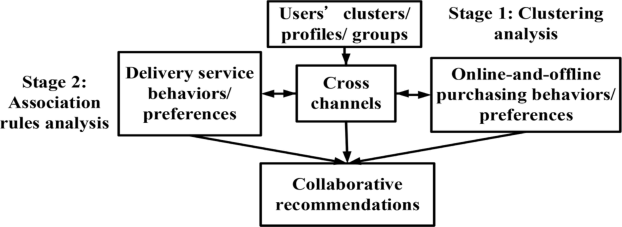
The Conceptual Model This study implements two-stage data mining analytics for clustering analysis and association rules, to investigate Taiwan consumers (n = 2,209) preferences for delivery service. This process clarifies online-and-offline purchasing behaviours and preferences to find meaningful profiles/pat- terns/rules for cross-channel collaborative recommendations. Figure 1 shows the theoretical model for data modelling and analytics.
Figure 1: The conceptual model.
Subject Background and Data Collection The questionnaire for this study was randomly distributed online from June 20, 2022, to September 4, 2022. A total of 2,316 questionnaires were collected, and after missing answers, duplicate IPs, and short response
Delivery Service and Online-and-Offline Purchasing for Collaborative Recommendations 493
time were excluded, 2,191 valid questionnaires remained, for an effective questionnaire recovery rate of 90.4%.
Database Design – Snowflake Schema Bill Inmon (1992) proposed data warehousing, which uses a specific data storage structure to organize and analyze the large amounts of data accumulated by the organization to help users with data mining, online analytics and processing, and the establishment of decision support systems. It has the function of processing many dimension tables and data, improves query efficiency, and can save storage space through appropriate regularization. In this study, snowflake schema contains one fact table and 25-dimension tables.
Data Mining Analytics Clustering Analysis Clustering analysis was the most used data mining method when subjects were grouped. This study uses K-means cluster analysis, which is also one of the most used clustering analyses by users (Cadavid et al. 2022). This study uses the K-means algorithm and divides consumers into groups according to their consumption behaviour and preferences. The steps are as follows:
A. Assume there are N data sets {X1, X2,..., Xp}, and randomly extract k initial clusters from them. B. The receiver uses the Euclidean distance to calculate the distance between each data and the average value of each initial cluster and then assigns each data to the cluster with the closest distance. The calculation method is:
||Xi-Zi||≦|| Xi-Zp||
Xi: represents each different data Zi, Zp: the mean value of the initial cluster, i={1,2,3,…,K}, p={1,2,3,…,K}, i̸=p C. Divide the observed value (X1,X2, . . . , Xp) into k determined cluster initial centres (m(1)
1 , . . . , m(1) k ), and then calculate The Euclidean distance from each observation value to k cluster centres is assigned to the cluster with the closest distance to it. The algorithm is as follows: S(t) i = {xp : ||xp −m(t)
i ||2 ≤||xp −m(t)
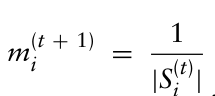
j ||2∀j, 1 ≤j ≤k} (1) D. When each cluster centre has already been classified observations, and then recalculate the new cluster centres, the algorithm is as follows:
X
m(t + 1)
xj (2)
Equation reproduced from the original PDF.
Then continue to repeat the above steps until the change of the cluster centre becomes smaller and smaller, and the observation value does not change, then the final structure is generated.
494 Liao and Huang
Association Rules Agrawal et al. (1993) first proposed that the main purpose is to find out the relationship between the data in the database, and to explore the meaning of the relationship. Association rules are often used to analyse the association of different commodity combinations in the database. This study assumes that consumers will purchase B (Consequent) because of the consumption behaviour of A (Antecedent), and the association rules are expressed by two parameters: Support and Confidence value. In the algorithm for finding association rules, the thresholds of Minimum support and Minimum confidence set by users must be met before the rules can be determined to be meaningful. The formulas for calculating support and confidence are as follows (Agrawal and Srikant, 1994): A. Support
Among all the transactions in the database, the ratio of the number of simultaneous occurrences of items A and B to the total number of transactions, its expression is Sup(A→B). The value of support is between 0% and 100%, and the higher the support, the higher the value.
The total number of transactions of items A and B Sup(A →B) = appearing at the same time The total number of transactions in the database (3)
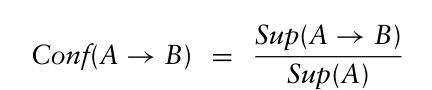
B. Confidence Confidence is the level of confidence in the rules. Among all the transactions in the database, the ratio of the number of transactions in which item A occurs to the total number of transactions in which item A and item B also appear at the same time, its expression is Conf(A→B). The value of confidence will be between 0% and 100%, the larger the value, the higher the confidence.
Equation reproduced from the original PDF.
The total number of transactions of items A and B = (4) appearing at the same time The number of transactions with A
appearing in the database
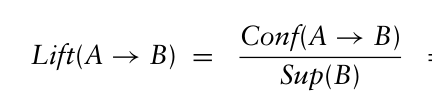
To reduce the numerical bias caused by support and confidence, the analysis index of association is used to improve the exploration of support and confidence, that is, the Lift value (Lee and Wu, 2023).
Equation reproduced from the original PDF.Equation reproduced from the original PDF.
Delivery Service and Online-and-Offline Purchasing for Collaborative Recommendations 495
RESULTS
Clustering Analysis Based on the clustering results, the characteristics of each group were obtained, and the clusters are referred to as Cluster 1 (643 data) LiVi office workers group; Cluster 2 (927 data) budget-conscious office worker group; and Cluster 3 (639 data) hedonistic student group.
Cluster-1 LiVi office workers group: This cluster is mainly office workers aged 30 to 44, with monthly incomes ranging from NTD 25,001 to NTD 40,000. Products from 7–11 are mostly delivered. The reason for delivery is to facilitate shopping and purchasing, and when it can have the same rights as physical shopping, epidemic prevention-related products are usually selected for delivery, and rapid delivery is important. Thus, if the platform is not stable enough, these customers are easily dissatisfied with the service. Most delivery consumers in this cluster are office workers, who use delivery services because of convenience and pay less attention to delivery discounts than the other two clusters.
Cluster-2 Budget-conscious office worker group: This cluster group is mainly female office workers aged 30 to 44, with monthly incomes ranging from NTD 25,001 to NTD 40,000. They often have a full range of products delivered because they want to get a lower price and have more considerations for delivery payment method. In this case, they choose to have products with higher demand delivered, are satisfied with the discounts, and bad customer service is usually the source of dissatisfaction with delivery services. Most delivery consumers in this cluster are office workers who are more interested in the discounts of delivery services.
Cluster–3 Hedonistic student group: This cluster group is mainly female college students aged 20 to 29. They choose products from 7–11 for delivery service because they don’t want to go out, and they will consider the delivery speed to decide whether to use the delivery service. They usually choose more frequently used products and give priority to delivery services. This group of consumers are generally satisfied with the special offers, while others are unhappy due to the unstable function of the delivery service platform. Most delivery consumers in this cluster are students. Although they are interested in the product delivery quality, they also are interested in the special offer/discount and delivery process.
Association Rules Analysis Pattern 1 – Associations of Delivery Service and Offline Channel Purchasing Behaviour
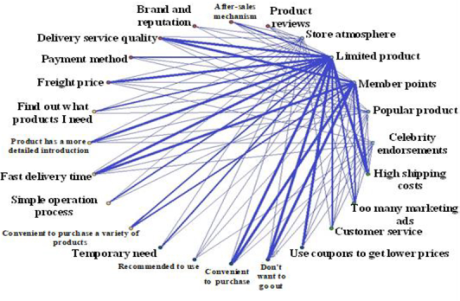
In this study, using the Apriori algorithm, five meaningful association rules were obtained, with Minimum antecedent support greater than 2%, Minimum rule confidence greater than 30%, and Lift values are greater than 2 (Fig. 2). Regarding cluster 1, for Rule1, when consequent is Celebrity endorsements, the antecedents include Convenient to choose and purchase; Delivery service quality; Products are introduced in more detail; and High shipping costs. For rule 5, when consequent is Store atmosphere, the
496 Liao and Huang
antecedents include Products can be ordered at the same time; Brand and reputation; Simple operation process; and Customer service.
Figure 2: Associations of delivery service and offline channel purchasing preferences (Cluster-1).
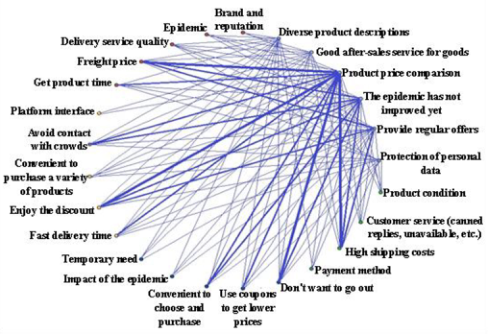
Pattern 2 – Associations of Delivery Service and Online Channel Purchasing Behaviour The Apriori algorithm was able to derive five meaningful association rules with Minimum antecedent support greater than 2%, Minimum rule confidence greater than 30% and Lift value are all greater than 2. In terms of cluster 1, for Rule 1, when consequent is Product price comparison, the antecedents include Convenient to choose and purchase; Delivery service quality; Products are introduced in more detail; and Platform system is unstable. For Rule 4, when consequent is Protection of personal data, the antecedents include Don’t want to go out; After-sales mechanism; Fast delivery time; and Order processing (Fig. 3). Pattern 3 –Associations of Delivery Service and Online-and-offline Purchasing on Cross-channel
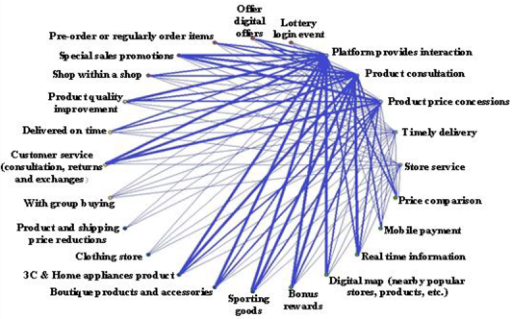
In this study, using Apriori algorithm, we were able to derive five meaningful association rules with Minimum antecedent support greater than 2%, Minimum rule confidence greater than 40%, and Lift value are all greater than 2. In terms of cluster 1, for Rule 2, when consequent is Convenient checkout, the antecedents include Timely delivery; Online payment and deduction; Spending money feedback; and Sporting goods. For Rule 3, when consequent is Offer digital offers, the antecedents include Product delivery complete; Mobile payment; Product quality improvement; and Clothing store (Fig. 4).
DISCUSSIONS Delivery Service and Offline Channel Purchasing Recommendations
As the influence of the pandemic decreased, the use of retail delivery has declined, and the number of people shopping in stores has gradually returned to pre-pandemic levels (Ratchford et al., 2023). This study suggests that
Delivery Service and Online-and-Offline Purchasing for Collaborative Recommendations 497
physical stores can use promotions, membership systems, etc., or view them through delivery platforms. Physical stores stock merchandise and provide feedback measures such as additional discounts or gifts to increase consumer spending. Therefore, by integrating retail delivery and physical stores, not only can consumers have more convenience and more choices, but there can be increased exposure and traffic in physical stores, which can give consumers more familiarity and trust with the retail brand.
Figure 3: Associations of delivery service and online channel purchasing preferences (Cluster-2).Figure 4: Associations of delivery service & online-and-offline purchasing on cross- channel (Cluster-3).
Delivery Service and Online Channel Purchasing Recommendations During the post-epidemic period, consumers have gradually begun to pay attention to whether online platform operators provide a variety of products, and they have also begun to pay more attention to delivery time and product reviews. However, product discounts and free shipping are not as attractive
498 Liao and Huang
as expected (Sarkar et al., 2024). Through delivery, consumers do not need to go to the store to purchase goods or go to a courier service point to return or exchange goods., which not only saves consumers’ time and energy, but also can extend services to consumers who do not wish to leave home.
Delivery Service and Online-and-Offline Purchasing for Cross-Channel Recommendations To promote online-and-offline purchasing, retail operators should improve customers’ consumption experience, services, and brand image. For example, physical stores can develop virtual reality to simulate the appearance of products for consumers’ reference. This belongs to offline to online; on the other hand, to support e-commerce, a shopping platform could also provide online booking, direct checkout, and delivery services after arriving at the venue for completing online to offline (Wu and Zhao, 2023).
Delivery Service and Online-and-Offline Purchasing for Cross-Channel Collaborative Recommendations Though delivery and retail are generally considered to be different industries, from the consumers’ viewpoint, they are inseparable. Delivery logistics uses the delivery platform to match consumers and delivery personnel, then outsourcing transportation services; retail operators rely on orders by consumers is a service code provided to delivery operators in terms of completing an order on a last mile. The retail industry focuses on product and channel operations, while delivery logistics provides the link between retail and consumers. Therefore, considering the consumer’s consumption process, this study explores consumer purchases and delivery services, so that collaborative recommendations can be mutually beneficial for all parties.
CONCLUSION
Collaborative recommendation is an approach that seeks to understand consumers’ lives and context. By continuously collecting and analyzing data on consumers from multi-party operators, it connects events, situations and information related to their lives, leading consumers to gradually explore their needs, wants and demands so that businesses can better recommend goods and services. From the perspective of e-commerce, delivery and retail operators can joint to discover valuable data on the platform through interactive data on consumer preferences for delivery service and online- and-offline purchasing. These operators can then summarize the information to make collaborative recommendations more accurately, thus increasing cross-channel e-commerce purchasing.
ACKNOWLEDGMENT
The authors would like to acknowledge the National Science and Technology Council, Taiwan, Republic of China [MOST 113-2410-H-032-051-MY2].
Delivery Service and Online-and-Offline Purchasing for Collaborative Recommendations 499
REFERENCES
Agrawal, R. Imielinski, T. Swami, A. (1993) “Mining association rules between sets of items in large databases.” Paper presented at the Acm Sigmod Record. Washington DC, USA, Vol. 22 No. 2. Agrawal, R. Srikant, R. (1994) “Fast algorithms for mining association rules.” Paper
presented at the Proceedings of the 20th International Conference on very Large Database, Santiago, Chile, Vol. 20 No. 4. Cadavid, J. P. U. Grabot, B. Lamouri, S. Pellerin, R. Fortin. A. (2022) “Valuing free-form text data from maintenance logs through transfer learning with CamemBERT.” Enterprise Information Systems, Vol. 16 No. 6. Guler, A. U. (2023) “Category expansion through cross-channel demand spillovers.” International Journal Of Research In Marketing, Vol. 40 No. 3. Inmon, W. H. (1992) “Building the Data Warehouse.” QED Technical Publishing
Group, New York. Lee, K. H. Wu. K. Y. K. (2023) “Making autonomous vehicle systems humanlike: lessons learned from accident experiences in traffic.” Enterprise Information Systems, Vol. 17 No. 6. Li, Y. Zhang, G. Pang, Z. Li, L. (2020) “Continuum approximation models for joint
delivery systems using trucks and drones.” Enterprise Information Systems, Vol.14 No.4. Liao, S.-H. Yang, L.-L. (2020) “Mobile payment and online to offline retail business models.” Journal Of Retailing And Consumer Services, Vol. 57 No. 4. Lin, Z. Liu, D. Ming, Z. (2023a) “Transfer learning for collaborative recommendation with biased and unbiased data.” Artificial Intelligence, Vol. 324 No. 4. Lin, F.-Y. Wu, J. Tseng, K.-K. Tang, Y.-M. Liu, L. (2023b) “Applied sentiment analysis
on a real estate advertisement recommendation model.” Enterprise Information Systems, Vol. 17 No. 6. Liu, Y. Wu, M. Lai, K.-H. Zhang Z. Wang, J. (2024) “Strategic responses to market uncertainty: Performance value of strategic agility and online-to-offline platform adoption” Enterprise Information Systems, Vol. 18 No. 1. Lu, S. Q. Singh, S. de Roos, N. (2023) “Effects of online and offline advertising
and their synergy on direct telephone sales.” Journal Of Retailing, Vol. 99 No. 3. Pachayappan, M. Sundarakani, B. (2023) “Drone delivery logistics model for ondemand hyperlocal market.” International Journal Of Logistics Research And Applications, Vol. 26 No. 12. Pan, Y. Xu, L. Olson, L. (2023) “An online-to-offline service recommendation
method based on two-layer knowledge networks.” Information Sciences, Vol. 648 No. 2. Ratchford, B. Soysal, G. Zentner, A. (2023) “Multichannel customer purchase behavior and long tail effects in the fashion goods market.” Journal Of Retailing, Vol. 99 No. 1. Reimer, T. (2023) “Environmental factors to maximize social media engagement: A
comprehensive framework.” Journal Of Retailing And Consumer Services, Vol. 75 No. 3. Rong, Z. Wang, Q. Zhang, H. (2023) “Effects of cross-platform multichannel shopping on online customer–firm relationship length, depth, and breadth: An empirical investigation.” Information Processing & Management, Vol. 60 No. 2.
500 Liao and Huang
Sarkar, B. Kar, S. Pal, A. (2024) “Does the bullwhip effect really help a dual-channel retailing with a conditional home delivery policy?”, Journal Of Retailing And Consumer Services, Vol. 78 No. 2. Singh, J. Goyal, G. Gill, R. (2020) “Use of neuromeric to choose optimal
advertisement method for omnichannel business.” Enterprise Information Systems, Vol. 14 No. 2. Wu, J. Zhao, C. (2023) “The Online Retailer’s Randomized Pricing Strategy to Compete With an Offline Retailer.” Intenational Journal Of Electronic Commerc, Vol. 27 No. 2. Xia, H. An, W. Liu, G. Hu, R. Zhang, Z. Wang, Y. (2023) “Smart recommendation
for tourist hotels based on multidimensional information: A deep neural network model.” Enterprise Information Systems, Vol. 17 No. 4.
LISTED IN THE AHFE DIGITAL BOOKSTORE CATALOGUE
Explore the complete digital volume
Human Interaction and Emerging Technologies (IHIET 2025)
Read this individual research paper free through the original publisher, or explore the full digital proceedings book.
ISBN 978-1-964867-73-1
Explore this ISBN in the AHFE Bookstore ↗Listed in the July 2026 bookstore catalogue; search by ISBN to confirm current availability · Digital book purchase optional