Sebastien Tremblay, Carolane Croteau, Mireille Patry, Helen Hodgetts, Cindy Chamberland (2025). Cognitive Science and Information Technologies in Team Sports: Enhancing Performance and Safety. In: Human Interaction and Emerging Technologies (IHIET-FS 2025): Future Systems and Artificial Intelligence Applications. AHFE Open Access, vol. 196, pp. 52–60. https://doi.org/10.54941/ahfe1005954
This research and development program leverages the integration of cognitive science, experimental psychology, and advanced technologies to enhance performance and safety in team sports. Through the development and validation of three innovative applications—TAKTIK, SENIC, and ENTOURAGE—the program demonstrates the potential for interdisciplinary approaches to address critical challenges in tactical learning, injury detection, and concussion management. TAKTIK is a gamified, AI-driven playbook designed to support players in learning and retaining complex tactical formations in football. By generating dynamic, cognitive exercises tailored to individual response accuracy and speed, TAKTIK provides actionable feedback that improves engagement and comprehension of game strategies. A preliminary study involving high school and university football teams indicates significant enhancements in players’ learning processes, suggesting that TAKTIK effectively meets the cognitive demands of team sports athletes. SENIC (ENgaging and Immersive Cognitive Simulation) wishes to advance concussion management by embedding cognitive tasks within sport-specific contexts to add dimensions of face validity and ecological validity. SENIC is a computer-based assessment that measures processing speed – reaction time to identify a change in ball (or puck) possession between on-screen players in video sequences in the team sport plat (e.g., football, soccer, rugby, hockey, basketball) – and smooth pursuit through an external eye-tracking system. These dynamic indicators of cognitive functioning provide a comprehensive assessment of post-concussion impairments. Initial validation studies comparing SENIC to established tools, such as the ImPACT test, reveal promising evidence for its sensitivity and reliability in supporting return-to-play decisions, particularly in fast-paced team sports. ENTOURAGE builds on the insights gained from SENIC to extend concussion management beyond evaluation, focusing on education and decision-making support for athletes, parents, and coaches. By offering real-time insights and integrating seamlessly with SENIC data, ENTOURAGE empowers community stakeholders with the tools necessary for informed decision-making in stressful situations, such as managing potential concussions during games or practices. The complementary design of SENIC and ENTOURAGE reflects a unified framework aimed at democratizing access to effective concussion management tools in team sports. The overarching program relies on a shared approach across these tools, characterized by the use of artificial intelligence, gamification, and user-centered design to enhance cognitive engagement and ecological validity. Each application addresses the specific cognitive and practical challenges of team sports, emphasizing the importance of adaptive, contextually relevant solutions for both performance optimization and safety enhancement. By combining interdisciplinary research with advanced information technology, our program underscores the transformative potential of cognitive science in addressing complex challenges in team sports.
The integration of cognitive science, experimental psychology, and advanced technologies is key to the development of technological solutions that can truly enhance performance and safety across a wide range of domains in the workplace and sport. Our approach is to develop smart applications that are human-centric, ecologically valid and cognitively in harmony with the way we process information. Across all three applications—TAKTIK, SENIC, and ENTOURAGE—ecological validity is emphasized through a shared focus on human-centered design and emerging technologies like artificial intelligence (AI) and machine learning. These tools adopt principles at the intersection of educational technology (EdTech) and sports technology (SportsTech) to increase user engagement and operational realism, ensuring that solutions resonate with athletes and coaches in situational relevant environments.
Experts have highlighted the importance of better use and integration of digital technologies in clinical neuropsychology (see Sullivan et al., 2023), but the discipline is slow to adapt to technological advances from which it could benefit (Diaz-Orueta et al., 2020). The advantages of digital technologies to enhance off-field assessment of concussion and return to play protocols are becoming increasingly recognized, with wearable technologies, mobile applications, and machine learning all considered key tools in the future management of sport-related concussion (Powell et al., 2021). For the
Cognitive Science and Information Technologies in Team Sports 53
last decade or so, there has been a keen interest in developing techno- pedagogical tools – such as serious games – that aim to enhance participation, performance and safety, as well as to evaluate cognitive functions involved in sports (see Pivec et al., 2012). Serious games are designed for learning and evaluation purposes, and emphasize the pedagogical value of fun and competition. Also, previous work on the use of gamified applications in health self-management (see Damaševiˇcius et al., 2023) suggests that adding a serious game to a concussion management protocol could provide a more meaningful and engaging experience for the athlete that would encourage commitment to the protocol.
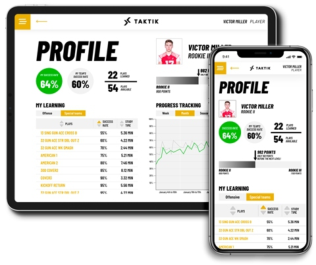
TAKTIK: Boosting the Learning of Football Tactics With a Gamified and Intelligent Mobile Application In American and Canadian Football, teams rely heavily on tactics and set plays. In the case of High School and College Football, players may have to learn up to 300 different set plays from training camp to weekly preparation during a season while at the same time having to perform academically. We present TAKTIK, a digital, gamified, and intelligent playbook that is specifically developed to enhance learning for players (see Figure 1). TAKTIK was built using expertise in cognitive science, UX design, gamification, and artificial intelligence. TAKTIK was developed in collaboration with coaches and players from the Rouge et Or Football Varsity team at Université Laval. Recent advancements highlight the application of AI and data-driven tools in enhancing tactical learning and injury prevention. For instance, TacticAI, an AI assistant for football tactics, exemplifies the transformative potential of leveraging geometric deep learning to optimize corner kick routines, as validated in collaboration with professional teams like Liverpool FC (Wang et al., 2024; see also Vorstandlechner et al., 2017). This underscores the value of interdisciplinary approaches that combine AI, cognitive science, and sport-specific contexts to address critical challenges. Furthermore, as emphasized by Naughton et al. (2024), the introduction of emerging technologies in sports science enables dynamic modelling of team and individual performance.
Figure 1: User interface on Tablet and smartphone.
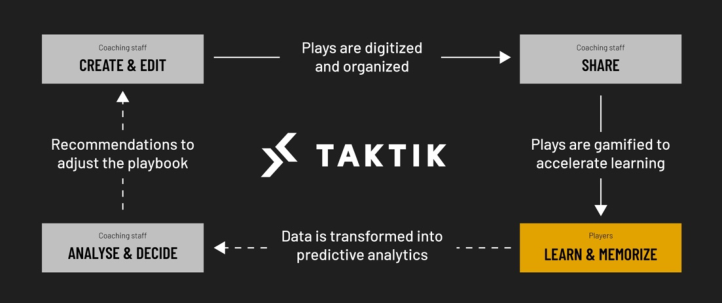
TAKTIK consists of two main modules. The COACH Module equips coaches with tools to create, import, and organize plays while enabling them to distribute plays to players and monitor study time and learning progress for each player through a dedicated dashboard. The PLAYER Module provides a digital version of the playbook, which generates engaging learning exercises to facilitate play memorization. An intelligent agent automatically transforms plays into adaptive learning exercises and tracks player performance metrics. Together, these modules streamline the learning process for players and provide coaches with actionable insights to optimize training efficiency. For each play in the digital libraries (imported or edited by the coaching staff), TAKTIK can generate dynamic and interactive cognitive exercises to facilitate the memorization of that play. Based on their response accuracy and response time as a function of difficulty levels, TAKTIK provides players with personalized feedback on performance. See Figure 2 for a depiction of the whole process.
Figure 2: Dynamic process of TAKTIK.
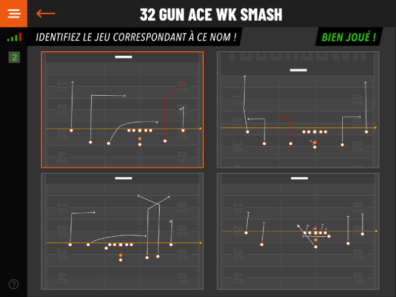
The design of TAKTIK’s cognitive exercises is inspired by the SPRINT approach (Spacing, Retrieval, and Interleaving; see McDaniels et al., 2013), a cognitive strategy grounded in evidence-based principles to enhance learning and retention. By integrating the SPRINT approach into tactical learning, TAKTIK enables players to optimize their learning processes. The exercises incorporate retrieval practice to strengthen memory and interleave various types of information to boost retention. This evidence-based approach aligns with cognitive strategies proven to promote durable retention of information (Hultberg et al., 2018). In one of the cognitive exercises designed to facilitate learning, players are shown a set play callout and must quickly identify the corresponding formation. This task is designed to enhance reaction speed and accuracy, mirroring the decision-making demands of a game environment (see Figure 3). To enrich the learning experience, gamified features such as points, levels, and leaderboards are incorporated, fostering a sense of achievement and friendly competition while motivating players to improve
Cognitive Science and Information Technologies in Team Sports 55
their performance. The platform provides a dynamic and engaging learning environment that reinforces both cognitive and practical skill acquisition.
Adopting a design thinking approach, we conducted a field study with High School and University Football teams, representing a sample of about 50 athletes and six coaches. Based on the outcomes of interviews and preliminary analyses of learning performance and qualitative data, it seems the use of cognitive dynamic exercises and gamification improves the way players study their playbooks. The personalised learning experience, instant metrics and feedback loops were very appreciated by most players and perceived as reinforcing their learning process. Overall, TAKTIK has the potential to transform the learning of football plays into an engaging, interactive, and effective process, fostering a deeper understanding of game tactics and facilitating game preparation
Figure 3: Screen capture of the discrimination learning exercise.
SENIC: A Sport-Related Cognitive Test An estimated 2.5 to 4 million sport-related concussions occur annually in the United States, with soccer alone accounting for approximately 0.28 to 0.41 injuries per 1,000 game exposures for male and female athletes, respectively (Demetriades et al., 2024). These injuries are linked to significant societal and economic impacts, including increased healthcare costs, prolonged recovery periods, and disruption to work and education for athletes and caregivers. Despite advances in concussion protocols, up to 40% of cases involve non- adherence by healthcare providers or athletes (Liebel et al., 2024). This highlights the need for accessible and context-specific tools that enable better identification and recovery monitoring. Solutions that involve coaches, parents, and schools in a collaborative framework are critical for addressing this challenge effectively (see Patricios et al., 2023).
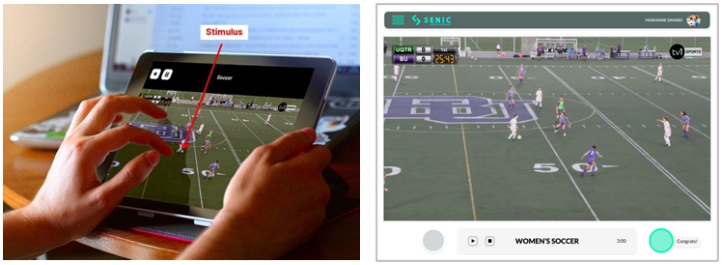
SENIC (ENgaging and Immersive Cognitive Simulation) wishes to advance concussion management by embedding cognitive tasks within sport-specific contexts (see Figure 4) to add dimensions of face validity and ecological validity. SENIC is a computer-based assessment that measures processing
speed – reaction time to identify a change in ball (or puck) possession between on-screen players in video sequences in the team sport played by the athlete under test (e.g., football, soccer, rugby, hockey, basketball) – and smooth pursuit through an external eye-tracking system. These dynamic indicators of cognitive functioning provide a comprehensive assessment of post-concussion impairments (see Hodgetts et al., 2023). Initial validation studies comparing SENIC to established tools, such as the ImPACT test, reveal promising evidence for its sensitivity and reliability in supporting return-to-play decisions, particularly in fast-paced team sports (see Croteau et al., 2024).
Figure 4: User interface of the SENIC simulation.
To examine the reliability and learning effect, performance at SENIC was assessed three times during the athletes’ season. Following a concussion, athletes were also invited to perform the test within a 72-hour period. One hundred healthy soccer varsity athletes (34 males, 66 females) aged between 13 and 26 years old (M = 17.68, SD = 3.03) completed the SENIC task. Measures of performance included the percentage of correct detection and median detection time for specific events in sports video sequences. Results revealed no significant difference across test sessions regarding the percentage of detection (M = 71.08, 73.01, and 72.07%, respectively, p = .150, f = .078) and detection time at SENIC (M = 443, 422, and 446 ms, respectively, p = .152, f = .079), indicating resistance to practice effects. Preliminary data on six concussed athletes showed that most exhibited a slower response time (4/6, = −116 ms) and a lower percentage of detection (5/6, = −4.74%) compared to baseline. SENIC has the potential to help better identify concussion-related cognitive impairments while avoiding the learning effects associated with testing. The goal of SENIC is to offer a stimulating and digital solution to the shortcomings often associated with traditional assessment tools (see Table 1).
Cognitive Science and Information Technologies in Team Sports 57
Table 1: SENIC compared to traditional neuropsychological tests.
Table available in the original PDF paper.
SENIC Traditional Tests & Tools No context. Tests are pure cognitive Realistic and personalized context. A simulation of decision-making within the sport played by the user exercises that are completely devoid of context Simple and realistic simulation.
Lengthy ( > 40 min) and complicated.
Athletes are not inclined to take the tests
Stimulation through immersion and game mechanics. Duration of less than 10 minutes Randomly generated simulation
Learning effect. The content of the tests does not change. A test cannot be used regularly
sequences sourced from a renewable database of video clips. No learning effect
Difficulties in return to play decision.
Promotes awareness and facilitates a
Lack of realism of the tests.
better decision-making for returning to play through immersive introspection
Eye-tracking technologies offer objective measures of oculomotor function, which are sensitive and well-characterized neuroanatomically. However, traditional tests often lack ecological validity, failing to replicate the dynamic demands of real sports. Murray et al. (2020) emphasizes that integrating assessments into sport-like tasks enhances relevance and accuracy. SENIC applies this approach by embedding eye tracking into realistic simulations to evaluate dynamic visual processing. Following concussions, athletes may show impaired smooth pursuit eye movements with slower velocities and reliance on faster, larger catch-up saccades. Capturing these patterns in ecologically valid contexts provides valuable insights into post- concussion abnormalities. By emphasizing ecological validity, SENIC wishes to improve recovery assessments and support informed return-to-play decisions in realistic settings.
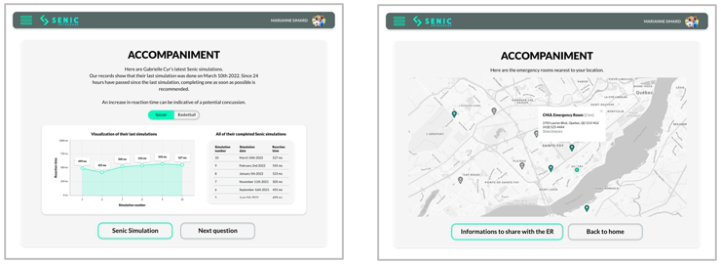
ENTOURAGE: Empowerment in the Management of Concussion Sports participation has deep positive impacts on individuals, communities and societies, including improvements in academic performance, lower risk of cardiovascular diseases and lower absenteeism (Torres et al., 2022). However, the benefits related to sports are overshadowed by insufficient safety precautions and injury prevention practices, which, in turn, can lead to negative socioeconomic impacts. Hallock et al. (2023) advocate for more ecologically valid and accessible management tools that engage athletes and their support networks in monitoring recovery and adherence to protocols. ENTOURAGE builds on the insights gained from SENIC to extend concussion management beyond evaluation, focusing on education and decision-making support for athletes, parents, and coaches. By offering real-time insights and integrating seamlessly with SENIC data (see Figure 5), the main goal of ENTOURAGE is to empower community stakeholders with the tools necessary for informed decision-making in stressful situations (see Sabouret et al., 2015).
Figure 5: User interface of the decision-support module of ENTOURAGE.
The application will provide an educative opportunity to discuss the significance of the injury with the athlete by allowing significant members of the athlete’s entourage to access game results using their own device. Parents and coaches of young recreational athletes would have an accessible tool to gain a comprehensive understanding of the cognitive and behavioral changes related to concussions in order to be supportive and empowering agents in his/her recovery. The complementary design of SENIC and ENTOURAGE reflects a unified framework aimed at democratising access to effective concussion management tools in team sports (see Table 2).
Table 2: Synergies between ENTOURAGE and SENIC.
Table available in the original PDF paper.
ENTOURAGE SENIC
Digital, ecological and immersive
To facilitate concussion management and empowers the athlete and their supporting network solution for the objective and non-invasive assessment and monitoring of concussion-related symptoms For parents, volunteer coaches and their
For Healthcare Professionals (HP)
entourage Divided into 3 modules: Awareness
Provides an assessment and decision
through simulation, education and personalized decision support
Allows HP to promote ENTOURAGE in
support tool for returning to play decisions via simulation The education module allows SENIC order to inform and raise awareness users to suggest content – for example, a vignette developed by a sports medicine clinic
The decision tree in the accompaniment
ENTOURAGE users can present a quick factsheet with their case history to clinics not using SENIC
module allows the creation of a case history that can by automatically transferred to SENIC
Cognitive Science and Information Technologies in Team Sports 59
CONCLUSION
The overarching program relies on a shared approach across these tools, characterized by the use of artificial intelligence, gamification, and user- centered design to enhance cognitive engagement and ecological validity. Each application addresses the specific cognitive and practical challenges of team sports, emphasizing the importance of adaptive, contextually relevant solutions for both performance optimization and safety enhancement. By combining interdisciplinary research with advanced information technology, our program underscores the transformative potential of cognitive science in addressing complex challenges in team sports.
ACKNOWLEDGMENT
This work was supported by grants from the National Sciences and Engineering Research Council of Canada (NSERC), the Ministère de l’Économie et de l’Innovation du Québec (MEI), and Prompt Québec awarded to Sébastien Tremblay. Special thanks to Steven Thomas (lead developer), Vicky Bacon (UX designer), and the coaching staff of the Rouge et Or varsity Football and Soccer teams. We are also grateful to all the students involved in data collection.
REFERENCES
Croteau, C., Chamberland, C., Patry, M., Frémont, S. and Tremblay, S. (2024). 3.5 SENIC: A sport concussion assessment and empowerment tool based on serious gaming. British Journal of Sports Medicine, 58, A17. Damaševiˇcius, R., Maskeli¯unas, R. and Blažauskas, T. (2023). Serious Games and
Gamification in Healthcare: A Meta-Review. Information, 14(2), pp. 105. Demetriades, A. K., Shah, I., Marklund, N., Clusmann, H. and Peul, W. (2024).
Sport-related concussion in soccer –a scoping review of available guidelines and a call for action to FIFA & soccer governing bodies. Brain and Spine, 4, 102763. Diaz-Orueta, U., Blanco-Campal, A., Lamar, M., Libon, D. and Burke, T. (2020).
Marrying past and present neuropsychology: Is the future of the process-based approach technology-based? Frontiers in Psychology, 11, 361. Hallock, H., Mantwill, M., Vajkoczy, P., Wolfarth, B., Reinsberger, C., Lampit, A. and Finke, C. (2023). Sport-Related Concussion: A Cognitive Perspective. Neurology Clinical Practice, 13(2), e200123. Hodgetts, H. M., Packwood, S., Vachon, F. and Tremblay, S. (2023). A microworld
simulation of dynamic cognition as a test of executive function. Journal of Clinical and Experimental Neuropsychology, 45(2), pp. 165–181. Hultberg, P. T., Calonge, D. S. and Lee, A. E. S. (2018). Promoting long-lasting learning through instructional design. Journal of the Scholarship of Teaching and Learning, 18(3), pp. 26–43. Liebel, S. W., Van Pelt, K. L., Pasquina, PF., McAllister, T. W., McCrea, M. A.,
Broglio, S. P., Svoboda, S., Susmarski, A., Rowson, S., Port, N., Putukian, M., Ortega, J., Mils, C., Mihalik, J., McGinty, G., McDevitt, J., Master, C., Lintner, L., Langford, D., … Anderson, S. (2024). Sport-Specific Recovery Trajectories for NCAA Collegiate Athletes Following Concussion. Annals of Biomedical Engineering, 52(10), pp. 2794–2802.
McDaniel, M. A., Fadler, C. L. and Pashler, H. (2013). Effects of spaced versus massed training in function learning. Journal of Experimental Psychology: Learning, Memory, and Cognition, 39(5), pp. 1417–1432. Murray, N. G., Szekely, B., Islas, A., Munkasy, B., Gore, R., Berryhill, M.
and Reed-Jones, R. J. (2020). Smooth Pursuit and Saccades after Sport-Related Concussion. Journal of Neurotrauma, 37(2), pp. 340–346. Naughton, M., Salmon, P. M., Compton, H. R. and McLean, S. (2024). Challenges and opportunities of artificial intelligence implementation within sports science and sports medicine teams. Frontiers in Sports and Active Living, 6, 1332427. Patricios, J. S., Schneider, K. J., Dvorak, J., Ahmed, O. H., Blauwet, C.,
Cantu, R. C., Davis, G. A., Echemendia, R. J., Makdissi, M., McNamee, M., Broglio, S., Emery, C. A., Feddermann-Demont, N., Fuller, G. W., Giza, C. C., Guskiewicz, K. M., Hainline, B., Iverson, G. L., Kutcher, J. S., … Meeuwisse, W. (2023). Consensus statement on concussion in sport: The 6th International Conference on Concussion in Sport–Amsterdam, October 2022. British Journal of Sports Medicine, 57(11), pp. 695–711. Pivec, M., Hable, B. and Coakley, D. (2012). Serious sports: Game-based learning in sports. In Proceedings of the 15th International Conference on Interactive Collaborative Learning (ICL), pp. 1–4. Powell, D., Stuart, S. and Godfrey, A. (2021). Sports related concussion: An emerging
era in digital sports technology. Digital Medicine, 4(1), 164. Sabouret, N., Schuller, B., Paletta, L., Marchi, E., Jones, H. and Youssef, A. B.
(2015). Intelligent user interfaces in digital games for empowerment and inclusion. In Proceedings of the 12th International Conference on Advances in Computer Entertainment Technology, pp. 1–8. Sullivan, L., McKenzie, L. B., Roberts, K., Recker, R., Schwebel, D. C., Pommering, T. and Yang, J. (2023). A Virtual Reality App Intervention to Improve Concussion Recognition and Reporting in Athletes Aged 9 to 12 Years: Development and Pilot Testing. JMIR Formative Research, 7, e43015. Torres, W., Maillane-Vanegas, S., Urban, J. B. and Fernandes, R. A. (2022). Impact of
sports participation on cardiovascular health markers of children and adolescents: Systematic review and meta-analysis. World Journal of Clinical Pediatrics, 11(4), pp. 375–384. Vorstandlechner, M., Gelautz, M. and Putz, C. (2017). Digital Playbook—A Teaching Tool for American Football. Electronic Imaging, 29(16), pp. 38–44. Wang, Z., Veliˇckovi´c, P., Hennes, D., Tomašev, N., Prince, L., Kaisers, M.,
Bachrach, Y., Elie, R., Wenliang, L. K., Piccinini, F., Spearman, W., Graham, I., Connor, J., Yang, Y., Recasens, A., Khan, M., Beauguerlange, N., Sprechmann, P., Moreno, P., … Tuyls, K. (2024). TacticAI: An AI assistant for football tactics. Nature Communications, 15(1), 1906.
LISTED IN THE AHFE DIGITAL BOOKSTORE CATALOGUE
Explore the complete digital volume
Human Interaction and Emerging Technologies (IHIET-FS 2025): Future Systems and Artificial Intelligence Applications
Read this individual research paper free through the original publisher, or explore the full digital proceedings book.
ISBN 978-1-964867-72-4
Explore this ISBN in the AHFE Bookstore ↗Listed in the July 2026 bookstore catalogue; search by ISBN to confirm current availability · Digital book purchase optional