Chenxi Yan, Yuntian Zhang (2025). Constructing Hybrid-Driven Agents for MOBA through Player Modeling: Integrating Behavioral Analysis and Narrative Persona in Human-Centered AI. In: Human-Computer Interaction & Emerging Technologies. AHFE Open Access, vol. 195, pp. 276–284. https://doi.org/10.54941/ahfe1006246
To address the challenges of rigid behavioral patterns, lack of semantic consistency, and insufficient emotional interaction in current MOBA game AI agents, this study proposes a Persona-Driven Game AI Agents (PDGAIA) framework based on the Human-Centered AI (HCAI). The framework integrates Dual-Channel Player Profiling, a Narrative Consistency Engine, and Hierarchical Reinforcement Learning (HRL) to enhance the personalization, immersion, and tactical adaptability of game AI. Using Tencent’s MOBA game Honor of Kings as a case study, player personas are constructed from large-scale match logs and survey data. By combining objective behavioral indicators and subjective psychological modeling, core player personality dimensions and their tactical preferences are identified. Based on narrative strategies, the player-modeled character prototypes are transformed into AI agents with consistent personas, leveraging Hunyuan LLMs for multimodal expression. An HRL framework is then employed to decouple tactical decision-making from action execution, enabling the development of stylized AI combat systems. This framework successfully ensures a coherent persona expression across combat behavior, voice tone, and tactical communication. Experimental results demonstrate that the dual-path approach, which combines data-driven modeling and narrative persona construction, significantly improves anthropomorphism and social presence, delivering a more immersive and intelligent gaming experience. The proposed framework provides a reusable HCI methodology for constructing Game AI agents.
In recent years, breakthroughs in Large Language Models (LLMs) and deep learning-driven game bot technologies have facilitated a paradigm shift in game AI agent design, transitioning from static rule-driven NPCs to dynamic, personalized, and socially intelligent agents (Alvarez & Vozaru, 2019; Chen et al., 2024). This transformation signifies the transition of game AI from a mere task execution tool to an emotional interaction partner. Due to its game mechanics involving multi-agent competition and cooperation, imperfect information, complex action control, and a vast state- action space, Multiplayer Online Battle Arena (MOBA) games are regarded
Constructing Hybrid-Driven Agents for MOBA Through Player Modeling 277
as a prime testbed for artificial intelligence research (Silva & Chaimowicz, 2017; Robertson & Watson, 2014). Representative MOBA games include Honor of Kings, League of Legends, and Dota 2.
However, traditional AI systems based on Behavior Trees and Supervised Learning still exhibit significant limitations in MOBA scenarios (Berner et al., 2019). First, single-objective optimization frameworks (e.g., maximizing win rate) result in rigid behavioral patterns, lacking stylized tactical expression (Ye et al., 2020). Second, the separate training of action execution modules and language generation systems leads to a lack of semantic consistency between combat behavior and tactical communication. Finally, traditional NLP-based dialogue models struggle to support open-domain personalized interactions, resulting in a deficiency in emotional engagement.
To address these challenges, this study proposes the Persona-Driven Game AI Agents (PDGAIA) framework, grounded in the Human-Centered Artificial Intelligence (HCAI) paradigm (Shneiderman, 2022). The framework enables a transition from functional to personality-driven game AI through three key technological innovations. First, Objective Behavioral Metrics and Subjective Psychological Modeling are integrated into a Dual-Channel Player Profiling mechanism. Second, a Narrative Consistency Engine is employed to transform player-modeled character prototypes into AI agents with coherent personas. Finally, a Hierarchical Reinforcement Learning (HRL) architecture is constructed to support hierarchical behavioral simulation (Song et al., 2021).
RELATED WORKS Existing research on MOBA-specific player modeling primarily focuses on extracting behavioral insights from game data. Zhang et al. (2021) employed deep neural alignment models to train AI agents that exhibit human-like teammate behavior, demonstrating human-agent adaptivity in Honor of Kings. Similarly, Ahmad et al. (2019) applied spatio-temporal clustering and Interactive Behavior Analytics (IBA) in games like Dota 2 to extract strategic decision-making and team coordination metrics. Expanding on this modeling approach, Santos et al. (2019) and Habibi et al. (2023) incorporated psychological analysis of in-game behaviors, proposing methods to infer personality traits from gameplay telemetry and affective cues. These studies highlight potential pathways for integrating emotional and psychological dimensions into MOBA AI agents.
Parallel advancements in interactive storytelling and narrative persona adaptation aim to align AI decision-making with player personas by adjusting in-game narratives based on individual preferences. Dynamic storytelling systems can adapt in real time according to player engagement patterns (Thue et al., 2007), while Ramirez and Bulitko (2012) extended this approach by incorporating player emotions and AI agents into adaptive narrative trajectories. Although these systems effectively customize interactive storytelling experiences in role-playing games (RPGs), their applications in MOBA environments remain underexplored, where real- time strategic decision-making dictates structured narrative sequences.
278 Yan and Zhang
Additionally, Holmgård et al. (2014) introduced procedural personas as a means of simulating player archetypes for predictive decision modeling, emphasizing the potential of narrative persona-driven AI behavior adaptation in MOBA games.
To integrate these advancements with Human-Centered AI, recent studies have explored AI-human collaboration frameworks within MOBA environments. Gao et al. (2023) introduced the Meta-Command Communication framework, an interpretable AI system designed to enhance coordination and adaptability in MOBA team dynamics. Building on this, Gao et al. (2024) proposed Reinforcement Learning from Human Gain (RLHG), shifting the AI optimization paradigm from performance-driven to human experience-driven enhancement. These approaches underscore the role of explainability and human alignment in MOBA AI. Moreover, incorporating emotional states into NPC decision-making has proven effective, marking a shift toward adaptive, emotionally responsive AI entities capable of delivering more immersive and intelligent gaming experiences.
METHODOLOGY
This section describes our method in dual-channel player portrait construction and AI agent construction. Data and results are also presented.
Dual-Channel Player Portrait Construction Objective Behavioral Metrics User behavior data is extracted from the match logs and activity traces of Honor of Kings’ billion-level users. A system of indicators comprising nine major dimensions and more than 260 sub-items has been constructed (Table 1). Most of the listed indicators originate from long-accumulated business logging needs, making them micro-level and discrete. Due to inconsistencies in standardization, these indicators are difficult to integrate into a mixed model for effectively clustering different typical player groups. To address this issue, a motivation model based on players’ real responses and focusing on macro categories is introduced as the ground truth for selecting classification algorithms.
Constructing Hybrid-Driven Agents for MOBA Through Player Modeling 279
Subjective Psychological Model Incorporating expert knowledge from game designers, Nick Yee’s (2006) model of player motivations in online games (Table 2) has been improved. A questionnaire including seven basic information items and twelve 11-point Likert scale items is developed. Through stratified sampling, 13,201 valid responses were collected, with low-confidence samples removed based on response duration. To verify data quality, imbalance rates and Gini coefficients of individual scale data distributions are calculated to assess response sparsity. The core validation metrics are presented in Table 3.
Table 2: MOBA player motivation model.
Table available in the original PDF paper.
Dimension Game Motivation
Game Behavior High-Score Tendency
Low-Score Tendency Action Combat Playstyle Aggressive Offense Conservative Growth Control Hero Selection Showcasing Skills Simple and Direct Mastery Strategy Pre-Match Planning Tactical Mastery Passive Approach In-Match Tactics Unconventional
Stable Execution Moves Social Competition Mode Selection Striving for the Top Play for Fun Communication Style Active Commanding Cooperative
Following Cooperation Playstyle Team Collaboration Solo Play Coordination Achievement Collection Resource Collection Complete Set Casual Collection
Collection Immersion Aesthetics Aesthetic Pursuit Emphasis on Focus on Gameplay Aesthetics
Narrative Narrative Engagement Story-Driven Mechanism-Focused Creativity Design Personal Expression Individual Sharing Fixed Participation Exploration New Content Early Adopter Loyal Focus
Expansion
Table 3: Category balance of subjective motivation model.
Consistent AI Agent Construction Based on Dual-Channel Hybrid Modeling Character Archetype Mining Using the 216 objective behavioral metrics of questionnaire respondents as feature inputs, the model fits the twelve subjective scale items. A reverse-construction mining model is implemented to achieve a complete prediction of any user’s subjective motivation tendencies without requiring questionnaire responses while identifying the importance distribution of
280 Yan and Zhang
various gaming behaviors. A five-fold cross-validation is performed, and the classification results’ top and bottom 30% are mapped using 0–1 normalization, yielding an average AUC of 0.8408 (Table 4).
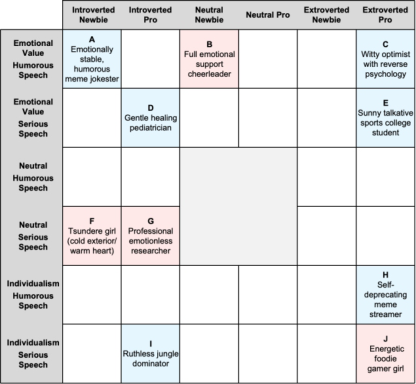
Subsequently, by comparing clustering results from dual-channel data and incorporating expert knowledge from narrative designers, a four- dimensional, thirty-six-quadrant character archetype matrix is identified, including introversion-extroversion (with neutral), high skill-low skill, emotional value-individualism (with neutral), and serious speech-humorous speech. Additionally, a five-role (crash, jug, supp, mid, farm) by three-style (radical, converse, grow) model is cross-mapped.
Narrative Expression First, ten differentiated AI character archetypes are extrapolated from the edge quadrants of the character matrix (Figure 1). Designers then draft background stories based on the selected archetypes, systematically constructing more than twenty persona elements, including personality tags, playstyle, voice characteristics, language habits, signature lines, narrative background, and dialogue templates. This framework simultaneously guides voice feature selection and dialogue style prompt generation. Ultimately, personalized voices are generated using the GiiNEX engine’s zero-shot voice cloning technology, while scenario-based dialogue generation is achieved through Tencent Hunyuan LLMs (Li et al., 2024) 7B-MoE-RolePlay. The process forms a complete closed-loop from character archetype design to narrative template generation and multimodal expression.
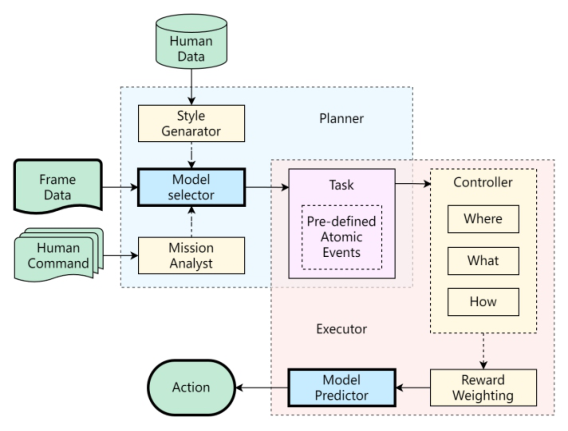
Behavioral Expression Hierarchical Reinforcement Learning (HRL) is a reinforcement learning method that decomposes complex tasks into more manageable subtasks, simplifying the learning process through a hierarchical structure (Nachum et al., 2018). Referring to HRL, a dual-network structure is designed to decouple tactical decision-making from strategic style (Figure 2). The upper- level style network (planner) samples human data based on the clustering
Constructing Hybrid-Driven Agents for MOBA Through Player Modeling 281
results obtained from dual-channel portrait modeling and constructs a diverse StyleGenerator using imitation learning methods. A Meta-RL framework is adopted to dynamically adjust the policy space, while the value network references interactive Mission interventions to weigh combat behavior Task decisions. The lower-level operation network (executor) is constructed based on the micro-operation reinforcement learning paradigm developed by Ye et al. (2020). Specifically, the upper-level Task is decomposed into Where, What, How triplets (Silver, 2019) as feature inputs to dynamically adjust reward weights, thereby influencing model decisions.
Figure 1: AI character matrix.Figure 2: PDGAIA HRL model structure.
282 Yan and Zhang
EXPERIMENTS AND EVALUATION Behavioral Divergence Verification
By segmenting matches into early, mid, and late stages based on time, we developed over 20 combat behavior feature indicators across three dimensions: strategic direction, behavioral tendencies, and activity range. In 10,000 self-play matches, the 10 AI character types generated by this framework exhibited significant differences from the baseline model. For instance, in terms of early-game support actions, converse_supp style (0.82) outperformed radical_jug style (0.79), grow_farm style (0.68), and the baseline (0.53). Similarly, in team command response rate, character E (93%) ranked highest, followed by character G (78%), the baseline (66%), and character I (42%).
Player Perception Evaluation Building on the integration of Flow Theory (Csikszentmihalyi, 1990) and the Three-Factor Theory of Anthropomorphism (Epley et al., 2007), a theoretical foundation for evaluating player perception of game AI was established. Flow Theory explains the dynamic mechanism of narrative immersion through Challenge-Skill Balance (Csikszentmihalyi, 1990), while Anthropomorphism Theory distinguishes the synergy between Hot Cognition Resonance (emotional needs) and Cold Cognition (teamfight decision-making) (Caporael & Heyes, 1997). Together, these theories support the perception of Social Presence in AI, avoiding the traditional dichotomy between mechanical behavior and human-like interaction. This framework aligns with the improved player motivation model proposed in this study and is suitable for evaluating player perception. Specifically, the Godspeed Anthropomorphism Scale (Bartneck et al., 2009), validated in esports settings, and the Social Presence subscale of the Game Experience Questionnaire (GEQ) (IJsselsteijn et al., 2013) were adopted, with modifications made to accommodate the characteristics of MOBA games.
A total of 120 experienced Honor of Kings players (rank mean x = Starry Glory I, with an sub-rank standard deviation σ> 5) were recruited. Under double-blind conditions, each participant played 15 standard matches in teams with either the PDGAIA-generated AI (experimental group) or the behavior tree AI (control group). After each match, a dynamic anchoring rating method was employed, using professional player recordings as the benchmark of fully human (5 points) and traditional SL bot as the benchmark of mechanical behavior (1 point). Players were required to rate AI performance in real-time on a 5-point Likert scale. Data analysis revealed that the experimental group significantly outperformed the control group in Anthropomorphism (M = 4.62 vs. 4.05, p < 0.001, Cohen’s d = 0.92) and Social Presence (M = 3.81 vs. 2.97, p < 0.001), supporting the hypothesis that the PDGAIA-generated AI is superior to the behavior tree AI agent.
CONCLUSION
This study proposes and validates a hybrid-driven construction paradigm for MOBA Persona-Driven Game AI Agents (PDGAIA). The triadic HCAI
Constructing Hybrid-Driven Agents for MOBA Through Player Modeling 283
architecture—integrating dual-channel persona-narrative enhancement with hierarchical behavior design—overcomes the limitations of traditional single- objective MOBA AI optimization. For the first time, it achieves dynamic alignment between AI behavioral styles and narrative personas, offering a novel approach to anthropomorphic game AI design. Experimental results show that PDGAIA-generated AI characters (10 distinct types) exhibit significantly stronger behavioral differentiation than baseline models. Additionally, this framework enhances both the human-like qualities of AI agents and player immersion, while establishing an extensible technical foundation for human-centric game AI. Future work will focus on dynamic personality evolution and cross-game character adaptation, promoting the continuous evolution of game AI from instrumental intelligence to emotional intelligence.
ACKNOWLEDGMENT
This study was supported by the technical assistance of Tencent AI Lab’s GiiNEX AI-Driven Engine. We also would like to thank the data science team of the Honor of Kings project group for providing user tag data and questionnaire implementation support involved in the dual-channel persona modeling process.
REFERENCES
Ahmad, S., Bryant, A., Kleinman, E., Teng, Z., Nguyen, T. H. D., & Seif El-Nasr, M. (2019, October). Modeling individual and team behavior through spatio- temporal analysis. In Proceedings of the Annual Symposium on Computer-Human Interaction in Play (pp. 601–612). Alvarez, A., & Vozaru, M. I. R. U. N. A. (2019). Perceived behaviors of personality-
driven agents. In Violence, Perception, Video Games: New Directions in Game Research (pp. 171–184). transcript Verlag. Bartneck, C., Kuli´c, D., Croft, E., & Zoghbi, S. (2009). Measurement instruments for the anthropomorphism, animacy, likeability, perceived intelligence, and perceived safety of robots. International journal of social robotics, 1, 71–81. Berner, C., Brockman, G., Chan, B., Cheung, V., De˛biak, P., Dennison, C.,... &
Zhang, S. (2019). Dota 2 with large scale deep reinforcement learning. arXiv preprint arXiv:1912.06680. Caporael, L. R., & Heyes, C. M. (1997). Why anthropomorphize? Folk psychology and other stories. Anthropomorphism, anecdotes, and animals, 59. Chen, J., Wang, X., Xu, R., Yuan, S., Zhang, Y., Shi, W.,... & Xiao, Y. (2024).
From persona to personalization: A survey on role-playing language agents. arXiv preprint arXiv:2404.18231. Csikszentmihalyi, M., & Csikzentmihaly, M. (1990). Flow: The psychology of optimal experience (Vol. 1990, p. 1). New York: Harper & Row. Epley, N., Waytz, A., & Cacioppo, J. T. (2007). On seeing human: A three-factor
theory of anthropomorphism. Psychological review, 114(4), 864. Gao, Y., Liu, F., Wang, L., Lian, Z., Wang, W., Li, S.,... & Liu, W. (2023).
Towards effective and interpretable human-agent collaboration in moba games: A communication perspective. arXiv preprint arXiv:2304.11632.
284 Yan and Zhang
Gao, Y., Liu, F., Wang, L., Lian, Z., Zheng, D., Wang, W.,... & Liu, W.
(2024). Enhancing human experience in human-agent collaboration: A human- centered modeling approach based on positive human gain. arXiv preprint arXiv:2401.16444. Habibi, R., Pfau, J., & El-Nasr, M. S. (2023, September). Modeling player personality factors from in-game behavior and affective expression. In 2023 11th International Conference on Affective Computing and Intelligent Interaction Workshops and Demos (ACIIW) (pp. 1–8). IEEE. Li, Z., Zhang, J., Lin, Q., Xiong, J., Long, Y., Deng, X.,... & Lu, Q. (2024). Hunyuan-
dit: A powerful multi-resolution diffusion transformer with fine-grained chinese understanding. arXiv preprint arXiv:2405.08748. Nachum, O., Gu, S. S., Lee, H., & Levine, S. (2018). Data-efficient hierarchical reinforcement learning. Advances in neural information processing systems, 31. Ramirez, A., & Bulitko, V. (2012). Telling interactive player-specific stories and
planning for it: ASD+ PaSSAGE= PAST. In Proceedings of the AAAI Conference on Artificial Intelligence and Interactive Digital Entertainment (Vol. 8, No. 1, pp. 173–178). Robertson, G., & Watson, I. (2014). A review of real-time strategy game AI. AI Magazine, 35(4), 75–104. Santos, C. P., Hutchinson, K., Khan, V. J., & Markopoulos, P. (2019). Profiling
personality traits with games. ACM Transactions on Interactive Intelligent Systems (TiiS), 9(2–3), 1–30. Shneiderman, B. (2022). Human-centered AI. Oxford University Press. Silva, V. D. N., & Chaimowicz, L. (2017). Moba: a new arena for game ai. arXiv preprint arXiv:1705.10443. Song, H., Wang, Y., Zhang, K., Zhang, W. N., & Liu, T. (2021). BoB: BERT over
BERT for training persona-based dialogue models from limited personalized data. arXiv preprint arXiv:2106.06169. Thue, D., Bulitko, V., Spetch, M., & Wasylishen, E. (2007). Interactive storytelling: A player modelling approach. In Proceedings of the AAAI Conference on Artificial Intelligence and Interactive Digital Entertainment (Vol. 3, No. 1, pp. 43–48). Vinyals, O., Babuschkin, I., Czarnecki, W. M., Mathieu, M., Dudzik, A.,
Chung, J.,... & Silver, D. (2019). Grandmaster level in StarCraft II using multi- agent reinforcement learning. nature, 575(7782), 350–354. Ye D, Liu Z, Sun M, Shi B, Zhao P, Wu H, Yu H, Yang S, Wu X, Guo Q, Chen Q. Mastering complex control in moba games with deep reinforcement learning. InProceedings of the AAAI conference on artificial intelligence 2020 Apr 3 (Vol. 34, No. 04, pp. 6672–6679). Ye, D., Chen, G., Zhang, W., Chen, S., Yuan, B., Liu, B.,... & Liu, W. (2020). Towards
playing full moba games with deep reinforcement learning. Advances in Neural Information Processing Systems, 33, 621–632. Yee, N. (2006). Motivations for play in online games. CyberPsychology & behavior, 9(6), 772–775. Zhang, S. (2021). Towards Controllable Agent in MOBA Games with Generative
Read this individual research paper free through the original publisher, or explore the full digital proceedings book.
ISBN 978-1-964867-71-7
Explore this ISBN in the AHFE Bookstore ↗Listed in the July 2026 bookstore catalogue; search by ISBN to confirm current availability · Digital book purchase optional