Sakura Akahoshi, Kengo Shintani, Yota Sekiguchi, Tomoya Sakata, Samuel Sanjaya, Makoto Itoh (2025). Brand Perception and Trust in Autonomous Vehicle Brands in Japan. In: Advances in Human Factors of Transportation. AHFE Open Access, vol. 186, pp. 332–339. https://doi.org/10.54941/ahfe1006522
While autonomous driving technology is expected to become a new mobility, brand trust, and image play an important role in users. In this study, we aimed to clarify the trust and image of specific AV brands and users. We surveyed 25 brands from Asia, Europe, and the U.S. to investigate the impact of trust, brand image, and word images. As a result, Japanese companies were ranked as the most trusted brands, and brand recognition greatly impacted trust. In addition, brands with low recognition are less likely to gain trust, and differences in brand image are also related to trust. From there, we concluded the following: (1) Japanese companies are highly trusted in AVs manufacturing. (2) Higher brand recognition correlates with greater trust, as participants were likelier to trust brands they recognized well. (3) Words like "honest," "responsible," and "trustworthy" were strongly linked to trusted brands.
In recent years, autonomous driving technology has rapidly evolved and is attracting attention due to the expectation that it will bring social benefits such as reducing traffic accidents and making travel more efficient (Tsai et al., 2019; Othman, 2022). However, users do not always immediately accept new technologies. When introducing autonomous driving, technical performance, consumer trust, and the image of the vehicle brand are expected to play a significant role.
Previous studies have shown that increased trust in a brand reduces risk perceptions of technological innovation and increases the willingness to use and purchase new technologies (Basgoze, 2012; Planing, 2011). In particular, it is known that when using computerized systems, users make decisions based on systems that they have built trust in (Lee and Moray, 1992, 1994; Lewandowsky et al., 2000). This is also true for AVs, and building trust is considered essential for users to accept and use AVs.
In addition, in the automotive industry, vehicle reliability is closely related to safety perceptions (Peter and Ryan, 1976), and it is believed that the reliability of technology will greatly affect users’ safety perceptions in autonomous vehicles as well. In fact, if users cannot trust autonomous technology, it will be difficult for them to fully enjoy its benefits, so trust
Trust in Images of Autonomous Vehicle Brands in Japan 333 plays an important role in technology acceptance (Parasuraman and Riley, 1997). Furthermore, Aaker (1991) emphasized the impact of brand-related memories on consumer trust formation, stating that consumers need knowledge of the brand’s products in order to trust the brand. Therefore, brand recognition (i.e. familiarity), trust and credibility are likely to affect consumer acceptance of AV brands (Aaker, 1991; Clemer et al., 2018).
Based on these studies, this study aims to clarify the trust and image of specific brands and users regarding brands of AVs. Specifically, for each brand in Asia, Europe, and the U.S., the objectives were (1) to identify brands with high/low trust in autonomous vehicles and (2) to investigate the impact of the brand’s overall image on differences in trust in AVs.
METHOD
This study was approved by the Institute of Systems and Information Engineering ethics committee, University of Tsukuba (approval document: No. 2024R888).
Participants 66 individuals aged 18 or older participated in the survey conducted via Google Forms. Of these, 15 were excluded due to incomplete responses, leaving 51 valid responses. Among the participants, 41 males and 10 females aged between 18 and 30 (M = 23.0 years, SD = 2.18 years).
Materials
The selected autonomous vehicle brands (25 companies) and questions are shown in Tables 1 and 2. The target brands were narrowed down to 25, mainly from major automobile manufacturers in each country.
The brand image words were selected from the Brand Personality Dimensions proposed by Aaker (1997). This model is a method of classifying brand personality into five categories: “Sincerity,” “Excitement,” “Competence,” “Sophistication,” and “Ruggedness,” and thinking about which attributes the brand corresponds to. Based on this, we selected 13 words for this study.
Table 1: Autonomous vehicle brands.
Table available in the original PDF paper.
Country or Other Classifications Notation in the Paper Japan Company A, B, C, D, E, F Germany Company G, H, I, J, K the U.S. Company L, M, N Italy Company O, P Sweden Company Q England Company R Korea Company S
Continued
334 Akahoshi
Table 1: Continued Country or Other Classifications Notation in the Paper
Table available in the original PDF paper.
India Company T China Company U, V Subsidiaries, startups, etc. Company W (the U.S.), X (China), Y
(the U.S.)
Table 2: Questions.
Table available in the original PDF paper.
Categories Questions Basic properties Gender, Age, Regular driver’s license status, Driving frequency Trustworthy and untrustworthy brands If this brand developed your
autonomous car, please list each of the three brands you would trustworthy and untrustworthy. Brand recognition How much do you think you know about each brand you selected above? (1: Not at all familiar - 7: Very familiar) Brand image To what extent do you think the
following words apply to the image of each brand you selected above? “honest, sound, reasonable, trustworthy, responsible, reliable, innovative, cutting-edge, exciting, luxury, fashionable, intelligent, masculine.” (1: Not at all true, 7: Very true)
Procedure This study was conducted using Google Forms. Participants completed the Google Forms survey anonymously. Participants had the right to refuse to answer or to stop answering at any time.
Data Analysis To examine the relationship between brand trust and brand image for each brand, we further analyzed the differences in word associations between the trustworthy and untrustworthy groups based on brand recognition. In this analysis, we used a Mann-Whitney U test to compare the results.
RESULTS
Brand Trust
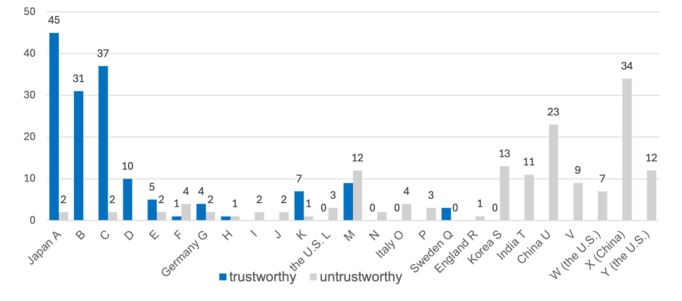
Figure 1 presents the results for the brands identified as trustworthy and untrustworthy (n = 153). Companies A, B, and C were frequently selected as trustworthy brands, accounting for three-quarters of the total. All three of these companies are Japanese companies. On the other hand, the brands
Trust in Images of Autonomous Vehicle Brands in Japan 335
perceived as untrustworthy were predominantly from Asia, Europe, and the U.S., except Company M (from the U.S.).
Figure 1: Trustworthy and untrustworthy brands.
Brand Recognition
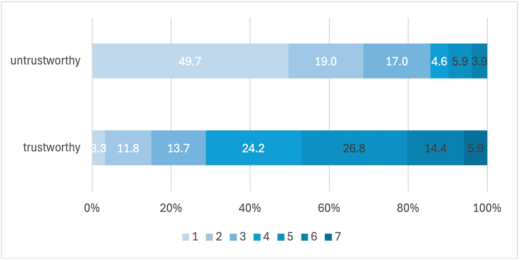
Figure 2 shows the distribution of brand recognition into trustworthy and untrustworthy brands. Regarding untrustworthy brands, about half of the respondents answered that they were “1: Not at all familiar,” while the range for trusted brands was relatively sparse, from “1: Not at all familiar” to “7: Very familiar.” This suggests that people tend to trust brands that they have known for some time when it comes to the development and sale of AVs.
Correlation Between Recognition and Brand Image To clarify the relationship between trust and brand image for each brand, we further analyzed the difference in word image between the trustworthy and untrustworthy groups according to brand recognition. The results are shown in Table 3. Among the samples who answered “untrustworthy,” no respondents answered “7: Very familiar” with the selected brand. Therefore, Table 3 shows brand recognition scores from 1 to 6.
Figure 2: Brand recognition (1: not at all familiar to 7: very familiar).
336 Akahoshi
Table 3: Difference in word image according to brand recognition.
Table available in the original PDF paper.
How much do you think you know about each brand? (1:Not at all familiar-7: Very familiar)
1 2 3 4 5 6
µ p µ p µ p µ p µ p µ p Honest Trustworthy 3.4 .243 4.39 <.001** 4.48 <.001** 5.14 .029* 5.2 .001* 5.55 .003* Untrustworthy 2.79 2.69 2.81 3.57 3.00 3.00
Trust, Recognition, and Image for AVs The results indicate a strong relationship between brand trust, brand recognition, and brand image in the context of autonomous vehicles. Japanese companies showed high levels of trust among participants. This indicates that in the Japanese market, companies that already have a proven track record of delivering high-quality products are perceived as more trustworthy in the development of autonomous driving technology.
Among foreign companies, German company K and the U.S. company M won high trust. The company K has a strong brand image in luxury cars and has earned trust in the Japanese market. This suggests that, like Japanese companies, brands that have long had a reputation for reliability with conventional vehicles are in an advantageous position to gain trust in the development of AVs. In Japan, Company M has an image of being a market leader in EVs. Although EVs are still in the early stages of adoption in the Japanese market, Company M’s technological capabilities and innovative brand positioning make it stand out from other the U.S. competitors.
Trust in Images of Autonomous Vehicle Brands in Japan 337
This shows that brand recognition and users’ perception of technological leadership and innovation have a significant impact on brand trust in the development of AVs.
Brand recognition also plays a crucial role in shaping trust. The participants’ recognition of trustworthy brands varied widely, ranging from unfamiliar to familiar. This contrasts with untrustworthy brands, where many participants reported minimal brand recognition. This indicates that recognition with a brand over time contributes to trust, especially in new technologies like AVs.
In terms of brand image, words such as “honest,” “responsible,”“reliable,” and “trustworthy” were more strongly associated with trustworthy brands, regardless of brand recognition level. This further reinforces the importance of these values in fostering user trust. On the other hand, words such as “luxury” showed no significant connection to trust, suggesting that a luxury brand image does not automatically translate into trust for AVs. Additionally, words like “cutting-edge” had limited significance, suggesting that being perceived as innovative or futuristic alone does not guarantee trust in the technology.
Advancing Research Into the Real World The findings of this study provide important insights for companies developing and marketing AVs. First, brands with established reputations for quality and safety in traditional vehicles can leverage their heritage to build user trust in autonomous driving technology. The analysis results show that brand recognition contributes significantly to building user trust, and that increasing recognition is particularly important for new and less well-known brands.
In addition, because brand image has a significant impact on building user trust, it is necessary to actively promote values that resonate with consumers, such as “sincerity,” “responsibility,” and “intelligence.” On the other hand, we found that simply emphasizing images such as “cutting-edge” and “luxury” does not necessarily gain user trust.
Limitations of This Study The limitations of this study are as follows:
(1) This survey was conducted in Japan. Most participants were Japanese, so they may be more familiar with Japanese companies and, therefore, more trusting of brands from their own country. (2) There were 51 valid responses, excluding incomplete responses. However, this represents a small number of opinions, and a more extensive survey is needed.
Future Studies Although this study was conducted mainly in Japan, collecting and comparing data on users’ brand trust and image in other countries would be beneficial. By investigating how cultural background and market maturity
338 Akahoshi
affect trust and brand image, a global perspective can be used to analyze the data.
CONCLUSION
This study aimed to identify brands with high and low trust in the development of AVs and to investigate the effect of differences in a brand’s overall image on trust in autonomous vehicle brands. The results showed the following: (1) Japanese companies are well-trusted in manufacturing AVs, and participants tend to have stronger trust in brands they have trusted for years. (2) It was confirmed that the greater the brand recognition, the greater the trust. In particular, participants who felt more recognition with the brand were more likely to trust it. (3) Words such as “honest,” “responsible,” “sound,” and “trustworthy” showed stronger associations with trustworthy brands, suggesting that participants place importance on trust and safety when it comes to AVs.
ACKNOWLEDGMENT
This work was supported by JSPS KAKENHI Grant Number 24H00361.
REFERENCES
Aaker, D. A. (1991). Managing brand equity: capitalizing on the value of a brand name. The Free Press, New York. Aaker, J. L. (1997). Dimensions of Brand Personality. Journal of Marketing Research,
34(3), 347–356. Ba¸sgöze, P. (2012). Effects of brand credibility on technology acceptance model adaptation of the model to the purchase intention, International Journal of Humanities and Social Science, 2(20), 292–298. Celmer, N. Branaghan, R. Chiou, E. (2018). Trust in Branded Autonomous
Vehicles & Performance Expectations: A Theoretical Framework. Proceedings of the Human Factors and Ergonomics Society Annual Meeting, 62(1), 1761–1765. doi:10.1177/1541931218621398. Lee, J. D., & Moray, N. (1992). Trust, control strategies, and allocation of function in human-machine systems. Ergonomics, 35(10), 1243–1270. doi:10.1080/00140139208967392. Lee, J. D., & Moray, N. (1994). Trust, self-confidence, and operators’ adaptation to automation. International Journal of Human-Computer Studies, 40(1), 153–184. doi:10.1006/ijhc.1994.1007 Lewandowsky, S., Mundy, M., & Tan, G. P. A. (2000). The dynamics of trust:
Comparing humans to automation. Journal of Experimental Psychology: Applied, 6(2), 104–123. Othman, K. (2022). Exploring the implications of autonomous vehicles: a comprehensive review. Innovative Infrastructure Solutions, 7(165). https://doi.org/10.1007/s41062-022-00763-6.
Trust in Images of Autonomous Vehicle Brands in Japan 339
Parasuraman, R., & Riley, V. (1997). Humans and Automation: Use, Misuse, Disuse, Abuse. Human Factors: The Journal of the Human Factors and Ergonomics Society, 39(2), 230–253. doi:10.1518/001872097778543886 Peter, J. P., Ryan, M. J. (1976). An Investigation of Perceived Risk at the Brand Level. Journal of Marketing Research, 13(2), 184–188. doi:10.1177/002224377601300210. Planing, P. (2011). The role of brand trust in the individual decision process towards
the use of new technologies: An empirical investigation. Psychology of Education Review, 35(1). Tsai, J. S. H. Juang, J. C. Tu, C. H. et al. (2019). Development of Key Technologies for Autonomous Driving Vehicles. In Proceedings of the 2019 International Automatic Control Conference (CACS). https://doi.org/10.1109/CACS47674. 2019.9024730
LISTED IN THE AHFE DIGITAL BOOKSTORE CATALOGUE
Explore the complete digital volume
Advances in Human Factors of Transportation
Read this individual research paper free through the original publisher, or explore the full digital proceedings book.
ISBN 978-1-964867-62-5
Explore this ISBN in the AHFE Bookstore ↗Listed in the July 2026 bookstore catalogue; search by ISBN to confirm current availability · Digital book purchase optional