Ting Wei, Yong Liu (2025). Recognising driver anger using multiple physiological signals. In: Advances in Human Factors of Transportation. AHFE Open Access, vol. 186, pp. 280–289. https://doi.org/10.54941/ahfe1006517
Anger is particularly important to recognise accurately and effectively as the most important negative emotion affecting driving safety and the driving experience. In this study, five physiological signals, namely RESP, ECG, EDA, PPG and EMG, were combined to identify driving anger, in order to construct a multi-physiological emotion recognition model and establish the correspondence between emotion and physiological indicators. The data were collected from the simulated driving experimental environment. Firstly, happy emotion, angry emotion and neutral emotion, were induced by driving contextual video stimulus materials and non-driving contextual video stimulus materials, and the effects of the induced anger emotions were compared. Second, physiological sensors were used to collect the physiological data of the subjects under different emotions, the SAM scale was filled in to measure the degree of emotion evoked in the subjects, and then one-to-one correspondence between the subjects' emotions and physiological indexes was carried out, so as to construct the physiological and emotional data sample library. Finally, three algorithms, namely, decision tree, support vector machine and LightGBM, were used to process the collected physiological data to further classify and identify the emotions. The results show that the recognition accuracy of the classification task is improved by 4.43% on comparing with the results before feature selection, and this method verifies that it is feasible to use the LightGBM model as the emotion recognition model, which can provide the technical implementation basis for the emotion prediction and emotion regulation model in the subsequent research.
Emotions play a crucial role in people’s daily lives, influencing not only how they express themselves but also their emotional states (Nasoz et al., 2010). Emotions impact a range of cognitive processes, including perception and organization of memory, categorization and preferences, goal generation, evaluation and decision-making, strategic planning, focus and attention, motivation and performance (Colquitt et al., 2000), intention, communication, and learning. The strong interface between emotions and cognition, as well as the influence of emotions on human performance in everyday tasks, necessitates the development of intelligent computer
Recognising Driver Anger Using Multiple Physiological Signal 281
systems capable of understanding users’ emotional states, recognizing their preferences and personalities, and responding accordingly.
As an essential part of affective artificial intelligence research, emotions have drawn increasing attention in the field of human-computer interaction (Harrison et al., 2007). Affective computing has emerged accordingly, which attempts to develop artificial intelligence with the capabilities of perceiving, understanding and regulating emotions. Studies on emotion have demonstrated that algorithms can successfully identify emotions from physiological signals (Picard et al., 2001; Westerink et al., 2008; Zhai and Barreto, 2006). The process of emotion recognition based on physiological signals primarily consists of emotion elicitation, physiological signal acquisition, preprocessing of physiological signals, feature extraction, and emotion recognition. Common machine learning algorithms currently in use include supervised learning methods such as the Naive Bayes Classifier, Support Vector Machine (SVM), K-Nearest Neighbor (KNN), and Decision Tree. LightGBM (Light Gradient Boosting Machine), a distributed gradient boosting framework based on decision tree algorithms (Guolin et al., 2017), is characterized by faster training speeds, lower memory usage, and the ability to handle large-scale data. Compared with conventional machine learning algorithms, LightGBM boasts significantly faster processing speeds and supports highly efficient parallel training.
Emotion elicitation is particularly critical in emotion recognition. Common methods of emotion elicitation include stimulus material induction and situational induction, each involving different types of materials and scenarios (Xiaolan, 2015). Stimulus material induction primarily involves presenting emotionally charged materials to participants to evoke corresponding emotions. Situational induction, on the other hand, creates different emotional experiences by manipulating contexts to elicit specific emotions. Currently, stimulus material induction is a more established method and includes visual stimuli (Uhrig et al., 2016) such as the International Affective Picture System (IAPS) (Lang et al., 2005) and the Chinese Affective Picture System (CAPS) (Lu et al., 2005), as well as video stimuli (Gross and Levenson, 1995; Koelstra, 2012). For instance, edited clips from television shows or movies that integrate visual and auditory sensations can more effectively induce emotions. Situational induction mainly involves simulated gaming scenarios and recall or imagination-based scenarios (Baker and Guttfreund, 1993; Janssen et al., 2013). Simulated gaming scenarios evoke real-context emotional experiences by engaging participants in gaming activities. For example, analyzing participants’ physiological indicators during gaming and asking them to report their emotional states can achieve the goal of emotion elicitation.
The present study aims to recognize emotions through physiological signals, with the ultimate goal of constructing a multimodal physiological signal-based emotion recognition model and establishing a correlation between emotions and physiological indicators. The specific objectives are as follows: First, to elicit three emotions—pleasure, anger, and neutrality—from participants. Second, to collect physiological data corresponding to different emotional states using physiological sensors, assess the degree of emotion
282 Wei and Liu
elicitation through subjective emotion rating scales, and establish a one-to- one correspondence between emotions and physiological indicators to build a physiological-emotion data repository. Finally, to employ machine learning algorithms to process the collected physiological data and further classify and recognize emotions.
EMOTION RECOGNITION IN DRIVING BASED ON PHYSIOLOGICAL SIGNALS Experimental Environment Setup
The experimental setup was established employing a driving simulation apparatus (Manufacturer: Gold Crown Electronic Technology Co., Ltd, named City Car Driving). The designated driving environment was a tranquil space of 2.5m*2.5m, with ambient temperature regulated to around 25
C and lighting conditions optimized for visibility, and good ventilation to ensure indoor air flow. The apparatus, as depicted in Figure 3, was composed of a stationary base driving simulator integrated with a display system. The simulator featured a steering wheel complete with a gas pedal, clutch, and brake pedal, complemented by gear and handbrake levers, all of which simulated the operational mechanics and ergonomics of an actual vehicle. The driving simulator was positioned in front of a display, which was facilitated through a Hewlett-Packard monitor (19 inches, resolution of 1920*1080 pixels, 60Hz). Two speaker devices met the audio playback requirements for the driving simulation, placed to the left and right of the monitor. The simulation environment utilized the 3D Instructor 2.0 software, with the car’s dashboard, rearview mirror, and left and right side mirrors displayed, allowing the driver to experience a more authentic driving sensation.
Physiological data from participants were collected using the ErgoLAB wearable multiparameter physiological recorder from Kingfar Technology. This device, equipped with a set of wearable sensors placed on various parts of the body, employs multi-sensor fusion technology and algorithms for monitoring physiological indicators. The sensors included a photoplethysmographic(PPG) sensor, an electrocardiogram (ECG) sensor, an electromyogram (EMG) sensor, an electrodermal activity (EDA) sensor, and a respiration (RESP) sensor. These sensors enabled real-time monitoring of respiratory rate, ECG changes, EDA changes, photoplethysmogram variations, and EMG activity. The wearable device ensured high-precision data collection while maintaining participant comfort, allowing continuous real-time monitoring of physiological parameters and human body states in natural or active conditions.
Participant Recruitment Participants were recruited through social media announcements within our university. Eligible participants were required to possess a valid driver’s license and have at least one year of driving experience. A total of 33 participants agreed to participate in the experiment, with ages ranging
Recognising Driver Anger Using Multiple Physiological Signal 283
from 23 to 33 years (mean age = 24.9 years, standard deviation = 2.3). All participants were graduate students, comprising 15 male and 18 female drivers with an average driving experience of 3.7 years (standard deviation = 2.63). None of the participants had visual or auditory impairments, and all had normal or corrected-to-normal vision. After signing the informed consent form, participants were briefed on the experimental procedure and guided through the process of wearing the physiological sensors. Participants were then required to follow the experimental steps to complete the tasks and fill out the Self-Assessment Manikin (SAM) scale. Upon completion of the experiment, participants received a monetary compensation.
Emotion Elicitation Materials Based on a review of the literature, video stimuli have been found to be more effective in eliciting target emotions compared to images or text. For the selection of materials to elicit pleasure and neutral emotions, comedy films and short clips with high ratings from public film libraries were chosen as stimuli for pleasure, while videos of landscapes and natural scenery without plot were selected to induce a calm emotional state. For eliciting anger, videos from real driving recorder footage containing scenarios such as malicious lane cutting and traffic violations were chosen as stimuli for anger in the driving context. Four staff members screened and organized the video materials based on these criteria. Ultimately, three videos each for pleasure, anger, and calm emotions were selected, with each video lasting approximately 2 minutes. This duration was chosen to effectively elicit the desired emotions while avoiding emotional fatigue in participants (Jingshi, 2021).
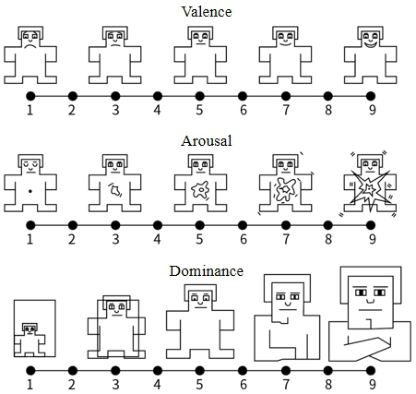
Experimental Design The experimental design and data collection were conducted using the ErgoLAB physiological testing platform software. Upon running the experimental program, participants were first presented with a set of instructions to read. After completing the reading, participants would signal by nodding, at which point the experimenter would begin recording physiological data, marking the official start of the experiment. Participants were then shown a video clip. During the viewing, if participants felt their emotions being aroused, they were instructed to press the “↓” key on the keyboard, with the software automatically recording the timestamp of the key press. After watching the video, participants were required to self-assess the elicited emotions using the SAM scale, which evaluates emotional states based on a 9-point scale across three dimensions: valence (pleasantness), arousal (level of activation), and dominance (degree of control) (see Figure 1). Participants were then given a 2-minute break to allow their emotions to return to baseline before proceeding to the next video. This process was repeated until all video clips in the first set were shown. Before starting the second set of experiments, participants were given a 10-minute break to alleviate visual fatigue and emotional fatigue. The same procedure was then followed for the second set of experiments, including physiological
284 Wei and Liu
data collection and completion of the subjective rating scales. After the experiment, participants were briefly interviewed to confirm the validity of all key-press moments and to delete any records resulting from accidental operations.
Figure 1: Emotional self-assessment Manikin.
RESULTS
Self-Reported Data Results A total of 33 participants were recruited to watch 18 video clips designed to elicit three emotional states: anger, neutral, and pleasure. Physiological signals, including ECG, EDA, EMG, RESP, and PPG, were simultaneously collected from the participants. After verifying the experimental and subjective data, six participants were excluded due to incomplete physiological data caused by electrode detachment or insufficient sensor battery power. Additionally, two participants were excluded due to incomplete participation in both sets of experiments, resulting in missing data. Consequently, data from 25 participants were fully recorded and used for analysis.
The subjective data from the SAM scale were imported into IBM SPSS 26.0 for analysis.
Reliability Analysis: The reliability of the SAM scale was assessed using Cronbach’s alpha. The overall reliability for the dimensions of arousal, valence, and dominance across anger, pleasure, and neutral was found to be 0.633, indicating acceptable reliability.
Normality Test: The normality of the data was assessed using a significance test. The resulting p-value was 0.031, which is less than 0.05. This suggests that the null hypothesis of normality should be rejected, indicating that the sample data do not follow a normal distribution. The median (quartile) values
Recognising Driver Anger Using Multiple Physiological Signal 285
revealed that the emotions of neutral, pleasure, and anger were successfully elicited. The results are shown in Table 1.
Physiological Data Results Data Synthesis and Emotion Labeling A total of nine emotion-inducing videos were used in the physiological experiment. Based on the timestamps recorded by participants using a keypress to mark moments of significant emotional arousal, these moments were identified as the peak instances of the respective emotions. For the analysis, a 20-second segment of physiological data was extracted, consisting of 10 seconds before and 10 seconds after the marked moment. The first 10 seconds represented the onset of the emotion, while the subsequent 10 seconds captured the sustained development of the emotion.
Given that the SAM scale is a 9-point rating scale, the arousal scores were categorized into three levels to better assess the effectiveness of emotion elicitation: low arousal (1-3), moderate arousal (4-6), and high arousal (7-9). Data with low arousal ratings were excluded, retaining only the valid data points. Ultimately, 380 samples of anger, 426 samples of pleasure, and 290 samples of neutral were obtained. Each sample included 20 seconds of physiological signals (ECG, PPG, RESP, EMG, and EDA) as well as the corresponding SAM scale ratings. By aligning the emotion categories from the SAM scale with the physiological data, supervised machine learning could be conducted using the emotion labels.
Preprocessing of Physiological Signals Due to complexity and susceptibility to interference from power frequency or other physiological signals, physiological signals are often weak and require preprocessing to ensure accurate analysis. In this study, physiological signals were preprocessed using the ErgoLAB physiological testing platform software, which offers a signal analysis module designed to preprocess signals for subsequent analysis and statistical evaluation (Ayata et al., 2020; Tamura et al., 2014).
Discrete Wavelet Transform (DWT) was employed for the preprocessing of physiological signals (Guoliang and Junchun, 2004). The primary objective
286 Wei and Liu
of using DWT was to remove noise and baseline drift from the signals. The equation for DWT is given by:
Equation reproduced from the original PDF.
where ψ∗
m,n (t) is the extension of the basic wavelet function ψ (t), m, n are the scale and translation parameters, respectively, the signal is projected on a two-dimensional plane after the wavelet transform, which is conducive to signal extraction.
Feature Extraction of Physiological Signals Feature extraction of physiological signals was conducted across three dimensions: time domain, frequency domain, and non-linear domain. For each emotion-inducing video, a total of 38 features were extracted from the five physiological signals. The primary features extracted included the maximum value, minimum value, mean, standard deviation, and variance.
Emotion Recognition Three machine learning algorithms—SVM, Decision Tree, and LightGBM— were selected for emotion classification to compare their reliability in emotion recognition. The classifiers were implemented using Python, with 70% of the data used for training and the remaining 30% used for validation. Ultimately, by tuning the parameters, a balance was achieved between reducing the number of features and improving recognition accuracy. This process yielded an effective feature set for emotion recognition, as shown in Tables 3–5.
Table 2: Effective feature set for emotion recognition.
Recognising Driver Anger Using Multiple Physiological Signal 287
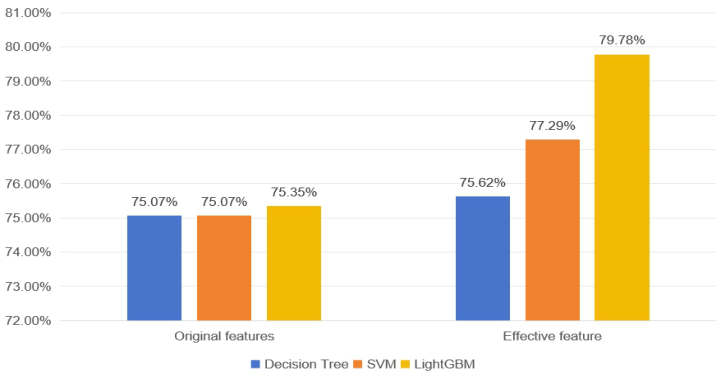
Generally, the effective features derived from PPG and EMG signals were more numerous, indicating that these two signals contribute more significantly to the classification of drivers’ emotions. This suggests that when a driver’s emotional state changes, PPG and EMG signals are more likely to be affected and exhibit changes, whereas other physiological indicators may show less pronounced variations. After the feature selection process, the classification accuracy was compared between the effective feature set and the original feature set, as shown in Figure 2. The results indicate that the accuracy improved after selecting the effective features, demonstrating the importance of feature selection in optimizing the recognition model and enhancing classification accuracy.
When comparing the classification results of the effective feature set across different models, it was observed that LightGBM achieved higher accuracy than both the Decision Tree and SVM models. This suggests that the LightGBM model is more effective for recognizing driving-related emotions.
Figure 2: Emotion recognition accuracy comparison between effective feature set and original feature set.
DISCUSSION
In this study, a driving anger recognition model was successfully constructed using multiple physiological signals (ECG, PPG, EDA, EMG, and RESP), and the superiority of the LightGBM algorithm in emotion classification was validated. The key findings are summarized as follows:
1. Effectiveness of Emotion Induction. Anger was effectively induced through driving-context videos (e.g., reckless lane-cutting, traffic violations), with its high arousal level (median SAM score of 8) significantly differing from neutral (median = 3) and pleasant emotions (median = 6). These results demonstrate the efficacy of driving-specific stimuli in emotion research.
288 Wei and Liu
2. Discriminative Capacity of Physiological Signals. PPG and EMG signals exhibited the highest sensitivity to emotional changes, contributing the most features to the effective feature set (12 for PPG, 11 for EMG). This suggests that these signals may hold greater practical value for real-time monitoring of driver emotions. 3. Model Performance. The LightGBM model achieved a 4.43% improvement in classification accuracy after feature selection, outperforming both Decision Tree and SVM. This indicates its enhanced suitability for processing high-dimensional, nonlinear physiological data.
The current study has several limitations. First, the sample size was limited (N = 25), and data were collected solely in a simulated environment. Future work should expand the participant pool and validate the model’s generalizability through real-road experiments. Additionally, a broader range of driving scenarios (e.g., traffic congestion, night driving) should be incorporated to diversify emotion induction conditions.
Next, long-term emotional patterns will be investigated to analyze the cumulative effects of anger on driving behavior. Further research should also address individual differences in physiological responses and explore hybrid emotion states (e.g., anger-anxiety) to refine recognition accuracy.
CONCLUSION
This study provides a detailed methodology for recognizing driving anger through a driving simulation experiment. Five physiological signals—ECG, PPG, EDA, EMG, and RESP—were analyzed, and a total of 105 emotional features were extracted across three dimensions: time domain, frequency domain, and non-linear domain. This process established a comprehensive original feature set based on multiple physiological signals. Subsequently, the Random Forest model was employed to identify 40 effective features that are more critical for emotional changes, thereby optimizing the feature set for emotion recognition. Decision Tree, SVM, and LightGBM algorithms were utilized for emotion recognition analysis. Due to limitations in sample size and time, the average classification improved by 4.43% compared to the results before feature selection. However, this method validated the feasibility of using the LightGBM model for emotion recognition. The findings lay a technical foundation for future research on emotion prediction and emotion regulation models.
ACKNOWLEDGMENT
The authors would like to acknowledge all the experimental participants for their contributions to the experimental data and the laboratory staff at the College of Arts, Wuhan Textile University for their help in data collection.
Recognising Driver Anger Using Multiple Physiological Signal 289
REFERENCES
Ayata D, Yaslan Y, Kamasak M E. Emotion Recognition from Multimodal Physiological Signals for Emotion Aware Healthcare Systems[J]. Journal of Medical and Biological Engineering, 2020: 40: 149–157. Bai Lu, Ma Hui, Huang Yuxia, et al. Development of the Chinese Mood Picture
System - a trial among 46 Chinese university students[J]. Chinese Journal of Mental Health, 2005, 19, 719–722. Baker R C, Guttfreund D O. The effects of written autobiographical recollection induction procedures on mood[J]. Journal of Clinical Psychology, 1993, 49(4):563. Colquitt J A, Lepine J A, Noe R A. Toward an integrative theory of training
motivation: A meta-analytic path analysis of 20 years of research[J]. Journal of Applied Psychology, 2000, 85(5): 678–707. Fu Xiaolan. Emotional Psychology[M]. Shanghai: East China Normal University Press, 2015:5. Gross J J, Levenson R W. Emotion elicitation using films[J]. Cognition and Emotion,
1995, 9(1): 87–108. Guo Jingshi. Machine Learning Based Emotion Recognition of ECG Signals[D].
Taiyuan: Shanxi University, 2021. Guolin K, Qi M, Thomas F, et al. LightGBM: a highly efficient gradient boosting decision tree[C]// New York, USA, Proceedings of the 31st International Conference on Neural Information Processing Systems, 2017: 3149–3157. Harrison S, Tatar D, Sengers P. The Three Paradigms of HCI[C]//California, USA,
SIGCHI Conference on Human Factors in Computing Systems, 2007: 1–18. Janssen J H, Tacken P, Vries J, et al. Machines Outperform Laypersons in Recognizing Emotions Elicited by Autobiographical Recollection[J]. Human- Computer Interaction, 2013, 28(5-6): 479–517. Koelstra S. DEAP: A Database for Emotion Analysis: Using Physiological Signals[J].
IEEE Transactions on Affective Computing, 2012, 3(1): 18–31. Lang P J, Bradley M M, Cuthbert B N. International Affective Picture System (IAPS): Affective ratings of pictures and instruction manual[R]. Gainesville: University of Florida, 2005. Nasoz F, Lisetti C L, Vasilakos A V. Affectively intelligent and adaptive car
interfaces[J]. Information Sciences, 2010, 180(20): 3817–3836. R. W. Picard, E. Vyzas, J. Healey, Toward machine emotional intelligence analysis of affective physiological state, IEEE Transactions on Pattern Analysis and Machine Intelligence 23 (10) (2001) 1175–1191. Tamura T, Maeda Y, Sekine M, et al. Wearable Photoplethysmographic Sensors—Past
and Present[J]. Electronics, 2014, 3(2): 282–302. Uhrig M K, Trautmann N, Baumgärtner U, et al. Emotion Elicitation: A Comparison of Pictures and Films[J]. Frontiers in Psychology. 2016, 7: 00180. Westerink J H, Ouwerkerk M, Overbeek T J M, et al, Computing emotion
awareness through galvanic skin response and facial electromyography[J]. Probing Experience 2008, 8:149–162. Zhai Z, Barreto A. Stress recognition using non-invasive technology[C]//Melbourne Beach, Florida, Proceedings 19th International Florida Artificial Intelligence Research Society Conference, 2006: 395–400. Zhao Guoliang, Yang Junchun. Noise rejection method of wavelets for ECG signal[J].
Journal of Harbin Eengineering University, 2004, 25(5): 1052–1060.
LISTED IN THE AHFE DIGITAL BOOKSTORE CATALOGUE
Explore the complete digital volume
Advances in Human Factors of Transportation
Read this individual research paper free through the original publisher, or explore the full digital proceedings book.
ISBN 978-1-964867-62-5
Explore this ISBN in the AHFE Bookstore ↗Listed in the July 2026 bookstore catalogue; search by ISBN to confirm current availability · Digital book purchase optional