Shinichi Fukushige (2025). Virtual teleportation into real spaces via digital avatars for remote collaborative design. In: Accessibility, Assistive Technology and Digital Environments. AHFE Open Access, vol. 162, pp. 21–28. https://doi.org/10.54941/ahfe1006009
Market globalization and the rapid evolution of customer requirements highly influence how the product design process must be performed. It is becoming increasingly important to consider usability, functionality, and visual harmony of products to be designed in the early design phases. Collaborative design in an immersive virtual environment (IVE) is a promising approach to enhancing the flexible cooperation of a geographically distributed design team. New ICT technologies have recently emerged that allow creating IVEs to facilitate synchronous and remote design review activities through easy interaction and data sharing among all participants. A virtual environment provides an immersive space where virtual actors (avatars) reproduce team members to achieve high presence, real-time communication, and remote collaboration. Though several collaborative software applications based on virtual reality (VR) technique have been developed to connect people and share design information in an IVE, in most cases, the artificial 3D environments do not represent real spaces. Basically, existing VR-based applications focus on inspection and modelling functions for analyzing target products thoroughly (i.e., rotate and manipulate CAD models, zoom, measure specific model items, add or delete some parts) based on 3D-CAD platforms. This study focuses on synchronous and remote design review meetings in a real space where a target product is installed and used. The technical review processes require tele-communication and mutual view sharing among remote reviewers and local collaborators. Examples include remote inspection for public infrastructure, superposition of a design concept over a real building for renovation, and remote machinery maintenance instruction. To improve a user’s perception of “being present in another real space,” the concept of virtual teleportation is introduced. This is a tele-conferencing and space sharing technology in which participants can remotely work together as if they were in the shared real space during communication. This paper proposes a simplified virtual teleportation system for the extemporary sharing of a real space and industrial products to be reviewed. This system combines augmented reality (AR) and VR to provide an IVE that enables reviewers in different geographic locations to communicate with other collaborators at a local site through their digital avatars. The users will feel as if they are looking, talking and meeting with each other face to face through their digital avatars in the real place. The system setup supports the remote evaluation of product design installed in a real space from the viewpoint and viewing angle of the avatars. Instead of performing real-time 3D reconstruction of the scene, the proposed system constructs a static IVE from panoramic images of the local site. This approach is simpler but still preserves the visible detail of the real space and the target equipment.
Globalising markets and rapidly evolving customer requirements are having a major impact on how products need to be designed. Considering usability, functionality and visual harmony of the products to be designed is becoming increasingly important in the early design phases. Collaborative design in an immersive virtual environment is a promising approach to enhancing the flexible cooperation of a geographically distributed design team. New ICT technologies have recently emerged that enable the creation of virtual environments to facilitate synchronous and remote design review activities through easy interaction and data sharing between all participants. The virtual environment provides an immersive space where virtual actors (avatars) reproduce team members to achieve high presence, real-time communication, and remote collaboration. Though several collaborative software applications based on virtual reality (VR) technique have been developed to connect people and share design information in a virtual environment (Germani et al., 2003), in most cases, the artificial 3D environments do not represent real spaces. Basically, existing VR-based applications focus on inspection and modelling functions for analysing target products thoroughly (i.e., rotate and manipulate CAD models, zoom, and or measure specific model items) based on 3D-CAD platforms (Feeman et al., 2018).
This study focuses on synchronous and remote design review meetings in a real space where a target product is installed and used. In many cases, such technical review processes require tele-conference and mutual
view sharing among remote reviewers and local collaborators. Application examples include remote inspection for public infrastructure, superposition of a design concept over a real building for renovation, and remote machinery maintenance instruction. A similar system, called Dynamics 365 Remote Assist (Microsoft, 2023) (Bansal et al., 2022), provides a communication service for remote instruction based on mixed reality platform. However, in this approach, the viewpoint of the remote user is fixed by the camera position of a local user’s headset (Ong et al., 2008).
To improve the user’s perception of being present in another real space, the introduction of tele-immersion technology (Gibbs et al., 1999)(Khan et al., 2016) is a promising approach. This is a tele-conferencing and space sharing system in which participants can remotely work together as if they were in the shared real space during communication. The users will feel as if they are actually looking, talking and meeting with each other face to face in the real place. However, the conventional tele-immersion requires the real-time reconstruction of 3D surfaces using stereo vision or depth sensing of the scene. This means multiple cameras or depth sensors must take rapid sequential shots of the same objects, continuously performing distance calculations to replicate real-time movement into the 3D environment (Kahlon, 2023). The 3D surfaces and movements of the users and objects are transferred and reconstructed in another space. Consequently, a high bandwidth network and high-performance computing is necessary because of the large amounts of data that tele-immersion produces (Ohi, 2018).
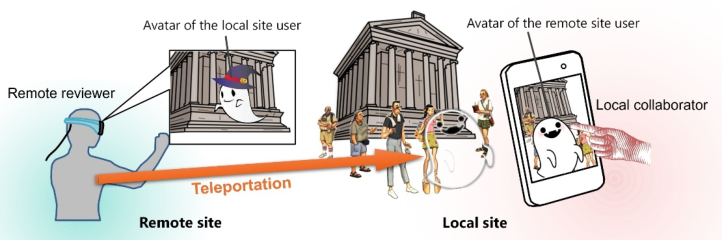
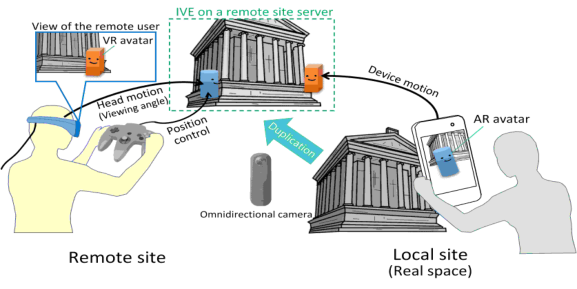
This paper hence proposes a simplified tele-immersion system for virtual teleportation into a remote real space and for extemporary sharing of equipment to be reviewed. This system combines augmented reality (AR) and VR to provide an immersive environment that enables reviewers in different geographic locations to immerse themselves into a remote site and to communicate with local collaborators at the site through their AR avatars as shown in Figure 1. The system setup supports the remote evaluation of the equipment from the viewpoint and viewing angle of the avatars. Instead of performing real-time 3D reconstruction of the scene, the proposed system constructs a static space virtualized from panoramic images of the local site. This virtual teleportation approach is simpler but still preserves the visible detail of the real space and the target equipment to be designed.
Figure 1: Communication between local and remote site users through their avatars.
Virtual Teleportation Into Real Spaces via Digital Avatars for Remote Collaborative Design 23
VIRTUAL TELEPORTATION SYSTEM FOR REMOTE DESIGN REVIEW Preprocessing
In a preprocessing phase, a collaborator at a local site takes panoramic pictures with an omnidirectional camera at arbitrary points around the equipment to be reviewed. The camera transcribes visual fields that cover the entire spheres at the exposure stations, and the spherical images are simultaneously transferred to a remote site.
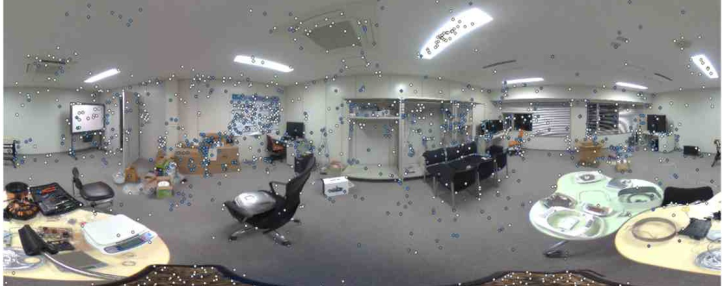
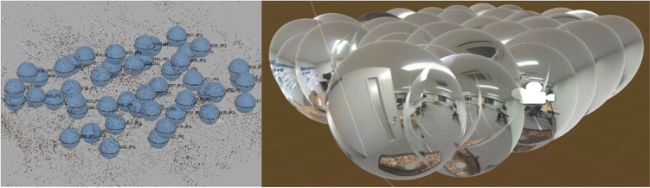
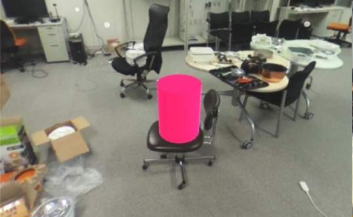
At the server of the remote site, a virtualized space of the local site is reconstructed from the omnidirectional images of the site. As shown in Figure 2, feature points in the spherical images are detected and matched among the images to compute the location of the camera stations and viewing angles using structure from motion (SfM) technique (Hartley and Zisserman, 2004). The images are mapped onto the inner face of sphere objects. The image spheres are rearranged in a cyber space to duplicate the real scene of the local site, as shown in Figure 3. In this configuration, virtual objects can be superimposed at the correct locations over the images from different viewpoints as shown in Figure 4, which is a major characteristic of this immersive environment.
Figure 2: Feature point detection and matching among spherical images.Figure 3: Rearrangement of image spheres in a cyber space to duplicate the static scene of a local site. (Left image) estimation of camera positions, (right image) image spheres rearranged to the camera positions.
24 Fukushige
Figure 4: A virtual object (cylinder) located in the same position seen from different viewpoints in a virtual space.
Virtual Teleportation to Local Site and Tele-Communication via Digital Avatars Using the system setup shown in Figure 5, viewers (remote site users) select their viewpoint and viewing angle from the centres of the spherical images so that they may move throughout the virtualized space of the local site where the target equipment is installed. In this study, “space sharing” refers to the creation of a static digital copy of a real space for remote reviewers to go around and the sharing of visual recognition among local and remote users.
The remote reviewer uses a VR headset to immerse himself/herself into the virtualized real space and communicate with the local collaborator, who uses a mobile device (e.g., smart phone or tablet PC). The motion of the VR avatar in the virtualized space corresponds with that of the device manipulated by the local user, and the avatar’s location and orientation respectively represent the viewpoint and view angle of the device camera in real space.
The AR avatar is controlled by the remote user to replace him/her as an actor in the real space of the local site, supporting conversation with local collaborators by indicating his/her viewpoint.
Figure 5: System overview of the virtual teleportation and tele-communication through digital avatars. The VR headset of a remote user displays digital twin of the local space and the VR avatar of the local user, while the mobile device of the local user displays the AR avatar of the remote user superimposed on the real video image of the local scene.
Virtual Teleportation Into Real Spaces via Digital Avatars for Remote Collaborative Design 25
CASE STUDY A case study was conducted to compare the proposed system named “TeleGhost” with a conventional mobile teleconference (MTC) system using a video camera attached on a tablet PC. Six participants, aging from 23–44 were communicate with each other using both the TeleGhost system and the reference MTC system.
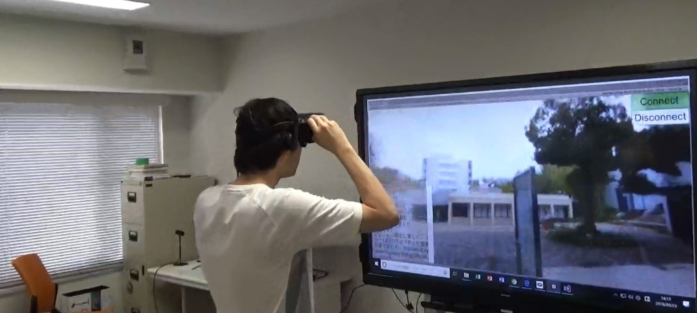
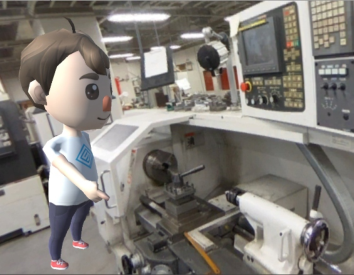
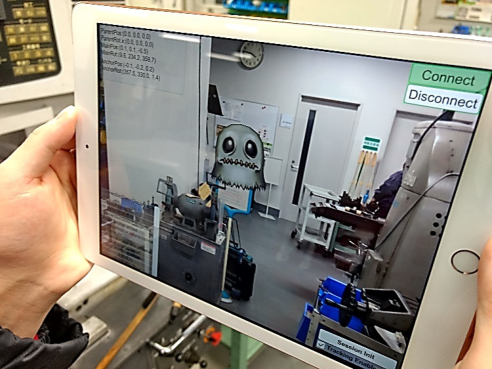
Figure 6 shows a remote site user who immerses himself into a local site by using VR headset. Figure 7 shows the view of the remote site user in the TeleGhost setup, where the VR avatar of the local site user is positioned at the local user in front of the machining centre which is the target equipment for review. The direction of the avatar face represents that of the mobile device in real space. The avatar points at a certain part of the machine to indicate his/her focus. The system cannot be applied to reviewing the dynamic behaviour of the machine, since the virtualized environment comprised of omnidirectional images is static. This is a limitation of the proposed approach. Figure 8 shows the AR avatar of the remote site user (reviewer), superimposed on the rear camera image of the mobile device. The head position of the avatar corresponds with the viewpoint of the remote reviewer.
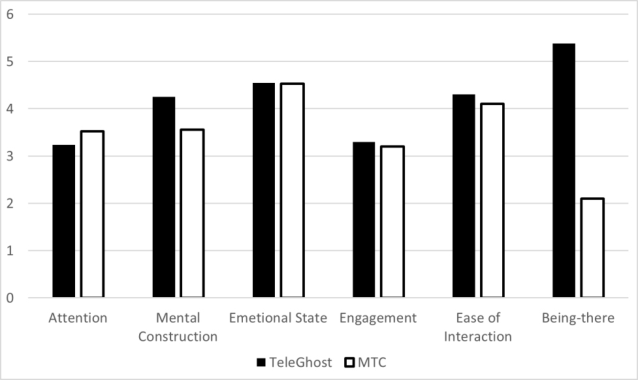
For each round of the experiment, we had one remote person and four local participants (Vucic and Skorin-Kapov, 2015). The remote participant was asked to collaborate with local participants/environment based on design review scenarios focusing on a machining centre usability. After the experiment, the participants were asked questions related to an immersion and presence parameters, attention, mental construction, emotional state, engagement, ease-of-interaction and being-there (Table 1) (Heeter, 1992) (Diemer et al., 2015) (Khan et al., 2016). We have used a Likert style 7-point rating system (1 to 7) to the system comparison (Likert, 1932), where 1 represents strong disagreement (negative) and 7 represents strong agreement (positive).
The comparative results (TeleGhost vs CMT) of the questions above are presented in the form of means of participant responses as shown in Figure 9. The black bars show the responses for the TeleGhost system and the white bars show the responses for the CMT system. The results show that TeleGhost outperforms CMT on all immersion and presence parameters.
Among all parameters, being-there got the highest score for the TeleGhost system. This is because of immersion capability of the system. The VR space reconstructed from the local site images immerses the remote site user in the virtualized local space. Furthermore, the quality of interaction and level of engagement is also improved with an introduction of the AR and VR avatars in the proposed system. CMT outperforms TeleGhost only on attention parameter because of the capability of CMT in combination with a video conference application installed in a mobile PC. This CMT setup helps a remote user to get aware of the focus of a local user through the video angle. The remote and local users can share the same image of the local scene framed in the video captured from the mobile device.
26 Fukushige
Figure 6: Remote site user immersing himself in a local site by using a VR headset.Figure 7: A VR avatar of the local site user is superimposed on the view of the remote site user (left image). The right image is the real local scene and user captured from the same viewpoint. The back face of the tablet PC (in the right image) corresponds to the face of the VR avatar (in the left image).Table 1: Questions for participants.
Table available in the original PDF paper.
Criteria Questions Attention Which system increases the attention level during collaboration? Mental Which system helps you in creating a mental representation of a
Construction
local environment? Emotional
Which system has more effect on an emotional state of a person?
State Engagement Which system makes you believe that your actions are interdependent, connected to and responsive to the others? Ease of
Which system provides a better quality of experience (QoE)?
Interaction Being-there Which system creates a sense of spatial presence in a local environment?
Virtual Teleportation Into Real Spaces via Digital Avatars for Remote Collaborative Design 27
Figure 8: AR avatar of the remote user superimposed on the video see-through image of the local scene.Figure 9: Comparison of the participants’ responses between TeleGhost and MTC in terms of immersion and presence.
CONCLUSION
A simplified tele-immersion system integrating AR with VR was proposed for the remote collaborative design review of real equipment in a shared real space. Omnidirectional images of a local space are transferred to a remote site and used to create a duplicated environment of the real space in which remote and local users communicate through their avatars. The system improves on a user perception of being present in another space by employing a VR headset and an AR avatar. At the local site, the AR avatar is used as a visual representation of the remote user for the local collaborators. The head location and movements of the remote user are presented by the avatar
28 Fukushige
superimposed on the local scene. The proposed approach was validated by the case study where quantitative analysis was conducted on immersion and presence parameters.
Future tasks include the development of a remote collaboration method for design exploration in the proposed environment. To this end, functions for interactive 3D object manipulation for both local and remote site users need to be implemented.
ACKNOWLEDGMENT
This work was partially supported by Strategic Information and Communications R&D Promotion Programme (SCOPE), Ministry of Internal affairs and Communications, Japan.
REFERENCES
Bansal, G. Rajgopal, K. Chamola, V. Xiong Z. and Niyato, D. (2022) “Healthcare in Metaverse: A Survey on Current Metaverse Applications in Healthcare”, in IEEE Access, vol. 10, pp. 119914–119946. Diemer, J. et al. (2015) “The impact of perception and presence on emotional
reactions: A review of research in virtual reality”, Frontiers in psychology, vol. 6. Egido, C. (1988) “Video conferencing as a technology to support group work: A review of its failures”, in Proc. of the 1988 ACM conference on Computer- supported cooperative work (CSCW ‘88), pp. 13–24. Feeman, S. M. Wright, L. B. Salmon, J. L. (2018) “Exploration and evaluation of CAD
modeling in virtual reality”, Computer-Aided Design and Applications, vol. 15, no. 6, pp. 892–904. Germani, M. Mengoni, M. Peruzzini, M. (2003) “An approach to assessing virtual environments for synchronous and remote collaborative design”, Advanced Engineering Informatics, vol. 26, no. 4, pp. 793–813. Gibbs, S. J. Arapis, C. and Breiteneder, C. J. (1999) “TELEPORT - Towards
immersive copresence”, Multimedia Systems. vol. 7, no. 3, pp. 214–221. Hartley, R. and Zisserman, A. (2004) Multiple View Geometry in Computer Vision, Cambridge University Press, Second Edition. Heeter, C. (1992) “Being there: The subjective experience of presence”, Presence:
Tele-operators and Virtual Environments, vol. 1, no. 2, pp. 262–271. Kahlon, Y. et al. (2023) “The Holographic Studio: Real-time virtual teleportation in Mixed Reality for enhancing design education”, in Proc. of 41st Education and Research in Computer Aided Architectural Design in Europe (eCAADe) Conference, 2023, pp. 139–148. Khan, M S., Li, H., ur Réhman, S. (2016) “Tele-Immersion: Virtual Reality based
Collaboration”, In Proc. of HCI International 2016, Part I, pp. 352–357. Likert, R. (1932) “A technique for the measurement of attitudes”, Archives of psychology. Microsoft Dynamics 365 Remote Assist (2023). https://learn.microsoft.com/en-us/
dynamics365/mixed-reality/remote-assist/ra-overview, accessed May 9, 2025. Ohi, S. (2018) “Tele-immersion concepts”, IEEE Transactions on Visualization and Computer Graphics, vol. 24, no. 10, pp. 2827–2842. Ong, SK. Yuan, ML. Nee. AYC. (2008) “Augmented reality applications in
manufacturing: A survey”, Int. J. Production Research, vol. 46, no. 10, pp. 2707–2742. Vucic, D. and Skorin-Kapov, L. (2015) “The impact of mobile device factors on QoE for multi-party video conferencing via WebRTC”, in Proc. of 13th International Conference on Telecommunications (ConTEL), pp. 1–8.
LISTED IN THE AHFE DIGITAL BOOKSTORE CATALOGUE
Explore the complete digital volume
Accessibility, Assistive Technology and Digital Environments
Read this individual research paper free through the original publisher, or explore the full digital proceedings book.
ISBN 978-1-964867-38-0
Explore this ISBN in the AHFE Bookstore ↗Listed in the July 2026 bookstore catalogue; search by ISBN to confirm current availability · Digital book purchase optional